Alien Winter — II

“Let my love like sunlight surround you
and give you illumined freedom.”
~ Rabindranath Tagore

Sunshine isn’t an easy paramour.

In my hometown,
it spills over in
volcanic excess–
scorching land,
human bodies,
cattle and crops,

even as it gently
rocks the hills
with its undulating dance
on terraced tea gardens.

Yet in this frosty city,
it plays hard to get.
Deaf to pleas,
appearing on whim,
the hometown beau
avenges yesterday’s curses
by spurning today’s
advances.

Sunshine is a tricky lover.

Also see Alien Winter — I

Alien Winter — III

Alien Winter — I

Sun erases snow
wind howls
winter beseeches.
The church spire
stands mute,
unmoved,
cold.

The wind pauses
its howl,
lunchtime beckons.
School children run
to grab a
windfall of leaves.

Snow motes swirl
ruffling the air’s hair,
the earth’s an eager
bosom.
Children conjure up
castles, snowmen.

The wind screams
tearing through
flags, bare trees
windows
and a sheet of
congealed memory,
unfreezing on the
surfacce–
a foggy morning in
my hometown
half a world
away.

Alien Winter — II

Alien Winter — III

Dashrath’s Dinner Party by Amiya Sen (Short Story)

Translated from the Bengali by Bhaswati Ghosh

As she pulled the curtains off the doors and windows and dumped them on the floor, Shakuntala hollered, “Munga, come here, fast!”

Dashrath was at the dining table, shaving. Casting a glance towards Shakuntala, he said, “Why are you taking those off yourself? Have Munga do that…if you fell down—”

“That worthless servant of yours. You brought home a rascal from the orphanage. It’s eight in the morning, and he is yet to finish his work in the kitchen. A heap of clothes remains to be washed. I must load them into the washer myself and wait until the cycle is completed. If left to him, he will ruin the clothes like he did last time. Sigh, your new safari suit and Gudiya’s expensive zari-bordered lehnga-choli.”

“Let it be. Where will you get a servant for 30 rupees in today’s market? We are managing just fine. Hey, Munga, get up on the stool, take down the curtains and pile them in the backyard. Then bring a duster. Clean everything in all the rooms. Khabardar, nothing should break, or else I will beat you to a pulp, you understand?”

Read the rest at Humanities Underground

The Kitchen, another story by the same author.

Titti

Amiya Sen (1916-1990) is a Bengali novelist and short story writer. Her writing has been published in various Bengali journals, including Desh, Jugantar, and Basumati.Aranyalipi and New Delhi-r Nepathye are her non-fiction books. She also wrote a children’s book called Shonai Shono Rupkatha.

Of Martyrs, Marigolds and Mayhem (Book Review)

Of Martyrs and Marigolds

Aquila Ismail

Create Space

Available at: http://www.amazon.com/Martyrs-And-Marigolds-Aquila-Ismail/dp/1463694822

Sixty-five years ago, India was freed of two centuries of British rule. The freedom, however, came with massive human tragedy. The country was divided into what is present-day India and Pakistan, on the basis of religion. The Partition of India resulted in some of the heaviest bloodshed witnessed in the history of the subcontinent. More than 12 million people were displaced as a result of the division. Sadly, the bloodletting that started at the time of Partition did not die down with the passage of time. In the years and decades to follow, the monster of communal tension assumed numerous sinister faces across the subcontinent and continues to rear its head to this day.

One manifestation of this simmering tension was the 1971 war between India and Pakistan, triggered by the Liberation War–a conflict between the Pakistani army and East Pakistanis. The actual war lasted only 13 days, making it one of the shortest wars in history. But the events leading up to it had started long before, culminating in the formation of a new country called Bangladesh. These events and their consequences–tragic and irreversible–are at the core of Aquila Ismail’s debut novel, “Of Martyrs and Marigolds.”

The novel narrates the story of a young girl, Suri, and her family–Urdu-speaking Muslims who had moved to East Pakistan from India at the time of Partition. It is estimated that between 2,000,000 and 3,000,000 civilians were killed in Bangladesh, and as many as 400,000 women were raped by the Pakistani armed forces. The conflict led a further eight to ten million people from the erstwhile East Pakistan seek refuge in neighbouring India.

The story of Bangladesh is mired in geographical, ethnic and linguistic complexities. In the division of India and Pakistan, the latter got parts of Punjab and Bengal, separated from each other by more than a thousand miles. Language emerged as a major bone of contention, with the majority East Pakistani population demanding Bengali to be made an official language. The language resistance that saw students becoming martyrs forms the backdrop of “Of Martyrs and Marigolds” as the story of Suri’s love affair with Rumi, a Bengali Muslim boy, unfolds.

The narrative, through rich detailing, reveals the liberal outlook of Suri’s father, a civil servant in the Pakistani administration. All through, Suri’s family remains supportive of the legitimate democratic movements in East Pakistan and critical of the high-handed and arbitrary ways of the West Pakistan leadership, which eventually unleashes military action upon its own people in East Pakistan. Numerous novels and short stories have brought to light the horrors of the atrocities committed by the Pak army on Bengalis.

In March of 1971, the tables turned with the same army conceding defeat to the Indian army. Along with freedom to Bengalis in the form of the new country of Bangladesh, this also brought reprisals against non-Bengalis, many of whom were believed to have colluded with the Pakistani military. However, as is the sad fallout in any conflict involving two communities, a lot of innocent civilians bore the brunt of the backlash too. Suri’s family represents one of many such Urdu-speaking units that got caught in the crossfire and were rendered helpless and homeless overnight.

“Of Martyrs and Marigold” impresses with its flourish of imagery–the verdant landscape of East Bengal, its folk songs, and cuisines happily share the pages with the Western influences–English literature, baseball, the Beatles to name a few–in Suri’s life. Remarkable too is the sensitivity with which a delicate subject that continues to generate strong reactions among people within the Indian subcontinent and outside it has been handled. The author’s sincere narrative stays away from vitriol or any suggestion of hate mongering, relying instead on a helpless victim’s heartfelt questioning of her fate.

The descriptions of reprisals against Urdu-speaking East Pakistanis are vivid to almost a disturbing effect. As in most conflicts, women are the worst sufferers, as they face both ends of the sword–the wrath inflicted upon those being targeted and a further sexual violence in the form of rape and physical torture. Ismail depicts instances of such violence with chilling workmanship. A few chapters towards the end present these horrors with excruciating details that continue to haunt the reader long after the book has been put down.

Some of the dialogues in the novel sound stilted and the pace of action slows down in the middle. The multiplicity of characters sometimes makes it difficult for the reader to follow the storyline, but this gets easily overlooked by the overall force of the story. “Of Martyrs and Marigolds” definitely instills hope in the reader for more such moving tales from Aquila Ismail’s pen.
On Durga’s Migrant Trails

durga puja

Note: This personal essay appears in Cafe Dissensus

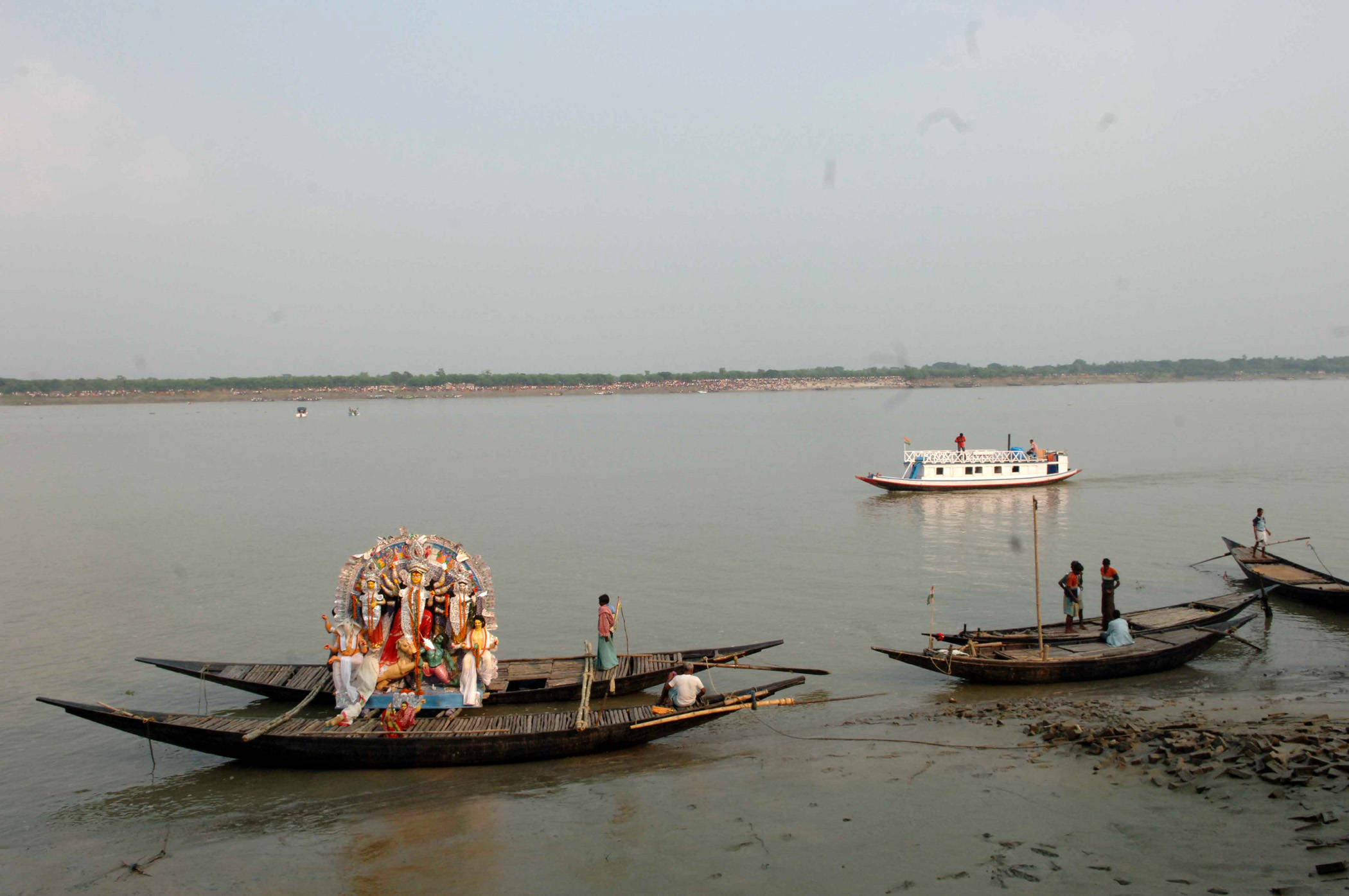
A group of children–between six to eight years in age–sat on a dusty rug on the ground with drawing sheets on boards before them. After drawing out scenes depicting one of the three theme choices provided to them, they furiously pushed crayons over the penciled sketches. My brother was one of the contestants of this on-the-spot- painting competition, interestingly called “boshey anko protijogita” in Bengali, literally meaning sit-and-draw contest. He drew a Christmas scene, having chosen the theme, “Your favourite festival.” A couple of hours later, when the results were out, he had real reason to celebrate– he had won the first prize.

There was nothing unusual about this except his choice of festival; the contest was part of a Durga puja celebration. Given that most of the festival entries depicted the ten-armed goddess and her rejoicing devotees and a few portrayed Diwali, which would approach in less than a month, the judges must have been either too brave or too liberal to adjudge a Christmas image as the best entry.

Was this because the venue of the puja and therefore the contest was outside mainland Bengal, in Delhi? I can’t really tell, for I was born and raised in what bonafide Bengalis call probaash–a sentiment-laced word for foreign land.

Photo source: Hinduism.about.com

The Crater Doesn’t Move: Flash Fiction

I’ve stopped sleeping in our bedroom. Without the blare of heavy metal booming out of Shankar’s room, slumber eludes me. I lie on the blue-green cot on the terrace, staring at the sky. Sleep is still absent.

I sit up and light a cigarette—my nemesis and redemption.

Fluffy mounds of cloud shroud the moon. As the cloud masses drift along the darkening horizon, the moon ambles with them. But this isn’t supposed to happen. Doesn’t the moon stay in one place while clouds sweep over it? If this is some strange celestial phenomenon, I will take it. Anything that defies reality.

My smoky mind joins the floating clouds.

Read/listen to the rest in Issue 3 of Open Road Review.

Immigrant’s Postcard: The Child is the Grandmother of the Woman

A series on my experiences as an immigrant in Canada

It’s the first day of swimming lessons for my husband and me. After the class, the instructor suggests we practice in a different lane. Apart from the two of us, a young Canadian girl and a gentleman from Pakistan join the practice. I am still practicing floating when a girl, snow white in complexion and no more than five years old, walks across the deck to stand near me.

“Is the water warm or cold?” she asks me.

“It’s not too cold,” I say.

She jumps in and squeals in delight, “It’s warm!” then jumps right out.

As we float, holding on to the deck wall for our dear lives, she asks me,

“Are you and him, Mom and Dad?” She points with her eyes to the Pakistani gentleman, floating in a corner away from the three of us.

“Me and who?” I ask her.

She points again to the Pakistani swimmer, saying, “This one.”

“No,” I say and draw her attention to my husband, floating right next to me, “Me and him are together.”

“Ah, so you are parents,” she says knowingly.

“No,” I simply say.

“So you are grownups.”

“Yes.”

“You are going to have a baby?”

“No.”

“You have a baby,” she says, rolling her eyes.

“No, I don’t.”

“I know you do.”

“No…”

“The baby got out. I know it did.”

With that, she walks away, casting one last all-knowing glance my way.

I beseech, “No!”

But to no avail. By now the little lady has already moved on.

READ ALL IMMIGRANT’S POSTCARDS HERE

Photo courtesy: http://vdleek.blogspot.ca/

Immigrant’s Postcard: A Prescription for Healing

A series on my experiences as an immigrant to Canada

It’s my first visit to the doctor’s office in my new city. The pain in my right leg is nagging to the point of being obstinate. Right at the entrance, next to the reception window, a sign says “If you are rude to my staff, I won’t see you today.” That’s not a very friendly doctor, I whisper to my husband, who is accompanying me to lend moral support. After the initial wait time (about 15 minutes), my name is called, and the clinic assistant checks my blood pressure, a routine exercise. Then begins the wait for the doctor. A good 20 minutes go by, until she knocks the room before entering it.

Image

After the initial pleasantries, the doctor asks me if I speak Hindi. I nod yes.

I tell her that my pain worsens upon standing on any hard surface for a while. She asks if I have to stand in the kitchen a lot.

“Yes,” I say.

“There’s a particular type of mat that has a cushioning effect. Place that in your kitchen,” she tells me, even suggesting the store from where to get it.

After writing a prescription for anti-inflammatory medication, the doctor returns to the thread she had left off with her reference to Hindi.

“Where in India are you from?” She asks.

“Delhi,” I say, hastening to add that my husband is a Sikh, from Punjab.

“We are from Lahore and speak only Punjabi at home.” She says, making it a point to let me know that the Punjabi she speaks is “very similar to what Sikhs speak.” That’s because she belongs to the jatt caste, one of the many who were converted to Islam, she informs.

She ends the (very friendly) conversation by recommending the cushioning mats again. “I too have this pain and always use the mats whenever I have a daawat at home and have to stand in the kitchen for long.”

It is technically India’s Independence Day. Two women from opposite sides of a land split into two in a cleaving that saw insane bloodshed share slices of history and culture over a medical visit.

And, they share insights on lessening pain.

READ ALL IMMIGRANT’S POSTCARDS HERE

Immigrant’s Postcard: Walking with Memory Shards

A series on my experiences as an immigrant to Canada

So we’ve been living in a new city for the last ten days. Last week, on my way back home from the indoor market (housing local farmers, butchers, bakers and dairy owners), I got lost–for the second time in three visits. Severely direction-challenged that I am, this isn’t new to me. A lot of times, I actually enjoy losing my way, only to find myself in an interesting part of the city. When this happened to me in London about three years ago, I remember having walked  into the area of Soho, where the evening seemed eager to graduate to  the tantalizing night ahead. I was in London for the first time and might not have visited Soho alone in a planned manner. Getting lost thus pushed me into an experience, which though unexpected, turned out to be memorably charming.

Back to last week’s loss-of-direction episode in my current city. When I finally realized my mental mapping skills were not taking me any closer to home, I sought a fellow-walker lady’s help. Thanks to her accurate directions, my feet quickly found solid ground and marched toward our apartment complex.

A couple of hundred meters from the apartment complex is a casual eatery with patio seating outside. As I passed the cafe, I heard an elderly gentleman asking a couple sitting in the patio for some help. I couldn’t hear well, but I heard him say, “My Alzheimer’s…” to which the gentleman sitting at the table on the patio said, “Well, you are still very much in London, sir.” By then I had moved farther. When I turned back, the lone, walking gentleman no longer stood next to the patio.

Even as I tried to make sense of the streets and intersections to reorient my geography, here was a man wandering with fractals of memory and no compass to rely on, wondering if he was still in the city where he started his walk.

It struck me then that we were in a city of the aging, with more visible services for the elderly than possibly any  other demographic group.

London, Ontario that is.

READ ALL IMMIGRANT’S POSTCARDS HERE