Guest Blog: Supriya Kar

Problems of Translation — II


This post is a continuation of
Ms. Supriya Kar’s previous post. She is doing her PhD in literary translation. Her research focuses on autobiographical writings of women from the Eastern Indian state of Orissa. Here, she discusses various problems of translation, particularly in the context of her work.

Read Part 1 here

Songs in Oriya:
The songs and chants in Oriya are marked by lyricism and onomatopoeic qualities and have therefore been left untranslated. These give a feel of the sound of Oriya. The examples include:
Hare Krushna Hare krushna, krushna krushna krushna hare hare
Hare Rama hare Rama, Rama Rama hare hare.

Chala kodala, chala kodala, patia bandhe, chhande chhande, bharide mati laal…

Kesharkunja sheja re…
Duti kara dhari hari boile kishori…
Are nauri, e ghata re nabandhe taree…
Hari haraye namo, Krishna Jadabaya namo, jadabaya, madhabaya, keshabaya namo.

Forms of Address: Chandrabhaga, Chanda, Ashoka, Abhada, Gangapani, Baula and Chandi: Terms of endearment and affection, which are used in the excerpts, have been left untranslated. These terms signify deep friendship based on love and trust. These are also given social and cultural acceptance through specific rites.

Use of Titles: Panchasakha, Bhaktakabi, Mahatma, Utkalmani: Eminent public figures acquired these titles, and came to be known through these rather than their proper names. Through repeated use these became part of their names. Although they denoted certain qualities, they were actually used as proper names. So these have been kept as such and glossed where required.

Names of Institutions: Kanyashram, Shrama Sansthan Anusthan, Dhanamani Matru Mangala Kendra, Kumari Sansad, Bakula Bana Vidyalay. Although these names denote the nature and function of these institutions they are also used as proper names. So they are kept as such and glossed wherever necessary.

Kinship Terms: Chhota Maa, Menki-nani, Andhari-Maa, Durga apa, Subhabou-bhauja, Mahi’s mother, Sushila-bhauja, Nayan-bou, Rama-bhauja, Pila-mother, Jugala Saante, Nala-da, Bhika-na, Bhula-uncle, Puri-uncle.
While translating kinship terms used in India, one has to tread cautiously between the twin extremes of ‘domestication’ and ‘defamiliarisation’. Sometimes, the English equivalents have been used and, at others, the kinship terms have been retained. As all the excerpts translated here are autobiographical writings, the kinship terms are used more often than in any other fictional genre. Retaining all the terms would have made the text loaded with unfamiliar and opaque expressions. So, at times, the relationships have been explained in the text itself, sometimes, the context makes the meaning of the terms obvious.

Conversational Style:
Attempts have been made to maintain the speech rhythms of Oriya in the translation of all the excerpts. In the translation of the excerpt from Sumani Jhodia’s autobiography, punctuation marks have not been used to retain the immediacy of her words since hers is an oral testimony.

Problems in the Source Text:
There are examples of writings in the excerpts translated here which do not really make any sense, but their meaning can only be guessed from the context. In such cases, these have been tackled in a pragmatic way.
One may mention here, Arthur Lindsay’s observation that the prime duty of translators is communicating information lucidly. He goes on to submit:

As translators, our objective is to enable the reader to understand the subject matter we are translating. Hence simplicity of language is obviously the most important weapon in our armoury. Further, I submit that the more complex the subject, the greater is the need for plain English. Even if the author is incapable of simplicity in the source text, in the target language this duty devolves upon us, since we are those who must moderate between author and reader.

In translating these excerpts, strategies such as deletion, expansion, and addition have been adopted to achieve lucidity as far as practicable.

Guest Blog: Supriya Kar

Ms. Supriya Kar is doing her PhD in literary translation. Her research focuses on autobiographical writings of women from the Eastern Indian state of Orissa. Here, she discusses various problems of translation, particularly in the context of her work.

Problems of Translation — I

In my thesis, twenty-four excerpts selected from autobiographical writings by women in Oriya are translated into English. Women whose lives these excerpts record hail from different social classes and milieus and their styles vary immensely. Therefore, maintaining the unique flavour of the texts and at the same time retaining a kind of uniformity and readability was a daunting task. Of course, there are elements in all these which one may find untranslatable. Translating is like cooking: it is one thing to say how a recipe is prepared and another to actually cook it. In this context, Piotr Kuhiwczak’s insightful observation assumes particular significance:

We can say that there is a clear distinction between discussing untranslatabilty and handling the untranslatable in the process of translation. For many of us, and this includes the students and diners I mentioned at the beginning of this essay, untranslatabilty is something that can be conceptualised and discussed ad infinitum. In contrast to this, translators have to deal with the untranslatable at a practical level. In a recent article, Margaret Jull Costa emphasises precisely this difference and the practical aspect of translation: ‘As a full time literary translator from Spanish and Portuguese, I suppose I can’t afford to believe in the untranslatable; it’s my job to translate everything, knowing that there might be some loss, but that there might also gain, and never giving in to that counsel of despair telling me that a translation is not a real thing, not the same thing, and definitely never a better thing.’

While translating, the aim was to translate so that the original should not lose its flavour, but be readable and enjoyable in the target language, without overloading the text with footnotes and glossaries that make it cumbersome for readers.


While translating from Oriya into English, the problems one encounters are more insidious than just finding the right word or expression. Partly, they flow from the very structure of the language. In addition, many of our descriptive words are highly onomatopoetic and thus almost impossible to render in English, as are the kinship terms and names of dishes, trees and flowers.

One can feel there is a palpable tension, which results from the pressure the source language exerts on the target language. The task of a translator is to minimise this tension as much as possible. Each and every sentence poses a problem. Inside the mind it goes on—permutations and combinations of words, struggling with the shape of each sentence— negotiating, groping for the right phrase. And yet the feeling of dissatisfaction persists.

Tenses in Oriya are organised slightly differently than in English. Although on paper they correspond, their boundaries do not quite map onto each other. This is because time conventions differ in different societies. The present is a much more elastic concept in Oriya than in English. That is why most Indians use English tenses wrongly. Common errors are the use of past perfect for simple past (‘I had done’ instead of ‘I did’) because Indians instinctively feel that simple past is not strong enough to indicate that something happened before now. They also use present continuous (I am doing) for simple present ‘I do.’ These problems exist across Indian languages. The problem is that while translators may be technically correct when they translate an Oriya literary text into an English present tense narrative, they are not being true to the precept that the target text should have validity as a work of art in its own right. It is bewildering to read a text translated into present tense, especially as somewhere down the line it tends to seep back into past tense.
There is a sprinkling of words connected with the physical reality of Orissa in these autobiographical writings. The list of such phrases, culture specific terms, which have been kept as such is provided below with explanations, where necessary:

Currency: adhala, pahula, ana. There is no corresponding currency in English.
Quantity: bharan, khoja, pa. These are ancient units of measurement and sometimes used idiomatically.
Slangs, Tongue-in-Cheek Expressions: chhatari, Bolibe jati sange eka ramani. There is no corresponding slang for ‘chhatari’ which is used derogatorily and abusively to mean a woman of loose morals. Literally, it means one who begs for food at chhatars or charity kitchens.
Bolibe jati sange eka ramani: People would say that one holy man is accompanied by a young woman. But the meaning of this tongue-in-cheek expression would lose its resonance if the original does not accompany its English translation.
Lunar Months: Bhadrav, Ashwina, Kartik, Margashira. A Lunar month corresponds to the period between one full moon to the next full moon. The lunar calendar is followed in observing festivals, as it is believed that the movement of the moon has a decisive influence over the affairs of human beings.
Food: ladu, badi, puri, malpua, mohanbhoga, khechudi, arisa, pura. Referring to these as delicacies or sweets would take away their cultural specificity.
Caste: karana, khandayat, chamar, radhi. The caste of a person signified his/her occupation, social status etc. These are also associated with notions of purity and pollution. The concept of caste is so quintessentially Indian that while translating Indian literary texts one has no option but to retain terms denoting caste.
Art: champu, jatra, patta. These words denote forms of fine and performing arts in Orissa, and do not have any English equivalents.
Religion: agni-pariksha, tulsi, triveni, pratah smaramy, mahamnatra, dhama, mahaprasad, mansik, homa, darshan, ashram, kathau, kirtan, akash-dipa, chaura, Amrutayana, Harinama, Ramanama, Ramdhun. These refer to religious practices which are rooted in Indian culture and their full significance can not be conveyed through English equivalents. They have therefore been retained in the translation and glossed where necessary.
Rituals and Social Practices: sholamangala, dashaha, hulahuli, haribola, shradha, ekadashi, purdah, ana-tutha, padhuan. These practices are typical of Oriya culture and so have been kept as such and glossed wherever necessary.
Festivals: Festivals such as Kumar Purnima, Raja, Kartik Purnima, Bali Trutiya underline the singularity of the cultural and religious practices prevalent in Orissa. Each festival is rooted in a specific narrative and has mythical associations. These are retained as such.

To be continued…

Image courtesy: http://www.icilondon.esteri.it/IIC_Londra/webform/SchedaEvento.aspx?id=211

Death’s Grief by Rabindranath Tagore

Translated by Bhaswati Ghosh

That there could be any gap anywhere in life wasn’t known to me at that time; everything seemed tightly knit within the ambit of laughter and tears. As nothing could be seen beyond that, I had received it as the ultimate truth. Suddenly, when death emerged out of nowhere, and, within a moment, created a hollow in the middle of this very manifest life, my mind was totally puzzled. All around me, trees, land, water, the sun, the moon, the stars, and the planets firmly continued to be as they were, yet that, which amid them was just as true as themselves—in fact, which, the body, this life, the heart had, through a thousand touches known to be even truer than all these supernal entities—when that loved one dissolved like a dream in an instant, it seemed to me an utter collapse of the self! How could I reconcile what remained with what was no more!

A darkness emerging from this pit attracted me all the while. I kept circling around and returning to the same spot, looked at that same darkness and searched for something in place of what had been lost. Humans can never entirely believe in nothingness. Whatever isn’t there must be untrue, and whatever is untrue cannot be there. That is why the effort to see within what can’t be seen and the search for acquiring that which can’t be had never stops. Just like a sapling, when bound inside a dark fence keeps growing upright on its toes in a desperate attempt to get past the darkness and raise its head in light, all my heart and soul, when suddenly fenced by death’s ‘not there’, desperately kept trying to emerge into the light of ‘is there.’ There’s no greater misery than to realize that the path to cross that darkness isn’t visible within that darkness.

However, in the middle of this despairing grief, a breeze of happiness would flow in my heart every now and then, taking me by surprise. The sad fact that life is not absolutely and inertly definite lifted a load off my chest. I felt joyous thinking that we aren’t imprisoned within the stone walls of unmoving truth. That which I had held on to had to be let go of. When seen from the perspective of loss, this evoked pain, but when I saw it from the angle of freedom, I felt spacious peace. That day, I, for the first time, realized like a strange truth that this world’s enormous weight balances itself with the give-and-take of life and death and flows in every direction thus; that weight won’t crush anyone with suppression—no one would have to bear the tyranny of a sole master called life.

This apathy made nature’s beauty even more intensely exquisite for me. For some days, my blind attachment to life nearly disappeared—trees swaying against bright skies would rain a burst of delight down my tear-washed eyes. Death had brought about the distance necessary for viewing the world with completeness and beauty. Standing detached, I watched the world’s image against the vast backdrop of death and knew it to be beautiful.

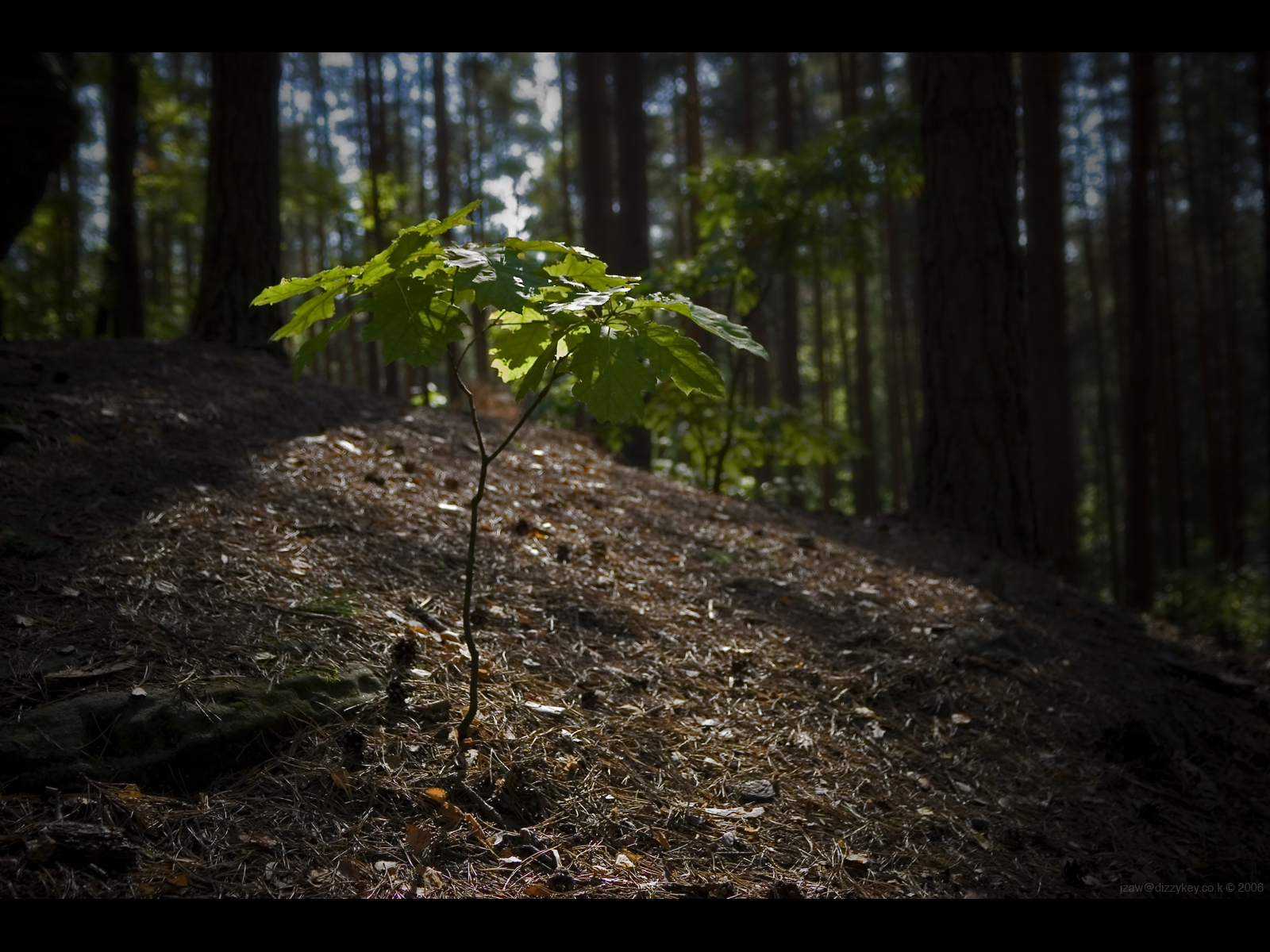
oak_sapling_warming_itself_in_the_morning_sun1

For a while at that time, a carefree attitude took over my heart, which was also reflected in my outward actions. I found it laughable to conform to the society’s courtesies by accepting them as truths. All that didn’t touch me at all. For a few days, I was completely oblivious to who thought what of me. I would just drape a thick shawl over my dhoti and wear a pair of chappals to go to Thacker’s shop for buying books. My meals were also characterized by haphazardness. For some time, my bed, even during rains and winters, remained on the balcony of the second story; there, I could see the stars eye to eye and meet the light of the dawn without any delay.

On the terrace of our house, alone at night, I would run my fingers like a blind man all over the night, in hopes of seeing a flag atop any peak in the domain of death or a letter or even some symbol etched on its black stone gates. Then, the next morning when light filled my bedding on the balcony, I would open my eyes and find the covering of my heart clearing away; I would find that the expansive view of life appeared as dew-fresh new and marvelous to my eyes as the way in which the world’s rivers, mountains and forests dazzle with the lifting of a fog.

Not that any of these was an austerity for practicing detachment. This was more like a holiday for me. When I found the cane-wielding teacher of this world to be a deception, I ventured to taste freedom by trespassing even small controls. If one fine morning one woke up and found out that the earth’s gravitational pull had lightened by half, why would one want to carefully tread the official path? One would, most definitely, wish to jump across the four-five storied houses on Harrison Road, and if, while enjoying the breeze in Maidan, one came across a monument, one wouldn’t even want to walk past it, but rather  lep over it. My condition was similar—the moment the pull of life loosened under my feet, I was eager to completely leave the beaten path.

Note: Recently, I lost a loved one to cancer. Though not born into our family, the person had become family for us, and the death only showed me how attached I had been to him without ever realizing that when the person was around. As I grappled with this loss, almost unable to accept the reality of it, I turned to Tagore for solace. The piece below, part of Tagore’s autobiography, reflects how he himself felt the depth of grief following his sister-in-law’s death, and how his heart finally found acceptance and even peace. Working on this translation proved to be a balm for me in these difficult moments.

Photo source: http://blog.bikeridr.com


Pagol or Madman by Rabindranath Tagore

Translated by Bhaswati Ghosh

A small town in the west. At an end of the big street, five or six palm trees rise above thatched roofs like a mute man making signs to the sky. Next to a derelict house, an ancient tamarind tree puffs up its dense, glistening foliage like clumps of green cloud. Young goats move about on the ground of this roof-less house. Behind them, the lushness of the forest range spreads across the horizon of the afternoon sky.Today, rain has completely withdrawn its dark cloak off this town’s head.

I have a lot of important things to write—those remain unwritten. I know this would be a cause of regret in the future; let that be; I would have to accept that. One can never know or stay prepared for the moment when or the form in which wholeness emerges, but when it does, one can’t welcome it empty-handed. At that moment, the one who discusses loss and gain must be a smart accountant and would do well in the world; but dear vacation of light in the midst of glum ashadh (1), in front of your momentary bright, cloud-less glimpse, I put to dust all my important activities—today, I won’t make calculations about the future—I am sold off to the present.

One day follows another, none of them demands anything of me; the calculations all add up, work happens smoothly. At such times, life progresses by linking one day to the next, one task to another, making everything uniform. Suddenly, when a special day appears without notice, like a prince from across the seas; a day unlike any other, the trail of all the days past is lost in an instant—on that day, it becomes difficult for routine work to proceed.

Such a day, though, is our big day—a day of irregularity, of ruining work. A day that arrives to defeat our everyday is our day of joy. The other days are for the intelligent, the careful. This one day is for giving ourselves completely up to madness.

Mad isn’t a hateful word to us. We worship Nimai (2) because of his craziness; Maheshwar (3) too is our lunatic god. The West is debating as to whether talent is only a form of developed craziness—but here (in the East), we don’t feel ashamed to accept this as true. Inspiration is, of course, craziness, it is an exception to the rule, it comes only to upset order—it emerges all of a sudden—like today’s haphazard day—and destroys all the work of working people—some curse it, some others go crazy, dancing and delighting with it.

Bholanath (4), who remains as the joyful one in our scriptures, is one such oddity among all deities. I see that mad lord amidst the flood of sunshine shining through this day’s washed blue sky. His tabour plays steadily within the heart of this thick afternoon. Today, death’s naked pure face stands still in the middle of this work-filled world—with beauty and peace.

Bholanath, I know you’re strange. In every moment of life, you’ve appeared with your begging sack. and completely wrecked all calculations and measurements. I’m familiar with your Nandi (5) and Bhringi (6). I can’t say that they haven’t given me a drop of your intoxicating beverage; these drops have inebriated me, everything has been upset—today nothing is in order for me.

I know that happiness is an everyday item, but bliss is beyond every day. Happiness remains constricted, fearing it may get dirty; bliss rolls over dust and shatters its separation with the universe; that is why to happiness, dust is inferior, but for bliss, dust is an ornament. Happiness is afraid of losing something; bliss is delighted to relinquish everything; for this reason, to happiness, emptiness is poverty, but to bliss, poverty is abundance. Happiness carefully protects its grace within the confines of order; bliss openly expresses its beauty in the freedom of destruction; this is why happiness is bound to outward rules, but bliss breaks those bounds to create its own rules. Happiness waits for nectar to arrive; bliss drinks the poison of sorrow with ease. For this reason, happiness is partial to only good, but for bliss, good and bad are no different.

There’s a madman in all of this creation who brings in everything that is inconceivable for no reason at all. He’s the centrifugal force who is forever pulling the universe outside rules. The god of rule is always trying to put all the world’s paths into a neat orbit, and this madman overturns that and twists it into a coil. At his whim, this madman creates birds in the clan of snakes and man in the family of apes. There’s a desperate attempt in the world to permanently protect all that has occurred and all that is; he plunders all of that to carve paths for what is not yet there. His hands don’t hold a flute, harmony isn’t his tune; his pinak (7) rumbles, all orderly yagna (8) is ruined, and out of nowhere, something wonderful appears on the scene. Craziness and talent, both are his creations. The one whose string breaks at his pull goes mad, and the one whose string plays in an unheard melody becomes gifted. Mad people are outside the range of the ordinary, and so it is with talented people. The mad, however, remain on the fringe only, while the gifted take ordinary people into a new realm, thereby increasing their rights…

It’s not as if this mad lord of ours appears only at certain moments; in creation, his madness is always at work; we only get a glimpse of it in certain moments. Death is forever making life new, bad is brightening good, and the inconceivable is giving value to the trifle. When we get such a glimpse, the freedom within the form becomes evident to us.

Today, amid this cloudless light, I see that amazing face. The road across, the thatched-roof provisions store, the broken house, the narrow by-lane, the trees and vegetation—I used to see all these with the pettiness of everyday familiarity. That’s why these had confined me—kept me in house arrest within these daily images. Today, all of a sudden, all the pettiness is gone. On this day I see that for so long as I had been viewing the unknown as familiar; my seeing wasn’t clear at all. Today, I can’t finish looking at all these. Today, all of these things surround me, yet they don’t imprison me, they all make way for me. My madman was here only—that spectacular, unknown wonder, who did not ignore this thatched-roof provisions store—only, I didn’t have the light before my eyes with which to view him. What is amazing about today is that these nearby images have acquired for me the glory of a far-off place. The impenetrability of the snow-capped Himalayas and the impassability of the wave-ridden ocean express their fraternity with the madman.

In this way, one day we suddenly realise that the one with whom we had established a familial relationship remains outside our family. The one whom we had taken to be readily available in every moment is actually rare and hard to get. Those, around whom we had drawn a boundary thinking we knew them well, appear to have acquired a marvellous mystery by crossing all boundaries. The same one who, when viewed from the side of rules and balance, appeared rather small, quite regular, very familiar, when viewed from the side of breach, from the angle of that graveyard-roaming madman, turns me speechless—amazing! Who is that! The one whom I have always known is now this, who! The one who is part of the home on one side belongs to the heart on the other. The one who is important to work on the one hand is completely outside all necessities on the other. The same one whom I touch on the one hand is, on the other, beyond all grasp. The one who has managed to fit well with everyone is, at the same time, a total misfit, absorbed in self.

Today I saw the one whom I don’t see every day. In so doing, I gained freedom from every day. I thought I was bound by the everyday rules within the fence of familiarity surrounding me. Today I see, I have been forever playing on the lap of grand wonder. I thought that I had been making my daily calculations under the sharp gaze of a big officer in the office. Today, at the roaring laughter of the miscalculating madman—who is bigger than the big officer—reverberating through water, land, sky, air and the entire universe, I heave a sigh of relief. My workbook remains untouched. I lay down the pile of my important work at the feet of that capricious madman—let the blow of his Tandava (9) smash it into pieces and blow it off as dust.

1. Ashadh: A month of the Hindu calendar

2. Nimai: A prominent saint of medieval Bengal and the founder of Bengal Vaishnavism. Also known as Chaitanya Mahaprabhu.

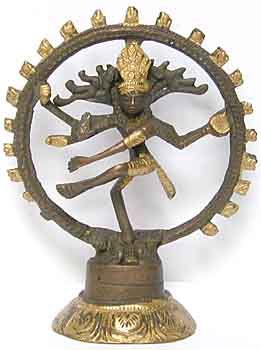
3. Maheshwar: Another name for Shiva, a major Hindu deity. The god of destruction.

4. Bholanath: Alternative name for Shiva.

5. Nandi: Shiva’s vehicle, a bull.

6. Bhringi: Originally a demon who was transformed by Shiva into a humble devotee and admitted into his force as a commander of his armies.

7. Pinak: Shiva’s bow.

8. Yagna: A Hindu ritual, dating back to Vedic times, carried out to please gods. Oblations are poured into sacrificial fire, as everything that is offered into the fire is believed to reach the gods.

9. Tandava: In Hindu mythology, Shiva’s Tandava is a vigorous dance that is the source of the cycle of creation, preservation and dissolution.


The Year’s End by Rabindranath Tagore

Today as I reached the silent peacefulness of this place, away from the clamor of the capital’s human assembly, the sky was covered in evening’s glow. Cloud clusters had lent a soft hue to the green of the forest by placing shadows on it; had I stayed in the capital, I couldn’t have seen this face of the year’s last day with the clarity that I did here. There, a covering of whirlwind encircles everything; that covering hides the united form of beginning and end in creation. The music of human life needs to pause for returning to the start again and again. But amid the cacophony of crowd one feels taan* after taan play on without pausing to return to the first beat. There, man moves with the crowd’s push; that movement is devoid of rhythm…

When evening descends on a city, it can’t reveal itself, the day’s noise barges in to choke its voice. Daytime’s labor looks for crude excitement in evening’s leisure. Tired of body and mind, I had thought I wouldn’t gain entry into the year’s last day today. Suddenly, thick clouds caressed the woods; the expansive bliss spread across the horizon didn’t appear as emptiness but as beauty. I see this evening filled to the brim with the wholeness that rests within the endless stream of the world’s work. In meditation I realized, that which I know to be the end in the outside world hides the seeds of new life in this place.


In every moment I see that life’s entire prosody is contained within conclusion. Without pause, rhythm would lose its identity…In mankind’s history, several civilizations have vanished after a period of grandeur. The reason was that those civilizations had lost the pause; they only scattered their enterprise, didn’t care to pick up the same…So the rhythm broke. The first beat came back in the wrong place, and it wasn’t cessation; it was destruction.

It is my good fortune to have come here today. In the city I returned from, the evening’s face is one of frenzy, not of well-being. There, death’s identity has lost its solemnity. Human habitations make every effort to deny death. That’s the reason one can’t see the truth of death in such places…May the end show us that face of liberation, which contains wholeness.

Calmly I say, “Dear End, within you resides the infinite. I see in your eyes a trace of tear on this last day of the year; separation, dejection, and weary melancholy eclipse dusk’s darkness. Despite that, assimilating and crossing over all those, I hear your voice within and without. Om. The heart’s pain has only lent it beauty—tears haven’t dulled it, yet made it gentler. Every evening, death reveals its calm and graceful face across the immense star-draped sky. Embracing it, we lay down—relieved—all the day’s burdens.

At the end of the year, I see that same vast face resting on the untiring, imperishable throne of darkness. I pay my obeisance to it.”

* Taan is a virtuosic technique used in the performance of a vocal raga in Hindustani classical music. It involves the singing of very rapid melodic passages on the syllable “a.” It is similar to the technique ahaat, used in Arabic music. [From Answers.com]

On a Cloudy Day by Rabindranath Tagore

All our days are filled with work and people. At the end of each day, one feels the day’s work and exchanges have said all that needed to be said. One doesn’t find time to grasp that which remains unsaid.
This morning, cluster upon cluster of cloud has covered the sky’s chest. There’s work to be done today as well, and there are people milling about. But there’s a feeling that all that lies inside cannot be exhausted on the outside. Humankind has crossed seas, scaled mountains, dug holes under the ground to steal gems and riches, but the act of transmitting one person’s innermost thoughts and feelings to another—this, humans could never accomplish. PartlyCloudy
On this cloudy morning, that caged thought of mine is desperately flapping its wings inside me. The person within says, “Where is that forever friend who will rob me of all my rain by exhausting my heart’s clouds?”
On this cloud-covered morning I hear the voice inside me rattling the closed door’s fetters again and again. I wonder, what should I do? Who is the one at whose call my words will cross work’s barrier to journey through the world with a lamp of song in my hands? Where is the person whose one look would string together all my beads of pain into a garland of joy and make them glow in a singular light? I can only give this pain to the one who begs it of me with the perfect note. At the bend of which road stands that ruinous beggar of mine? My inner ache wears a saffron robe today. It wants to emerge into a path, which, like the innocent single string of an ektara, chimes within the ‘heart’s person.’
Translated by Bhaswati Ghosh

In Conversation with Ramkinkar: Book Review

Yes, I have already blogged about this book. But it’s worthy of two mentions, if not more. Shilpi Ramkinkar Alapchari or In Conversation with Artist Ramkinkar ranks as one of the best books I have read in the last five years. The author, Somendranath Bandopadhyay sure knows how to bring conversations alive on the printed page. For, not one among the series of dialogues this book features reads like a well-structured interview or stiff intellectual discourse. The tone of the book, in itself conversational and informal, makes the animated interaction between the two principal voices even more life-like.

The book’s most overpowering element is the close, personal, and honest view of Ramkinkar, the man. Here is a barber’s son, coming from a financially humble background, pulled by the charm of idol-making in his village, who reaches the zenith of India’s art horizon. This ascension is only a fraction of Ramkinkar, though. What makes it so remarkable is his complete obliviousness to the fame and recognition he achieves. The book presents layer after layer of this lovable artist completely shorn of materialistic or pride-geared ambitions, rooted to the soil for all his life, not overwhelmed while receiving honor, and unfazed in the face of the most shattering despair. I saw a simple man, who never considered himself any special when the whole world revered him as a genius. A man who felt the closest to the people of the earth—the santhal tribal folks—whom he loved and respected from the core of his being for their simplicity, hard working nature and joyful living. I saw an artist so innocent and unadorned that he cared naught for the ways of the civilized world. The same ways he sometimes found so uncomfortable to deal with he calls the people displaying those as “the ones that sound so out-of-tune. “ I also saw a man pulsating with the rhythm of life, radiating warmth, and uninhibited when laughing out loud. Although a book doesn’t carry sound, the power of this one’s words helped me imagine Ramkinkar’s thunderous laughter.

Another day’s story. At the counter of Vishwabharati’s central office. (Kinkarda has) come to the cash section to withdraw his salary. While handing out the pay, the counter colleague politely informs Kinkarda that this would be his last salary packet. Kinkarda is stunned. He says, “Why, why is that?” “You retired a month ago. So…” Hearing that Kinkarda falls off the sky, “What are you saying, what will I eat then? So you won’t give me pay next month?” “No, sir,” the counter official informs awkwardly.

Kinkarda dashes off to the Vice Chancellor’s house. Kalidas Bhattacharya, the VC, was having lunch. Hearing Kinkarda’s voice he rushes out with food-stained hands. After hearing the story he says, “You heard it correctly at the office. The university has to work according to its rules, you see; that’s the problem. But there are provisions for those who retire. You, too, have those. You will receive a pension every month. Besides that there’s provident fund, gratuity…”

Kinkarda is elated. “Ah! I thought the same. There must be some arrangement. See, good thing I came to you. That’s what I was wondering, there has to be a way.”

This man is strange. His anxiety and its release are both worth watching. His mind is detached from all things material. The fists are loose. In those loose fists he’s only held art all his life.

As endearing as it is to see the sculptor’s personality, it’s still not a full view. Without knowing Ramkinkar the artist, the full depth of his inner self isn’t fathomable. Again, the author brings this part of Ramkinkar Baij in all its glory. The conversations mostly hover around the artist’s works and the author’s keen understanding of them. We get deep into the mind and heart of a creator, learning how each of his works came into being—both mentally and organically. Someone who has no artistic acumen, the discussions on Ramkinkar’s finest creations fascinated me with every nuance leading to their origin. To learn that the figure of Sujata, the woman who had served milk rice pudding to Buddha, had actually been inspired by a lanky student at Shantiniketan was not a let down, but a revelation. Especially when one learned the associated story of how the famous Nandalal Bose, Ramkinkar’s mastermoshai at Shantiniketan, advised putting a bowl on top of the woman’s head, transforming her into Sujata.

“Study isn’t done only with open eyes, but with the eyes closed as well. You see beauty with your eyes and with your heart. Only when the two meet is the seeing complete….Your eye’s vision comes near the heart’s, and the heart’s vision moves toward the eye’s. Somewhere in the middle they meet…But this meeting isn’t free from conflict, my dear, it has a lot of friction. And what remains after all the clash isn’t two any longer—the two then merge into One.”

In Conversation…mentions how even Tagore acknowledged Ramkinkar’s genius. One day, the poet summoned the young artist to his room. When the latter answered the call, frightened and nervous, Tagore said to him, “So, will you be able to fill this entire campus with your works?” Probably the greatest prize Ramkinkar received (and he did receive some prestigious awards).

While reading the book I lamented not being born early enough to see this humane, child-like, genius of a sculptor. But I am glad Somendranath Bandopadhyay preserved his essence so lovingly for me to cherish.

Note: All quoted text written by Somendranath Bandopadhyay, translated by Bhaswati Ghosh.

Monsoon Letter by Rabindranath Tagore

Dear Friend,

Living as you do amid the desert country of Sindh, I invite you to imagine the monsoons in Calcutta.

In this letter, I remind you of Bengal’s rain. Of ponds swelling with water, mango orchards, wet crows, and ashadhe tales. And if you can recall the Ganga’s bank, then think of the cloud’s shadow on the streaming water and of the Shiva temple located within the peepul tree under the cloud cover. Think of the veiled village women who fill water from the rear banks, getting drenched as they make their way home through the bamboo briars, passing paathhshalas and cowsheds; think of how the rain splashes in from a distance by placing its feet over the waving crop fields; first on the mango orchards at the end of the field, then on the bamboo backwoods; next, every single hut, every village fades out behind the monsoon’s transparent cover, little girls sitting before huts clap and invite the rain with their songs—in the end, the downpour captures all land, all forest, every village into its snare. Unceasing rain—in the mango fields, bamboo bushes, rivers; on the head of the crouched boatman as he flinches while wrapping his blanket. And in Calcutta, rain falls in  Ahiritola, Kansharipara, Teriti Market, Borobazaar, Shova Bazaar, Harikrishna’s Lane, Motikrishna’s Lane, Ramkrishna’s Lane, Zigzag Lane—on mansion roofs, shops, trams, the head of buggy coach drivers and so on.

These days it doesn’t rain heavily, the way it used to in our childhood. Today’s rain has no grandeur of the past, it is as if the monsoon season is focused on economy—it’s on its way out after sprinkling a little water—just some gluey mud, some drizzle, a bit of inconvenience. One can manage the entire rainy season with a torn umbrella and a pair of shoes from the China bazaar. I don’t see the revelry of the yesteryear’s thunder, lightning, rain, and breeze. Rains of the past had a song and dance, a rhythm and a beat—these days the monsoon seems to be gripped by the jaws of ageing, by ideas of calculation and bookkeeping, by concerns of catching a cold. People say it’s only a sign of me growing old.

Perhaps it is that. Every age has a season; perhaps I am past that. In one’s youth it’s spring, in old age autumn, and in one’s childhood, rain. We don’t love home as much as we do in our childhood. The monsoon season is for staying at home, for imagining, for listening to stories, for playing with one’s siblings. In the darkness of the rain, far-fetched folklores assume a degree of truth. The screen of a thick downpour seems to put a cover on the world’s official activities. There are fewer wayfarers on the streets, fewer crowds, the usual busyness isn’t visible in places—the doors of houses are shut, coverings drape offices and shops…

Bengal rain

…I remember, during rainy days, I would run across our sprawling verandah—the door banged with the wind, the giant tamarind tree shook with all its darkness, the courtyard welled up with water up to one’s knees, water from four tin taps on the terrace gushed forth with a thud to join the courtyard water…Back then, flowers bloomed on our keya tree beside the pond (the tree is no more). During the rains, when the steps on the pond’s bank vanished one by one, and the water finally flooded into the garden—when the clustering heads of the bel flower plant stayed upright above the water and the pond fish played around the water-logged trees in the garden — at that time, I raised my dhuti to the knee and imagined romping around the garden. In rainy days, when one thought of school, what a gloom clasped one’s heart, and if Mastermoshai ever knew what one thought upon suddenly spotting his umbrella at the end of the lane from one’s verandah…

I hear these days many students think of their teachers as friends and dance with delight at the thought of going to school. Perhaps this is a good sign. But it seems there are a growing number of boys who don’t love play, rain, home, and holidays—boys who don’t love anything in this wide world besides grammar and geography lessons. The sharp rays of civilization, intellect, and knowledge, it seems, are making the population of innocent children dwindle, replacing it with precocity.

Ashadhe tales = Improbable, fantastical stories

Translated by Bhaswati Ghosh

Living Conversations

Capturing the life, sensibilities, and works of a person—that’s what biographies and autobiographies are made of. But could there be another way to bring to life the essence of an individual? If the book I am reading these days is anything to go by, the answer is yes, emphatically at that.

Shilpi Ramkinkar Alapchari
or In Conversation with Ramkinkar by Somendranath Bandopadhyay (review promised later) is an amazing read. An intriguing glimpse into the mind and heart of one of India’s most revered sculptor-artists, the book is neither a biography nor a series of interviews; yet perhaps it is more than either. The curious thing is that the book cannot be strictly classified into any type. Like Ramkinkar Baij’s life and art, it transcends stale definitions. As I read through this informal set of dialogues the author and the artist shared over the course of a year, I wonder what is it that keeps me—someone who has no background in visual arts—so hooked to the book? I have nailed some of the reasons:

1) Interesting subject: For me, this is the strongest aspect of the book. The author chose to record his interactions with a person who has such an original voice that is sure to pull a reader. Ramkinkar’s free-spirit, touching diffidence, ability to remain untouched by both praise and censure of the highest order, and his child-like innocence and absentmindedness—all these make him so “approachable” for the reader. The author does an admirable job of bringing Ramkinkar as he was, mainly because he keeps the sculptor’s voice intact.

“To tell you the truth, I have found everything from life—no less than twelve annas, could be more. All these things that surround me, the fields, village people, the everyday life of Santhals—all this. Just see all the drama that goes on through the year. Keep your eyes and ears open—and see—fill your two eyes to the brim—soak in all you want to. How much can an artist take during his lifetime anyway?”

2) Distinct voices: Another facet that makes this ongoing conversation so engaging for the reader is the difference in the author’s and the artist’s voices. Bandopadhyay has done a superb job of distinguishing the two voices—his own marked by cultivated sophistication, Ramkinkar’s by unrestrained expression. This only fits the nature of the book—telling us two different people are talking to each other about a shared interest.

This morning, I am a bit late in coming to him. I enter; a little ashamed. He is looking for something. Every now and then, his hands reach under the pillow. Hearing the sound at the door, he looks up. A lost look.

“Where did it go? I’d kept it here only. Saw it in the morning too. Just a while ago.”

“What is it? Have you lost something?”

“A two-rupee note, my dear—red note, small. Trouble is, there’s no bidi. The container is empty. I think there were some bidis in it. Vanished.”

“Shall I look?”

“Do, please.”

No, Kinkarda’s said red note is nowhere to be found. I search everywhere. At last, a torn-cover notebook comes out—from under the bed sheet. If anywhere, the note has to be inside it. In between the folds of small chits. One says “two matchboxes,” another “Charminar—1 packet.” The dates are very old. Suddenly, I notice a folded red something. Yes, it’s money. Not a two-rupee note, though, but a cheque. After the first figure, multiple zeros stand in a row. But the date? Like in those chits, it elapsed long ago.

“You found it?” Kinkarda eyes it, too. His animated eyes gleam with the joy of discovery.”

“Not a note; this is a cheque.”

“Oh, I thought we found it.” Kinkarda becomes frustrated again.

A fat-amount cheque lies in neglect under the covers. The man is restless over a small red note.

The bidi arrives, though. The co-operative store is right in front of his house.

With a gladdened heart, he rotates a bidi in his fingers before putting it into his mouth. Shaky fingers light a matchstick. He releases the smoke in a long, satisfied swirl.

“What’s that book in your hands?”

“Jacob Epstein.”

“Wah, wah! It has plates, I hope?”

“Of course.”

He looks at ‘Rima’ intently. Then, ‘The Day and the Night’. For a long time. The bidi smoke keeps ebbing out, until it disappears. He dumps the unconsumed dying bidi in the container and holds the book up with both hands.

“Do you see what he has done?”

Loving respect lights Kinkarda’s face. His eyes run over the sculptures so familiar to him, as if he is shedding affection on them with his joyful glance.

3. Author’s passion for the main theme: I believe that’s the basis of this conversation. The author, in spite of serving as a professor of Bengali literature in Shantiniketan, happens to be a passionate art enthusiast and has written an important book on Tagore’s art. His conversation with a great sculptor becomes so lively only because he himself is a lover of the subject and has studied it deeply. The author shows a fine appreciation for Ramkinkar’s works and doesn’t shy away from sharing his unease over a few finer points of some of the sculptor’s greatest works.

“I really like that work (The Storm) of yours. I like it because of its stunning vitality. The pulse of life in the two girls’ figures is of course there, but what really astounds me is the soft smile in that hard rock…

But I have a doubt, Kinkarda. Been having it for a long time now. I have thought of talking to you about it. Couldn’t muster the courage. Now that I have the chance, may I?

That boy’s figure. It feels as if it has been forcibly added. I have seen it carefully a lot of times. Tried to understand the work. Somehow, the boy’s figure isn’t in sync with the rhythm of the women’s figures. Even though I like the figure, I like his stance.”

Kinkarda keeps quiet. For a long time. He must be thinking of something with closed eyes, or revolving around his creation in his mind’s eye.


“There’s vitality in the boy’s figure, too. But I can’t totally dismiss your observation, my dear. No, no, you are right. Right you are…

Listen then.

The folds behind the girls’ saris’ ends—do you know how much those weigh? They are loaded with iron and concrete. It’s very difficult to keep them floating. You are seeing the end is flying; you see it with light ease. And me? I had sunk under the pressure of those folds. How do I keep those ends flying? A sculptor has to think about these practical things. I was harried with those sari ends. Ha, ha, ha. In the end, I added that boy. It’s a support. I even gave him my flute. To stand there, touching the sari ends.”

4. Description of setting: The author’s literary bent comes into full view when he recounts the atmosphere in each chapter. Not just the surroundings, but the atmosphere of Ramkinkar’s face, his typical mannerisms, his loud laughter—all recreate the different hues of moods the author had experience as he chatted with the genius sculptor.

20, Andrews Palli. Kinkarda lives in this house now.

He sits in the front room by the small slice of verandah. Sitting, sleeping—all in this room. The door is ajar. It stays like that all the while. Looking at the near dark, silent room it’s hard to believe Kinkarda is here at the moment. Can he ever be compared to this deafening silence?

The very mention of this name brings up so many images in the mind.

Kalabhavan premises. Kinkarda sits under a tree during some free moments off his teaching. A bunch of curious students from different countries huddle him. A thunderous guffaw booms out of this engrossed assembly and stuns passersby.

Kinkarda stands on an elevated platform. He wears a saffron lungi, a tal-leaf toka on his head, his lips sealed. The tireless hammer and chisel in his hands break the afternoon stillness. A newly-born sculpture faces him with a hard concrete body. There’s no measure of time.

Is it any wonder that the more I read this book, the more I feel I know Ramkinkar, the free man, the marvelous sculptor, intimately?

Note: All quoted text written by Somendranath Bandopadhyay, translated by Bhaswati Ghosh.

Images:

The Speculist
http://www.pbase.com/cassanco/image/48243916

Song of the Red Road

An unbound auburn road bears songs not washed away by the gust of time; songs the sage poet sang to extol the road’s hypnotic effect on the weary traveler’s mind. The road lives, the songs live, too. The road and its songs are one now.

That ruddy road down the village makes my heart stray.
Who does the hand reach out to, only to roll over the dust?


The road makes its own way, unrestricted and haphazard and comes to meet its friend, the giant banyan tree. She knows the sun likes to play behind it, splashing its gleam through the banyan’s curtains.

When I first met that banyan tree, its leaves were the green color of spring. The sky’s fugitive light would flash through its gaps and embrace earth’s shadows on the grass. After that ashadh’s rain came; like the clouds its leaves became somber. Today the pile of leaves is akin to the mature intelligence of the elderly, no outside light can pervade its gaps… This morning, she said to me, dangling her enormous emerald necklace, “Why are you sitting with all those bricks and stones on your head? Come all out in the open like me!”


After sharing her pleasure-pain tales with the banyan, the red road curves toward the shal forests. There, inebriated trees oscillate on the wayward wind’s notes.

How rapturous, this dance of light on leaves
The wild storm in the shal forest makes my heart quiver.
Following the trail of the red road, folks dart to the haat
A little girl sits by the dusty path and spreads out her toys
These scenes that I bear witness to strike the cords of my heart’s veena.


The sun has stopped its play for the day. Dusk joins the red road as she makes her way to commune with her people—those who know the soil and the forests as dear friends. Santhal villagers greet the road with their earthy smile and rustic songs.

The Santhal girl comes and goes
through the pebble-strewn road by the Shimul tree.
A thick sari tightly wraps her dark, slim body.

One of god’s absent-minded artisans

must have lost his way while creating a black bird

and perusing ingredients from monsoon’s clouds and lightning

fashioned that woman.


Then night comes—with the glow of intermittent fireflies flickering through the invisible marshes along pale green ponds. The auburn road doesn’t stop. It continues to sing—all out in the open—where day and night, past and present, work and play are enmeshed with the One.

All of the above is a languid reminiscing of my journey to Shantiniketan in March.

Note: All quoted text written by Rabindranath Tagore, translated by Bhaswati Ghosh.