My short personal essay is now up at Cafe Dissensus Everyday, the blog of Cafe Dissensus magazine. This piece was first published in Pithead Chapel.

My short personal essay is now up at Cafe Dissensus Everyday, the blog of Cafe Dissensus magazine. This piece was first published in Pithead Chapel.
My essay on the poetry of protest by Namdeo Dhasal and Amiri Baraka, two poets who died recently. In today’s DNA.
It’s only Tuesday, but the collective spirits of myself and the husband included are already sagging. We decide to give in to the trite solution of an impromptu eating-out outing. I suggest the Chinese restaurant located at a stone’s throw from our apartment.
Winter is setting in, and it’s dark by the time we walk towards the place. It remains dark even when we arrive at its doors–no glowing OPEN sign beckoning us. That’s when I read the restaurant’s hours, painted in red and yellow on the wall. Closed on Tuesdays, it says.
The spirit lurches further, but we continue to walk on. B suggests we check out a shawarma place, about half a kilometre away, in the opposite direction. So we turn back, the chilly November breeze blasting on our faces. We pass by the shawarma joint, suddenly enthused to explore a bit more–maybe another Chinese restaurant? Down a few more paces, suavely-dressed people look out at us from the swanky and unaffordable Che resto-bar, even as I ponder on the incongruity of its name.
McDonalds and Jambalya–a Thai-Caribbean restaurant get a miss from us too. We are looking for cheap food, yet give an elitist ignore to McD. As we cross the road, I realize agitated hunger bugs are good agents for fighting a drooping spirit. I feel the bugs chorusing in my belly. We walk by another expensive Thai restaurant and veto a “Vietnamese and Pizza” place before walking into a corner store that also sells Caribbean take-out. The words Goat Curry on the menu light up our faces, but the shine is erased a moment later, when the kitchen manager–a sturdy black lady–emerges from the kitchen with a broom in her hand and informs us they are about to close the doors.
The hunger bugs align with the spirit and heave in my belly.
As we wait for the walking signal to cross the street, something silky-soft kisses my head, then my face. I turn around astonished even as a young man pulls a huge flag away from me, saying, “I am sorry, didn’t mean to flag you.” With him are a few more young men, some of them in white Guy Fawkes masks. We cross the street together.

A sudden craving for burritos seizes the husband, although there are no Mexican eateries anywhere within our walking range. We have already covered a couple of kilometres on foot, so I turn down the idea of going back home, getting out the car to go to his favourite Mexican grill. He remains relentless in his burrito demand, yet makes a turn–as abrupt as the heroine of Marquez’s “Love in the Time of Cholera” when she spurns her letter-writing lover–towards a shawarma shop.
A chubby-cheeked young man greets us from behind the counter. He’s cooking up a storm with chicken shawarma and hands us nibbles to taste as we place our orders. He makes two chicken shawarmas for us, and every time he receives our nod for adding a condiment (Tzatziki, hot sauce, pickled turnips, red onions), he says “Shukriya” with a self-assured smile. With the selfsame cordiality, he asks us to sit and eat and not do a take-out. Our tired feet agree, and we become the only two patrons in the big restaurant, its walls punctuated with prints of Babylonian structures. As he sits down with his own shawarma for dinner, our young host tells us he’s from Iraq but had lived mostly in Syria before moving to Canada.
In one evening, B and I unwittingly become participants of the Million Mask March and receivers of delicious Middle Eastern hospitality.
Shukriya/shukran, for both.
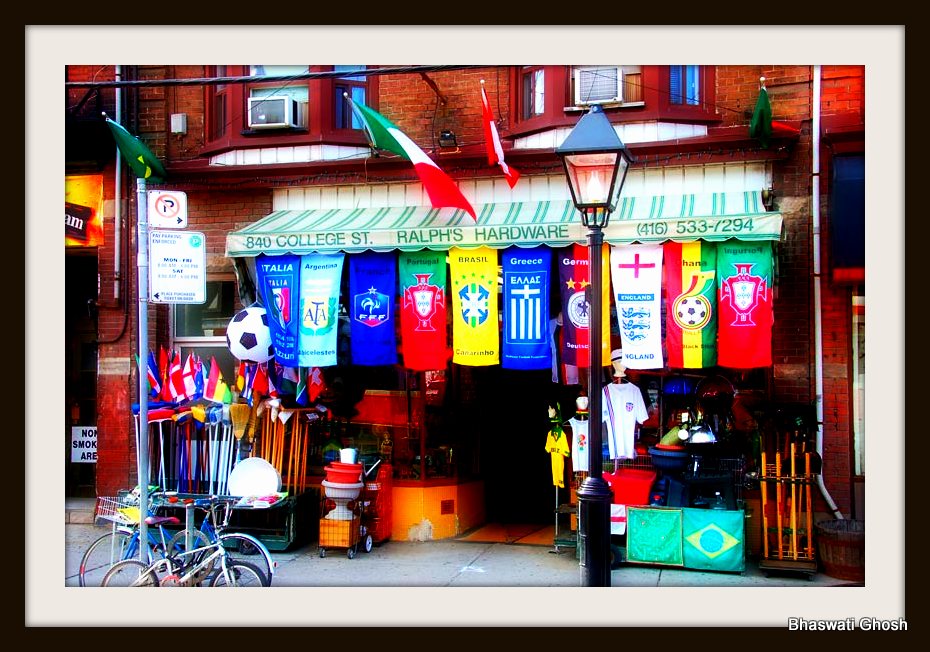 Flags. They had become the latest automotive displays, fluttering atop cars – sedans and pickup trucks, SUVs and smart cars – in crazy abandon. The tiny flags caught my eyes in the summer of 2012, as I drove around Mississauga, the Toronto suburb that was my home. Canada Day, the official holiday to celebrate the unification of three colonies into a single country called Canada, was still nearly a month away. So the sudden show of patriotism puzzled me.
As more flag-bearing cars cruised along in the days to come, I discovered not all sported the red maple leaf of Canada against a snow-white backdrop. If anything, the colours and images of the flags far outnumbered the colours or breeds of the cars that flew them with pride. That’s when the reality – its transience – of Euro Cup struck me. Admittedly a provisional vexillologist for the period of the tournament, I turned to Google with curious search terms – ‘Red and white flag with pigeon,’ and ‘Red and green flag with emblem on top.’
As the Euro soccer mania gained momentum, television news channels in Toronto didn’t have to send correspondents to different European countries to get viewer reactions. Nor did they pick up news feed from international agencies. That’s because Europe itself lives in Toronto – people of European descent form the largest bloc of immigrants in the city. When Italy entered the tournament’s final, the TV channels needed to do little more than to place a camera in Toronto’s Little Italy, where all hell had broken loose as fans erupted to celebrate their home team’s victory over Germany in the semi-finals.
My own move to the land of abundant maple syrup and universal healthcare marked a diagonal shift in more ways than one. From the sun-dappled mountains of San Francisco, California, my husband and I decided to come to Canada as landed immigrants. ‘You will like it in Canada,’ he had reassured the writer in me, while we were still contemplating the move. His observation alluded to his comparison of the US west and east coasts (the latter being closer to Toronto). Occasional work-related trips to certain parts of New York exposed him to the thriving diversity there, manifesting in a rainbow of costumes in the streets, words from different languages drifting into one’s ears as well as the vibrancy of the region’s arts and literature scene.
A year ago, as a potential resident of London, ON, I spent a gorgeous summer afternoon in Victoria Park. My husband was coming to the city for his final round of a job interview, and I tagged along, just in case we didn’t get a chance to visit the city again. Sitting in this expansive park that afternoon, I contemplated what it would be like to live in London. As I complete a year in the forest city, here are my impressions from a summer ago.

A children’s festival is in progress in Victoria Park. I sit on a bench and see squirrels and birds engaging in mini battles over morsels.
Squirrels scamper in ceaseless motion–climbing up and down trees, scurrying across the grass, pausing in wonderment for a few seconds before taking off again.
Dogs, kids in strollers enjoy free walks, rides.
Church bells ring; lunch-goers emerge from offices, heading to big and small eateries to satiate the hunger god.
A man sprawls on the grass, reading a newspaper.
Beside me, on the bench, the pages of a national daily flutter in midsummer’s breeze, letting go of the heaviness of yesterday’s news.
Under a tree, a girl sits alone, ear-phones plugged into her natural audio sockets.
I turn behind and find a brown squirrel looking at me intently.
A young couple sleeps on the grass, embracing each other, oblivious of the world around them.
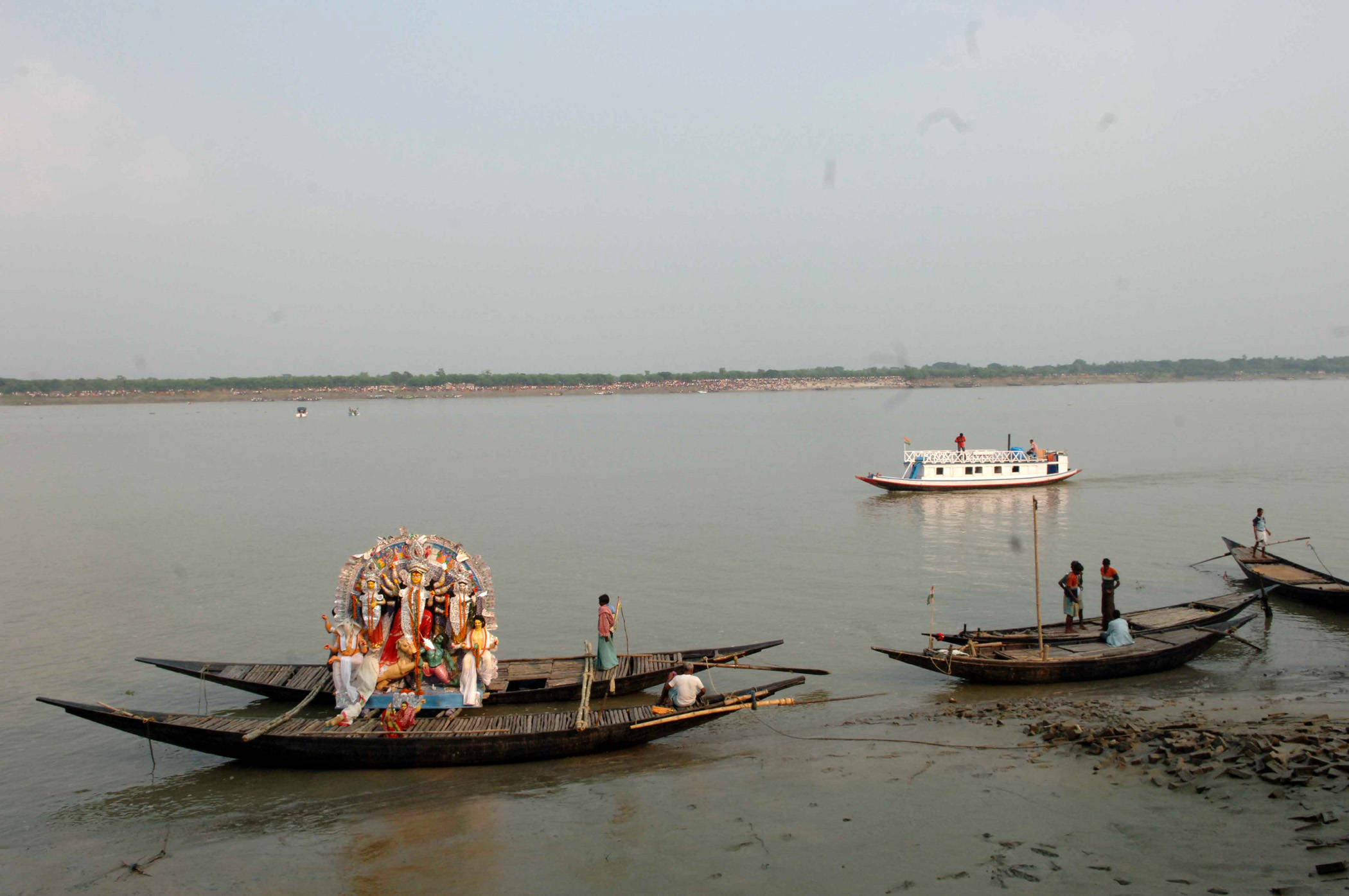
Note: This personal essay appears in Cafe Dissensus
A group of children–between six to eight years in age–sat on a dusty rug on the ground with drawing sheets on boards before them. After drawing out scenes depicting one of the three theme choices provided to them, they furiously pushed crayons over the penciled sketches. My brother was one of the contestants of this on-the-spot- painting competition, interestingly called “boshey anko protijogita” in Bengali, literally meaning sit-and-draw contest. He drew a Christmas scene, having chosen the theme, “Your favourite festival.” A couple of hours later, when the results were out, he had real reason to celebrate– he had won the first prize.
There was nothing unusual about this except his choice of festival; the contest was part of a Durga puja celebration. Given that most of the festival entries depicted the ten-armed goddess and her rejoicing devotees and a few portrayed Diwali, which would approach in less than a month, the judges must have been either too brave or too liberal to adjudge a Christmas image as the best entry.
Was this because the venue of the puja and therefore the contest was outside mainland Bengal, in Delhi? I can’t really tell, for I was born and raised in what bonafide Bengalis call probaash–a sentiment-laced word for foreign land.
Photo source: Hinduism.about.com
A series on my experiences as an immigrant in Canada
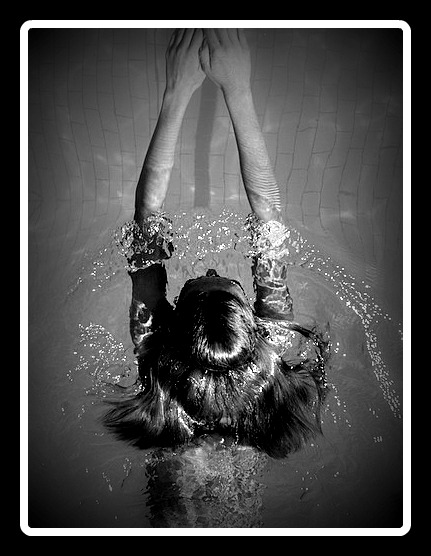
It’s the first day of swimming lessons for my husband and me. After the class, the instructor suggests we practice in a different lane. Apart from the two of us, a young Canadian girl and a gentleman from Pakistan join the practice. I am still practicing floating when a girl, snow white in complexion and no more than five years old, walks across the deck to stand near me.
 “Is the water warm or cold?” she asks me.
“It’s not too cold,” I say.
She jumps in and squeals in delight, “It’s warm!” then jumps right out.
As we float, holding on to the deck wall for our dear lives, she asks me,
“Are you and him, Mom and Dad?” She points with her eyes to the Pakistani gentleman, floating in a corner away from the three of us.
“Me and who?” I ask her.
She points again to the Pakistani swimmer, saying, “This one.”
“No,” I say and draw her attention to my husband, floating right next to me, “Me and him are together.”
“Ah, so you are parents,” she says knowingly.
“No,” I simply say.
“So you are grownups.”
“Yes.”
“You are going to have a baby?”
“No.”
“You have a baby,” she says, rolling her eyes.
“No, I don’t.”
“I know you do.”
“No…”
“The baby got out. I know it did.”
With that, she walks away, casting one last all-knowing glance my way.
I beseech, “No!”
But to no avail. By now the little lady has already moved on.
READ ALL IMMIGRANT’S POSTCARDS HERE
Photo courtesy: http://vdleek.blogspot.ca/
A series on my experiences as an immigrant to Canada
It’s my first visit to the doctor’s office in my new city. The pain in my right leg is nagging to the point of being obstinate. Right at the entrance, next to the reception window, a sign says “If you are rude to my staff, I won’t see you today.” That’s not a very friendly doctor, I whisper to my husband, who is accompanying me to lend moral support. After the initial wait time (about 15 minutes), my name is called, and the clinic assistant checks my blood pressure, a routine exercise. Then begins the wait for the doctor. A good 20 minutes go by, until she knocks the room before entering it.

After the initial pleasantries, the doctor asks me if I speak Hindi. I nod yes.
I tell her that my pain worsens upon standing on any hard surface for a while. She asks if I have to stand in the kitchen a lot.
“Yes,” I say.
“There’s a particular type of mat that has a cushioning effect. Place that in your kitchen,” she tells me, even suggesting the store from where to get it.
After writing a prescription for anti-inflammatory medication, the doctor returns to the thread she had left off with her reference to Hindi.
“Where in India are you from?” She asks.
“Delhi,” I say, hastening to add that my husband is a Sikh, from Punjab.
“We are from Lahore and speak only Punjabi at home.” She says, making it a point to let me know that the Punjabi she speaks is “very similar to what Sikhs speak.” That’s because she belongs to the jatt caste, one of the many who were converted to Islam, she informs.
She ends the (very friendly) conversation by recommending the cushioning mats again. “I too have this pain and always use the mats whenever I have a daawat at home and have to stand in the kitchen for long.”
It is technically India’s Independence Day. Two women from opposite sides of a land split into two in a cleaving that saw insane bloodshed share slices of history and culture over a medical visit.
And, they share insights on lessening pain.
READ ALL IMMIGRANT’S POSTCARDS HERE
A series on my experiences as an immigrant to Canada
So we’ve been living in a new city for the last ten days. Last week, on my way back home from the indoor market (housing local farmers, butchers, bakers and dairy owners), I got lost–for the second time in three visits. Severely direction-challenged that I am, this isn’t new to me. A lot of times, I actually enjoy losing my way, only to find myself in an interesting part of the city. When this happened to me in London about three years ago, I remember having walked into the area of Soho, where the evening seemed eager to graduate to the tantalizing night ahead. I was in London for the first time and might not have visited Soho alone in a planned manner. Getting lost thus pushed me into an experience, which though unexpected, turned out to be memorably charming.
Back to last week’s loss-of-direction episode in my current city. When I finally realized my mental mapping skills were not taking me any closer to home, I sought a fellow-walker lady’s help. Thanks to her accurate directions, my feet quickly found solid ground and marched toward our apartment complex.
A couple of hundred meters from the apartment complex is a casual eatery with patio seating outside. As I passed the cafe, I heard an elderly gentleman asking a couple sitting in the patio for some help. I couldn’t hear well, but I heard him say, “My Alzheimer’s…” to which the gentleman sitting at the table on the patio said, “Well, you are still very much in London, sir.” By then I had moved farther. When I turned back, the lone, walking gentleman no longer stood next to the patio.
Even as I tried to make sense of the streets and intersections to reorient my geography, here was a man wandering with fractals of memory and no compass to rely on, wondering if he was still in the city where he started his walk.
It struck me then that we were in a city of the aging, with more visible services for the elderly than possibly any other demographic group.
London, Ontario that is.
READ ALL IMMIGRANT’S POSTCARDS HERE
A series on my experiences as an immigrant to Canada
Summer has nearly preempted spring in Toronto, as the mercury keeps shooting past 20 degrees Celsius, breaking all kinds of records. From the time we arrived here (June last year), we have been warned and reassured in turns of the perilous winter that lay ahead and exactly which jacket and which brand of snow boots to get to beat the cold. Well, the winter seems to be behind us and not only the weather (hardly snowy, never perilous), but even my wardrobe has started mocking me. So we went to buy some summer clothes.
At the departmental store, a Caucasian family of four–the parents and their two young boys–preceded me in the customer service line. As the father proceeded to make the payment for their purchases, the mother and the younger son, not more than three years old, hustled back to grab one more item. When all his items had been scanned, the father said to the counter lady, “Please wait a minute. There’s one more thing I’d like to get. But not if it’s too expensive.” The mother, with the toddler in her arms, hurried back. The little boy had a toy–a small stuffed monkey with a green back and an orange head–in his hands. As they reached the counter, the father handed the stuffed toy to the counter lady. She scanned it and turned the computer screen towards the father– “Twenty dollars.” The father was quiet for a few seconds, as if numbed by the price.

Shortly, mum and dad exchanged a few words in what seemed like some Eastern European language. By this time, the little boy, still in his mother’s arms, had grabbed the colourful monkey back. The father didn’t say anything to his son (nor did the mother); he just shook his head at the counter lady.
The customer service lady, evidently an Indian, looked at the golden-haired kid and said, “Maybe next time?” When he still didn’t look ready to part with his monkey, she gently took it from him, saying, “Here, let me scan it, so we can have it ready for you the next time?” The boy remained quiet, didn’t create any fuss, and the family left the store.
The counter lady’s gentle intervention in the tricky situation reminded me of a line my husband remembers from his childhood. Every time he asked for something that was out of his parents’ reach, they would cajole him, “Kal le denge, haan?” meaning, “We’ll buy this for you tomorrow.” It is the golden promise that makes “tomorrow” so coveted for children across generations.
Letting down a toddler must be hard for any parent. It’s perhaps a tad harder for immigrant parents who have come to a new country and a bleak economy.
READ ALL IMMIGRANT’S POSTCARDS HERE
 Bhaswati Ghosh