
Immigrant’s Postcard: The March, the masks, the meal

A series on my experiences as an immigrant in Canada

It’s only Tuesday, but the collective spirits of myself and the husband included are already sagging. We decide to give in to the trite solution of an impromptu eating-out outing. I suggest the Chinese restaurant located at a stone’s throw from our apartment.

Winter is setting in, and it’s dark by the time we walk towards the place. It remains dark even when we arrive at its doors–no glowing OPEN sign beckoning us. That’s when I read the restaurant’s hours, painted in red and yellow on the wall. Closed on Tuesdays, it says.

The spirit lurches further, but  we continue to walk on. B suggests we check out a shawarma place, about half a kilometre away, in the opposite direction. So we turn back, the chilly November breeze blasting on our faces. We pass by the shawarma joint, suddenly enthused to explore a bit more–maybe another Chinese restaurant? Down a few more paces, suavely-dressed people look out at us from the swanky and unaffordable Che resto-bar, even as I ponder on the incongruity of its name.

McDonalds and Jambalya–a Thai-Caribbean restaurant get a miss from us too. We are looking for cheap food, yet give an elitist ignore to McD. As we cross the road, I realize agitated hunger bugs are good agents for fighting a drooping spirit. I feel the bugs chorusing in my belly.  We walk by another expensive Thai restaurant and veto a “Vietnamese and Pizza” place before walking into a corner store that also sells Caribbean take-out. The words Goat Curry on the menu light up our faces, but the shine is erased a moment later, when the kitchen manager–a sturdy black lady–emerges from the kitchen with a broom in her hand and informs us they are about to close the doors.

The hunger bugs align with the spirit and heave in my belly.

As we wait for the walking signal to cross the street, something silky-soft kisses my head, then my face. I turn around astonished even as a young man pulls a huge flag away from me, saying, “I am sorry, didn’t mean to flag you.” With him are a few more young men, some of them in white Guy Fawkes masks. We cross the street together.

1000478_1379524422269637_626229992_n

A sudden craving for burritos seizes the husband, although there are no Mexican eateries anywhere within our walking range. We have already covered a couple of kilometres on foot, so I turn down the idea of going back home, getting out the car to go to his favourite Mexican grill. He remains relentless in his burrito demand, yet makes a turn–as abrupt as the heroine of Marquez’s “Love in the Time of Cholera” when she spurns her letter-writing lover–towards a shawarma shop.

A chubby-cheeked young man greets us from behind the counter. He’s cooking up a storm with chicken shawarma and hands us nibbles to taste as we place our orders. He makes two chicken shawarmas for us, and every time he receives our nod for adding a condiment (Tzatziki, hot sauce, pickled turnips, red onions), he says “Shukriya” with a self-assured smile. With the selfsame cordiality, he asks us to sit and eat and not do a take-out. Our tired feet agree, and we become the only two patrons in the big restaurant, its walls punctuated with prints of Babylonian structures. As he sits down with his own shawarma for dinner, our young host tells us he’s from Iraq but had lived mostly in Syria before moving to Canada.

In one evening, B and I unwittingly become participants of the Million Mask March and receivers of delicious Middle Eastern hospitality.

Shukriya/shukran, for both.
Read all Immigrant’s postcards here.

Where a line is a circle: Toronto

This personal essay appears in the third issue of Earthen Lamp Journal. The journal’s theme was ‘East, West: Juxtapositions and Intersections.’

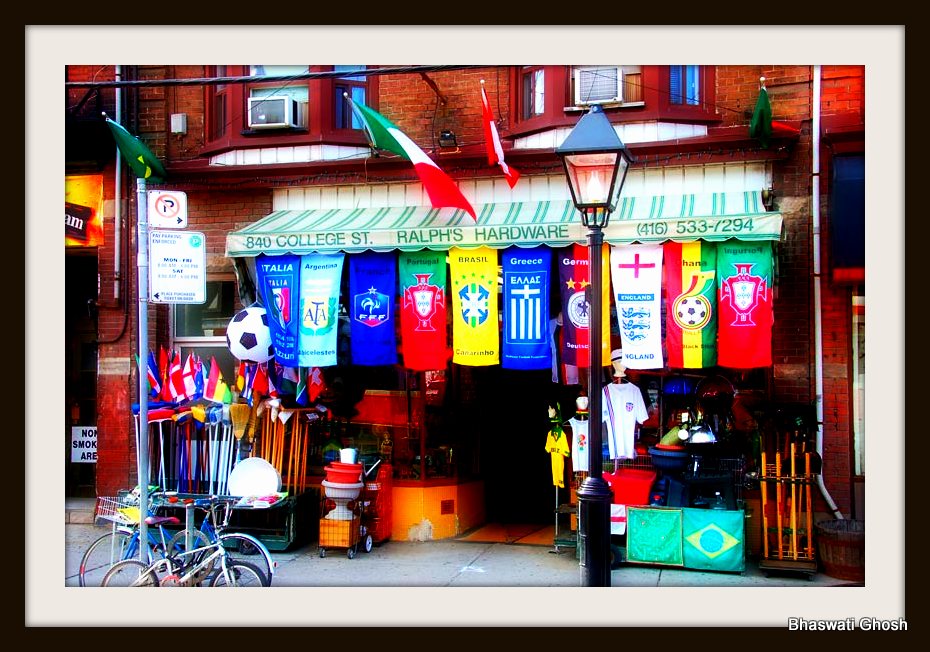
world-cup-2010_02Flags. They had become the latest automotive displays, fluttering atop cars – sedans and pickup trucks, SUVs and smart cars – in crazy abandon. The tiny flags caught my eyes in the summer of 2012, as I drove around Mississauga, the Toronto suburb that was my home. Canada Day, the official holiday to celebrate the unification of three colonies into a single country called Canada, was still nearly a month away. So the sudden show of patriotism puzzled me.

As more flag-bearing cars cruised along in the days to come, I discovered not all sported the red maple leaf of Canada against a snow-white backdrop. If anything, the colours and images of the flags far outnumbered the colours or breeds of the cars that flew them with pride. That’s when the reality – its transience – of Euro Cup struck me. Admittedly a provisional vexillologist for the period of the tournament, I turned to Google with curious search terms – ‘Red and white flag with pigeon,’ and ‘Red and green flag with emblem on top.’

As the Euro soccer mania gained momentum, television news channels in Toronto didn’t have to send correspondents to different European countries to get viewer reactions. Nor did they pick up news feed from international agencies. That’s because Europe itself lives in Toronto – people of European descent form the largest bloc of immigrants in the city. When Italy entered the tournament’s final, the TV channels needed to do little more than to place a camera in Toronto’s Little Italy, where all hell had broken loose as fans erupted to celebrate their home team’s victory over Germany in the semi-finals.

My own move to the land of abundant maple syrup and universal healthcare marked a diagonal shift in more ways than one. From the sun-dappled mountains of San Francisco, California, my husband and I decided to come to Canada as landed immigrants. ‘You will like it in Canada,’ he had reassured the writer in me, while we were still contemplating the move. His observation alluded to his comparison of the US west and east coasts (the latter being closer to Toronto). Occasional work-related trips to certain parts of New York exposed him to the thriving diversity there, manifesting in a rainbow of costumes in the streets, words from different languages drifting into one’s ears as well as the vibrancy of the region’s arts and literature scene.

Read the rest of the essay here.

The Cities

Cities

This poem appears in the August issue of Lakeview International Journal of Literature and Arts (page 83-84). Click here to read the entire issue, chock-a-block with quality fiction, non-fiction and visual art.

Two cities live in the City.

One survives on frozen habits
thawed every night–
cell phone alarms, recycled intercourse,
snores, chanted mantra-like.

It’s the city that keeps
offices, banks, coffee shops
and hospitals running
with tired precision.

This city chews on cold, stringy
Mondays-Thursdays,
for the deep-fried Friday
that follows.

The city’s twin blends with the usual city
smoother than cocktail mixes.
It walks with, holds hands of,
gives an ear to
the normal city.

The twin claims
park corners in stealth,
to exhale late-evening
ecstasy.

This city doesn’t stiffen at night,
but flows over it–
river-like, turning nocturnal conventions
on their heads, revving up
bars, street corners.
Swinging to music, floating on lights,
jazzing up drinks
with heady alternatives.

It is the city that makes headlines,
with 3AM shootings, gang-war or not,
reminding the City Normal
to better watch out.
Or else.

Afternoon Meditations

A year ago, as a potential resident of London, ON, I spent a gorgeous summer afternoon in Victoria Park. My husband was coming to the city for his final round of a job interview, and I tagged along, just in case we didn’t get a chance to visit the city again. Sitting in this expansive park that afternoon, I contemplated what it would be like to live in London. As I complete a year in the forest city, here are my impressions from a summer ago.

London

A children’s festival is in progress in Victoria Park. I sit on a bench and see squirrels and birds engaging in mini battles over morsels.

Squirrels scamper in ceaseless motion–climbing up and down trees, scurrying across the grass, pausing in wonderment for a few seconds before taking off again.

Dogs, kids in strollers enjoy free walks, rides.

Church bells ring; lunch-goers emerge from offices, heading to big and small eateries to satiate the hunger god.

A man sprawls on the grass, reading a newspaper.

Beside me, on the bench, the pages of a national daily flutter in midsummer’s breeze, letting go of the heaviness of yesterday’s news.

Under a tree, a girl sits alone, ear-phones plugged into her natural audio sockets.

I turn behind and find a brown squirrel looking at me intently.

A young couple sleeps on the grass, embracing each other, oblivious of the world around them.

Snow and Coffee (Short story excerpt)

By Bhaswati Ghosh

An excerpt from a short story, published in the latest issue of Stealing Time (a literary magazine for parents), themed Relations. To read the full story, purchase the issue here.Snow CoffeeAs she hurried for her train, a blast of snow slapped her cheeks, reminding Aruna of when she had landed at Toronto’s Pearson International Airport for the first time. The frigidity had made her question her decision to come to Canada. It was too late, she had reminded herself.

When she landed in this haven for immigrants nine years ago, Aruna had been nervous. At their parting, her husband Raghu assured her, “It’s only a matter of a few months, maximum a year, Aru. I will be there after that.”

But those few months had multiplied into as many as it took to make nine years. Years that taught Aruna that time was as slippery as her husband’s promise to join her in Canada. Between trying to make a living and raising twelve-year-old Vishnu, she had aged by two decades instead of one. Looking at the mirror one day, Aruna tried to make sense of how it turned out to be like this—three lives that were supposed to make a family now fragmented like left-over noodle strands on a diner’s plate. Those early years they had spent together contained no suggestion of the later distancing. Her husband had seemed caring and involved, if excessively guided by his quest for a “good life.”

Now, snow and coffee — once alien to her– had become second nature to Aruna. And her good life had little to do with what her husband had imagined. She reflected on how time changes a person’s inner landscape in accordance with the outer one.

The train sped past white houses, streets, trees. Aruna planted her cheek, covered with the woolen scarf she’d wrapped around her neck, to the window. The thickly snow-decked walls that vanished and re-appeared on the horizon were home. She rubbed her glove-clad hands and sipped coffee from the paper cup that danced slightly to the train’s motion on a tray table in front of her.

Arriving in the province, she had felt confident of getting a job. Her many years as a lifestyle journalist in India couldn’t have been for nothing. So she consumed herself with the other variables—managing her son’s education, getting a health card made, securing a driver’s licence, and all the other minutia of moving to a new place.

But she rented a damp basement apartment and managed the other details with ease. Only the job eluded her.

In three weeks, the city had turned from an indifferent host into an unforgiving master. The city demanded labour from Aruna in order to grant her an extended stay. A conversation with her widowed landlady made the prospects look bleaker than the foggy winter mornings…

Reader’s reviews:

The story very well opens the eyes of ‘outsiders’ in India etc., who look longingly towards the West as a utopia, to its sordid reality. The life of the immigrant, the brutal self reliance it has to fall back on in an unknown land, is nicely stated. In a way the story shows how non self reliant we are in India with all our relatives ready to absorb the shocks of our life and to make it more tolerable; in this sense, it is to the essentially relations-bound Indian mind to which the story speaks. 
~ Prathap Kamath
Your story brings out both the struggle and the elation after a successful struggle very beautifully. At first, it is quite unbelievable why Aruna was putting up with Raghu. Couldn’t she just pack up and start life afresh? And then it dawned upon me that life wasn’t so easy. Breaking all ties isn’t easy at all. And this difficult life is what you have described so well in this story.
…Just the feeling that Canada is so far away from home – and Raghu, in India – and is so, so cold makes this entire struggle so sublime and so worth it. Congrats to you for making some kind of a comparative study between the bleakness of Canada’s climate and the bleakness within Aruna to more beautifully sketch her struggle.Another good thing about the story is its length. You haven’t wasted words and sentences.
~ Hansda Sowvendra Shekhar

On Birthday by Rabindranath Tagore

River-nurtured is this life of mine.
The conferment of mountain peaks
run through its veins,
its terrain, carved by many alluviums,
life’s enigmatic nectar
transfused, from several directions
grain by grain.
Web-streams of music from the East and the West
envelop its dream and its arousal.
The river that’s the world’s envoy
bringing the distant closer,
and the unknown’s invitation at the doorstep
Created my birthday —
All along, my boundless, flowing abode
has floated in its current
from shore to shore.
I am an outcast, a wanderer
my birthday platter brims over
and over, without fail
with grains of unrestrained kindness.

(Translation: Bhaswati Ghosh)

River View by Gaganendranath Tagore

জন্মদিনে

২৮

নদীর পালিত এই জীবন আমার ।

নানা গিরিশিখরের দান

নাড়ীতে নাড়ীতে তার বহে ,

নানা পলিমাটি দিয়ে ক্ষেত্র তার হয়েছে রচিত ,

প্রাণের রহস্যরস নানা দিক হতে

শস্যে শস্যে লভিল সঞ্চার ।

পূর্বপশ্চিমের নানা গীতস্রোতজালে

ঘেরা তার স্বপ্ন জাগরণ ।

যে নদী বিশ্বের দূতী

দূরকে নিকটে আনে ,

অজানার অভ্যর্থনা নিয়ে আসে ঘরের দুয়ারে ।

সে আমার রচেছিল জন্মদিন —

চিরদিন তার স্রোতে

বাঁধন-বাহিরে মোর চলমান বাসা

ভেসে চলে তীর হতে তীরে ।

আমি ব্রাত্য , আমি পথচারী ,

অবারিত আতিথ্যের অন্নে পূর্ণ হয়ে ওঠে

বারে বারে নির্বিচারে মোর জন্মদিবসের থালি ।

Alien Winter — II

“Let my love like sunlight surround you
and give you illumined freedom.”
~ Rabindranath Tagore

Sunshine isn’t an easy paramour.

In my hometown,
it spills over in
volcanic excess–
scorching land,
human bodies,
cattle and crops,

even as it gently
rocks the hills
with its undulating dance
on terraced tea gardens.

Yet in this frosty city,
it plays hard to get.
Deaf to pleas,
appearing on whim,
the hometown beau
avenges yesterday’s curses
by spurning today’s
advances.

Sunshine is a tricky lover.

Also see Alien Winter — I

Alien Winter — III

Alien Winter — I

Sun erases snow
wind howls
winter beseeches.
The church spire
stands mute,
unmoved,
cold.

The wind pauses
its howl,
lunchtime beckons.
School children run
to grab a
windfall of leaves.

Snow motes swirl
ruffling the air’s hair,
the earth’s an eager
bosom.
Children conjure up
castles, snowmen.

The wind screams
tearing through
flags, bare trees
windows
and a sheet of
congealed memory,
unfreezing on the
surfacce–
a foggy morning in
my hometown
half a world
away.

Alien Winter — II

Alien Winter — III

Dashrath’s Dinner Party by Amiya Sen (Short Story)

Translated from the Bengali by Bhaswati Ghosh

As she pulled the curtains off the doors and windows and dumped them on the floor, Shakuntala hollered, “Munga, come here, fast!”

Dashrath was at the dining table, shaving. Casting a glance towards Shakuntala, he said, “Why are you taking those off yourself? Have Munga do that…if you fell down—”

“That worthless servant of yours. You brought home a rascal from the orphanage. It’s eight in the morning, and he is yet to finish his work in the kitchen. A heap of clothes remains to be washed. I must load them into the washer myself and wait until the cycle is completed. If left to him, he will ruin the clothes like he did last time. Sigh, your new safari suit and Gudiya’s expensive zari-bordered lehnga-choli.”

“Let it be. Where will you get a servant for 30 rupees in today’s market? We are managing just fine. Hey, Munga, get up on the stool, take down the curtains and pile them in the backyard. Then bring a duster. Clean everything in all the rooms. Khabardar, nothing should break, or else I will beat you to a pulp, you understand?”

Read the rest at Humanities Underground

The Kitchen, another story by the same author.

Titti

Amiya Sen (1916-1990) is a Bengali novelist and short story writer. Her writing has been published in various Bengali journals, including Desh, Jugantar, and Basumati.Aranyalipi and New Delhi-r Nepathye are her non-fiction books. She also wrote a children’s book called Shonai Shono Rupkatha.