A new column about literary journeys I will be curating in Saaranga. This inaugural post starts with my own story.
At seven — an age when writing only means filling the school homework notebook with the dreary repetition of my handwriting — the joy of reading arrives at my door. It’s a hot morning of my summer vacations in New Delhi, and like on most such mornings, I’m preoccupied with some or the other holiday homework — tasks designed to keep children in line and make them more tolerable to their family members for two long and sultry months. A postman knocks on our gate holding that rare item — a parcel — that lights up our faces with barely- concealed smiles. As my grandmother emerges from the kitchen and opens the package with her turmeric-stained fingers, out come the precious contents — a book of Bengali chhawra or rhyming verses and illustrated Ramayana and Mahabharata for children in Bengali — books she had ordered for me through relatives in Calcutta. The fun of words rolling into limericks and nonsense verse as you uttered them, of reading stories you didn’t have to write an exam for, of letting your mind fill with imagination what the words in the books left out — these must have been the initiation for me on the road to being a literary pilgrim.
*
The year I move on to middle school, I decide to switch schools. I’m glad I do, because in grade six, I find the teacher who would influence me the most in my life. Abha Das, a petite woman who wears crisp cotton saris and glasses on her small but penetrating eyes, doesn’t merely give lectures on the stories in our English textbook. She makes each one of the stories, which she takes days to finish, a riveting experience — at once an education in the craft of storytelling and reading with empathy and understanding. As she gives a lecture on E. R. Braithwaite’s To Sir with Love, she asks us to look back and think of the times we felt belittled because of our identity. By doing this — throwing us headlong at our vulnerabilities — she dissolves the distance between the narrator and us. Relating to the characters we read about in fiction in such a visceral way would help make me be a better reader even before I show any promise of being a writer. One morning, I would find the teacher waiting at the end of our morning assembly line. She’s there to thank me for a birthday card I’d left on her desk in the staffroom with a poem titled To Ma’am with Love. Her teaching would turn my joy of reading into a deeper love for words. I would now notice their intonation, their music, and recognize their inherent power to breed both love and violence.
*
Even as Abha Ma’am enthralls us in school, at home, too, another petite woman — Amiya Sen, my grandma — remains a force I can’t ignore. She’s a grandmother like every other, doting and endlessly patient, yet she’s more. I see her go to work at an office when no other friend’s grandmother does. She stitches the best frock dresses for me every Durga Pua and knits me sweaters with the most exquisite patterns every winter. She reads — books, newspapers, magazines, my school textbooks, packets made from old newspapers — like there’s no tomorrow. And she writes. She writes after returning from work, she writes in between cooking meals, she writes after running errands, she writes late into the night after everyone has fallen asleep, she writes the first thing in the morning before anyone wakes up. She has no writing desk to fulfill this fetish; I only see her writing on the floor where she sprawls on her stomach to lie on a straw mat, her arms resting on a pillow. She would be my first example of what a full-time writer truly means — not someone who has no job and earns their living through writing, but someone who steals and grabs every millisecond of available time to write while carrying out the seven thousand and nine other responsibilities that eat into her writing time. At thirteen, I write my first short story in Bangla and show it to her with nervousness. With a warm hug of approval, she encourages me to write more. Two years later, before I’m able to grasp the full scope of her writing artistry, she leaves the world. And she leaves me clueless about fighting loneliness, about living with the scary beast of loneliness.
*
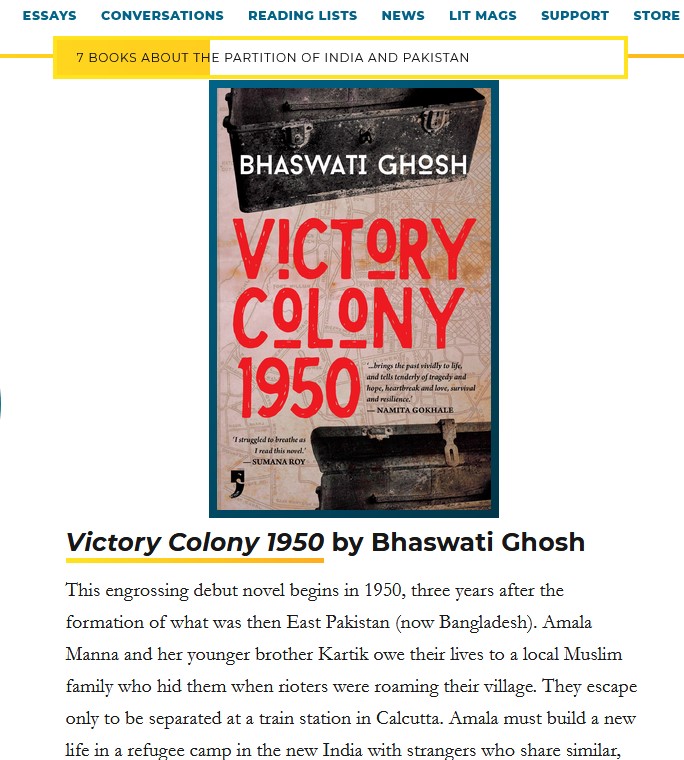
Three decades go by. I am far removed from the house I grew up in, the one that my writer grandmother built with her life’s savings and dreams. I now live with my husband in Canada where it’s cold for more than half a year. In the thirty years since my grandmother passed away and I passed out of school where Abha Ma’am taught me, I’ve carried more than luggage. I have lugged Grandma’s stories — literally and figuratively. I have with me a bunch of short stories she wrote longhand, to type out and prepare for possible publication. But I also have the stories she told me as I grew up — stories of her childhood back in undivided India, of her life as a young bride, of her coming to Delhi and learning the English alphabet from her children, of the heartbreaking and unrelenting tragedies she’d had to endure in her life, of the unceasing pain of being displaced from her desh, the native soil of East Bengal that she’d been estranged from with India’s division in 1947. Somewhere along the way, all of these make a story grow inside me, and I end up writing a novel. When Victory Colony, 1950, my first book of fiction is published, I feel happy, relieved and sad at once. Like every new author, I’m elated to finally see my story out there in the world. Yet somewhere inside, it hurts me to realize that the one person I would have liked to read it isn’t there.
A year after the book is published, I have a dream featuring my grandmother. She is lively and as engaged with current events as she always had been, and I feel anxious anticipating her reaction to my novel. When I wake up, a bittersweet sensation tugs at my throat. I feel relief and yet I also feel an ache.
Perhaps that is what our literary wanderings are about — arriving at life’s crossroads, with both pain and joy staring at us. It is my pleasure to welcome you all to Saaranga’s new column on these journeys with authors — I hope you’ll indulge us and enjoy taking in the songs, dramas and scenes that forge our writerly paths.
This post, written by Rekha Karmakar who blogs at Tabulous Mom, is a tribute to Amiya Sen, my grandmother, whom the blogger knew as a neighbour in Delhi more than five decades ago.
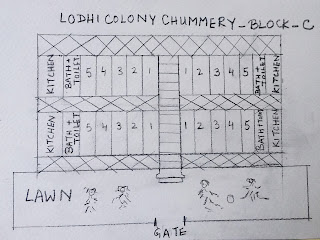
A rough sketch of the layout of a chummery in Lodhi Colony (New Delhi) in the 1950s, from my distant memory, where Amiya Sengupta’s and our family lived
This story is not about any female revolutionist, during the British period, who took up arms to fight for the country’s independence. It is about an ordinary humdrum housewife like our mothers and aunts who toiled in the kitchen and looked after their families.
I knew this lady since I was five years old though I lost track of her in course of time. One may wonder why I am writing about her after so many years.
To be very honest, my memories were rekindled by a story written by her worthy granddaughter Bhaswati Ghosh, who currently lives in Canada and is herself a writer. Her story about her grandmother Amiya Sengupta in ‘Memoir Excerpts: Excerpt from Till the River Runs Dry’ published in SETUMAG.IN brought back my memories about her.
Like many of my FB friends, I had not met Bhaswati, who, I suppose, is also an alumni of my school in Delhi. Once she wrote on FB about her maternal grandmother Amiya Sengupta, who would write stories in her copybook, some of which were also published.
‘Amiya Sengupta’ ? I pondered for a while as it rang a bell in my mind. I thought it might be the ‘mashima’ of our ‘chummery’ in Lodhi Colony in New Delhi. I messaged Bhaswati enquiring about her grandmother and was immediately confirmed by her that I was on the right track.
Why did it take me so much time to figure out who Amiya Sengupta was? Later it occurred to me it might have been because those days women were not usually known by their names. They were either ‘boro bou’/’mejo bou’/’choto bou’ (daughters-in-law as per hierarchy) or ‘so and so’s mother’ after their children were born. Amiya Sengupta was ‘mashima’/auntie to us and ‘Gita’s ma’ to others. Her eldest daughter Gita happens to be the mother of Bhaswati.
A few years after independence (in the 1950s), a group of young and daring Bengalis came to Delhi, with their families, to build a new India. My father, Amiya Sengupta’s husband Sudhir Chandra Sengupta and a few others were among them.
Away from home, these men were put up in ‘chummries’ along with their families. ‘Chummeries’ were two storeyed buildings used as a ‘mess’ for bachelor British soldiers during the British raj. Central govt employees of different states of India were temporarily put up in those buildings after independence.
There used to be a staircase in the middle of the building. On each side of it, there were five rooms in a row. These had a bed room and a small drawing room sort of space in front. Each batch of five rooms had three common bathrooms and three common toilets, which were kept quite clean.
Next to it, was the kitchen which was divided into five parts though none had a door. Food was cooked on ‘balti unans’ (coal fire ovens made in a bucket) or mud ‘unans’ built on the floor.
Quite often, I would sit next to my mom and listen to the ladies talking while they were cooking. It usually veered around recipes and always ended with talking about their ‘daish’/native land in East Pakistan as the memories were still very fresh. Amiya Sengupta, whom I shall, henceforth, refer to as ‘mashima’, always took the lead.
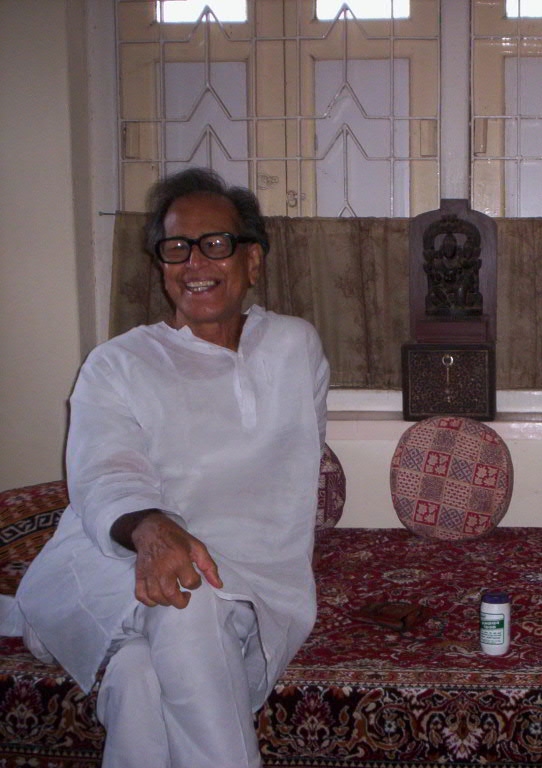
Amiya Sen
‘Mashima’ and ‘meshomosai’ stayed on the same floor, as we did, with their two children – a daughter and a son. They were a little older than my parents, who regarded them as their friend, philosopher and guide.
‘Meshomosai’ was very good in mathematics. Whenever I got stuck, I would go to him. Usually the first few sums of an exercise were solved in the class but the last few ones, which were difficult, would invariably be given as home task. Hence, I would have to go to him very often. ‘Meshomosai’ was very glad to help but on one condition. The condition was that I would have to pick up his grey hair for getting the sums solved. (His hair had become grey untimely). I, too, readily agreed. Now I realize I must have made him almost bald considering the number of times I went to him to get my sums solved. 🤩
In the meanwhile, ‘mashima’ did a diploma course in sewing. Not only that, she opened a sewing school at home where she gave tuition to the ladies of the neighbourhood. I always felt she was different from others as no one else, at that time, would ever have thought of adding to the family income by giving tuition in sewing though she was not in dire need of money.
My mom was one of her early batch of students and a favourite one too. My mom bought a Usha sewing machine, which was considered to be quite expensive at that time. But my mom made very good use of it by churning out innumerable frocks for us, shirts and shorts for my brother, blouses and petticoats for herself and pajamas for my father. After her children grew up, she stitched curtains, pillow covers etc.
A few days back, when I called my mom, she ruefully told me that she had sold the Usha machine to a man as she could not move her fingers properly to sew. Unable to control my curiosity, I asked her how much she had sold it for. She replied it was sold for Rs 200/-. She also told me that she had bought the sewing machine for Rs 125/-, by adding money from her saving. She proudly added that it was ‘Tailor’ model, the one which the tailors used for sewing. The other ordinary model was cheaper.
After a few years, we were all shifted to East Vinay Nagar (later named Laxmi Bai Nagar), where new quarters were erected for us. These were two storeyed buildings, having 2BHK flats, with a small balcony in front and a tiny kitchen garden at the back. Both our families were in the same block. The ‘chummeries’, we heard, were demolished later to make way for new buildings.
(After four decades of leaving Delhi, I went back to Laxmi Bai Nagar again but felt like Rip Van Winkle, without being able to recognize anything).
All the moms were very happy having a separate and self contained flat though it took some time to get adjusted to the new upcoming colony.
‘Mashima’, however, did not stop after getting a diploma in sewing. She appeared privately for Matriculation, Intermediate and B.A. examinations from Punjab University and lastly did M.A. in Bengali from Delhi University though her children were quite old at that time. She also started learning Hindi and appeared for Prabhakar (equivalent to Hindi Hons.). Hindi was promoted a lot at that time by the Central government to make it the national language of India. I do not remember if she took up a job at that time. But from her granddaughter Bhaswati’s writing, I came to know that later in life she had a government job.
Many decades have passed since then. I might have jumbled up many facts about her as I was myself a young school going girl at that time. I got a few inputs from her granddaughter too.
This story is not about facts but about the grit and spirit of ‘mashima’. Marrried at fifteen and coming from Barisal in East Pakistan, I realize now, she achieved a great feat. Very few women of her time would have ventured to appear for Board and University examinations from the scratch. Her family, too, must have given her a lot of support or it would not have been possible for her to do anything.
During summer, in Delhi, we used to sleep on the charpoys (portable beds made with strings), in the lawn, in front of our house. ‘Mashima’s family used to sleep just a few feet away from us. Quite often I noticed that she would read a book in the light of the lamp post that was just over her charpoy. Such was her tenacity.
‘Mashima’ had a passion for writing, which she did braving many odds. As per her granddaughter, ‘mashima’ has four books, many published articles and short stories to her credit. I wish her granddaughter Bhaswati edits and compiles them again.
One thing, I must say, is that she was very fortunate to have a granddaughter like Bhaswati, who delved into her writings and gave her due credit for it. I wish my granddaughter Kimaya also, at least, reads my post from my humble blog tabulousmom.blogpost. com when she grows up.
I pay my respect to ‘mashima’ through this post and wish her soul rests in peace.
I won’t let the sun set now. Look, I’ve broadened my shoulders and tightened my fists. I have learned to stand firm by embedding my feet on the slope.
I won’t let the sun drown now. I heard you’re riding its chariot and I want to bring you down You, the emblem of freedom You, the face of courage You, the earth’s happiness You, timeless love The flow of my veins, you The spread of my consciousness, you; I want to help you climb down that chariot.
Even if the chariot horses spew fire, The wheels won’t turn any longer I’ve broadened my shoulders. Who will stop you I’ve expanded the earth With bangles of golden grain I will decorate you With an open heart and songs of love I’ve widened my vision to hoist you as a dream in every eye.
Where will the sun go anyway It’ll have to stay put here In our breaths In our colours In our resolves In our sleeplessness Do not despair I won’t let a single sun sink now.
अब मैं सूरज को नहीं डूबने दूंगा। देखो मैंने कंधे चौड़े कर लिये हैं मुट्ठियाँ मजबूत कर ली हैं और ढलान पर एड़ियाँ जमाकर खड़ा होना मैंने सीख लिया है।
घबराओ मत मैं क्षितिज पर जा रहा हूँ। सूरज ठीक जब पहाडी से लुढ़कने लगेगा मैं कंधे अड़ा दूंगा देखना वह वहीं ठहरा होगा।
अब मैं सूरज को नही डूबने दूँगा। मैंने सुना है उसके रथ में तुम हो तुम्हें मैं उतार लाना चाहता हूं तुम जो स्वाधीनता की प्रतिमा हो तुम जो साहस की मूर्ति हो तुम जो धरती का सुख हो तुम जो कालातीत प्यार हो तुम जो मेरी धमनी का प्रवाह हो तुम जो मेरी चेतना का विस्तार हो तुम्हें मैं उस रथ से उतार लाना चाहता हूं।
रथ के घोड़े आग उगलते रहें अब पहिये टस से मस नही होंगे मैंने अपने कंधे चौड़े कर लिये है। कौन रोकेगा तुम्हें मैंने धरती बड़ी कर ली है अन्न की सुनहरी बालियों से मैं तुम्हें सजाऊँगा मैंने सीना खोल लिया है प्यार के गीतो में मैं तुम्हे गाऊँगा मैंने दृष्टि बड़ी कर ली है हर आँखों में तुम्हें सपनों सा फहराऊँगा।
सूरज जायेगा भी तो कहाँ उसे यहीं रहना होगा यहीं हमारी सांसों में हमारी रगों में हमारे संकल्पों में हमारे रतजगों में तुम उदास मत होओ अब मैं किसी भी सूरज को नही डूबने दूंगा।
From womb to the world, I bring emergencies in my wake.
LAJPAT NAGAR
Ten days after I’m born, democracy in my country gets turned on its head; constitutional rights are left meaningless for all practical purposes. The Indian government has just declared a state of Emergency. While I have no memory from that time, people who do still recoil in remembered fear when talking of those “Dark days.” Of disappearances and forced sterilizations, of tortures, interrogations and blank newspaper pages – a way to refuse toeing the government line.
My mother has to fight her own emergency, meanwhile. Her marriage has just fallen apart and she’s back in her parents’ home in Lajpat Nagar in New Delhi. When I come bundled up from Holy Family, the Christian missionary hospital where I am delivered to Kasturba Niketan – the refugee rehabilitation colony where my grandmother works, my mother is in desperate need of a job.
Before that first house grows on me, the Emergency has been lifted and my mother finds employment. Her old employer – the library at Delhi University – takes her back, making an exception on its policy regarding rehiring former employees. Her pre-marriage work record helps as much as her post-marriage personal crisis.
Like air and freedom, light, too, is suspicious of prison cells. Here, muscularity, minacious, well-oiled, prowls around the clock, a wild cat in command of its turf. Women petrify into grinding stones too heavy for new sorrow.
Juicy allegations buzzing with mendacity test the nerve of testosterone. Old friends discover each other anew as if they had been separated for years. Porous prison walls are the only true ally, at times smothering, closing in, like an obsessive lover.
Here, children lick more darkness than milk and try to believe the sky to be a true story. The rainbow is a fairy tale. Long conversations conserve grey cells and crumble invisible walls more solid than concrete.
Light shuns prison cells like fish dodging a cast net. On certain rain-whorled evenings, a rainbow and a full-blooded moon still get caught through the perfidious windows of this spotted palace.
Note: The italicised text are quotes by Devangana Kalita, Umar Khalid and Anirban Bhattacharya respectively.
You gave me a gold-plated fountain pen And a cornucopia of writing equipment. A small walnut-wood desk. Letterheads in different designs. Silver paper with an enamel finish. Scissors, knife, sealing wax, ribbon. A glass paperweight. Red, blue, green pencils. A letter must be written every Other day, You ordained for me.
I finished bathing in the morning So I could sit down to write a letter.
But I can’t decide on what to write. There’s only one news — That you have left. This, you already know. Yet, it seems like You aren’t really aware of this. So I think of letting you know — You have left. Every time I begin to write Something tells me this isn’t easy news to share. I’m no poet — One who can give voice to a language; Or vision to words. The more letters I write, the more I shred them.
It’s ten o’ clock already. Your nephew, Boku, is ready for school, I need to feed him first. This is my last attempt — Let me write to inform you That you have left. The rest is only a jungle of Doodles crowding the blotted ink.
পত্রলেখা
দিলে তুমি সোনা-মোড়া ফাউণ্টেন পেন,
কতমতো লেখার আসবাব।
ছোটো ডেস্কোখানি।
আখরোট কাঠ দিয়ে গড়া।
ছাপ-মারা চিঠির কাগজ
নানা বহরের।
রুপোর কাগজ-কাটা এনামেল-করা।
কাঁচি ছুরি গালা লাল-ফিতে।
কাঁচের কাগজ-চাপা,
লাল নীল সবুজ পেন্সিল।
বলে গিয়েছিলে তুমি চিঠি লেখা চাই
একদিন পরে পরে।
লিখতে বসেছি চিঠি,
সকালেই স্নান হয়ে গেছে।
লিখি যে কী কথা নিয়ে কিছুতেই ভেবে পাই নে তো।
একটি খবর আছে শুধু--
তুমি চলে গেছ।
সে খবর তোমারো তো জানা।
তবু মনে হয়,
ভালো করে তুমি সে জান না।
তাই ভাবি এ কথাটি জানাই তোমাকে--
তুমি চলে গেছ।
যতবার লেখা শুরু করি
ততবার ধরা পড়ে এ খবর সহজ তো নয়।
আমি নই কবি--
ভাষার ভিতরে আমি কণ্ঠস্বর পারি নে তো দিতে;
না থাকে চোখের চাওয়া।
যত লিখি তত ছিঁড়ে ফেলি।
দশটা তো বেজে গেল।
তোমার ভাইপো বকু যাবে ইস্কুলে,
যাই তারে খাইয়ে আসিগে।
শেষবার এই লিখে যাই--
তুমি চলে গেছ।
বাকি আর যতকিছু
হিজিবিজি আঁকাজোকা ব্লটিঙের 'পরে।
In ‘Bateshwar’s Contribution’, a short film by Sandip Ray I recently watched, Bateshwar Sikdar, a veteran writer, suddenly finds himself in the company of visitors and advice – both unsolicited. Over the course of three days, as many individuals, supposedly Sikdar’s fans come to him with the same strange request. They all want him to make the ending of a novel he’s writing, a happy one. Based on a story by Rajshekhar Basu, often hailed as the greatest humourist of the last century, the film, or rather that peculiar request, struck a personal chord with me in what has been my nascent journey into published authorship so far. I am coming to that in a bit.
In Sikdar’s case, when the first reader, a young man, approaches him on one of his morning walks, there isn’t much to suspect – he’s seen gushing with praise for the senior writer and shows great interest in his current serialized work ‘Ke Thaakey, Ke Jaaye?’ (Who Stays, Who Goes?). In fact, he seems so involved with the story that he’s eager to find out the fate of a female character. He asks Sikdar about the same, referring to the character as the novel’s heroine. Sikdar reminds him that there are two heroines in the novel, and when the young reader specifies he’s referring to Aloka who is fighting a serious illness, Sikdar tells him that she’s going to die. Our young reader seems heartbroken and pleads with the author to let her live. Exasperated, Sikdar tells him off and continues on his walk. The next morning, the entreaty turns into a mild threat when another man, a renowned surgeon, drops by at Bateshwar’s house with the same proposition – to let Aloka live. As with the first petitioner, Sikdar turns down the physician’s request and remains firm on his stand to eliminate Aloka to have Sharbari, the novel’s other heroine, take her place. He would have a third and final requester – a woman who introduces herself as a film actor – who comes to him with the offer of buying the film rights for ‘Who Stays, Who Goes?’. She’s eager to play Aloka in the film she informs Sikdar, but he has to ensure she’s cured of her illness and continues to live. Sikdar, though excited at the offer, still remains reluctant to change his story’s ending. It’s only when the lady threatens to jump ship and make a similar offer to a rival author that he reverses his long-held decision to let Aloka die.
As she hurried for her train, a blast of snow slapped her cheeks, reminding Aruna of when she had landed at Toronto’s Pearson International Airport for the first time. The extreme weather had made her question her decision to come to Canada. It was too late, she had reminded herself.
When she landed in this haven for immigrants nine years ago, Aruna had been nervous. At their parting, her husband Raghu assured her, “It’s only a matter of a few months, maximum a year, Aru. I will be there after that.”
But those few months had multiplied into as many as it took to make nine years. Years that taught Aruna that time was as slippery as her husband’s promise to join her in Canada. Between trying to make a living and raising twelve-year-old Vishnu, she had aged by two decades instead of one. Looking at the mirror one day, Aruna tried to make sense of how it turned out to be like this—three lives that were supposed to make a family now fragmented like left-over noodle strands on a diner’s plate. Those early years they had spent together contained no suggestion of the later distancing. Her husband had seemed caring and involved, if excessively guided by his quest for a “good life.”
Now, snow and coffee — once alien to her– had become second nature to Aruna. And her good life had little to do with what her husband had imagined. She reflected on how time changes a person’s inner landscape in accordance with the outer one.
The train sped past white houses, streets, trees. Aruna planted her cheek, covered with the woollen scarf she’d wrapped around her neck, to the window. The thickly snow-decked walls that vanished and re-appeared on the horizon were home. She rubbed her glove-clad hands and sipped coffee from the paper cup that danced slightly to the train’s motion on a tray table in front of her.
Arriving in the province, she had felt confident of getting a job. Her many years as a lifestyle journalist in India couldn’t have been for nothing. So she consumed herself with the other variables—managing her son’s education, getting a health card made, securing a driver’s licence, and all the other minutia of moving to a new place.
But she rented a damp basement apartment and managed the other details with ease. Only the job eluded her.
In three weeks, the city had turned from an indifferent host into an unforgiving master. The city demanded labour from Aruna in order to grant her an extended stay. A conversation with her widowed landlady made the prospects look bleaker than the foggy winter mornings.
“Beta, I would suggest you try to find something at a grocery store. Or Tim Horton’s or McDonalds.”
“But Aunty, I worked in…”
“I know,” the landlady had interrupted, “you were a journalist. But this country doesn’t hand out jobs in your chosen field so easily. Maybe if you had a degree. But you don’t. You’ll have to be more humble, my dear.”
Aruna felt a dampness envelop her entire body. The very idea of working in a grocery store behind the cash counter made her bones stiff. The dullness of the job, the ominous possibility of turning into an automaton numbed her. Yet, college at her age was nonsense. There was no money. There was no time. She had a child. She tried to adjust to the idea she would have to get started somewhere, even behind a counter, even wearing a funny uniform.
One afternoon, as specks of sunlight sneaked in through the shoe-box windows of her drawing-cum-bedroom, Aruna got out of the house, armed with her trusted jute handbag and the resumes inside it. The snow outside had melted only a little, and black ice lined the streets. The knife-sharp chill had turned the sun into a frosty pale-yellow orb. It bit into Aruna’s skin right through her thrift store jacket.
She walked into the shopping plaza in front of her. With lunch hour drawing near, several cars entered the parking lot. The passengers were headed for a pizza joint. A few stores away, Aruna saw some activity—a new store seemed to be opening. The men offloading furniture from a truck looked to be from her part of the world. She approached one of them, a hefty, mustached and sun-glassed man, wearing a long black jacket and smelling of cologne.
“Er, excuse me, is a new shop coming up here?”
The man turned to her and adjusted his glasses before replying,
“Yeah. We are opening a restaurant.”
Aruna allowed a sheepish smile and reached for the resume inside her purse. A crumpled piece of folded paper came out. By the time she straightened it, the mustached man had already moved on and was almost inside the new restaurant.
Aruna nearly ran to catch up with him. He turned around and stopped at the door.
“Here,” said Aruna, huffing, “my resume.”
The man took the paper from her hands and invited her inside.
And so she found her job–at the South Indian vegetarian eatery, right in the heart of the suburb that had been swelling with South Asian population. Being a Tamil Brahmin helped–in the end, it wasn’t her qualifications or experience, but ethnicity that mattered.
Nausea and nauseating people were what Aruna could recall when she thought of the initial days of her job. Serving the same combinations of gravies and lentils infused with tamarind, curry leaves and coconut, throughout her long shifts turned her stomach. She thanked her luck that daily breakfast was part of her job perks. By the time the shift ended, she hardly had appetite for anything.
But she would take that over the gut-churning invitations some diners extended to her.
“Join me for a late-night movie with drinks.”
“Hey, my wife is vacationing in India. Care to spend the weekend with me?”
“What day is your weekly off? I can come over to your place to keep you company.”
Aruna knew Raghu’s absence made it easier for these passes to be hurled at her. With time and some help from her co-workers, she learned to cite an activity with Vishnu as a credible excuse. Conjugal armour wasn’t necessary. Her son was both her shield and compass.
She couldn’t learn to deal with the apparition of longing, though. The one that showed up frequently, especially on weekends, when she served families huddled at table after table. She would imagine sitting at one of them, being teased by Raghu and Vishnu and giggling in the self-absorbed, vain way she saw some younger women do. After nearly two years, it dawned on her that Raghu probably didn’t want to come to Canada at all. His response to her entreaties in this regard had a tone of measured yet affectionate indifference.
A year later that suspicion was confirmed. The then-teenaged Vishnu had been caught in a drunken brawl close to their home. Aruna had received a call from the police at her workplace. Her boss reluctantly allowed her half a day’s leave. She rushed to the hospital where her son and two other kids had been brought for treatment. An inquiry had begun. Though her mind was spinning with the possibilities: trial, imprisonment, expulsion, worse; in front of Vishnu, she remained normal and even sporting, “Beta, you wanted to have a drink? You should have asked me. This isn’t how you take it–on an empty stomach. Wait until you are legally ready. We’ll have it together. Deal?”
He seemed to understand, his own fear making him receptive. She called Raghu the next day, still suffused with worry. He said:
“Hey, all this happens, Aru. It’s his age. Cheer up!”
“But you do realize that I am all by myself here. I have to face his teachers, the police, maybe even…”
“You will manage it all, my feisty lady,” Raghu had interrupted. “I am confident you will tackle it fine.”
Aruna had broken down over the phone, unable to accept her husband’s phony reassurance, his unconcern. Raghu had yelled that he was forced to be far away only because of Aruna and Vishnu. So he could give them a “good life.” Silently, she had thought of her lean bank account and wondered who, in fact, was getting that “good life.” But she had said nothing. If this crisis wouldn’t bring him to her side, she sensed then, nothing would.
Now assistant manager at the restaurant, Aruna was able to take the time she needed to attend the court hearings for Vishnu’s violence. They went on for a year. Those hearings, weekly meetings with his school counselor, and her increased responsibilities at work–tracking the accounts, preparing budgets, taking stock of inventory–all silvered her once kohl-black hair with a vengeance.
While she longed for the cocoon of a loving family, her middle age offered a different reality. Finding too little time face-to-face, cell phone texts and emails became her allies in raising Vishnu. Through them, she was privy to the heartaches, acrimonious debates, and insults edging on slurs that were at the core Vishnu’s growing up. But somewhere along the way, the rough edges of adolescence smoothed out, and Vishnu turned from an errant child into a friend. Aruna thanked her gadget gods.
“Stop working like a donkey, Amma,” he counseled.
“Oh and what’s going to fund your fancy professional keyboard?” she would quip, thinking of his musical aspirations.
“Maybe that will have to wait. I can practice at Karan’s. You cut your hours at any rate. You are going to collapse if you carry on like this.”
Slowly, Aruna stopped feeling Raghu’s absence. In fact, she began to wonder if she would ever be able to live with him again. Acquaintances and even regulars at the restaurant would ask questions about her husband. She knew that her silence suggested that he was perhaps living a good life himself, not working toward giving one to his wife and son.
Over liberal sips of wine and unrestrained laughter, her closest friends heard more than silence: “Know what? I couldn’t care less. Who is stopping me from bringing a man into my bedroom?”
But in truth, she had found in loneliness a better, more trusted partner. She had, to her surprise, become at ease with being alone in the bed. And as years piled on years, it didn’t seem to really matter.
The restaurant staff–the suspicious and glassy-eyed accountant Sethuraman, the helper boys, Gopal and Dinesh, and all the chefs–from the bulbous-bellied, middle-aged Bala to the bony, soft-smiling young Manoj–had become her extended family. Sethuraman confided his fears and reservations to her, whether at his son’s craze for violent video games or the “lack of etiquette” among nouveau riche diners. The chefs considered her a big sister and sought her advice on important matters like which insurance policy to buy and what made a good gift for a wife’s birthday.
But for all that, Aruna felt glad that the restaurant hadn’t turned into her home. Despite the chaotic dust-storm blowing through her life, she was determined to find a nest: A haven not just for her own trapped soul, but also for Vishnu and his mates to flap their hormone-charged teenage wings with slaphappy abandon.
After the fallout had settled from Vishnu’s brawl, once all the court hearings and counseling had ended, she had found them a town home. Her restaurant family had worked as moving crew, packing and transferring items from her chilly basement with care. Vishnu had saved some money out of his weekly allowances and bought knick-knacks as surprises for Aruna–a small Ganesha figurine, a wind chime for the entrance, a couple of guitar-shaped key hangers.
Evenings, which began at 10 pm when her workday ended, were a combination of m’s: music and masala. Vishnu had recently joined a local South Asian band and was composing music on his keyboard, which he would then test on Amma’s “unreasonably tolerant” ears. He would rebuke her at times,
“Amma, how can you find this nice? It sounds so amateurish.”
“Yes, but you would agree this is much better than what you played last time, wouldn’t you?” Aruna would say.
“Hmpff! You’re not paying attention. Never mind, go back to your cooking.”
And so she would. The kitchen of their new home had become her creative laboratory, spa, and refuge, all at once. The earthy whiff of cumin seeds as they spluttered in the hot oil in a skillet assured Aruna all was well. The pungency released by garlic crushed in a mortar- pestle or asafoetida in searing oil alluded to the spunk and excitement lurking within every seemingly insipid day.
While chopping onions for a Kerala-style fish curry, she smiled at the thought of how her palate had been transformed by Canada and its long winters as well as her son’s rapidly-evolving gastronomic index. Growing up, she would twitch her nose at the mere mention of fish; now she not only cooked it, gently simmering it in a creamy coconut milk stew, but also enjoyed biting into its flesh, spooning in some steamed rice and curry as well.
Food–not the grub people stuff themselves with to satiate hunger, nor even the gratifying ingestion of chosen foods to fill one’s ego and belly on special occasions–but the unsung yet care-sodden home meals, the mothers’, grandmothers’ and distant aunts’ creations—had become Aruna’s lodestar in a territory that offered her unparalleled freedom–to be messy, to fail in experiments, to not stop experimenting. And it gave her the ability to make her son happy.
“When I move out, I am taking you with me. I don’t want to miss this awesome food,” he said one morning as he sipped from a glass of mango shake. Every summer, Aruna would buy boxes of mangoes, expensive as they were, having been imported from India or Pakistan, to make sure that Vishnu could have his mango shakes and lassis for breakfast.
“Why would you need to move out at all?” Aruna asked. “This house is all yours, Beta. But you will give me the third floor, won’t you?”
“The entire third floor? Nah, Amma, you can’t have my music room, no way.”
Laughing, they argued over the proposed division of the house for half an hour, before agreeing on letting it be the way it was–with Vishnu deciding what part of the house belonged to him. That sometimes included his mother’s bedroom. Contrary to feeling betrayed or wronged, Aruna found her son’s near-feudal sense of ownership to be a snug blessing. Anything to make him stay in the house–even if that meant sleeping on the living room couch for nights on end.
Things had started falling into a pattern, like the predictable rhythm of seasons in Canada. Aruna particularly cherished the fall, when leaves changed colours faster than a painter’s brush strokes–as sensuous reds flirted with boisterous yellows and fiery oranges, the thermometer’s dipping mercury made bodies seek the embrace of jackets and light cardigans, sunset morphed into huge pumpkins and descended on grocery stores and maple syrup flowed indulgently over pancakes at breakfast tables. And schools re-opened after the summer break. For a mother of a teenage son, what was there to not love about fall?
Autumn also awakened the writer in Aruna. At first, she fed long nights that refused to bring sleep with DVDs of the latest Bollywood flicks. But she tired of them. On those restless nights, she wrote, remembering the career she had left behind years before. If food acted as her release, writing was her plunge–the deep-sea dive that took her on secret, often uncomfortable journeys. In writing she was compelled to confront and listen to the many women within her–those whose roles she played in real life and those whom she could never be. The single mother, the survivor, the lonely spinster, the comforting cook. The charming partner, the dependant wife, the fighting feminist.
When a freelance opportunity to write for a lifestyle magazine came along, Aruna grabbed it with her raddled hands. An occasional article on parenthood, a sometimes report of a cultural event, an infrequent restaurant review–the writing wasn’t exactly soul-lifting, but it was better than washing dishes at the restaurant, which she had continued to do even after becoming a senior manager.
Then, Bharat, the restaurant owner started complaining to Aruna about finances. He had incurred a substantial debt and would be cutting down on staff. The words dropped on Aruna’s ears as a whipping hailstorm. She knew what it meant. She told Bharat she wouldn’t survive without the restaurant; that it had become a part of her. The continuance of her job had become a reality as simple as the nonexistence of her husband. Losing this “normal,” which had taken years to make, scared her.
Bharat had tried to calm her, “I don’t want to let go of you either. I can’t. We’ll find a way.”
As a start, he suggested part-time work for her. Aruna understood that would also mean part-time salary and didn’t know what to say. She hated the idea of asking Raghu to send additional money: for nine years, he had paid their electricity and phone bills, but no more. And Vishnu was at least two years away from making his own money.
Her hours were cut. The numbers told her that adding the expense of college education didn’t make sense. And yet, a sense of vindication surged within her as she ran: not away from her Canadian life, but deeper into it.
The restaurant went on, and so did she. Through the bleached, bleak Ontario winterscape she rode a train into the city. Thrice a week she attended classes at the college alongside students half her age: broadcast journalism. On two other days, she volunteered at a local TV station. Restaurant work now meant just a few hours in the evening. The digits on her salary cheque had dropped.
For the first time in nine years, nonsense made total sense to Aruna. She was in possession of her power and her possibility, and for the first time she allowed herself a solo flight over an uncertain territory.
The frosty surroundings reminded her that the white always changed to green, no matter how old or young the trees were. As she glided above the ennui of routine and the relevance of marriage, Aruna breathed free. So did all the strands of hair on her cigarette-ash head.
[The End]
First published in Stealing Time literary magazine (print) in 2013.