What Manto’s ‘Das Rupay’ Tells Us About Sexual Violence Against Girls Today

Originally published in The Wire.

“She was playing with little girls in the neighbourhood alley.”

This is how Saadat Hassan Manto opens his story Das Rupay (Ten Rupees). “She” is the story’s young protagonist, yet, as Manto implies by introducing her with the generic third-person pronoun instead of her name, she could be any girl. Nearly eight decades after he wrote that story, she – the fictitious Sarita – seems to be gathering a disconcertingly increasing number of real-life sisters in India. As one comes across news reports of little girls being sexually violated – each more harrowing than the other – across the country, Das Rupay serves as an unnerving reminder of everything that’s at stake for and taken away from a young girl when she is raped.

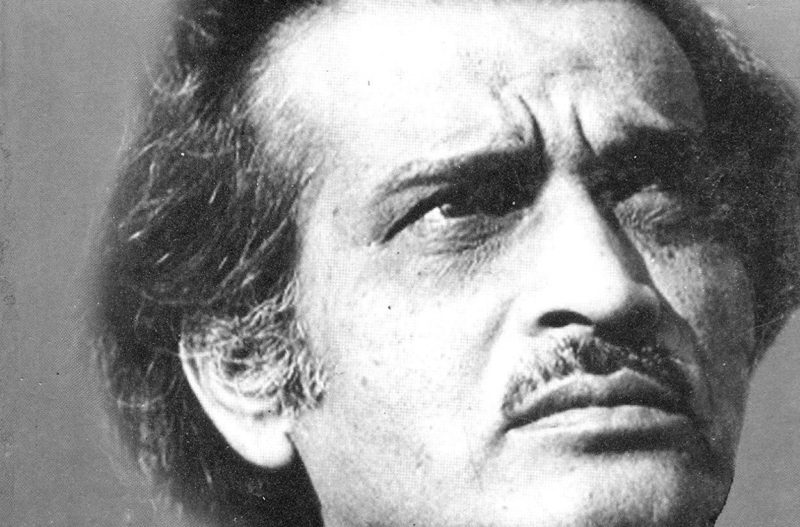
Image result for manto with daughter

Pushed into the flesh trade by her mother, 15-year-old Sarita is more a little girl than a teenager. Like most little girls, she’s free from worries. She enjoys, like I did in my teens, playing with girls a lot younger than her. And from the slivers of her personal life that have filtered through the horrific news surrounding an eight-year-old girl’s rape and murder in Kathua, we know she enjoyed playing with her horses. More recently, in the case of an 11-year-old girl who was raped by a dozen-and-half men over seven months in Chennai, her mother blithely assumed her daughter was playing with her friends when, in fact, she was being sexually abused.

Back in my teenage years, not all neighbours appreciated my propensity to play with girls younger than me. Some found such “childishness” annoying. As Tagore, too, illustrates in his short story, Samapti, this expectation for a girl to relinquish her girlhood no sooner than she hits puberty is anything but atypical in the Indian context.

In Das Rupay, Sarita’s playing in the nukkad irks her widowed mother for a different reason. Her daughter is an easy source of income and she hates to keep Kishori, the local pimp – and the fat-pocketed customers he brings  – waiting. As a cover for her complicity in trafficking her own child, the mother makes tall claims like, “I’m thinking of enrolling her to the municipality school that just opened,” which her neighbours know to be a sham. Sadly, for today’s flesh-and-bone Saritas, the school building isn’t always a safe place. School teachers, older students and even a principal in Patna can turn into sexual predators, as recent news reports suggest.

Read the rest in The Wire.

Map Making

The cubicle slumbers with a whirr of weekday monotony.
Defying screen slavedom, we three meet for lunch. She
from China, I from India and she from Canada. School
harks back to the lunch table as I cajole her to share
my chicken pot-pie. We discuss roots. “South-western China,”
she says, hastening to add the immigrant’s near excusatory,
“but education in Beijing and Shanghai.” She nods
when I speak of women and their place in Asia. My
“decent-enough-to-earn-me-a-writing-job-English”
surprises her. We branch out into languages thus.
Mandarin is hers. She makes sure her child mutters
it too, even though he claims to be a Canadian. I
talk about my mother tongue and how it created a new
country. Their eyes brighten, ears perk up. And she, the lanky,
blue-eyed one is taking a shot at Italian, her husband’s
root tongue. “Oh Italian!” our Asian friend squeals,
“Do they all carry guns there?”

And so we begin making
maps with fleeting-floating stock images, hackneyed
threads–losing sight and redeeming it with a native’s
estimation. I tell them about India, its many topographies–
“each state a country unto itself,” the need for
its women to develop lateral vision and thick
skins. What’s her origin, I ask the blue-eyed one.
“Danish-Swede hybrid,” she says lamenting the inhuming of
both languages beneath the inter-generational sedimentation
over the arctic snow.

We part with sweet somethings, convoluted
cartography and a promise to “do this again.”

Leading Ordinary Lives / Kunwar Narayan

Kunwar Narayan
(Translation mine)

I know
I can’t change the world,
Or win a fight against it.

It’s possible that I
Become a martyr fighting
And beyond that earn a martyr’s
Tomb or an artist’s fame…

But being a martyr
Is a different game altogether

There are people who despite
Leading entirely ordinary lives
Have been known to become
Martyrs, quietly.

मामूली ज़िन्दगी जीते हुए / कुंवर नारायण

जानता हूँ कि मैं
दुनिया को बदल नहीं सकता,
न लड़ कर
उससे जीत ही सकता हूँ

हाँ लड़ते-लड़ते शहीद हो सकता हूँ
और उससे आगे
एक शहीद का मकबरा
या एक अदाकार की तरह मशहूर…

लेकिन शहीद होना
एक बिलकुल फ़र्क तरह का मामला है

बिलकुल मामूली ज़िन्दगी जीते हुए भी
लोग चुपचाप शहीद होते देखे गए हैं

A People Ravaged: Peeling off the Many Layers of Partition Trauma

First published in The Wire

Literature, Gender, and the Trauma of Partition: The Paradox of Independence
Debali Mookerjea-Leonard
Routledge, Taylor & Francis Group, 2017

In writing my first novel, whose protagonist is a young refugee woman from East Pakistan, I employed the device of coincidence to achieve a happy ending. Doing so wasn’t a sudden rush on my part to end what had become a protracted writing project but a well thought-out conclusion. It was not to be. When they read it, two of my trusted beta readers quashed it summarily, citing it as lazy and escapist. Even though incredible incidents can happen in real life, one of them advised, in a work of fiction, coincidences are hard to pull off convincingly.

An incident Debali Mookerjea-Leonard mentions in the preface to Literature, Gender and the Trauma of Partition: The Paradox of Independence starkly bears out this paradox.

Shortly after the All India Muslim League’s call for Direct Action in Calcutta in 1946, the author’s grandfather was stranded in Howrah station as public transport had been suspended in the wake of the sectarian clashes. He eventually got a ride from a kind Muslim family who had a private car, but had to climb on the footboard as the vehicle was full. To ensure his safety, he was given a flag of the Muslim League and advised to shout “Pakistan Zindabad” when passing through Muslim neighbourhoods. He did, and reached his home safely.

The insanity that gripped the subcontinent a year later when India was partitioned has been arduously chronicled in historical archives. In the privileging of journalistic reportage and record-keeping, personal histories surrounding the traumatic event haven’t received much attention until recently. The initiatives of Urvashi Butalia, Ritu Menon, Kamla Bhasin, and Jashodhara Bagchi, among others come to mind.

Mookerjea-Leonard’s book is an important intervention in this regard, not only because of its meticulous research and compelling arguments but because it sits in that nebulous middle – a no man’s land if you will – of fact and fiction. The author examines with incisive rigour fictional works on Partition and juxtaposes them against factual information and recent recordings of oral histories. As someone not directly affected by the event, hers is a lens that is both objective and earnest.

The works discussed in Literature, Gender and the Trauma of Partition are mostly from Bengal, which the author calls the “neglected shelves” of Bengali literature, written by writers from both sides of the Radcliffe divide. As she mentions in the Preface, this book is her tribute to her city, Calcutta. It is also a conscious effort to shine a light on the sufferings of those at the eastern end of the divide, as the tragedy of Partition in Bengal has been either underrepresented or misrepresented when compared to Partition in Punjab. This could well be attributed to, as Mookerjea-Leonard is cognisant of, the predominant and recurrent theme ofdisplacement in the east as opposed to that of horrific violence in the west.

Read the rest in The Wire.

The Wolf’s Eyes are Red/Sarveshwar Dayal Saxena

(Translation: Bhaswati Ghosh)

The wolf’s eyes are bloodshot.
Glare at him
Until your eyes
Turn red, too.
What other choice do you have
When the wolf is in front of you?

भेड़िए की आंखें सुर्ख हैं / सर्वेश्वरदयाल सक्सेना

भेड़िए की आंखें सुर्ख हैं।
उसे तबतक घूरो
जब तक तुम्हारी आंखें
सुर्ख न हो जाएं।
और तुम कर भी क्या सकते हो
जब वह तुम्हारे सामने हो?

Deshgaan' – Janata Weekly

Sarveshwar Dayal Saxena (1927-1983)

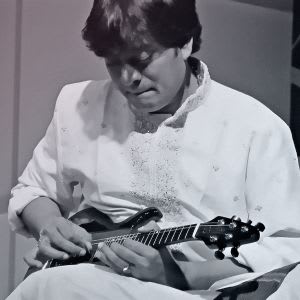
LISTENING TO U. SRINIVAS

Mandolin’s secrets have no use for cover.
They burst open into splintered reveries
And flood your waking dreams.

Mandolin lures moody southern
Winds; blows them lustily in your
Courtyard. The breeze ruffles
Your hair, your sourness.

At temples, Mandolin gathers the
Holy fire of the morning sun to bathe
Your face.

When Mandolin plays, you turn
Into a snake and slither without a hiss
To a corner where the string
Charmer leads you.

Mandolin indoctrinates without
A mantra. Magicians rarely
Need one. You become a bird and
fly away with Mandolin.

More on U. Srinivas here.

U. Srinivas songs, U. Srinivas song MP3 download

Book Review: Love and the Turning Seasons – India’s Poetry of Spiritual & Erotic Longing

I recently had the opportunity tot read “Love and the Turning Seasons,” an exquisite collection of bhakti poetry in translation from Aleph. I wrote about it in Kitaab.

Love and the Turning Seasons

Title: Love and the Turning Seasons – India’s Poetry of Spiritual & Erotic Longing
Edited by Andrew Schelling
Publisher: Aleph
Pages: 294
Price: ₹399

I left shame behind,

took as an ornament
the mockery of local folk.
Unswerving, I lost my cleverness
in the bewilderment of ecstasy.

— Manikkavacakar (9thcentury), Tr. A.K. Ramanujan

In a lover’s enraptured world, love is the breeze that strips one, quite simply, of the garment of shame. In reading Love and the Turning Seasons, the newest offering from Aleph Classics, a series that aims to bring new translations of India’s literary heritage, the reader is swept in that denuding breeze. Edited by Andrew Schelling, the collection of poems bears the slightly beguiling subtitle, India’s Poetry of Spiritual & Erotic Longing. I say beguiling because it would seem like the poems could fall in either category – spiritual or erotic. In reality, as Manikkavacakar, the ninth-century Shiva devotee tells us, the line between the two states is as diaphanous as air itself. For, in the “bewilderment of ecstasy”, who is left to distinguish between the flesh and the spirit? This seamless merging of the body and the soul is at the heart of this anthology of bhakti poetry, translated by various poets and literary translators.

Love and the Turning Seasons alights upon the reader as a songbird to take her across time and space – from the sixth century (barring the Isa Upanishad) right up to the twentieth, on an anticlockwise path beginning in the south of India and ending in the east. Despite the multiplicity of expressions of the bhaktas or poet-minstrels, informed as they were by specific cultural and regional parlance, what unifies them is their rejection of societal norms in their unwavering quest for the divine. These were among the first true radicals in the Indian context, repudiating, with delightful contempt, tradition and convention. Gender-bending, caste-subverting, these individuals lived and (even) died on their own terms and sang of the divine with ariose abandonment. As Lal Ded, another Shiva devotee from Kashmir said,

Who instructed you, O Brahmin,
to cut this sheep’s throat—
to placate a lifeless stone?

— Lal Ded (early 1300s), Tr. Andrew Schelling


The Sanskrit word bhakti means devotion and has come to connote intense, even blind idolatry, and in these troublingly skewed times, bhakta (devotee) has become a bad word, an uncomplimentary term for blind followers of certain ideologies, political or otherwise. As the anthology affirms through its diverse voices, the bhakti poets were anything but blind in their devotion.

Read the rest in Kitaab.


Day’s End

The evening adjusts the hem
of her smooth rose wine
stole. You and I move
to the back porch. The sky
flushes to allure us with its
pink. But work and all that
went wrong with it take their
toll.

Bird wings hustle. Soon it will
be dark. We’ll pick up our
half-sipped glasses of
wine. When the day’s fatigue,
its taunts, its grime start
sinking us, the evening’s
blush will still leave its
mark.

The Crop by Sarveshwar Dayal Saxena

Translation: Bhaswati Ghosh

Even if I were to
hold the pen
like a plow,
a spade
or a trowel,
I wouldn’t be able to
harvest the crop.

I can only prepare the soil.
A few rare ones will sow the seeds of revolution
and nourish my toil,
carrying my journey forward.

Tomorrow, when I’m no longer there,
the crop will grow and flourish,
ripple in the breeze.
My spirit, a flush of golden sunshine
Will touch the feet
of those who planted the seeds
Those who harvest it will sow more seeds
I shall only sleep buried in the earth underneath.

Image result for crop

फसल / सर्वेश्वरदयाल सक्सेना

हल की तरह
कुदाल की तरह
या खुरपी की तरह
पकड़ भी लूँ कलम तो
फिर भी फसल काटने
मिलेगी नहीं हम को ।

हम तो ज़मीन ही तैयार कर पायेंगे
क्रांतिबीज बोने कुछ बिरले ही आयेंगे
हरा-भरा वही करेंगें मेरे श्रम को
सिलसिला मिलेगा आगे मेरे क्रम को ।

कल जो भी फसल उगेगी, लहलहाएगी
मेरे ना रहने पर भी
हवा से इठलाएगी
तब मेरी आत्मा सुनहरी धूप बन बरसेगी
जिन्होने बीज बोए थे
उन्हीं के चरण परसेगी
काटेंगे उसे जो फिर वो ही उसे बोएंगे
हम तो कहीं धरती के नीचे दबे सोयेंगे ।

Balancing yin and yang in Coyoacan

First published in Cafe Dissensus Everyday

It’s the third day of our visit to Mexico City – also the first working day since we landed here. I’ve yet to recover from a severe case of food poisoning, but don’t want to spoil our plans to visit Frida Kahlo’s and Leon Trotsky’s houses in Coyoacan – situated practically at the other end of the city. We decide to take a cab, our first on this trip. The cab driver exudes the friendliness characteristic of his ilk and offers us candy and bottled water. And he brings us to La Casa Azul, Frida Kahlo’s Blue House – now a museum.

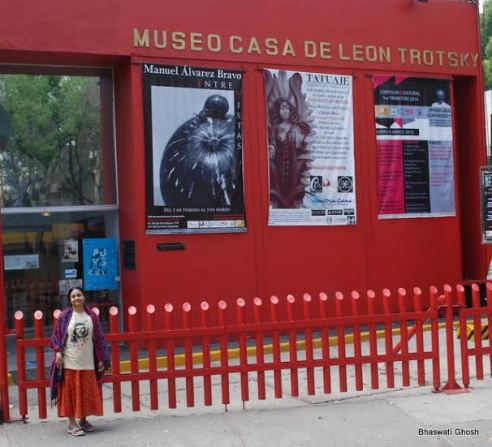
Only when we reach the gate do we realize our cabbie friend probably chose not to mention that the museum remains closed on Mondays. I’m too exhausted from the stomach bug but lurch on to follow my husband to Trotsky House, some six minutes away. Same luck there – a closed gate greets us. Having skipped breakfast, I’m as dizzy and disoriented as I’m disappointed at the wasted taxi ride. By now I’m so famished, I fear I might faint. We walk a few paces and notice a cafe and step inside. It’s a small place with no more than four tables. At one table, three ladies – all in their sixties — appear to be the only other customers.

One of them gets up and says to us, “Welcome, come on in. Please have a seat.”

As we make ourselves comfortable, she asks us what we would like to eat. “Tea, coffee?”

My husband glances at me and says, “Tea for you?”

I’m still a bit dizzy to respond, but the word, ‘tea’, stimulates me — this is the first time I’ve heard it uttered in a restaurant in Mexico City. I nod yes and manage to mutter, “And toast.”

“Tea and toast for you,” the lady says. “And for you?” she asks my husband.

“Cafe Americano,” he says.

His choice lights up her face. “Aha! Americano – that’s how we drink our coffee here!”

Even as black coffee forges that initial bond, the other two ladies convince my husband to have scrambled eggs with tomatoes and onions with black beans on the side – the Mexican way.

The lady who took our order moves to the kitchen to guide a young man managing the cooking. One of her two friends asks us where we are from.

“India,” my husband says and goes on to tell them how similar he finds India and Mexico to be, despite the two countries being situated on the opposite sides of the globe. The houses, markets, the trees and the people all remind us of home, we tell them.

The lady nods and says smilingly, “Yes, countries with beautiful people. Beautiful like women.” She winks at my husband and adds, “And like men, too.”

I notice some of my disappointment stemming from missing the museums is wearing off. The young man emerges from the kitchen with my tea. The bag of tea steeping in a cup of hot water is one I’m not familiar with but find refreshing, especially as I sip it with bites of the biscuit the ladies have shared with us – tasting exactly like Marie biscuits sold in India.

The motherly lady arrives with a plate containing my order. The two pieces of crisp, well-done toast, along with the black tea, are just what the doctor ordered for me.

She settles down with her friends as they ask us where all we’ve been so far.

“The Centro Historio (historical district), Zocalo, the National Palace to see Diego Rivera’s murals, La de Ciudadela – the artisan market…,” my husband rolls off.

The women suggest other places like the museums of popular art and anthropology.

We mention our plan to visit the Teotihuacan pyramids the next day.

“Oh yes, you must go there,” one of them says, adding, “be sure to keep your wallets safe, though.”

“Oh, we know that,” my husband says. “It’s the same way in India.”

“It is,” the lady who took our order confirms with a smile. She should know, for she visited India three years ago – Delhi and Rajasthan.

As we eat our breakfast, one of the ladies informs us the three of them are part of a tai-chi group. The maternal lady, who, by now we’ve figured out to be the cafe owner, happens to be their teacher.

“You have yin and yang,” says her chatty friend, pointing to my earrings.

“I do,” I say, pondering on the strange balances of the morning – the sickness and the comfort of the taxi ride, the closed museums and the restorative breakfast, missing Frida and getting acquainted with such an interesting sisterhood of Mexican women.
BG2

“And I have this, too,” I lift my shawl to reveal Che Guevara’s face on my t-shirt.

“I saw that,” our chatty friend responds, her face suddenly grim. “I don’t like him,” she mutters.

I pull my shawl back up immediately and say, “That’s why I’m hiding him.”

Her grin returns.

This is the first conversation, a real conversation we’ve had since coming to this city of lovely Hispanic people. And been fed breakfast in true home style, complete with the right balance of humour, hospitality and Mexican warmth.

As we get ready to take our leave, the tai-chi teacher says, “You have to return to Coyoacan. You can’t leave without meeting Frida.”

“We will,” we promise.

The third friend, the quietest of them all, stops us as we move towards the exit. She insists on giving us a ride in her car to the central spot in Coyoacan.

Photo-credit: Bhaswati Ghosh