Immigrant’s postcard (mini) – Four days in Québec City — Part 1

Read other Immigrant’s Postcards here.

Day 1:  The Sisters

DSC05665After a 10-12 km walking tour of the fortified city and along the river, we sit down on a bench at the foot of the majestic Château Frontenac hotel to catch our breath.A stream of people—mostly tourists, some office goers, a few elderly folks—pass us by.
A group of three Chinese women (sisters? friends?)—probably in their fifties—arrives. We can’t decipher their animated conversation. But two of them take their cameras out to photograph the third lady, who is only too happy to pose.

She stands next to a bench facing us, holding an arm up. “Hold on, I’m not done yet,” she seems to say to her friends while swiftly moving up the hill behind the bench. There, she takes her position, raising an arm and a leg even as she prods the other two women to click fast.

Passersby pause in their walk to take in this unique scene; some explode into laughter.

And although there is no sea in sight, all I’m reminded of is the comradeship of the widowed sisters-in-law in Tapan Sinha’s “Nirjan Saikate.”

Day 2: Pocket change 11707794_10153519566065087_1302432540971826171_o

Back from a lush and soothing ferry ride across the St. Lawrence River, we buy crepes from a mother-daughter stand at a local artisan fair. We walk into a park to consume the supper.

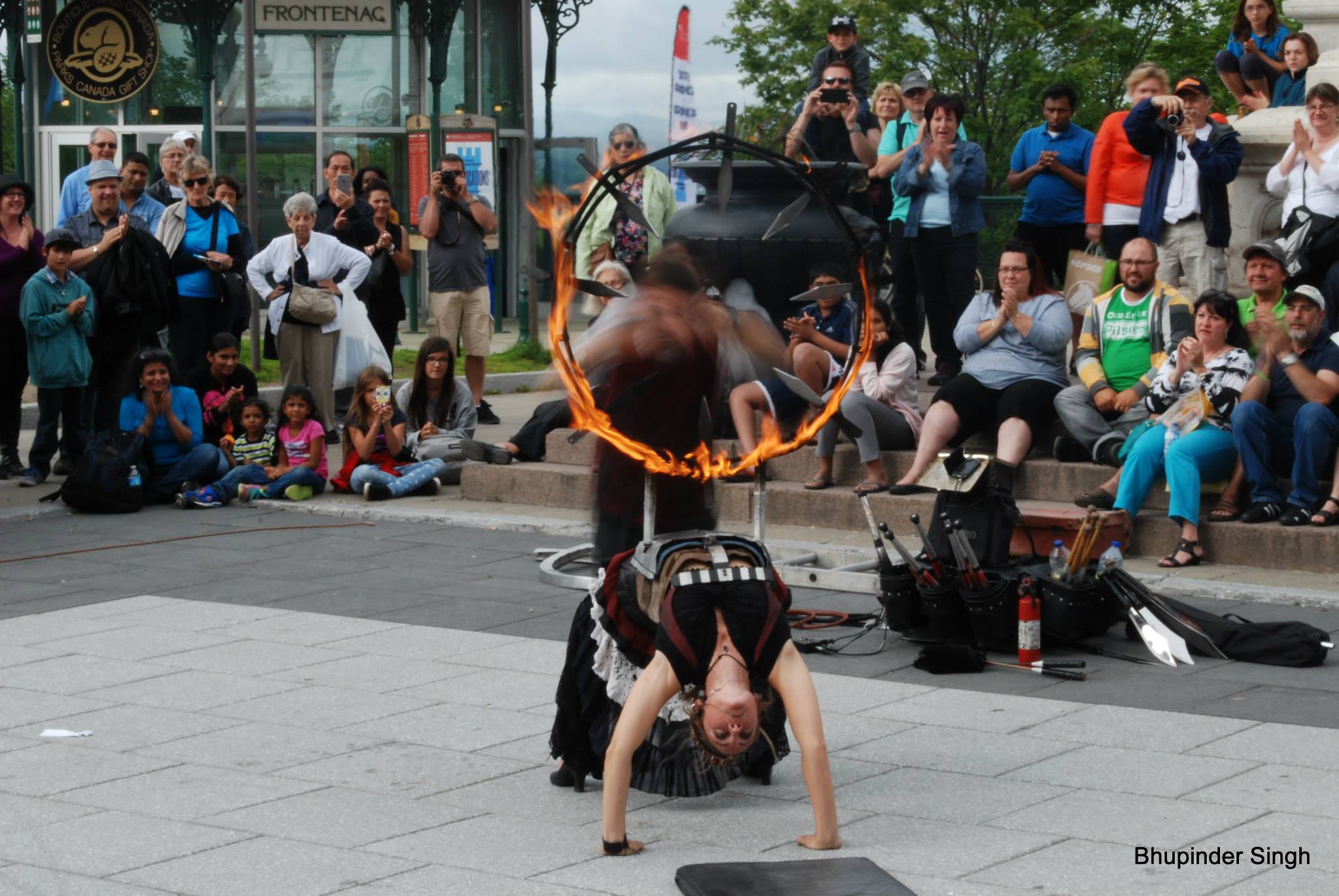
A couple of young musicians emerge to set up their arrangements even as snatches of a conversation between two members of the audience floats over to my ears. The man is telling his female partner/friend about the man-woman busker team we saw perform at the Château Frontenac square yesterday.

As with every street performance, the daring duo had requested the gaping, near-voyeuristic audience to make donations at the end of the show.

Our man in the park today talks about his chat with the male busker. “I asked him how much money do people actually put in your hat after the show?

“He told me most people put pocket change – the quarters, nickels and loonies. Very few – maybe one or two people – actually put five or ten dollar bills.

“And so that’s what you give after watching a 45-minute show in which the performers risk their lives. And right after that, you spend $200 on dinner.”

I can validate what he is saying. Yesterday, when I sheepishly carried two five-dollar bills to put in the buskers’ hat, I noticed those were the only non-coin currency items in the hat.

Suddenly, I don’t feel so bad about eating crepes clumsily in the park instead of dining at a fancy restaurant.

Read Part 2

Immigrant’s Postcard: The Game

Read other Immigrant’s Postcards here.

She is petite, her skin a burnished coffee tone. Ever smiling, this beautiful Ethiopian woman is a janitor and my friend. We chat about her weeknight chores and weekend plans. She tells me about her gang of girlfriends, the one that’s stuck together for 14 years, the one that meets every month for a potluck or a fun outing.

“No husbands or kids,” she tells me. The rules of the game are uncompromisingly clear. The women, all hardworking immigrants from Ethiopia, earn this–their day of leisure–and they wouldn’t let encumbrances of domesticity ruin it.

I point to her braided hair and request her to teach me how to do it. Not a problem she says, flashing her toothy smile.

The next time we run into each other, I find her extra animated .

“Did you see Survivor? On TV last night?” she asks me.

I nod in the negative. We don’t have cable, so I don’t get to watch that show.

“You know, there is an Indian girl in it. You’re from India, right?”

“Yes,” I nod.

“Oh my god–she is so good. She has a good strategy, she is smart…she knows how to get there. We are all wishing for her to win.”

I have no idea of the show she is talking about.

But I know she is right.

Survivor — that’s a game Indian girls of all ages play. A lot. With or without strategies. At home, on streets, in buses. And inside cars and university campuses.

Aranyalipi — Notes from refugee quarters, by Amiya Sen

[This is an extract from “Aranyalipi,” Amiya Sen’s nonfiction book-length account of refugees from East Pakistan who had been rehabilitated in Dandakaranya, a region that includes parts of Chhattisgarh, Orissa and Andhra Pradesh. The Dandakaranya Development Authority was created by the union government in 1958 to assist refugees from Pakistan. This excerpt appears in Muse India’s Literature of Refugees issue.]

Translated by Bhaswati Ghosh

Dear Su,

…I had no idea about DaAmiya Senndakaranya. After crossing a hundred and forty-five miles of hilly terrain between Mana camp and Raipur we reached Kondagaon–high above the plains. Yet, even at that point, I didn’t realize we were at the forest’s gate. This was the entrance to the heart of the Dandakaranya project. I had imagined the real Dandak forest lay deeper inside. This was a dense settlement of thousands of people–little Bengal, just like little Andaman.

Jogani astounded me. This was the first planned village as part of the project, about six or seven miles from Kondagaon. In July 1959, the village of Jogani was established with 88 families and a total population of 392.

Although we are now urban dwellers on a mass basis, the image of a village is well etched in our hearts. It is rare to find an individual who hasn’t seen a village or lived in one for at least some time. But what a village this was! A few drab-looking tin houses sat in an area cleared off the forest floor. No other human settlement was visible through the gaps of the scattered shaal trees lining the nearby area.

A few broken houses dotted the landscape. Many of those rehabilitated here with government aid had already left the village. Jogani’s land is sterile; it doesn’t cultivate any edible crop. I was told that only two or three families had been lucky enough to receive arable land. The rest of the land was left unclaimed at the time of my visit. Those who left the village didn’t do so without giving a fight to the infertile soil. Along with their menfolk, women too had taken up crowbars to rid the soil of shaal saplings and weeds. For days on end, many of them ate grass seeds to curb hunger. At last, helpless and defeated, they drifted off this settlement.

There is soil-testing laboratory in Jagdalpur, Madhya Pradesh. Apparently, all peasant refugees are allotted land only after the soil is tested in that lab. But Jogani tells a different story–it doesn’t seem like the soil of this village was ever tested. This could be the first step of an experiment with agriculture-reliant refugees.

Those who have stayed back in the village depend on jobs or labour. Take Jaladhar Sarkar, for instance. He came to India in 1954, from Bishwambhapur village in Srihatta district. After living in a camp for four years, he has been rehabilitated in Jogani with twenty-one bighas of land. He and his two sons support a family of six or seven by working as peons and construction workers. The land they received lies fallow and unused.

In 1960, a loom had been opened in Jogani. It still exists but has lost its sheen. Work goes on at an irregular pace. Whenever the products made there accumulate, there is a pause in the work of daily wagers.

Currently, the only employment generator around Jogani is Borgaon Industrial Centre, about four or five miles from the village. Men and women from Jogani walk every day to work there. Among them, the daily wagers are the most disadvantaged. The work, low-paying as it is, doesn’t come with the guarantee of being available all through the year.

It was a Monday. The village, if one could call this desert-like place that, looked totally deserted. Besides shaaland mahua trees, there was no sign of green anywhere. Not even a pumpkin or bottle gourd patch that one saw in Mana’s camps. Mana has water, it has canals and ponds. Here, tube wells exist. Had paddy or any other crop grown on the land, the villagers would have pumped out water to cultivate some vegetables. But where is the time for that now! Every morning they must run to Borgaon in search of work. If only that could fill their bellies! But then, it’s possible that that the soil here is indeed barren.

I met a few people–none of them evinced any joy on having received land and a house for free. Actually, they got the money for their houses as a loan, which they needed to pay off once they were settled. But what settlement and what pay-off? With no place to go, they continue to stay here, in spite of all hardship. But they are not un-enterprising. They toil hard to make sure their children receive education. They would take up any work that comes their way. But the opportunities are so limited.

The very first step of the Dandakaranya settlement left me disappointed. In comparison, I was pleased to see Bijapur as part of my present trip. This was situated in Bastar too, but as a transit camp, not a village. As of March 15, 1965, 67 families stayed there.

There were only two tube wells in the entire camp. But a spot of green welcomed one to every hut. Bottle gourd and pumpkin vines climbed up the roofs of huts. Mounds of mahua flowers were spread out to dry in front of several houses. These would be boiled to make jaggery. This settlement was forest-dependant too. But the dense cluster of huts and the camp’s consistent population had imbued it with a lively atmosphere. The camp dwellers effused optimism. They dreamed of ascending to a better life — of farmland, house, agricultural loan, and the victory roll of produce brushing against plough.

Life is at work, everywhere. Saplings pierce cracked walls to sprout. Flowers bloom on mountain tops. I have even seen fish germinating in the city’s makeshift drains.

I enter a hut and find a young mother carrying her infant on her lap. It’s her first born. The young father, though excited, is also a bit distressed. Nights in Bastar are still quite chilly. The child doesn’t have any warm clothing. In many homes, I saw just kanthas and pillows for bedding. No one has quilts or blankets. Almost all these people arrived in India following the 1964 riots in Pakistan.

In an instant, that cabinet stuffed with blankets in Mana flashed before my eyes.

I ask the refugees, “Didn’t you get any blankets?”

“No, didimoni,” say the men and women in unison. “We only got woks, enamel plates, a bucket and a few such things. These were given to us in Sealdah station. We didn’t get anything after coming here.”

“You all came here through Mana, right?”

“Yes, didimoni.”

The path to enter Dandakaranya is through Mana—the headquarters of all transit camps and work centres of the project.

According to government statistics, refugees over the age of eight are provided sixteen rupees or clothing worth that amount. The record doesn’t mention how many times this happens; possibly only once. The record also notes the distribution of blankets.

“Woollen blankets may be supplied at the rate of one blanket per adult, subject to a maximum of three per family.” [Estimates Committee, (B.C. No. 412) 1964-65]

The blankets were meant for last year’s riot victims. These refugees belong to the same category. Why didn’t they get the blankets then?

The dole money the refugees receive isn’t enough to cover even two square meals a day, let alone allow for clothes. But leave aside government funds and statistics; the stash I saw in Mana came mostly from donations meant for refugees. If those blankets don’t come to these unfortunate people, have they been filled in almirahs just for the purpose of being displayed to VIPs?

In Mana, expecting mothers received yet another benefit. When a baby was born, the mother and her child got a set of new clothes. The women of Jogani aren’t as fortunate.

A gentleman accompanying me said, “Don’t believe everything they say. These people here are no less sly; they might have sold off the blankets.”

I know it is easier being the devil than the lord. But looking at their faces, it appeared improbable that so many male and female devils had landed here from East Bengal.

For argument’s sake, even if one accepted the gentleman’s proposition, the question remains as to why these people sold off the blankets. One can discount those who have left the camp. But those who have stayed back know very well how indispensable blankets are during winters here. They are also aware that it is impossible for them to find any alternative sources of combating the cold weather. If knowing this, they still sold off the blankets, it follows they must have done so out of extreme penury.

The British robbed India to add riches to its empire. And we have robbed our own poor of food and shelter–in the name of freedom.

The Bulldozer (short story)

I was sleeping when suddenly it started banging inside my ears, and I jumped up on the bed. As I looked out of the window, I could see the egg-yolk sun in the sky. Just then, Ab came running up to me, grabbed my arm and took me outside. Everything was broken all around us—big chunks of stones and concrete. As I walked out with Ab, I saw Umm standing outside the door. She was crying. Then I saw the fat blue bulldozer walking away—the monster machine that always smashed the walls of our homes.
bulldozer-small
When I came inside, I couldn’t find Husna on the bed. I dug under the pillow and bed sheet to look for her, but she wasn’t there. When I looked around, I saw everything mixed up on the floor. The calendar, the wall clock, which was broken, my favourite flower vase with Umm’s beautiful flower painting, Ab’s books, his glasses—everything was on the floor. I looked for my doll, but couldn’t see Husna in the mess. The walls were cracked and pieces of them were lying in the mix too. 
Read the rest of the story in Warscapes magazine.

Snow and Coffee (Short story excerpt)

By Bhaswati Ghosh

An excerpt from a short story, published in the latest issue of Stealing Time (a literary magazine for parents), themed Relations. To read the full story, purchase the issue here.Snow CoffeeAs she hurried for her train, a blast of snow slapped her cheeks, reminding Aruna of when she had landed at Toronto’s Pearson International Airport for the first time. The frigidity had made her question her decision to come to Canada. It was too late, she had reminded herself.

When she landed in this haven for immigrants nine years ago, Aruna had been nervous. At their parting, her husband Raghu assured her, “It’s only a matter of a few months, maximum a year, Aru. I will be there after that.”

But those few months had multiplied into as many as it took to make nine years. Years that taught Aruna that time was as slippery as her husband’s promise to join her in Canada. Between trying to make a living and raising twelve-year-old Vishnu, she had aged by two decades instead of one. Looking at the mirror one day, Aruna tried to make sense of how it turned out to be like this—three lives that were supposed to make a family now fragmented like left-over noodle strands on a diner’s plate. Those early years they had spent together contained no suggestion of the later distancing. Her husband had seemed caring and involved, if excessively guided by his quest for a “good life.”

Now, snow and coffee — once alien to her– had become second nature to Aruna. And her good life had little to do with what her husband had imagined. She reflected on how time changes a person’s inner landscape in accordance with the outer one.

The train sped past white houses, streets, trees. Aruna planted her cheek, covered with the woolen scarf she’d wrapped around her neck, to the window. The thickly snow-decked walls that vanished and re-appeared on the horizon were home. She rubbed her glove-clad hands and sipped coffee from the paper cup that danced slightly to the train’s motion on a tray table in front of her.

Arriving in the province, she had felt confident of getting a job. Her many years as a lifestyle journalist in India couldn’t have been for nothing. So she consumed herself with the other variables—managing her son’s education, getting a health card made, securing a driver’s licence, and all the other minutia of moving to a new place.

But she rented a damp basement apartment and managed the other details with ease. Only the job eluded her.

In three weeks, the city had turned from an indifferent host into an unforgiving master. The city demanded labour from Aruna in order to grant her an extended stay. A conversation with her widowed landlady made the prospects look bleaker than the foggy winter mornings…

Reader’s reviews:

The story very well opens the eyes of ‘outsiders’ in India etc., who look longingly towards the West as a utopia, to its sordid reality. The life of the immigrant, the brutal self reliance it has to fall back on in an unknown land, is nicely stated. In a way the story shows how non self reliant we are in India with all our relatives ready to absorb the shocks of our life and to make it more tolerable; in this sense, it is to the essentially relations-bound Indian mind to which the story speaks. 
~ Prathap Kamath
Your story brings out both the struggle and the elation after a successful struggle very beautifully. At first, it is quite unbelievable why Aruna was putting up with Raghu. Couldn’t she just pack up and start life afresh? And then it dawned upon me that life wasn’t so easy. Breaking all ties isn’t easy at all. And this difficult life is what you have described so well in this story.
…Just the feeling that Canada is so far away from home – and Raghu, in India – and is so, so cold makes this entire struggle so sublime and so worth it. Congrats to you for making some kind of a comparative study between the bleakness of Canada’s climate and the bleakness within Aruna to more beautifully sketch her struggle.Another good thing about the story is its length. You haven’t wasted words and sentences.
~ Hansda Sowvendra Shekhar

Immigrant’s Postcard: Walking with Memory Shards

A series on my experiences as an immigrant to Canada

So we’ve been living in a new city for the last ten days. Last week, on my way back home from the indoor market (housing local farmers, butchers, bakers and dairy owners), I got lost–for the second time in three visits. Severely direction-challenged that I am, this isn’t new to me. A lot of times, I actually enjoy losing my way, only to find myself in an interesting part of the city. When this happened to me in London about three years ago, I remember having walked  into the area of Soho, where the evening seemed eager to graduate to  the tantalizing night ahead. I was in London for the first time and might not have visited Soho alone in a planned manner. Getting lost thus pushed me into an experience, which though unexpected, turned out to be memorably charming.

Back to last week’s loss-of-direction episode in my current city. When I finally realized my mental mapping skills were not taking me any closer to home, I sought a fellow-walker lady’s help. Thanks to her accurate directions, my feet quickly found solid ground and marched toward our apartment complex.

A couple of hundred meters from the apartment complex is a casual eatery with patio seating outside. As I passed the cafe, I heard an elderly gentleman asking a couple sitting in the patio for some help. I couldn’t hear well, but I heard him say, “My Alzheimer’s…” to which the gentleman sitting at the table on the patio said, “Well, you are still very much in London, sir.” By then I had moved farther. When I turned back, the lone, walking gentleman no longer stood next to the patio.

Even as I tried to make sense of the streets and intersections to reorient my geography, here was a man wandering with fractals of memory and no compass to rely on, wondering if he was still in the city where he started his walk.

It struck me then that we were in a city of the aging, with more visible services for the elderly than possibly any  other demographic group.

London, Ontario that is.

READ ALL IMMIGRANT’S POSTCARDS HERE

Ten-day Fast (Short Story)

By Harishankar Parsai

Translated by Bhaswati Ghosh

(Courtesy: http://bahatidhara.blogspot.com )

January 10

Today I told Bannu, “Look Bannu, the times are such that Parliament, laws, the constitution, judiciary—all have become useless. Big demands are getting met by threats of fasting and self-immolation. The democracy of twenty years has become so sick that the fates of fifty crore people are decided by the threat of one man going hungry or dying. I say the time is ripe for you too to sit on a fast for that woman.”

Bannu became thoughtful. For years, he has been after Radhika babu’s wife, Savitri. He even received thrashing once for trying to persuade her to elope. He can’t get her to divorce her husband because Savitri hates Bannu.

After some pondering he said, “But can one go on a fast for this?”

I said, “Right now, one can fast for anything. Just recently Baba Sankidas got a law enacted by fasting that makes it mandatory for every man to keep his hair knotted without ever washing it. All heads are reeking of stench. Yours is a small demand—just a woman.”

Surendra was there as well. He said, “Yaar, what are you saying! Fasting to snatch someone else’s wife? We should have some shame. People will laugh.”

I said, “Arre yaar, big-time fasting saints didn’t feel any shame. We are, after all, ordinary folks. As far as laughing is concerned, people all over the world have laughed so hard over the cow-saving movement that their stomachs are hurting now. No one is in a position to laugh for another ten years. Anyone who does will die of stomach ache.”

Bannu said, “Shall I find success?”

I said, “That depends on how you make the issue. If it’s made well, you will get the woman. Come, let’s go to the ‘expert’ to seek guidance. Baba Sankidas is a specialist. His practice is running well. These days, four people are fasting under his guidance.”

We went to Baba Sankidas. After listening to us he said, “All right. I can take up this issue. You just have to follow what I say. Can you threaten to immolate yourself?”

Bannu trembled. Said, “I am scared.”

“You don’t have to burn, dear. Just threaten to.”

“Even the idea scares me.”

Baba said, “Okay, then you go on a fast. We will make the ‘issue’.”

Bannu shook again. “I won’t die, would I?”

Baba said, “Smart players don’t die. They keep one eye on the medical report and the other on the mediator. You don’t worry. We will save you and also get you that woman.”

January 11

Today Bannu sat on a fast unto death. Incense and lamps are burning inside the tent. One party is singing a bhajan—‘May the lord grant good sense to all.’ The atmosphere has turned pious from the very first day. Baba Sankidas is an expert in this art. The statement he has got published and distributed on Bannu’s behalf is rather strong. In it, Bannu says, “My soul has awakened and proclaimed that it is incomplete. My other half lies in Savitri. Either conjoin both the soul parts and make them one or give me freedom from this body. I am fasting unto death for conjoining the two soul parts. My demand is that Savitri be made mine. If I don’t get her, I will free this soul part from my mortal body by fasting. I am fearless because I am on the side of truth. Victory to truth!”

Savitri came, full of rage. She asked Baba Sankidas, “This scoundrel is fasting for me, isn’t he?”

Baba said, “Dear lady, don’t use abusive language. He is on a sacred fast. He might have been a scoundrel earlier. Not anymore. He is fasting.”

Savitri said, “But he should have at least asked me. I spit on him.”

Baba calmly said, “Lady, you are only the ‘issue’. How can one ask the ‘issue’? The people who took part in the Cow-saving movement never asked the cow whether to have a movement or not to save it. Lady, you may go now. My advice is for you or your husband not to come here. In a day or two, public opinion will be formed, and the public won’t tolerate any insults from you.”

She went away, mumbling.

Bannu became sad. Baba assured him, “Don’t worry. Victory will be yours. Truth always wins in the end.”

Jaunary 13

Bannu easily gives in to hunger. Today, on just the third day of the fast, he began groaning. Bannu asked, “Has Jayaprakash Narayan come yet?”

I said, “He usually comes on the fifth or sixth day. That’s his norm. He has been informed.”

He asks, “What did Vinoba say on this issue?”

“Baba said, “He has resolved the issue of means and ends, but his words can be twisted a bit to use them in our favour.”

Bannu closed his eyes. Said, “Bhaiya, please get Jayaprakash babu quickly.”

Journalists also came today. They were wracking their brains.

They began asking, “What is the purpose of the fast? Is it in the public’s favour?”

Baba said, “Purpose isn’t the matter now. Right now, it is critical to save his life. Sitting on a fast is such a huge self-sacrifice that the purpose automatically becomes sacred.”

I said, “This will only serve the public. So many people want to grab the wives of other people, but don’t know how to. If this fast is successful, it will guide the public.”

January 14 

Bannu has become weaker. He is threatening to break the his fast. This will publicly humiliate us. Baba Sankidas reasoned with him.

Today, Baba executed another miracle. He has managed to get the views of a certain Swami Rasanand published  in newspapers. Swamiji claimed that observing religious austerities has granted him the power to look into anyone’s past and future. He has come to know that in his past life, Bannu was a saint called Vanmanus, and Savitri was his wife. He has assumed a human form after three thousand years. His relation with Savitri goes back to many eons. The fact that an ordinary man such as Radhika Prasad is keeping a saint’s wife in his house, amounts to blasphemy. He appealed to all god-fearing people to oppose this profanity.

This opinion has had a good effect. Some people were seen chanting slogans of “Victory to truth!” One crowd was sloganeering in front of Radhika babu’s house…

“Radhika Prasad is a sinner! Woe to the sinner! Victory to truth.”

Swamiji has organized prayers for saving Bannu’s life across temples.

January 15 

At night stones were pelted at Radhika babu’s house.

Public opinion has been formed.

Our agents have heard men and women and saying this…

“Poor thing has been hungry for five days.”

“Hats off to such devotion.”

“But it didn’t melt the heart of that hard woman.”

“Her husband is so shameless too.”

“I believe he was a saint in his past life.”

“Didn’t you read Swami Rasanand’s opinion?”

“It’s a sin to keep a saint’s wife in one’s home.”

Today, eleven married women carried out Bannu’s aarti.

Bannu was delighted. His heart leaps at the sight of married women.

The newspapers are filled with the news of the fast.

Today a crowd went to the Prime Minister’s house to demand his intervention and save Bannu’s life. The prime minister refused to meet the people.

We will see how long he refuses to meet.

Jayaprakash Narayan came in the evening. He was unhappy. Said, “How many lives must I save? Is this my job? Every day someone or the other sits on a fast and screams for their life to be saved. If he wants to save his life, why doesn’t he eat? Why do we need a mediator to save lives? The sacred weapon of fasting is being used to snatch someone else’s wife.”

We reasoned with him, “This issue is of a different nature. It was his soul’s cry.”

He calmed down. Said, “If it is the soul’s cry, I will take it up.”

I said, “Moreover, the feelings of scores of truth-loving people are associated with this.”

Jayaprakash babu agreed to mediate. He will first meet Savitri and her husband, then the prime minister.

Bannu kept looking at Jayaprakash babu pathetically.

Later we told him, “You, idiot, don’t look so worn down. If they sense your weakness, any leader will pour sweet lime juice down your throat. Don’t you see how many politicians are moving about with sweet limes in their shoulder bags?”

January 16

Jayaprakash babu’s mission has failed. Nobody is willing to listen. Prime Minister said, “Our sympathies are with Bannu, but we can’t do anything. Let him break his fast, then we can find a solution by engaging in peaceful talks.”

We were frustrated. But Baba Sankidas wasn’t. He said, “At first, everyone rejects the demands. This is the norm. Let’s make the movement stronger. We have to convey through newspapers that a lot of “acetone” is showing up in Bannu’s urine. That his condition is serious. We must publish views that ask for saving his life at all costs. Is the government just going to sit and watch? It must urgently take steps to save Bannu’s precious life.

Baba is an amazing man. He has so many tricks up his sleeve. He says, “The time has come to include the issue of caste in this movement. Bannu is a brahmin and Radhika Prasad a kayasth. Provoke brahmins and kayasths alike. A Brahmin Association minister is going to contest the next elections.

“Tell him this is his opportunity to get the collective votes of brahmins.”

Today a proposal came from Radhika Babu for Bannu to have a rakhi tied by Savitri.

We turned it down.

January 17 

Today’s newspaper headlines–

“Save Bannu’s Life!”

“Bannu’s Condition Serious!”

“Life-saving Prayers in Temples!”

In one of the newspapers we paid advertisement rates to publish this–

“Prayer of crores of truth-loving people—Save Bannu’s Life! Bannu’s death will have dire consequences!”

The view of the minister from Brahmin Association was also published. He has made this a matter of brahmin pride and has threatened direct action.

We have hired four goons for throwing stones at kayasth houses.

After dealing with that, the same people will throw stones at brahmin houses.

Bannu has paid them the advance.

Baba feels that by tomorrow or day after curfew should be imposed. At least imposing Article 144 is definitely in order. This will strengthen our “case.”

January 18 

Last night, stones were thrown at brahmin and kayasth residences.

This morning, a serious clash ensued between two separate brahmin and kayasth groups.

Article 144 has been clamped in the city.

The air is tense.

Our representative group met the prime minister. He said, “This will have legal hurdles. We would need to modify the marriage act.”

We said, “So please modify it.  Issue an ordinance. If Bannu dies, fire will erupt in the whole country.”

He said, “First you make him break the fast.”

We said, “The government must agree with his demand in principle and set up a committee that will show Bannu the way to acquire that woman.”

The government is monitoring the situation. Bannu must endure more pain.

The situation hasn’t changed. There’s a “deadlock” in the talks.

Minor conflicts are erupting.

Last night we got stones pelted at the local police station. This had a good impact.

Today, the “Save life” demand became more vociferous.

January 19 

Bannu has become very weak. He is scared he may not make it.

He has been muttering that we trapped him into this. If perchance he publicly airs his opinion, we will be “exposed.”

Something must urgently be done.  We have told him that if he now gives up his fast, the public will kill him.

The representative group will go for another meeting.

January 20 

“Deadlock.”

Only one bus could be burnt.

Bannu is still being difficult.

We are continuing to say on his behalf, “He will die, but not bend!”

The government looks worried.

The Ascetics Association has given its support to the demand today.

The Brahmin Society has given an ultimatum: Ten Brahmins will immolate themselves.

Savitri tried to commit suicide, but was saved.

There are long queues for Bannu’s darshan.

A senior UN official has been notified via telegram today.

Prayer meetings took place in different locations.

Dr. Lohia has said that as long as this government is in power, lawful demands will not be fulfilled. Bannu should abduct this government instead of Savitri.

January 21 

The government has accepted Bannu’s demand in principle.

A committee has been formed to resolve practical problems.

Amid bhajan and prayers, Baba Sankidas fed fruit juice to Bannu. The leaders’ sweet limes dried up in their shoulder bags. Baba said public sentiment must be respected in a democracy. The emotions of scores of people were linked to this issue. It is a good thing that the issue was peacefully resolved. Otherwise, a violent revolution would have flared up.

The brahmin legislative candidate has struck a deal to have Bannu participate in his campaign. He has paid a fat amount. Bannu’s price has gone up.

To the men and women touching his feet Bannu said, “All happened by God’s grace. I am only His medium.”

Slogans rent the air—Victory to Truth!