Of Martyrs, Marigolds and Mayhem (Book Review)

Of Martyrs and Marigolds

Aquila Ismail

Create Space

Available at: http://www.amazon.com/Martyrs-And-Marigolds-Aquila-Ismail/dp/1463694822

Sixty-five years ago, India was freed of two centuries of British rule. The freedom, however, came with massive human tragedy. The country was divided into what is present-day India and Pakistan, on the basis of religion. The Partition of India resulted in some of the heaviest bloodshed witnessed in the history of the subcontinent. More than 12 million people were displaced as a result of the division. Sadly, the bloodletting that started at the time of Partition did not die down with the passage of time. In the years and decades to follow, the monster of communal tension assumed numerous sinister faces across the subcontinent and continues to rear its head to this day.

One manifestation of this simmering tension was the 1971 war between India and Pakistan, triggered by the Liberation War–a conflict between the Pakistani army and East Pakistanis. The actual war lasted only 13 days, making it one of the shortest wars in history. But the events leading up to it had started long before, culminating in the formation of a new country called Bangladesh. These events and their consequences–tragic and irreversible–are at the core of Aquila Ismail’s debut novel, “Of Martyrs and Marigolds.”

The novel narrates the story of a young girl, Suri, and her family–Urdu-speaking Muslims who had moved to East Pakistan from India at the time of Partition. It is estimated that between 2,000,000 and 3,000,000 civilians were killed in Bangladesh, and as many as 400,000 women were raped by the Pakistani armed forces. The conflict led a further eight to ten million people from the erstwhile East Pakistan seek refuge in neighbouring India.

The story of Bangladesh is mired in geographical, ethnic and linguistic complexities. In the division of India and Pakistan, the latter got parts of Punjab and Bengal, separated from each other by more than a thousand miles. Language emerged as a major bone of contention, with the majority East Pakistani population demanding Bengali to be made an official language. The language resistance that saw students becoming martyrs forms the backdrop of “Of Martyrs and Marigolds” as the story of Suri’s love affair with Rumi, a Bengali Muslim boy, unfolds.

The narrative, through rich detailing, reveals the liberal outlook of Suri’s father, a civil servant in the Pakistani administration. All through, Suri’s family remains supportive of the legitimate democratic movements in East Pakistan and critical of the high-handed and arbitrary ways of the West Pakistan leadership, which eventually unleashes military action upon its own people in East Pakistan. Numerous novels and short stories have brought to light the horrors of the atrocities committed by the Pak army on Bengalis.

In March of 1971, the tables turned with the same army conceding defeat to the Indian army. Along with freedom to Bengalis in the form of the new country of Bangladesh, this also brought reprisals against non-Bengalis, many of whom were believed to have colluded with the Pakistani military. However, as is the sad fallout in any conflict involving two communities, a lot of innocent civilians bore the brunt of the backlash too. Suri’s family represents one of many such Urdu-speaking units that got caught in the crossfire and were rendered helpless and homeless overnight.

“Of Martyrs and Marigold” impresses with its flourish of imagery–the verdant landscape of East Bengal, its folk songs, and cuisines happily share the pages with the Western influences–English literature, baseball, the Beatles to name a few–in Suri’s life. Remarkable too is the sensitivity with which a delicate subject that continues to generate strong reactions among people within the Indian subcontinent and outside it has been handled. The author’s sincere narrative stays away from vitriol or any suggestion of hate mongering, relying instead on a helpless victim’s heartfelt questioning of her fate.

The descriptions of reprisals against Urdu-speaking East Pakistanis are vivid to almost a disturbing effect. As in most conflicts, women are the worst sufferers, as they face both ends of the sword–the wrath inflicted upon those being targeted and a further sexual violence in the form of rape and physical torture. Ismail depicts instances of such violence with chilling workmanship. A few chapters towards the end present these horrors with excruciating details that continue to haunt the reader long after the book has been put down.

Some of the dialogues in the novel sound stilted and the pace of action slows down in the middle. The multiplicity of characters sometimes makes it difficult for the reader to follow the storyline, but this gets easily overlooked by the overall force of the story. “Of Martyrs and Marigolds” definitely instills hope in the reader for more such moving tales from Aquila Ismail’s pen.

On Durga’s Migrant Trails

durga puja

Note: This personal essay appears in Cafe Dissensus

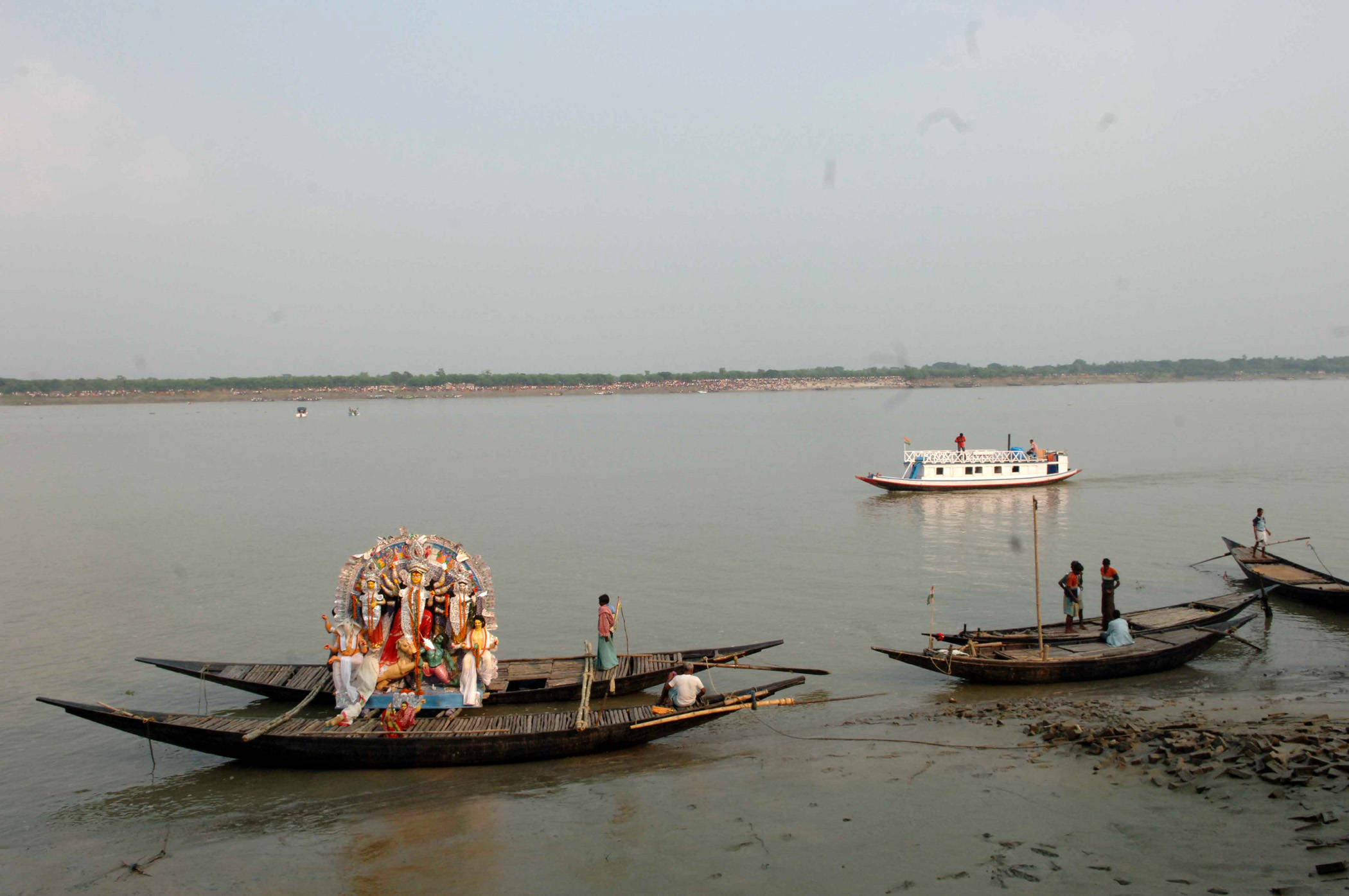
A group of children–between six to eight years in age–sat on a dusty rug on the ground with drawing sheets on boards before them. After drawing out scenes depicting one of the three theme choices provided to them, they furiously pushed crayons over the penciled sketches. My brother was one of the contestants of this on-the-spot- painting competition, interestingly called “boshey anko protijogita” in Bengali, literally meaning sit-and-draw contest. He drew a Christmas scene, having chosen the theme, “Your favourite festival.” A couple of hours later, when the results were out, he had real reason to celebrate– he had won the first prize.

There was nothing unusual about this except his choice of festival; the contest was part of a Durga puja celebration. Given that most of the festival entries depicted the ten-armed goddess and her rejoicing devotees and a few portrayed Diwali, which would approach in less than a month, the judges must have been either too brave or too liberal to adjudge a Christmas image as the best entry.

Was this because the venue of the puja and therefore the contest was outside mainland Bengal, in Delhi? I can’t really tell, for I was born and raised in what bonafide Bengalis call probaash–a sentiment-laced word for foreign land.

Photo source: Hinduism.about.com

The Crater Doesn’t Move: Flash Fiction

I’ve stopped sleeping in our bedroom. Without the blare of heavy metal booming out of Shankar’s room, slumber eludes me. I lie on the blue-green cot on the terrace, staring at the sky. Sleep is still absent.

I sit up and light a cigarette—my nemesis and redemption.

Fluffy mounds of cloud shroud the moon. As the cloud masses drift along the darkening horizon, the moon ambles with them. But this isn’t supposed to happen. Doesn’t the moon stay in one place while clouds sweep over it? If this is some strange celestial phenomenon, I will take it. Anything that defies reality.

My smoky mind joins the floating clouds.

Read/listen to the rest in Issue 3 of Open Road Review.

Immigrant’s Postcard: The Child is the Grandmother of the Woman

A series on my experiences as an immigrant in Canada

It’s the first day of swimming lessons for my husband and me. After the class, the instructor suggests we practice in a different lane. Apart from the two of us, a young Canadian girl and a gentleman from Pakistan join the practice. I am still practicing floating when a girl, snow white in complexion and no more than five years old, walks across the deck to stand near me.

“Is the water warm or cold?” she asks me.

“It’s not too cold,” I say.

She jumps in and squeals in delight, “It’s warm!” then jumps right out.

As we float, holding on to the deck wall for our dear lives, she asks me,

“Are you and him, Mom and Dad?” She points with her eyes to the Pakistani gentleman, floating in a corner away from the three of us.

“Me and who?” I ask her.

She points again to the Pakistani swimmer, saying, “This one.”

“No,” I say and draw her attention to my husband, floating right next to me, “Me and him are together.”

“Ah, so you are parents,” she says knowingly.

“No,” I simply say.

“So you are grownups.”

“Yes.”

“You are going to have a baby?”

“No.”

“You have a baby,” she says, rolling her eyes.

“No, I don’t.”

“I know you do.”

“No…”

“The baby got out. I know it did.”

With that, she walks away, casting one last all-knowing glance my way.

I beseech, “No!”

But to no avail. By now the little lady has already moved on.

READ ALL IMMIGRANT’S POSTCARDS HERE

Photo courtesy: http://vdleek.blogspot.ca/

Immigrant’s Postcard: A Prescription for Healing

A series on my experiences as an immigrant to Canada

It’s my first visit to the doctor’s office in my new city. The pain in my right leg is nagging to the point of being obstinate. Right at the entrance, next to the reception window, a sign says “If you are rude to my staff, I won’t see you today.” That’s not a very friendly doctor, I whisper to my husband, who is accompanying me to lend moral support. After the initial wait time (about 15 minutes), my name is called, and the clinic assistant checks my blood pressure, a routine exercise. Then begins the wait for the doctor. A good 20 minutes go by, until she knocks the room before entering it.

Image

After the initial pleasantries, the doctor asks me if I speak Hindi. I nod yes.

I tell her that my pain worsens upon standing on any hard surface for a while. She asks if I have to stand in the kitchen a lot.

“Yes,” I say.

“There’s a particular type of mat that has a cushioning effect. Place that in your kitchen,” she tells me, even suggesting the store from where to get it.

After writing a prescription for anti-inflammatory medication, the doctor returns to the thread she had left off with her reference to Hindi.

“Where in India are you from?” She asks.

“Delhi,” I say, hastening to add that my husband is a Sikh, from Punjab.

“We are from Lahore and speak only Punjabi at home.” She says, making it a point to let me know that the Punjabi she speaks is “very similar to what Sikhs speak.” That’s because she belongs to the jatt caste, one of the many who were converted to Islam, she informs.

She ends the (very friendly) conversation by recommending the cushioning mats again. “I too have this pain and always use the mats whenever I have a daawat at home and have to stand in the kitchen for long.”

It is technically India’s Independence Day. Two women from opposite sides of a land split into two in a cleaving that saw insane bloodshed share slices of history and culture over a medical visit.

And, they share insights on lessening pain.

READ ALL IMMIGRANT’S POSTCARDS HERE

Immigrant’s Postcard: Walking with Memory Shards

A series on my experiences as an immigrant to Canada

So we’ve been living in a new city for the last ten days. Last week, on my way back home from the indoor market (housing local farmers, butchers, bakers and dairy owners), I got lost–for the second time in three visits. Severely direction-challenged that I am, this isn’t new to me. A lot of times, I actually enjoy losing my way, only to find myself in an interesting part of the city. When this happened to me in London about three years ago, I remember having walked  into the area of Soho, where the evening seemed eager to graduate to  the tantalizing night ahead. I was in London for the first time and might not have visited Soho alone in a planned manner. Getting lost thus pushed me into an experience, which though unexpected, turned out to be memorably charming.

Back to last week’s loss-of-direction episode in my current city. When I finally realized my mental mapping skills were not taking me any closer to home, I sought a fellow-walker lady’s help. Thanks to her accurate directions, my feet quickly found solid ground and marched toward our apartment complex.

A couple of hundred meters from the apartment complex is a casual eatery with patio seating outside. As I passed the cafe, I heard an elderly gentleman asking a couple sitting in the patio for some help. I couldn’t hear well, but I heard him say, “My Alzheimer’s…” to which the gentleman sitting at the table on the patio said, “Well, you are still very much in London, sir.” By then I had moved farther. When I turned back, the lone, walking gentleman no longer stood next to the patio.

Even as I tried to make sense of the streets and intersections to reorient my geography, here was a man wandering with fractals of memory and no compass to rely on, wondering if he was still in the city where he started his walk.

It struck me then that we were in a city of the aging, with more visible services for the elderly than possibly any  other demographic group.

London, Ontario that is.

READ ALL IMMIGRANT’S POSTCARDS HERE

Anhey Ghorey Da Daan—Making the Unseen Visible

Anhey Ghorey Da Daan (Alms for the Blind Horse) isn’t a film you will watch every day. The language of the film, Punjabi, makes it an even bigger rarity. For a while now, the Hindi film industry in India, popularly known as Bollywood, has been projecting a certain version of Punjabi culture—gaudily-dressed bhangra dancers, songs laced with Punjabi phrases or dashing heroes–self-assured, upwardly mobile and often given to crass humour.

Based on a Gurdial Singh novel of the same name, Anhey Ghorey breaks that pattern with grating sharpness. Rarely, if ever, was a story told about the people who are not any of the above. About those marginal men and women whose very existence is of little meaning for those who keep these people in the fringes.  Here is a film encapsulating a day in the life of a Mazhabi Sikh family, who are ranked the lowest in the caste hierarchy. Yet encapsulation is probably an inadequate and even inaccurate word to describe this debut film of director Gurvinder Singh.

For Anhey Ghorey is not so much a tapestry, but a number of threads hanging down a wire, even as the breeze around them threatens to rip these threads apart. The film opens with the house of Dharma being bulldozed by a powerful landlord who has sold the land to an industry. The tremors of this demolition are felt by Dharma’s neighbours, including the family that is at the centre of the story. The male elders’ collective plea to the village head or sarpanch falls on deaf ears, as his gun-wielding henchmen step forward to show the poor villagers who the boss is.

Thereafter, the story moves to the town of Bhatinda, where Melu, the son of the family, is a rickshaw puller. Despite moving to the city, he finds the pasture no greener than in his village. He is still on the margins, working hard and long hours, but not earning enough to lead a life of dignity.

This part—the middle of the film—can be a challenge for the mainstream/conventional viewer, who expects a turn of events to unfold. Instead what appears is a documentary-like collage of staccato images, punctuated with dialogue exchanges between stray characters. The director’s emphasis on using ambient sounds—the thunderous rumble of an approaching train, the screeching halt of a bus, the shrill noise of metals being sharpened—to amplified effects, is deliberate. In place of harmony as created by music, these sounds strike as discordant notes—announcing, as it were, that something isn’t quite all right in the world.

The subtlety of the film is such that it penetrates the viewer’s psyche even without a hard-hitting linear storyline. The imagery, particularly the way the camera has been used to convey the sense of the story, is arresting. For me, the verdant fields seen through the just bulldozed walls of Dharma’s house, the mass of empty rickshaws on a day the rickshaw pullers call for a strike in the city, or the village women standing next to each other in the dark on the tense night when gunshots are heard on the streets were more telling than any spoken dialogue.

The film ends in sombre irony—even as Melu’s father proceeds at night towards the city to meet his son, Melu, having had enough of the city life, returns to his village. But it isn’t just the irony that makes the scene of the father’s departure memorable. As he decides to make the journey, he seeks his young daughter Dyalo’s opinion. Her silence makes the old man, noticeably sparse in speech and defeated  in silence, utter one of the most endearing dialogues of the film—“If you don’t want me to go, I will stay back.” A stoic Dyalo, however, urges him to go ahead and meet his son.

Upon his return to the village–swept in uneasy darkness–Melu sees his sister Dyalo, who has ventured out of the house, unable to hold her restive spirit. Suddenly, all those threads hanging precariously are brought together—if only momentarily.

Anhey Ghorey is in the league of the best of contemporary world cinema. Both the content and the aesthetics of the film set it apart from the slew of Punjabi or Punjabi-themed films coming out of India. It might not be an easy film to watch. But then neither is the story reality of families leading sub-human lives no one cares about, an easy one to come to terms with.

Read another review of the film here.

Guest Blog: Anandamayee Majumdar

Anandamayee Majumdar has been translating Rabindranath Tagore’s songs for a while now. Her translations are available on Gitabitan in English, where she and her friend, Rumela Sengupta, have transcreated more than 700 songs of Tagore so far.  Here Anandamayee shares the challenges and rewards of translating Tagore.

Translating Rabindrasangeet

I am deeply honoured and humbled by the fact that Bhaswati asked me to write something about translating Tagore songs, a topic she wanted to post in her own blog. Here I will describe the motivation and experiences that have been relevant to me in my work. I understand that this is nothing more than a personal experience.

Translation of Rabindranath’s songs is an arduous job, and often times a frustrating one. For one, those who are conversant in Bangla, know how difficult it is to educe similar resonance and melody (surely to be missing in a translation) of the song. It is hard enough to create the same aura of just the poem itself, let alone the rhythm or the melody. Therefore to the Tagore fan of Bengal, any transcreation can easily seem like a travesty.

I need to clarify that so far as records go, there have been two kinds of translations, serving two different purposes. Both are worthy of effort, in my opinion. One, in which the transcreator tries to weld the lyrical threads of the song into her work, creating a poetic essence of the song. The other kind of translation, is that which matches the beats and measures of the original poem. The aim of the latter, is to be able to read it, as well as sing to it.

I personally think, simply to be able to educe similar emotions as the original song can be tremendously difficult, with translated work. One can only try one’s best, and not be too complacent about it. Yet, the translator at some point finds her own wings. Nobody else can tell her what to do. Since similar to creation, transcreation too can become a work of art and ingenuity. Therefore, no two paths could be the same. And so, there could be different ways to transcreate the same song by two different people.

When I first came outside Bengal to the US, I was posed with a problem of sharing Rabindranath’s songs with my friends, who were not conversant in Bengali. I had to translate a few songs to my friends at University of Connecticut in 2001, so we could share them and sing them together. I found that these translations when shared, resonated with the English speaking community — specifically, with those that had spiritual awareness in their lives. Later I was also asked to translate some of Rabindranath’s famous operas, Chitrangada and Shaapmochon by a dance academy for their own performance. These were aimed at the participants and the audience, who were mostly non-conversant in Bangla. Later, I was quelling out my own stress of traveling long distances every week, by translating Tagore songs; also, I was determined not to let my long hours of travel turn out to be entirely futile.

The desire to organize and stockpile these translations, or transcreations as we call them, came from my friend Rumela Sengupta, my soul-mate and dear friend from college, who was also transcreating Tagore songs as a way to connect to her spiritual core. We shared a similar passion for Rabindranath and his songs, and had often hummed them together back in our youth. Rumela created a blog in 2009, that she named ‘Gitabitan in English’, at http://gitabitan-en.blogspot.com. An artist among other things, she brought into it a flair of her own. True to her spirit, she gave it the space and beauty it needed for making this a home cum pleasurable workplace for us, to funnel our emotions and creative passions, to heal our inner selves, to connect to others who loved Rabindranath, and to somehow reach out to those who needed him through our transcreations.

After this blog was born, the contributions became more motivated, and more regular. We began to choose songs to transcreate on a certain day, based on our needs and emotions of that day. Then again we also tried to be context sensitive, to be able to produce some work that would be seasonable and synchronous to the time of year or any concurrent collective occasion. This makes the work more relevant in some sense. We also tried to respond to the specific requests that were sometimes made of us, of transcreating certain lyrics.

We realized that others who had a chance to view the blog often left important comments, and that it would need a separate space of discussion. Rumela set up a discussion forum in Facebook, called Thoughts of Tagore where the transcreations were immediately posted. Friends Suman Dasgupta, Soumya Sankar Basu and Arindam Sengupta and others, often gave us razor-sharp and profound critique that we needed to craft these transcreations into the molds they would eventually become. Their feedback often times, honed the meaning, freshened the imagery, or bore out the essence with crispness. These individuals are our much coveted co-creators.

Since Rumela set up the blog, we have transcreated more than 700 songs. Since Rabindranath’s Gitabitan — his entire collection of songs, encompasses more than 2200 songs, we have a long way to go, to make the entire garden of songs available in English.

Whenever an urge to express arises, I seek one of his songs that seem to guide my emotions, my results of immediate soul-searching. This is all a very personal story to some extent. The good thing is, Tagore-songs import messages that are so universal, I need not bother that they have lost their aura in the present day. So the real challenge is to reach out through a contemporary, universally agreed upon diction, one that spans continents and cultures.

To put this into context of the work that is ‘out there’, we have read the works of many other translators to date, most noteworthy, maybe are Arnolde Bake, Khitish Roy, Ludwig Wittgenstein, William Radice, Ketaki Kushari Dyson, Amiya Chakravarty, and others. We have often been referred to their work, by the pundits we have asked for feedback along our way. We have read most of the existing work of these trendsetters with great passion.

I recently came across a US citizen named John Thorpe visiting Bangladesh, his work brings him to a culturally thriving milieu in the neighborhoods of Rajshahi University. In his fifties now, he has been translating Rabindrasangeet for fifteen years, his aim is to be able to sing them. He sings in both the original Bengali version and in his version of English, with a deep, majestic voice. I noticed his choice of words was quite fresh and contemporary. The fact that he tried to preserve the original cadence, did not cause havoc to the poetic essence. Fascinated by his efforts, I tried following this route on my own. I had previously been urged by quite a few individuals to try this out, but had refrained. I had not found the correct motivation at that point. But now, listening to John sing, it felt right. The path was frustrating, rewarding and effort-some at the same time. One may work on one or many more transcreations a day if this challenge of rhyming or singing to the transcreation, is not present. But with the challenge of allowing the rhythm to flow naturally just as the original, and to let the poetic essence exude just as well, the choice of expressions need such a lot of experimentation, that it often takes a while to finish the process. It is a frontier that is still fresh for me, and I feel both the butterflies and the exhilaration of an explorer.

I am aware of my own lacking conditions, and therefore, my passion for attaining a hold on English literature has grown over time. I confess that I am no English writer, or even a student of literature for that matter. Literary limitations do bother me a lot. I hold, therefore a great value for those specific constructive critique and comments that seem sincere and heartfelt, from the readers of this blog — they have molded my work. I also have been privileged to come across some enlightened writers (in English), who have a lovely command over the English language, and who I take to deeply, mainly because they write from the heart and have an effeminate style.

I believe that if we can let an inspiration wash over us, we can heal ourselves, and that could light up any creation. Without inspiration, without the flame that kindles our desire into action, anything that we do becomes dull. This has happened to many of my own transcreations. On the other hand, sometimes I just happen to sit down and start. This often results into a primary draft which does not appeal at all. But over time, that draft serves as the stepping stone, a skeleton of the work. By and by, I try to chisel out the extraneous, the unimportant, and preserve only the substance that feels right. Language itself is so fluid and magnetic. If one is not intrigued by its beauty, if it is not delectable, as well as spiritual, one can not create a worthy translation, because Rabindranath is both about profound spiritual beauty and consummate expression. As a transcreator, one has the obligation as well as the freedom to take the song (the poem and the melody together), and make it one’s own. It should not be a feeble attempt at making it available in another language, it should be borne out of one’s own heart.

I try to borrow idioms and ideas from everyday life sometimes. I do try and keep a mental note of new phrases, and idioms, and striking nuances of speech, that may come handy and could be used later for some future work.

Editing plays a major role in crafting out these transcreations. I usually edit a lot of times even after a post has appeared on the blog… until I feel that I have given it my best. Even then, it is good to come back to that post after a while, when you can read it as a third person, without attachment.

My interest is also an inherited one. I have had the exposure to Tagore’s songs since I was a child. The learning and practice of Tagore’s songs, poems and opera have been made natural for me by my family. My grandfather Subodh Majumdar was one of the first people in Bengal to self-teach Tagore songs, and to distribute them to his family and country. Renowned singers have taken their music lessons and inspirations from this unusually gifted man. In his thirties, he was making critical discussions on the notations of  Rabindrasangeet with the venerable notation-maker and musician (grandson of Tagore’s brother) Dinendranath Tagore in Santiniketan. Subodh Majumdar was also taking sitar lessons with maestro Ustaad Vilayat Khan at Sangeet Academy in Kolkata. At his own home in Khulna, he was teaching the sitar, Khol, Pakhwaj, violin, harmonium, tabla, flute and Esraj to his seven children.

Rabindrasangeet (among other songs) filled the breath of the house. My father Subrata Majumdar who was also extremely multifaceted,  had transcreated Tagore songs and poems in his twenties. Some of these got published in the family magazine. When I first came across these translated songs and poems, they read so well, I can still recall my elation at reading those soulful, crisp passages. My parents, my aunts also happen to be musicians and teachers in Tagore songs in their own rights. I am much indebted to my family, who have made Rabindranath my companion and friend, since I was a child. Therefore, transcreating Tagore was just one of the things that I can trace back to my family, like many other things.

For me, this is the story of how these transcreations came about, what I think about them, and what works for me. I think that pathway also describes the motivations and frustrations met along the way, for this work.
Immigrant’s Postcard: Maybe next time?

A series on my experiences as an immigrant to Canada

Summer has nearly preempted spring in Toronto, as the mercury keeps shooting past 20 degrees Celsius, breaking all kinds of records. From the time we arrived here (June last year), we have been warned and reassured in turns of the perilous winter that lay ahead and exactly which jacket and which brand of snow boots to get to beat the cold. Well, the winter seems to be behind us and not only the weather (hardly snowy, never perilous), but even my wardrobe has started mocking  me. So we went to buy some summer clothes.

At the departmental store, a Caucasian family of four–the parents and their two young boys–preceded me in the customer service line. As the father proceeded to make the payment for their purchases, the mother and the younger son, not more than three years old, hustled back to grab one more item. When all his items had been scanned, the father said to the counter lady, “Please wait a minute. There’s one more thing I’d like to get. But not if it’s too expensive.” The mother, with the toddler in her arms, hurried back. The little boy had a toy–a small stuffed monkey with a green back and an orange head–in his hands. As they reached the counter, the father handed the stuffed toy to the counter lady. She scanned it and turned the computer screen towards the father– “Twenty dollars.” The father was quiet for a few seconds, as if numbed by the price.

Shortly, mum and dad exchanged a few words in what seemed like some Eastern European language. By this time, the little boy, still in his mother’s arms, had grabbed the colourful monkey back. The father didn’t say anything to his son (nor did the mother); he just shook his head at the counter lady.

The customer service lady, evidently an Indian, looked at the golden-haired kid and said, “Maybe next time?” When he still didn’t look ready to part with his monkey, she gently took it from him, saying, “Here, let me scan it, so we can have it ready for you the next time?” The boy remained quiet, didn’t create any fuss, and the family left the store.

The counter lady’s gentle intervention in the tricky situation reminded me of a line my husband remembers from his childhood. Every time he asked for something that was out of his parents’ reach, they would cajole him, “Kal le denge, haan?” meaning, “We’ll buy this for you tomorrow.” It is the golden promise that makes “tomorrow” so coveted for children across generations.

Letting down a toddler must be hard for any parent. It’s perhaps a tad harder for immigrant parents who have come to a new country and a bleak economy.

READ ALL IMMIGRANT’S POSTCARDS HERE