Review of ‘Nostalgic for A Place Never Seen’ in East India Story

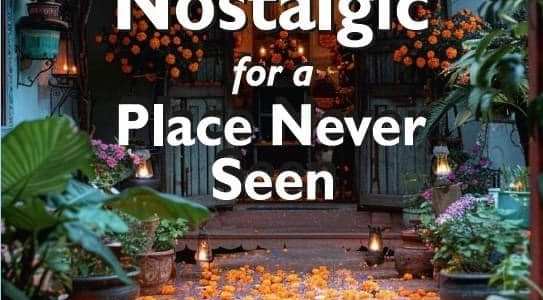
Gargi Kalita reviewed my debut poetry collection, NOSTALGIC FOR A PLACE NEVER SEEN in East India Story. Read the review:

Bhaswati Ghosh’s Nostalgic for a Place Never Seen is a debut poetry collection that maps the evocative terrain of belonging. It explores how home is a terrain of the mind, a pulse of longing bridging the intimate and the global. A review by Gargi Kalita.

Nostalgia is never merely a return to the past—it is a tender reimagining, a delicate reconstruction of moments and emotions that memory alone can no longer fully contain. Home, in this sense, is not merely a geographical fixity but a terrain of the mind, a pulse of longing that beats through time, language, and loss. It is within this evocative terrain that Bhaswati Ghosh situated her debut  poetry collection Nostalgic for a Place Never Seen ,a volume that reads like a cartography of belonging drawn from within the self and across shifting geographies. Ghosh, a bilingual writer and translator based in Canada,with roots in New Delhi, belongs to the  lineage of Indian diasporic poets whose work bridges the intimate with the historical, the local with the global.

Some places are etched not in geography, but in remembrance—borne across generations like heirlooms wrapped in stories, scents, and silence. Bhaswati Ghosh’s Nostalgic for a Place Never Seen traces an emotional landscape, where her grandmother’s lost Barisal finds a home in verse.This poetry collection, imbued with reflections on migration, memory, and identity, is organized into eight thematically rich sections— “Dwellings: Temporary and Permanent”, “Places, Faces, Traces”, “Scents, Tastes, Textures”, “Seasons of the Heart”, “Water, Earth, Air, Fire”, “The Humming Octave”, “The Wordsmiths”, and “Movements in and Out of Time”. Across 72 poems of the collection, Ghosh explores personal and historical landscapes of belonging shaped by displacement, capturing the tension between the fleeting and the lasting, and inviting readers to find home in language and memory.

At the heart of Nostalgic for a Place Never Seen is a poignant reflection on memory, identity, displacement, cultural inheritance, and longing that extends beyond personal history. Bhaswati Ghosh’s poetry weaves internal and external landscapes, capturing the emotional geography of diasporic consciousness—a yearning not just for a place, but for the sense of rootedness it once held.

The title poem, “Nostalgic for a Place Never Seen,” which lends its name to the collection, forms the emotional nucleus of the book. Drawing on Ghosh’s inherited memory of her grandmother’s forced migration from Barisal in East Bengal (now Bangladesh)  to post-Partition Delhi, it reflects the vivid presence of places never personally visited but deeply felt through intergenerational storytelling. This aligns with Marianne Hirsch’s concept of “postmemory”—the transmission of trauma and displacement across generations. Ghosh captures this poignantly in both “Nostalgic for a Place Never Seen” and “Native Dialect.”

In a video about Sugandha, I see a mother

combing her daughter’s hair. Before I know it,

the daughter turns into my grandma

and breaks into a song.

‘Why don’t you come anymore?’ she asks.

— Nostalgic for a Place Never Seen

When her little sister visited

and Grandma broke into their

Barisailya patois, I heard songs

of home in the words. Of boat

races and river markets. Of a

home I’d dreamt of in past

lives amid simulated

nostalgia.

— Native Dialect

In the opening section, Dwellings: Temporary and Permanent, poems like “Sleeping at My Mother’s House” and “Displaced Persons’ Colony” do not merely reconstruct domestic spaces; they evoke the invisible sediment of emotion—love, loss, security, fragility, displacement —that inhabits these spaces. These dwellings become mnemonic devices, where physical architecture merges with psychological and ancestral landscapes.

Likewise, in Places, Faces, Traces, the poet functions as a flaneuse of memory, fluidly moving through places like Lajpat Nagar, Buenos Aires, and Mukteshwar—each becoming a site of introspection and remembrance.These locations act less as physical sites and more as emotional landscapes, forming a metaphorical map. Ghosh suggests that memory is borderless, bound more to emotion than to nation, language, or place. The poems wrestle with the impermanence of space and the persistent search for anchorage amidst flux.

Perhaps the most evocative section of the book is Scents, Tastes, Textures, which serves as a visceral archive of cultural identity. In poems like “Cooking Hilsa” and “Cumin,” food becomes a tactile memory, carrying heritage on the tongue and in the body. These sensorial evocations act as gateways to lost homes and forgotten rituals, echoing Roland Barthes’s idea of the “grain” in language—where meaning is felt rather than just stated. For Ghosh, food is not merely sustenance; it is survival, nostalgia, and resistance. As she writes in “Cumin”:

Taste is the original rebel. It resists being caged in

 closed jars or steaming woks.

In the later sections—Seasons of the Heart and Movements In and Out of Time—Ghosh turns inward, tracing the subtle shifts of self and emotion. Poems like “Learning, Unlearning” and “Debts to Pay” reflect on growth and changing roles, offering a sense of becoming rather than just loss or nostalgia. Ghosh shows that belonging is fluid, woven through memory and choice, and this quiet evolution is captured in “Learning, Unlearning”, where she writes:

She learns to pause more on the

page. I unlearn the stiffness of knowing it all.

A central thread in the collection is Ghosh’s nuanced exploration of “home”—Is home a physical dwelling, a landscape of memory, a sound, a scent or even a fleeting feeling? Ghosh’s poems move through Delhi, ancestral villages, and diasporic spaces, revealing home as both grounding and elusive. Echoing Edward Said’s “imagined geographies,”as  she shows that places are shaped more by memory and feeling than by maps. The collection also explores identity and belonging from a female perspective, as Ghosh reclaims her grandmother’s story—giving voice and agency to women often sidelined in Partition narratives.

Stylistically, Ghosh’s poetry is defined by a quiet musicality that emerges not from ornamentation but from emotional authenticity. Yet, within this understated lyricism lies a deft command of literary craft—her metaphors, imagery, and structure deepen each poem’s emotional resonance. In “Fading Colour,” letters losing their hue become haunting emblems of histories dimmed by time and silence. In “Pickling Language,” the simple act of preserving becomes a vessel for memory and identity, where ancestral syntax ferments quietly in jars.

Ghosh’s lyrical minimalism resists excess, favouring the resonance of ordinary moments—stillness, observation, memory—each imbued with metaphorical richness. Subtle threads of Bengali and Hindustani lend her lines a textured intimacy, anchoring the diasporic experience in language. Eschewing nostalgia, she crafts verses of precision and clarity, conjuring cities like Delhi, Mexico City, and Buenos Aires not through maps, but through mood, rhythm, and metaphor. The result is poetry both introspective and worldly—rooted in the particular, yet open to the universal.

In an age where identity is continually redefined by movement and loss, Nostalgic for a Place Never Seen reminds us of the power of poetry to anchor us—to a language, a scent, a home, even if that home exists only in memory. Traversing continents and generations through everyday rituals and stories, Ghosh explores cultural heritage, displacement, and   belonging, evoking empathy and prompting reflection on our own ties to memory and place.

There are certain spaces the soul longs for—not merely to dwell in, but to truly belong. Amid the scattered rhythms of postmodernity, this yearning becomes a search for rootedness not in geography, but in presence—a place deeply felt, where one is the place, and the place is the self. And that is what Bhaswati Ghosh’s Nostalgic for a Place Never Seen ultimately embodies—making it a vital literary contribution to Indian English poetry, diasporic literature, and memory studies.

Book Details:

Interview in The Artisanal Writer

Sabyasachi Nag, Poetry Editor for The Artisanal Writer, a Canadian journal and literary arts collective exploring, inquiring and celebrating the craft and practice of writing, interviewed me. We discussed by debut poetry collection, NOSTALGIC FOR A PLACE NEVER SEEN (Copper Coin Publishing) and other aspects of my poetic journey.

Sabyasachi Nag (SN): Congratulations on your first poetry title? How did you arrive at the collection, did you conceive of it first and went about constructing the poems or did the poems coalesce at some point into the collection? How did you settle on the title? Could you tell us a bit more about the voice of the narrator? Is it intended as a singular narrator or many: one consistent voice or polyphony?

Bhaswati Ghosh (BG): The poems in Nostalgic for a Place Never Seen came about in a spontaneously serendipitous way. Until a few years ago, I was primarily a prose writer — dabbling mostly in creative non-fiction and the occasional short story. In August 2020, my debut novel, Victory Colony, 1950 was published.

In the spring of 2021, a friend who hosts a poetry-writing collective every April for the National Poetry Writing Month, invited me to join. This was at the peak of the COVID-19 pandemic — we were housebound — and true to the cliches associated with poetry and solitude, the moment lent itself well to self-reflection. I enjoyed writing poetry in a collective — we read and shared feedback on each other’s works. This not only provided me with creative stimulus, it also brought camaraderie and connection at a time when we were dealing with isolation, anxiety and tragedy on an epic scale.

This exercise of writing a poem daily for a month for three years gave me enough poems to think of a collection while also allowing me to hone my craft and learn from fellow poets. Eventually I could see certain patterns and themes in the poems. The book’s title derives from one of the poems in the collection bearing the same title.

I would hesitate to pin a singular voice to the poems in this collection. More than a narrator expressing them, I feel poems breathe with their own life force and the poet is more like a vehicle bringing them to the surface.

SN: Although the book is sectioned in seven parts: dwellings; faces; scents, tastes and textures; seasons; elements; music; words and movements – there is a thematic circularity as it starts with displacement and ends in displacement. Is that intentional? The title alludes to a place never seen – so obviously this is a book about places – but is that place a reconstruction or recollection – is it a real place or a place from mythology?

BG: It’s less intentional than it appears to be. Many of the poems in the collection were written using prompts from various sources. When bringing them together, it seemed like a good idea to segment the poems thematically to help readers move through the collection with ease. Think of these as signs along a hiking trail in a forest. As one reader noted in her review of the book, “Thankfully the book is divided into sections, giving context and guidance as the poet shares the universe of memories and impressions that her senses have gathered and her mind synthesized.”

Many of the poems in the book do deal with the idea of location — both temporal and figurative. This made the idea of being nostalgic for a place that’s not merely physical but encompasses more — histories, memories, dreams, longings — pertinent.

SN: The book is wonderfully peppered with non-English words (mainly Bengali, your mother tongue). Is it about getting the voice right? Could you talk a bit about your process guiding your syntactic choices in this collection? Are you guided by meaning, and is there a point where you stop translating words from the mother tongue? Or do you arrive at a poem with a certain sound construct that you then look for the language and settle on words that evoke that sound?

BG: When writing poetry, one works within certain frameworks — in terms of form and structure but also atmosphere and aesthetics. In doing so, I occasionally leaned on words from Bengali or Hindustani to evoke a particular sense of the local. I see these insertions as both geographical signposts and emotive sparks that flow into a poem. They carried a spirit all of their own and had to be left there.

It’s difficult to put a finger on what triggers such word choices — it could be the intonation or musical texture peculiar to a word or phrase, but it could also be a very specific and indelible memory associated with a word, its pre-history and the sensory response it generates — not only within the poet but also among those who might be familiar with that expression. As a reader, being part of a world that’s more interconnected than ever, these interventions make poetry even more exciting and attractive to me.

In his essay Bringing Foreign Language to the Poem, Eric Steinger writes, “As poets, I believe we should take advantage of our available resources. Doing so can make poems interesting, nuanced, authentic, and contribute to the poem’s/poet’s voice.” This resonates with how some of the music-themed poems in Nostalgic for…evolved, using terms from traditional North Indian classical music systems.

SN: Several poems revolve around central characters – the grandmother (there are almost 20 references), mother (approximately 25 references) and father (10 references)…how much of this collection is autobiographical?

BG: I think that of all genres, poetry is probably the most autobiographical, as if by default. Even when a poem itself is not derived from one’s life arc, it’s a distillation of the poet’s inquiry into the subject at hand. That said, a fair bit of Nostalgic for…is indeed autobiographical — it’s an exploration of places, relationships, displacement — the last of these is perhaps the most pronounced of all the themes in the collection, heightened even more by my experience as an immigrant in Canada, my home since for almost a decade and a half now. As I made this long-distance journey to North America from India following my marriage, I began to sense, for the first time, the loss my grandmother might have felt when she’d been uprooted from her home in East Bengal (now Bangladesh) at the time of India’s independence in 1947 when the country was divided into India and Pakistan. Her stories of displacement and the trauma that accompanies it were no longer abstract tales for me; they became real as I too began experiencing the twinges of separation from home (New Delhi in my case), my family and loved ones.

SN: The narrator alternates between participant, witness and celebrant – is this collection a spoken record and oral testimony a conversation with history or a response to a “place never seen” and hence a void?

BG: It’s all of these descriptors you refer to — I couldn’t have said it better. The poems were written at different points in time and in disparate geographical settings, which might explain the switch between the voices. Quite a few of them came to me during my travels to Latin America, a region that fascinates me endlessly. My visits to places such as Mexico City (Mexico), Havana (Cuba), Cartagena (Colombia) and Buenos Aires (Argentina) have uncannily filled me with a sense of homecoming, owing perhaps to, the tropical climate, general chaos, and a profusion of colour, music and bustle of these places.

Then there are poems (Native Dialect, Nostalgic for a Place Never Seen, Milking Green Blessings) that relate to my grandmother’s loss of her homeland to the tragic event of India’s Partition I mentioned earlier.

The poems on music are deeply personal reflections of my responses to particular ragas (a melodic framework for composition, consisting of a specific set of notes and associated with certain emotions, times of day, or seasons).

There are poems on sensory delights such as food or scents, textures and sounds. In all of these explorations, the underlying quest is that of finding home as an antidote to the various types of voids I might be experiencing or holding within.

SN: How do you think the work responds to the questions it raises in the context of the timeand place the work is situated in?

BG: A lot of the poems in the collection relate to physical spaces — dwellings, markets, villages, cities, hills — straddling between continents, atmospheres, cultures and time periods. They raise questions like whether dislocating from one place and relocating to another can really be permanent, except maybe in material terms. The collection contemplates on city life with all its paradoxical oddities and inexplicable pulls. It wrestles with the manner in which the demands of the here and now contend with the salve and cushion of memory. It unlatches the many dimensions of love and takes in with curiosity its lessons for the soul. It observes movement and seeks to inhabit the in-betweenness of journeys.

As an example, I wrote the poem, Sunset on the Malecón, after returning from a visit to Havana, Cuba in 2017. This was a city that held a lot of fascination for me, given the history of the Cuban Revolution, the tiny island’s resistance to US imperialism, its association with the former Soviet Union, the lionized personas of Fidel Castro and Che Guevara. My stay in Havana in a post Soviet world, however, left me with more questions than answers. I found it a city in a time warp — unable to discard the past and yet desperate to step out of it in some ways.

Cars, once shiny, wrecks now, tire the streets.
On balconies, old men mask sighs with
cigarette smoke and loud confabs.
The morning that arrived many suns
ago ducked out like friends whose
empires collapsed overnight.


(From Sunset on the Malecón)

SN: Did you have an intended audience for the book?

BG: I didn’t have any audience in mind when writing the poems — that process is deeply personal for me. When I compiled the poems for preparing the manuscript, my hope was that the collection would find readers who can join the journeys — external and internal — the poems voyage along. There’s great satisfaction in hearing from reader friends about how a poem from the book took them back to their grandparents or reminded them of the various addresses they’ve lived at. So to answer the question, instead of aiming to reach particular audiences, I tried to put my faith in the book finding its own reader tribe.

SN: In pushing your work beyond your first title what were you most conscious of? What were/are you trying to achieve with this book in terms of your literary career?

BG: As I mentioned in a previous answer, this book happened in the most unexpected of ways — I had no expectations from it beyond that the poems within would touch those who read them. Writing can be a contradictory practice — at once allowing one to engage with and yet also disconnect from the busy, sad and often horrific world we find ourselves in. I’m ambivalent about the word “career” as a definition for any work, but literary work in particular. Like the travels through the places in Nostalgic for a Place Never Seen, writing, for me, is a road trip — staying open and curious through the drive and pausing at pit stops to rest and reflect.

SN: What was the most satisfying aspect about writing this book (other than perhaps thesatisfaction of finishing it)?

BG: The best part about writing the poems for this collection was the freedom to write them without knowing they could end up between the covers of a book. Participating in National Poetry Writing Month in April for the past four years has meant an entire month of writing poetry every day — and while that seemed daunting in the beginning, I was surprised to see how quickly that nervousness transmuted into joy and creative learning.

Writing with other poets was a bigger treat as it exposed me to a diversity of voices and styles while allowing me to find my own. Another element that made writing poetry immensely satisfying was the thrill of the unknown. A poem often begins with a kernel and not as a fully fleshed-out edifice. It  can be quite an adventure to see how it emerges bit by bit and the point at which it’s deemed complete. This mystical element makes poetry very dear to me — both the reading and writing of it.

SN: How would you like this book to be taught – as a historical document, socio-political document or as a document about a certain kind of taste in writing or particular aesthetic, genre, literary style or something else?

BG: I see Nostalgic for a Place Never Seen as a synthesis of all those elements — it has family stories that bounce off the history of the Indian sub-continent, the politics of forced migration intersecting with urban anxieties, and an immigrant’s uneasy existence in parallel universes.

In the collection, I’ve also attempted to cross linguistic barriers with the hope that the poems are fluid enough for readers to enjoy them while partaking of certain flavours that might be unfamiliar at first. What’s exciting about having a book out in the world is the many meanings it then reveals. If this collection is ever used for teaching, I’d like it to make all those meanings available and perhaps be in conversation with each other.

Review of NOSTALGIC FOR A PLACE NEVER SEEN in Cha

Read this review of NOSTALGIC FOR A PLACE NEVER SEEN by Sayan Aich in Cha: An Asian Journal

Nostalgia is humanity’s Janus-faced companion—simultaneously looking back and forward, with someone or something perpetually tugging at us from behind. Yielding to it is not a mere indulgence but, at times, a necessity—offering the wisdom to understand who we are, shaped by the “roots” and “routes” that define our journeys. In a world increasingly fraught with conflict and displacement, it is only natural that narratives exploring these two R’s—roots and routes—should continue to emerge. For the people of the Indian subcontinent, whose shared and traumatic histories of Partition and the Bangladesh Liberation War remain deeply embedded in cultural memory, nostalgia serves as both a fertile and essential motif in the collective psyche and fiction. Stories born from survival and resettlement must be preserved and passed down to new generations of readers and listeners, lest they be erased by the official historiography of the nation. Since time immemorial, the world has progressed and endured through storytelling—the foundational thread of every community, woven through acts of telling and retelling across generations.

Bhaswati Ghosh’s debut poetry collection, Nostalgic for a Place Never Seen, encapsulates all of this—and more. Having grown up in New Delhi and now residing in Canada, Ghosh traverses and inhabits multiple worlds—the cities of her childhood and adulthood, the towns she has visited in her travels, and the villages she has never set foot in but knows intimately through the vivid recollections of her grandmother’s storytelling. In her poetry, time and space coalesce, overlap, and blur, mirroring the way memory itself operates—fluid, unpredictable, and untethered to rules or chronology. The past and the imagined intertwine, shaping a landscape where nostalgia is not merely a longing for what was, but for what could have been.

Read the rest in Cha: An Asian Journal

How I became Nostalgic for a Place (I’d) Never Seen (My debut poetry collection)

I wrote a book of poems.

It’s been a while since I’ve posted anything here, and it’s taken me a while to write this post. The sharp chill of winter. Work-life imbalance. Laziness. Procrastination. You get the drift.

Nostalgic for a Place Never Seen, my debut poetry collection, came out in November last year from Copper Coin Publishing.

I’ve been writing poetry on a regular basis for only the last four years, so having this collection fills me with both wonder and gratitude. Wonder because of the serendipitous manner in which stray poems flocked together to build a nest. Gratitude for how that nest found its tree — the publisher.

Nostalgic for a Place Never Seen

Nostalgic for a Place Never Seen traverses multiple geographies — temporal and metaphysical. Divided into eight sections: Dwellings — Temporary and Permanent; Places, Faces, Traces; Scents, Tastes, Textures; Seasons of the Heart; Water, Earth, Air, Fire; The Humming Octave; The Wordsmiths; and Movements in and out of Time — the poems in this collection ponder on themes such as migration and displacement, finding home, food, textiles, music, love and nature.

Read a selection of the poems in Scroll.

And in Usawa.

Read a review in The Tribune.

Here it is on Goodreads.

I hope you’ll give this book a read. If you’re in India, you’ll find the book in store (and online) at Midland Books, Full Circle, and Bahrisons.

If you wanted to buy it online, you could do so from:

Copper Coin Publishing (India and international)

Amazon.com

Amazon.in (India)

Flipkart (India)

From the book’s back cover:


Thank you so much. I can’t wait to hear your thoughts about the poems.


Fatima’s Fish and Rice (short story)

First published in hākārā

As she spread it over Dharala’s breast, heaving and restless, each fold of the meshed fibre courted a brisk movement of Fatima’s limbs. For maximum catch. The cast net yielded more readily to her commands now. The river had become just as adept at catching her secrets. There was only so much you could hide over a three-year relationship.

Taming the net hadn’t been easy for Fatima. In those initial months, after the truck crushed Masud’s hand, her rickety frame could barely grab the massive net without skidding into the river’s swampy edge. For almost a year, between hospital visits and the battle to ensure Masud didn’t sleep on an empty stomach, Fatima had experienced little luck honing her fishing skills. With a bed-ridden Masud, the couple lived almost entirely on the greens that Fatima foraged during her failed fishing expeditions. Rafiq brought them geri-gugli and chuno maachh every now and then, for which he refused even a hint of payment. Periwinkles and small fish weren’t items he would sell to Masud, a neighbour and his fishing partner, until only recently. Masud’s unforeseen disability saw Rafiq and Tarannum turn into the parents Masud and Fatima had lost a few years ago.

Fatima dragged the net out of the river’s bosom. With her feet submerged in Dharala’s anchoring grip, she shuddered as the memory of the days after Masud’s accident came rushing back to her. Days that had felt chilly even in the burning joishthho heat. She had barely recovered from the loss of the child in her womb when the truck hit Masud. Her unborn child still jolted her out of sleep at night. Clumps of sweat embossed her face every time she struggled to imagine what the baby’s face would look like if it were born. She would find herself gagging and in need of a sip of water to be able to breathe again.

She would be a day person, Fatima had decided over these three years. Nights were never kind to her. Night, the skinny ghost, an owl’s hoot. It echoed with the sound of whispering laughter and then of footsteps, making the darkness even more viscous. It carried the trapping scent of hasnuhana floating from somewhere nearby. And of the memory of hands rubbing her shoulder and grabbing at her breasts before she could make sense of it all … Nights were irreconcilable for Fatima, like the slick of fish oil that refused to be washed off. She never said a word to him, but Masud smelled the fear on her skin. He forbade her from going out after sunset.

For months that added up to almost a year, Fatima could barely replace a fraction of Masud’s income – by planting paddy on other people’s farms during the sowing season and then winnowing it for well-off families, selling a handful of eggs from the two chickens she reared, and cleaning the houses of neighbours for weddings and Eid celebrations. That and the generosity of Rafiq and Tarannum helped them survive, even if it meant Fatima had to practically give up rice herself and eat jowar flour boiled in water and mixed with some greens instead. The scent of steaming rice, which she now cooked exclusively for Masud, made her crave it more than ever before. She trained herself to restrain this instinct by rolling the end of her sari into a ball and covering her nose the moment the rice grains began bubbling in the water.

On some days, before returning home from the odd jobs she’d taken up, Fatima sauntered off, tired and heavy, to Rafiq’s house for a break. And for a mission. Tarannum was teaching her how to use a cast net. They worked with a net that Rafiq had discarded after it wore out in more than a few places. Tarannum showed Fatima how the best results were achieved by knowing when to let go and when to rein it in. You had to allow the rope to slip through your hand so the net could smoothly hit the bottom, and then as soon as it did, you needed to get a good grip on the rope and pull it right back up, lest the catch escaped. Seeing Fatima’s interest, Tarannum mended the net bit by bit and the two women began fishing, at first in the pond adjoining their house and then in Dharala. That’s when Fatima began sharing her secrets with the river. On most days, they got a decent enough catch of assorted fish. The women would split the haul, but not before releasing the small fish they caught into the river.

It seemed funny to Fatima how she and Tarannum had become fishing partners, the same way Masud and Rafiq had once been. The previous Eid, Rafiq had combined three decades’ worth of his savings with a particularly large remittance from his older son, a construction worker in Dubai, to buy a second-hand boat. For Masud, who was many river lengths away from getting his own boat, Rafiq’s new acquisition came as a blessing. He no longer had to pay rent for using another man’s boat, and Fatima and he began enjoying more fish-and-rice days.

Masud planned to combine a few months’ savings to put up a new roof. The constant leakage during the monsoons made Fatima ill every year. Now that she was expecting, he couldn’t let his baby arrive under a dripping roof.

Good fortune has a special allergy for poor people, Fatima would infer soon. The truck got Masud’s right – his dominant – hand and the money saved for the roof went towards his treatment. Then, Fatima lost the child.

‘Who gave you the fish?’ Fatima didn’t miss the hiss in Masud’s voice.

‘Tarannum apu. They’re having guests today, she had some extra,’ Fatima said, hastening to change. A second more and Masud would definitely spot the streak of mud lining the base of her sari. He would spot the river on her.

‘Hmm,’ Masud said and turned over in bed. Lately, even the smallest of pricks bristled him.

Read the rest in hākārā

Art by Piu Mahapatra

Recovering Lost Threads — The Art of Long Conversations

First published in Parcham

I am in Delhi, where without an air conditioner, the house feels like an oven set to a constant, trapping heat and the outside feels like a sweeping field of fire. I came here, in my home city in April 2022, after a gap of three years and three months. It’s an April that feels like June, the peak of Delhi summers. After recovering from jet lag, a trip to the Himalayas and meals with relatives, I step out — braving the 46C furnace, to sit down with a few folks and listen. These interview-conversations are for gathering information for my current work-in-progress — a book on Delhi. But they are a lot more than that.

As I sat down in the drawing rooms of my interviewees’ houses, I noticed something other than their generosity of time. I discovered the comfort, now fast disappearing, of long conversations. Back in my childhood, this was a real thing. The very mention of a relative coming to visit and stay with us from cities like Jamshedpur or Kolkata, put us into dizzy anticipation — of dhaala bichhanas, makeshift floor beds and goppo, a colloquialism for golpo or stories that rolled into the night and continued until the wee hours of morning. This — the unplanned chat hours — were the most delicious part of a relative’s visit. While few of these addas — informal chat sessions — pertained to issues of global significance, they were always about reliving, and sometimes even re-imagining, lost times. We were fortunate to have the gift of unadulterated time back then — time that hadn’t been polluted by the eye’s addiction to screens, time that didn’t require us to update the world with our social or gastronomic status, time that didn’t make us feel guilty about spending hours simply lying on the floor and chatting.

Read the rest in Parcham
Photo by Andreea Ch on Pexels.com

My Literary Wanderings ~ arriving at life’s crossroads, with both pain and joy!

A new column about literary journeys I will be curating in Saaranga. This inaugural post starts with my own story.

At seven — an age when writing only means filling the school homework notebook with the dreary repetition of my handwriting — the joy of reading arrives at my door. It’s a hot morning of my summer vacations in New Delhi, and like on most such mornings, I’m preoccupied with some or the other holiday homework — tasks designed to keep children in line and make them more tolerable to their family members for two long and sultry months. A postman knocks on our gate holding that rare item — a parcel — that lights up our faces with barely- concealed smiles. As my grandmother emerges from the kitchen and opens the package with her turmeric-stained fingers, out come the precious contents — a book of Bengali chhawra or rhyming verses and illustrated Ramayana and Mahabharata for children in Bengali — books she had ordered for me through relatives in Calcutta. The fun of words rolling into limericks and nonsense verse as you uttered them, of reading stories you didn’t have to write an exam for, of letting your mind fill with imagination what the words in the books left out — these must have been the initiation for me on the road to being a literary pilgrim.  

*

The year I move on to middle school, I decide to switch schools. I’m glad I do, because in grade six, I find the teacher who would influence me the most in my life. Abha Das, a petite woman who wears crisp cotton saris and glasses on her small but penetrating eyes, doesn’t merely give lectures on the stories in our English textbook. She makes each one of the stories, which she takes days to finish, a riveting experience — at once an education in the craft of storytelling and reading with empathy and understanding. As she gives a lecture on E. R. Braithwaite’s To Sir with Love, she asks us to look back and think of the times we felt belittled because of our identity. By doing this — throwing us headlong at our vulnerabilities — she dissolves the distance between the narrator and us. Relating to the characters we read about in fiction in such a visceral way would help make me be a better reader even before I show any promise of being a writer. One morning, I would find the teacher waiting at the end of our morning assembly line. She’s there to thank me for a birthday card I’d left on her desk in the staffroom with a poem titled To Ma’am with Love. Her teaching would turn my joy of reading into a deeper love for words. I would now notice their intonation, their music, and recognize their inherent power to breed both love and violence. 

*

Even as Abha Ma’am enthralls us in school, at home, too, another petite woman — Amiya Sen, my grandma — remains a force I can’t ignore. She’s a grandmother like every other, doting and endlessly patient, yet she’s more. I see her go to work at an office when no other friend’s grandmother does. She stitches the best frock dresses for me every Durga Pua and knits me sweaters with the most exquisite patterns every winter. She reads — books, newspapers, magazines, my school textbooks, packets made from old newspapers — like there’s no tomorrow. And she writes. She writes after returning from work, she writes in between cooking meals, she writes after running errands, she writes late into the night after everyone has fallen asleep, she writes the first thing in the morning before anyone wakes up. She has no writing desk to fulfill this fetish; I only see her writing on the floor where she sprawls on her stomach to lie on a straw mat, her arms resting on a pillow. She would be my first example of what a full-time writer truly means — not someone who has no job and earns their living through writing, but someone who steals and grabs every millisecond of available time to write while carrying out the seven thousand and nine other responsibilities that eat into her writing time. At thirteen, I write my first short story in Bangla and show it to her with nervousness. With a warm hug of approval, she encourages me to write more. Two years later, before I’m able to grasp the full scope of her writing artistry, she leaves the world. And she leaves me clueless about fighting loneliness, about living with the scary beast of loneliness. 

*

Three decades go by. I am far removed from the house I grew up in, the one that my writer grandmother built with her life’s savings and dreams. I now live with my husband in Canada where it’s cold for more than half a year. In the thirty years since my grandmother passed away and I passed out of school where Abha Ma’am taught me, I’ve carried more than luggage. I have lugged Grandma’s stories — literally and figuratively. I have with me a bunch of short stories she wrote longhand, to type out and prepare for possible publication. But I also have the stories she told me as I grew up — stories of her childhood back in undivided India, of her life as a young bride, of her coming to Delhi and learning the English alphabet from her children, of the heartbreaking and unrelenting tragedies she’d had to endure in her life, of the unceasing pain of being displaced from her desh, the native soil of East Bengal that she’d been estranged from with India’s division in 1947. Somewhere along the way, all of these make a story grow inside me, and I end up writing a novel. When Victory Colony, 1950, my first book of fiction is published, I feel happy, relieved and sad at once. Like every new author, I’m elated to finally see my story out there in the world. Yet somewhere inside, it hurts me to realize that the one person I would have liked to read it isn’t there. 

A year after the book is published, I have a dream featuring my grandmother. She is lively and as engaged with current events as she always had been, and I feel anxious anticipating her reaction to my novel. When I wake up, a bittersweet sensation tugs at my throat. I feel relief and yet I also feel an ache. 

Perhaps that is what our literary wanderings are about — arriving at life’s crossroads, with both pain and joy staring at us. It is my pleasure to welcome you all to Saaranga’s new column on these journeys with authors — I hope you’ll indulge us and enjoy taking in the songs, dramas and scenes that forge our writerly paths. 

Homes and the World

My personal essay, Homes and the World, first published in Literary Shanghai.

Photo by cottonbro on Pexels.com

From womb to the world, I bring emergencies in my wake.

  1. LAJPAT NAGAR

Ten days after I’m born, democracy in my country gets turned on its head; constitutional rights are left meaningless for all practical purposes. The Indian government has just declared a state of Emergency. While I have no memory from that time, people who do still recoil in remembered fear when talking of those “Dark days.” Of disappearances and forced sterilizations, of tortures, interrogations and blank newspaper pages – a way to refuse toeing the government line.

My mother has to fight her own emergency, meanwhile. Her marriage has just fallen apart and she’s back in her parents’ home in Lajpat Nagar in New Delhi. When I come bundled up from Holy Family, the Christian missionary hospital where I am delivered to Kasturba Niketan – the refugee rehabilitation colony where my grandmother works, my mother is in desperate need of a job.

Before that first house grows on me, the Emergency has been lifted and my mother finds employment. Her old employer – the library at Delhi University – takes her back, making an exception on its policy regarding rehiring former employees. Her pre-marriage work record helps as much as her post-marriage personal crisis.

Read the rest in Literary Shanghai

Home is Grandma’s Butterfly Breath in a Guava Tree

First published in Plato’s Caves online

Home is a kidnapper who has finally made you submit to its territory, mapped and unmapped.

Home is your first partner in crime who, by introducing you to its hidden corners, gives a toddler you a taste of what manipulating adults with pranks feels like.

Home is the no-nonsense courtroom, where, you, still a toddler, take the gods to task by bashing up their idols at the altar for denying your grandma her own house.

Home is the compassionate table fan that breezes through the room on a hot summer day as Rafi and Geeta Dutt croon aankhon-hi-aankho-mein on the radio and two children – your brother and you – sprawl on the cool cement floor of a government quarter to hurry through your summer holiday homework.

Home is the indulgent playground overlooking that same government quarter where children make friends over hopscotch and their mothers, knitting buddies, on charpaais.

Home is the confused late-entry hero that is finally grandma’s own house. Its dust and half walls hold you in a perplexed daze. Your brother, yet to reach his teens, brings you back to reality as he returns with a pot of rice he’s managed to cook in the half-baked kitchen of this unfinished structure.

Home is the jealous new paara, neighbourhood, who estranges you from old friends and the loving playground with its consolatory offer of a cricket-colonized back street and stock loneliness.

Home is the keen, encouraging listener of your early-morning and late-evening riyaaz that mother helps add melody to with the harmonium she buys you off months of savings.

Home is the generous open terrace that grows in personality as you do in age – as your study-time ally in your yet-to-be-teen, mellow winter afternoons; as the host of a star-draped night sky beckoning you to let go in your ambivalent early 20s; as your gym and fitness partner later, when you do learn to let go.

Home is the comforting pal your grandfather brings you back to from the bus stop every evening after school. It’s where grandma waits with hot food and a listening ear for all your school stories, helping you bridge the interval until mother returns from work.

Home is the trusted ally you make your way back to, having survived an attack by gunmen in a public space, to hug your grandma, sick with worry. In the days to follow, home makes you an accelerated learner of what political revenge means even as your eyes adjust to the sight of blood on the streets you call paara.

Home is the saboteur who smashes that trust and hurtles you into the dark, suffocating dungeon of an empty house after making you witness the deaths of your grandparents for two years in a row.

Home is the traitor who makes you grow up while you’re still an adolescent without allowing you the time or the technique for the messy transition.

Home is the embarrassing hole in the bedsheet you cover with a folded quilt that you desperately hope wouldn’t shift when your university friends come over to your house to plan a trip.

Home is the sterile mate you’ve lost all love for but continue to live with, your days drained of élan vital, your nights a concert hall for sleep-snuffing nightmares.

Home, after years, no, a whole decade, is finally the conciliatory collaborator who invites you to work from home – with your mother, now retired from work, filling up all the hollows your grandparents’ departure had cleaved into its spaces.

Home is the humble plot of land your grandma bought, even if it’s no longer the house she built. Her breath moves through the guava tree she planted, still rooted to the faithful backyard soil and alights on your skin as a butterfly every time you fly back.

Home is a detective plot that can only unravel in back stories. Each flicker of memory is evidence of the scraps that went into constructing this labyrinth. Every solution is wisdom distilled only in hindsight.

Photo by Andreea Ch on Pexels.com

Book Review: Rashida Murphy’s ‘The Historian’s Daughter’

First published in Cafe Dissensus

Title: The Historian’s Daughter
Author: Rashida Murphy
Publisher: UWA Publishing, 2016

The Historian’s Daughter could well have been titled The House of Secrets. Isn’t that what a “house with too many windows and women” is likely to be? The historian in question is the father of Hannah, the novel’s secret-digging young protagonist. Throughout the first-person narrative, she refers to her father as the Historian because of his real-life profession and her mother as the Magician due to her spell-inducing sweetness. Why then isn’t the book called The Magician’s Daughter? That’s a secret Hannah must accidentally come upon, and one that her creator Rashida Murphy guards with skilled control as she takes the reader on a voyage spanning familial and political upheavals and migrations across continents and personal mind maps.

Hannah’s fetish for secret busting is a natural function of her environment. History is the kernel wrapped in its homonym cousin – mystery. Both mystery and history flow freely in Hannah’s house in the hills, which she shares with her parents, older sister Gloria, brothers, Warren and Clive and her numerous aunts who come visiting and stay put for extended periods of time. Her historian father’s library – one he has inherited from his “despicable” British father – is the first depository that would trigger, and in time train, her sleuthing skills. A series of books on the English “conquistadors” of India sets her off on her quest to understating and even confronting the past, however unsettling.

The dramas and dark corners of family life dominate the early part of Hannah’s – and the book’s – world. While she’s happy to be under Gloria’s elder-sisterly wings and bask in the Magician’s affection, what makes her recoil at the sight of her father is a muddied phantasm the reader must, like Hannah, uncover in layers. This is also the part of the novel that brims with Persian fragrances – black tea with mint and carrot halwa; and with fables – of heroes Rustom and Sohrab, which the Magician reads to her daughters and of Rani, a less-than-heroic aunt dubbed crazy and living practically under house arrest.

The dynamics of this universe of chaotic delight changes forever when Sohrab, an Iranian young man – enters the scene. An acquaintance of Farah, the Magician, Sohrab bears about him an uneasy wind – that of the turmoil sweeping through Iran during the period of the country’s revolution in the late 1970s.

As with seeds that winds disperse all over the place, the lives of Hannah and her family get scattered, and Hannah finds herself in Australia as an immigrant. Transplanted without the nourishing support of her mother or sister, it is in Perth that Hannah has to find her own bearings. This is also where she finds love as well as a reason to return to the continent she came from – first in Iran in search of her sister, then in India to look for the Magician. Through it all, she must not only witness but also endure – hardship and the excesses of revolutions; cruel family secrets and the maturing of love, loveless hearts and an infant’s unbridled affection. The story in this part oscillates between physical and mental spaces as Hannah negotiates the distance between her present and her memories. The narrative feels somewhat jerky at times, perhaps not too different from the rugged emotional terrain Hannah herself treads through.

Through it all, Hannah also finds her own voice as a woman – one that’s not shaped or seasoned by the stronger women of her childhood. She’s funny and sharp, confident, and vulnerable – a mass of real flesh and blood. She is bold but her courage isn’t about an absence of fear. It is about running with – not away from – fear. She’s impulsive and a passionate lover, but most of all, she’s a baton-bearer of the two women who she first learned to love from – her mother and sister. This is what makes The Historian’s Daughter a remarkably feminist novel in the garb of a family saga. Rashida Murphy is clear about fashioning it so, whether it is by making Gloria prevent Hannah’s genital mutilation by their aunt; the girls’ mother staging her own silent rebellion; or Hannah’s firmness in chasing her convictions, regardless of self-doubt and social pressure. These are strong women who aren’t afraid to acknowledge their weaknesses. 

The Historian’s Daughter engages as much with its plot twists as with its honesty and narrative sweep. The language is crisp, the imagery vibrant, and the plotlines like stable trellises for the vines they support. This is Murphy’s first book and, for me, a wellspring of promise and anticipation. The malleability with which her love of history, research, politics, and storytelling meld into a whole makes her a writer to look forward to.

‘The Historian’s Daughter’ is available on: Amazon.com