Review of ‘Nostalgic for A Place Never Seen’ in East India Story

Gargi Kalita reviewed my debut poetry collection, NOSTALGIC FOR A PLACE NEVER SEEN in East India Story. Read the review:

Bhaswati Ghosh’s Nostalgic for a Place Never Seen is a debut poetry collection that maps the evocative terrain of belonging. It explores how home is a terrain of the mind, a pulse of longing bridging the intimate and the global. A review by Gargi Kalita.

Nostalgia is never merely a return to the past—it is a tender reimagining, a delicate reconstruction of moments and emotions that memory alone can no longer fully contain. Home, in this sense, is not merely a geographical fixity but a terrain of the mind, a pulse of longing that beats through time, language, and loss. It is within this evocative terrain that Bhaswati Ghosh situated her debut  poetry collection Nostalgic for a Place Never Seen ,a volume that reads like a cartography of belonging drawn from within the self and across shifting geographies. Ghosh, a bilingual writer and translator based in Canada,with roots in New Delhi, belongs to the  lineage of Indian diasporic poets whose work bridges the intimate with the historical, the local with the global.

Some places are etched not in geography, but in remembrance—borne across generations like heirlooms wrapped in stories, scents, and silence. Bhaswati Ghosh’s Nostalgic for a Place Never Seen traces an emotional landscape, where her grandmother’s lost Barisal finds a home in verse.This poetry collection, imbued with reflections on migration, memory, and identity, is organized into eight thematically rich sections— “Dwellings: Temporary and Permanent”, “Places, Faces, Traces”, “Scents, Tastes, Textures”, “Seasons of the Heart”, “Water, Earth, Air, Fire”, “The Humming Octave”, “The Wordsmiths”, and “Movements in and Out of Time”. Across 72 poems of the collection, Ghosh explores personal and historical landscapes of belonging shaped by displacement, capturing the tension between the fleeting and the lasting, and inviting readers to find home in language and memory.

At the heart of Nostalgic for a Place Never Seen is a poignant reflection on memory, identity, displacement, cultural inheritance, and longing that extends beyond personal history. Bhaswati Ghosh’s poetry weaves internal and external landscapes, capturing the emotional geography of diasporic consciousness—a yearning not just for a place, but for the sense of rootedness it once held.

The title poem, “Nostalgic for a Place Never Seen,” which lends its name to the collection, forms the emotional nucleus of the book. Drawing on Ghosh’s inherited memory of her grandmother’s forced migration from Barisal in East Bengal (now Bangladesh)  to post-Partition Delhi, it reflects the vivid presence of places never personally visited but deeply felt through intergenerational storytelling. This aligns with Marianne Hirsch’s concept of “postmemory”—the transmission of trauma and displacement across generations. Ghosh captures this poignantly in both “Nostalgic for a Place Never Seen” and “Native Dialect.”

In a video about Sugandha, I see a mother

combing her daughter’s hair. Before I know it,

the daughter turns into my grandma

and breaks into a song.

‘Why don’t you come anymore?’ she asks.

— Nostalgic for a Place Never Seen

When her little sister visited

and Grandma broke into their

Barisailya patois, I heard songs

of home in the words. Of boat

races and river markets. Of a

home I’d dreamt of in past

lives amid simulated

nostalgia.

— Native Dialect

In the opening section, Dwellings: Temporary and Permanent, poems like “Sleeping at My Mother’s House” and “Displaced Persons’ Colony” do not merely reconstruct domestic spaces; they evoke the invisible sediment of emotion—love, loss, security, fragility, displacement —that inhabits these spaces. These dwellings become mnemonic devices, where physical architecture merges with psychological and ancestral landscapes.

Likewise, in Places, Faces, Traces, the poet functions as a flaneuse of memory, fluidly moving through places like Lajpat Nagar, Buenos Aires, and Mukteshwar—each becoming a site of introspection and remembrance.These locations act less as physical sites and more as emotional landscapes, forming a metaphorical map. Ghosh suggests that memory is borderless, bound more to emotion than to nation, language, or place. The poems wrestle with the impermanence of space and the persistent search for anchorage amidst flux.

Perhaps the most evocative section of the book is Scents, Tastes, Textures, which serves as a visceral archive of cultural identity. In poems like “Cooking Hilsa” and “Cumin,” food becomes a tactile memory, carrying heritage on the tongue and in the body. These sensorial evocations act as gateways to lost homes and forgotten rituals, echoing Roland Barthes’s idea of the “grain” in language—where meaning is felt rather than just stated. For Ghosh, food is not merely sustenance; it is survival, nostalgia, and resistance. As she writes in “Cumin”:

Taste is the original rebel. It resists being caged in

 closed jars or steaming woks.

In the later sections—Seasons of the Heart and Movements In and Out of Time—Ghosh turns inward, tracing the subtle shifts of self and emotion. Poems like “Learning, Unlearning” and “Debts to Pay” reflect on growth and changing roles, offering a sense of becoming rather than just loss or nostalgia. Ghosh shows that belonging is fluid, woven through memory and choice, and this quiet evolution is captured in “Learning, Unlearning”, where she writes:

She learns to pause more on the

page. I unlearn the stiffness of knowing it all.

A central thread in the collection is Ghosh’s nuanced exploration of “home”—Is home a physical dwelling, a landscape of memory, a sound, a scent or even a fleeting feeling? Ghosh’s poems move through Delhi, ancestral villages, and diasporic spaces, revealing home as both grounding and elusive. Echoing Edward Said’s “imagined geographies,”as  she shows that places are shaped more by memory and feeling than by maps. The collection also explores identity and belonging from a female perspective, as Ghosh reclaims her grandmother’s story—giving voice and agency to women often sidelined in Partition narratives.

Stylistically, Ghosh’s poetry is defined by a quiet musicality that emerges not from ornamentation but from emotional authenticity. Yet, within this understated lyricism lies a deft command of literary craft—her metaphors, imagery, and structure deepen each poem’s emotional resonance. In “Fading Colour,” letters losing their hue become haunting emblems of histories dimmed by time and silence. In “Pickling Language,” the simple act of preserving becomes a vessel for memory and identity, where ancestral syntax ferments quietly in jars.

Ghosh’s lyrical minimalism resists excess, favouring the resonance of ordinary moments—stillness, observation, memory—each imbued with metaphorical richness. Subtle threads of Bengali and Hindustani lend her lines a textured intimacy, anchoring the diasporic experience in language. Eschewing nostalgia, she crafts verses of precision and clarity, conjuring cities like Delhi, Mexico City, and Buenos Aires not through maps, but through mood, rhythm, and metaphor. The result is poetry both introspective and worldly—rooted in the particular, yet open to the universal.

In an age where identity is continually redefined by movement and loss, Nostalgic for a Place Never Seen reminds us of the power of poetry to anchor us—to a language, a scent, a home, even if that home exists only in memory. Traversing continents and generations through everyday rituals and stories, Ghosh explores cultural heritage, displacement, and   belonging, evoking empathy and prompting reflection on our own ties to memory and place.

There are certain spaces the soul longs for—not merely to dwell in, but to truly belong. Amid the scattered rhythms of postmodernity, this yearning becomes a search for rootedness not in geography, but in presence—a place deeply felt, where one is the place, and the place is the self. And that is what Bhaswati Ghosh’s Nostalgic for a Place Never Seen ultimately embodies—making it a vital literary contribution to Indian English poetry, diasporic literature, and memory studies.

Book Details:

Review of NOSTALGIC FOR A PLACE NEVER SEEN in Cha

Read this review of NOSTALGIC FOR A PLACE NEVER SEEN by Sayan Aich in Cha: An Asian Journal

Nostalgia is humanity’s Janus-faced companion—simultaneously looking back and forward, with someone or something perpetually tugging at us from behind. Yielding to it is not a mere indulgence but, at times, a necessity—offering the wisdom to understand who we are, shaped by the “roots” and “routes” that define our journeys. In a world increasingly fraught with conflict and displacement, it is only natural that narratives exploring these two R’s—roots and routes—should continue to emerge. For the people of the Indian subcontinent, whose shared and traumatic histories of Partition and the Bangladesh Liberation War remain deeply embedded in cultural memory, nostalgia serves as both a fertile and essential motif in the collective psyche and fiction. Stories born from survival and resettlement must be preserved and passed down to new generations of readers and listeners, lest they be erased by the official historiography of the nation. Since time immemorial, the world has progressed and endured through storytelling—the foundational thread of every community, woven through acts of telling and retelling across generations.

Bhaswati Ghosh’s debut poetry collection, Nostalgic for a Place Never Seen, encapsulates all of this—and more. Having grown up in New Delhi and now residing in Canada, Ghosh traverses and inhabits multiple worlds—the cities of her childhood and adulthood, the towns she has visited in her travels, and the villages she has never set foot in but knows intimately through the vivid recollections of her grandmother’s storytelling. In her poetry, time and space coalesce, overlap, and blur, mirroring the way memory itself operates—fluid, unpredictable, and untethered to rules or chronology. The past and the imagined intertwine, shaping a landscape where nostalgia is not merely a longing for what was, but for what could have been.

Read the rest in Cha: An Asian Journal

Homes and the World

My personal essay, Homes and the World, first published in Literary Shanghai.

Photo by cottonbro on Pexels.com

From womb to the world, I bring emergencies in my wake.

  1. LAJPAT NAGAR

Ten days after I’m born, democracy in my country gets turned on its head; constitutional rights are left meaningless for all practical purposes. The Indian government has just declared a state of Emergency. While I have no memory from that time, people who do still recoil in remembered fear when talking of those “Dark days.” Of disappearances and forced sterilizations, of tortures, interrogations and blank newspaper pages – a way to refuse toeing the government line.

My mother has to fight her own emergency, meanwhile. Her marriage has just fallen apart and she’s back in her parents’ home in Lajpat Nagar in New Delhi. When I come bundled up from Holy Family, the Christian missionary hospital where I am delivered to Kasturba Niketan – the refugee rehabilitation colony where my grandmother works, my mother is in desperate need of a job.

Before that first house grows on me, the Emergency has been lifted and my mother finds employment. Her old employer – the library at Delhi University – takes her back, making an exception on its policy regarding rehiring former employees. Her pre-marriage work record helps as much as her post-marriage personal crisis.

Read the rest in Literary Shanghai

Home is Grandma’s Butterfly Breath in a Guava Tree

First published in Plato’s Caves online

Home is a kidnapper who has finally made you submit to its territory, mapped and unmapped.

Home is your first partner in crime who, by introducing you to its hidden corners, gives a toddler you a taste of what manipulating adults with pranks feels like.

Home is the no-nonsense courtroom, where, you, still a toddler, take the gods to task by bashing up their idols at the altar for denying your grandma her own house.

Home is the compassionate table fan that breezes through the room on a hot summer day as Rafi and Geeta Dutt croon aankhon-hi-aankho-mein on the radio and two children – your brother and you – sprawl on the cool cement floor of a government quarter to hurry through your summer holiday homework.

Home is the indulgent playground overlooking that same government quarter where children make friends over hopscotch and their mothers, knitting buddies, on charpaais.

Home is the confused late-entry hero that is finally grandma’s own house. Its dust and half walls hold you in a perplexed daze. Your brother, yet to reach his teens, brings you back to reality as he returns with a pot of rice he’s managed to cook in the half-baked kitchen of this unfinished structure.

Home is the jealous new paara, neighbourhood, who estranges you from old friends and the loving playground with its consolatory offer of a cricket-colonized back street and stock loneliness.

Home is the keen, encouraging listener of your early-morning and late-evening riyaaz that mother helps add melody to with the harmonium she buys you off months of savings.

Home is the generous open terrace that grows in personality as you do in age – as your study-time ally in your yet-to-be-teen, mellow winter afternoons; as the host of a star-draped night sky beckoning you to let go in your ambivalent early 20s; as your gym and fitness partner later, when you do learn to let go.

Home is the comforting pal your grandfather brings you back to from the bus stop every evening after school. It’s where grandma waits with hot food and a listening ear for all your school stories, helping you bridge the interval until mother returns from work.

Home is the trusted ally you make your way back to, having survived an attack by gunmen in a public space, to hug your grandma, sick with worry. In the days to follow, home makes you an accelerated learner of what political revenge means even as your eyes adjust to the sight of blood on the streets you call paara.

Home is the saboteur who smashes that trust and hurtles you into the dark, suffocating dungeon of an empty house after making you witness the deaths of your grandparents for two years in a row.

Home is the traitor who makes you grow up while you’re still an adolescent without allowing you the time or the technique for the messy transition.

Home is the embarrassing hole in the bedsheet you cover with a folded quilt that you desperately hope wouldn’t shift when your university friends come over to your house to plan a trip.

Home is the sterile mate you’ve lost all love for but continue to live with, your days drained of élan vital, your nights a concert hall for sleep-snuffing nightmares.

Home, after years, no, a whole decade, is finally the conciliatory collaborator who invites you to work from home – with your mother, now retired from work, filling up all the hollows your grandparents’ departure had cleaved into its spaces.

Home is the humble plot of land your grandma bought, even if it’s no longer the house she built. Her breath moves through the guava tree she planted, still rooted to the faithful backyard soil and alights on your skin as a butterfly every time you fly back.

Home is a detective plot that can only unravel in back stories. Each flicker of memory is evidence of the scraps that went into constructing this labyrinth. Every solution is wisdom distilled only in hindsight.

Photo by Andreea Ch on Pexels.com

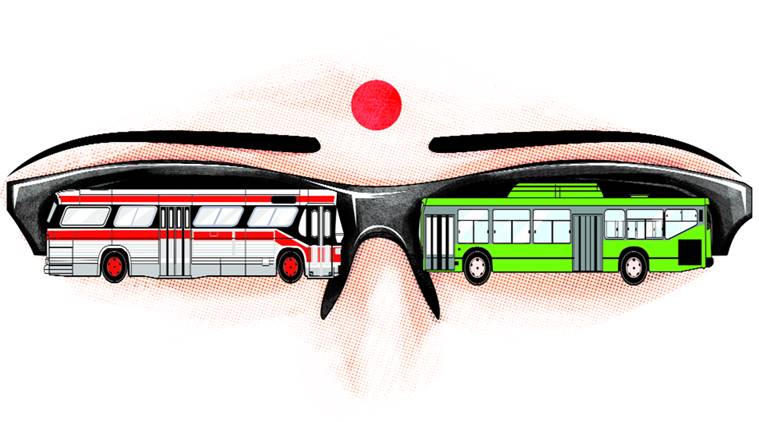
Back on the Bus

First published in Indian Express (Eye)

Canada, Delhi by DTC, Kalkaji to Netaji Nagar, south Delhi, North Campus, King County Washington, spirit community, indian express
Inside the bus, secrets waited. (Illustration: Suvajit Dey)

Riding a bus had become foreign to me. As foreign as waking up to noiseless mornings that could put nights to shame with their stark absence of light. Since migrating to Canada seven years ago, I had let myself happily slide into the snug comfort of a personal car to get around.

One winter morning, that ceased to be the case.

In the middle of December 2017, I found myself waiting for a public bus on a steel-grey dawn with mountains of stiff white snow all around me. A change in the work life of my husband, with whom I used to share a car to get to the workplace, had just shaken up my daily commute. This meant a not-so-minor adjustment, coming as it did during the country’s unforgiving, bordering on dangerous, winter. The bus stop nearest to our house was a good 8-minute walk, not the best idea in a period visited by frequent and violent snow squalls. The next best alternative was to leave early in the morning, an hour and a half before my usual schedule, so that my husband could give me a lift to the bus stop — the first of the two I needed to wait at — before proceeding to his place of work in a different city.

Standing there in the pitch dark of a sunless morning, an arctic chill cutting through my skin like a hundred hypodermic needles, I wondered if I’d be able to bear the regimen for too long.

My interest in the ethics of public transit, especially as it related to reducing carbon footprint, wouldn’t merely be put to test but seriously challenged as I became a daily bus passenger amid temperatures plummeting to -20C and below. At each of the two bus stops, I would have to wait anywhere between two-nine minutes. Then, after a half-hour bus trip, I would have to walk for another six minutes to reach my office from the bus stop closest to it. Enough time for a skin-numbing life lesson on the power of a single minute.
The Insider’s View

Inside the bus, secrets waited. There was warmth and ease, and not only because of the controlled temperature settings. The first time the bus turned a right-hand corner instead of moving straight on the road that led to my workplace, I sighed in frustration. This easily meant a longer commute than I was used to. Within moments, we were deep inside the sprawling campus of a university. A new world — of gothic buildings nestled in woods, winding roads and sidewalks and a river bisecting the eastern part of the campus — kept extending before my eyes like a poetic dream. Even the heaps of snow that blanketed most of the landscape couldn’t mask the beauty and magnificence of it.

Over the course of the long winter I would look forward to this — the most twisted — part of my commute the most. Tall trees across the campus, rendered nameless by their wintry bareness, framed the building structures with their filigreed branches. Looking at them I forgot clock-controlled time. For an instant, I would imagine what the place would look like in spring or summer. Yet, I was in no hurry for that visual to manifest. What lay before me sufficed, spectacularly.

Immigrants are notorious creatures of existential comparison. Riding the public transit inevitably brought back for me memories of commuting to college in Delhi by DTC (Delhi Transport Corporation) buses, necessary yet dreaded. The three years of my undergraduate programme required me to board a crowded bus from Kalkaji to Netaji Nagar, always late and often tilted with the weight of the humans it carried. My experiences as a female passenger in those three years made me vow never to ride a DTC bus once I had a job. I kept this promise to myself. From day one of earning a salary, I switched to Delhi’s ubiquitous paid personal transport — the autorickshaw. This was and felt like, a luxury, considering my paltry income. It also increased my respect for my mother, who had to rely on DTC buses for the entirety of her working life, travelling from south Delhi to North Campus. In Delhi’s hyper materialist environment, anything that cost you more indicated your ascension on the status-symbol ladder. If you could afford an auto, you would never look back at a DTC bus again.

Two decades later, as I ride the public transit at the other end of the world, the democracy of the act intrigues me. Beyond the obvious inclusiveness of wheelchair and infant stroller access, the bus here is what the suit-and-tie executive rides alongside the homeless bum with his overflowing cart of broken belongings. Its egalitarianism has liberated me from any stigma I might have been carrying for the public bus in my subconscious.
A Public Inn

Some of the closest friendships my mother enjoyed were forged in the public bus. As an introvert, I listened with envy to her stories of the in-bus sisterhood of working women. They shared everything, from in-law problems to kids’ issues, health worries and edible treats. Not having inherited her propensity for bonding with strangers, I have found books to be my most trusted bus buddies. Reading a book inside a moving bus is exhilarating. From Delhi to eastern India to rural China, the geographies I have traversed through the pages of the books I read seemed to take on a more active, pulsating life with the bus’s jerks and swerves. As I read, the distractions around me — the university students’ banter, the bus driver’s announcements, the view outside the window — taught me how the world of a daily passenger is both solitary and communal. The silent alliances formed are no less real than verbal ones. There’s reassurance in the mere act of travelling together, even if you don’t exchange a single word.

The daily bus route to my office, curiously numbered 13, didn’t merely help me survive the Canadian winter on an unyielding snow belt; it took me to a spot — aesthetic and emotional — where I ended up writing a poem on this journey. As I would discover, the public bus has its own community of poets and artists. Poetry on Buses is an initiative that encourages daily commuters in King County in Washington, the US, to write poems on their experiences on the bus and other modes of public transit. Their poems are then displayed on the local transit systems. In 2016, the project invited poems on the theme, “Your Body is Water.” The obvious comparison between water and public transport reminded me of own poem in which I imagine the streets on which the bus runs as a meandering river. In London, Ontario, where I live, a woman artist drew a series of sketches depicting life in the bus. She went on to post her illustrations at bus shelters around the city as a gesture of her appreciation for this mode of transport and its role in engendering a spirit of community.

The public bus is no longer foreign to me. It’s a mobile inn where I rest and recharge myself before the world appropriates my limbs and spirit.


A People Ravaged: Peeling off the Many Layers of Partition Trauma

First published in The Wire

Literature, Gender, and the Trauma of Partition: The Paradox of Independence
Debali Mookerjea-Leonard
Routledge, Taylor & Francis Group, 2017

In writing my first novel, whose protagonist is a young refugee woman from East Pakistan, I employed the device of coincidence to achieve a happy ending. Doing so wasn’t a sudden rush on my part to end what had become a protracted writing project but a well thought-out conclusion. It was not to be. When they read it, two of my trusted beta readers quashed it summarily, citing it as lazy and escapist. Even though incredible incidents can happen in real life, one of them advised, in a work of fiction, coincidences are hard to pull off convincingly.

An incident Debali Mookerjea-Leonard mentions in the preface to Literature, Gender and the Trauma of Partition: The Paradox of Independence starkly bears out this paradox.

Shortly after the All India Muslim League’s call for Direct Action in Calcutta in 1946, the author’s grandfather was stranded in Howrah station as public transport had been suspended in the wake of the sectarian clashes. He eventually got a ride from a kind Muslim family who had a private car, but had to climb on the footboard as the vehicle was full. To ensure his safety, he was given a flag of the Muslim League and advised to shout “Pakistan Zindabad” when passing through Muslim neighbourhoods. He did, and reached his home safely.

The insanity that gripped the subcontinent a year later when India was partitioned has been arduously chronicled in historical archives. In the privileging of journalistic reportage and record-keeping, personal histories surrounding the traumatic event haven’t received much attention until recently. The initiatives of Urvashi Butalia, Ritu Menon, Kamla Bhasin, and Jashodhara Bagchi, among others come to mind.

Mookerjea-Leonard’s book is an important intervention in this regard, not only because of its meticulous research and compelling arguments but because it sits in that nebulous middle – a no man’s land if you will – of fact and fiction. The author examines with incisive rigour fictional works on Partition and juxtaposes them against factual information and recent recordings of oral histories. As someone not directly affected by the event, hers is a lens that is both objective and earnest.

The works discussed in Literature, Gender and the Trauma of Partition are mostly from Bengal, which the author calls the “neglected shelves” of Bengali literature, written by writers from both sides of the Radcliffe divide. As she mentions in the Preface, this book is her tribute to her city, Calcutta. It is also a conscious effort to shine a light on the sufferings of those at the eastern end of the divide, as the tragedy of Partition in Bengal has been either underrepresented or misrepresented when compared to Partition in Punjab. This could well be attributed to, as Mookerjea-Leonard is cognisant of, the predominant and recurrent theme ofdisplacement in the east as opposed to that of horrific violence in the west.

Read the rest in The Wire.

In search of home and homeland: Seeking Palestine

Seeking Palestine: New Palestinian Writing on Exile and Home
Penny Johnson, Raja Shehadeh, editors
Olive Branch Press

Your mother’s face once sustained you. Now you have to strain your memory to trace its outline. The place you were born in you can’t return to, even if it were so you could die there. Y130225-seeking-palestineou can only be a nomad, an exile, or a refugee–never at home. Seeking Palestine, an anthology of nonfiction narratives gathers all these voices as it tries to make sense of the largely map-less Palestinian identity.

Susan Abulhawa chases this elusive piece in “Memories in an Un-Palestinian Story, in a Can of Tuna”. In her personal essay, the author best known for her novel, ‘Mornings in Jenin’ captures the breadth of a Palestinian’s nomadic condemnation. Her words–funny and shocking and tragic–tell how she was ping-ponged across geographies as a young girl. Thus, despite growing up in the US for most of her life, she says, “…I have come to understand that it (my life) represents the most basic truth about what it means to be Palestinian–dispossessed, disinherited and exiled.”

“Exile” is the permanent address many have been left with since the Israel-Palestine conflict began with the creation of the state of Israel in 1948. And so as poet and translator Sharif L. Elmusa etches in an essay combining his poetry and prose with river-like flow, not only their presence but even the absences of Palestinians are portable. To lug this presence/absence around, a Palestinian pays steep baggage fees. “I can only go inside myself / into the maze of the hippocampus / which is like going inside a pyramid / and finding the robbers had carted away / the belongings.// What will I shed this round / to complete my portable absence?”

Read the rest of the review at Armed with Amor.

Afternoon Meditations

A year ago, as a potential resident of London, ON, I spent a gorgeous summer afternoon in Victoria Park. My husband was coming to the city for his final round of a job interview, and I tagged along, just in case we didn’t get a chance to visit the city again. Sitting in this expansive park that afternoon, I contemplated what it would be like to live in London. As I complete a year in the forest city, here are my impressions from a summer ago.

London

A children’s festival is in progress in Victoria Park. I sit on a bench and see squirrels and birds engaging in mini battles over morsels.

Squirrels scamper in ceaseless motion–climbing up and down trees, scurrying across the grass, pausing in wonderment for a few seconds before taking off again.

Dogs, kids in strollers enjoy free walks, rides.

Church bells ring; lunch-goers emerge from offices, heading to big and small eateries to satiate the hunger god.

A man sprawls on the grass, reading a newspaper.

Beside me, on the bench, the pages of a national daily flutter in midsummer’s breeze, letting go of the heaviness of yesterday’s news.

Under a tree, a girl sits alone, ear-phones plugged into her natural audio sockets.

I turn behind and find a brown squirrel looking at me intently.

A young couple sleeps on the grass, embracing each other, oblivious of the world around them.

Alien Winter — I

Sun erases snow
wind howls
winter beseeches.
The church spire
stands mute,
unmoved,
cold.

The wind pauses
its howl,
lunchtime beckons.
School children run
to grab a
windfall of leaves.

Snow motes swirl
ruffling the air’s hair,
the earth’s an eager
bosom.
Children conjure up
castles, snowmen.

The wind screams
tearing through
flags, bare trees
windows
and a sheet of
congealed memory,
unfreezing on the
surfacce–
a foggy morning in
my hometown
half a world
away.

Alien Winter — II

Alien Winter — III