Fatima’s Fish and Rice (short story)

First published in hākārā

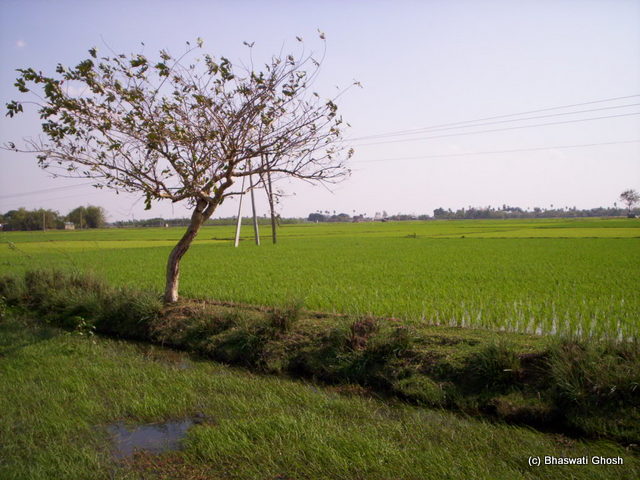
As she spread it over Dharala’s breast, heaving and restless, each fold of the meshed fibre courted a brisk movement of Fatima’s limbs. For maximum catch. The cast net yielded more readily to her commands now. The river had become just as adept at catching her secrets. There was only so much you could hide over a three-year relationship.

Taming the net hadn’t been easy for Fatima. In those initial months, after the truck crushed Masud’s hand, her rickety frame could barely grab the massive net without skidding into the river’s swampy edge. For almost a year, between hospital visits and the battle to ensure Masud didn’t sleep on an empty stomach, Fatima had experienced little luck honing her fishing skills. With a bed-ridden Masud, the couple lived almost entirely on the greens that Fatima foraged during her failed fishing expeditions. Rafiq brought them geri-gugli and chuno maachh every now and then, for which he refused even a hint of payment. Periwinkles and small fish weren’t items he would sell to Masud, a neighbour and his fishing partner, until only recently. Masud’s unforeseen disability saw Rafiq and Tarannum turn into the parents Masud and Fatima had lost a few years ago.

Fatima dragged the net out of the river’s bosom. With her feet submerged in Dharala’s anchoring grip, she shuddered as the memory of the days after Masud’s accident came rushing back to her. Days that had felt chilly even in the burning joishthho heat. She had barely recovered from the loss of the child in her womb when the truck hit Masud. Her unborn child still jolted her out of sleep at night. Clumps of sweat embossed her face every time she struggled to imagine what the baby’s face would look like if it were born. She would find herself gagging and in need of a sip of water to be able to breathe again.

She would be a day person, Fatima had decided over these three years. Nights were never kind to her. Night, the skinny ghost, an owl’s hoot. It echoed with the sound of whispering laughter and then of footsteps, making the darkness even more viscous. It carried the trapping scent of hasnuhana floating from somewhere nearby. And of the memory of hands rubbing her shoulder and grabbing at her breasts before she could make sense of it all … Nights were irreconcilable for Fatima, like the slick of fish oil that refused to be washed off. She never said a word to him, but Masud smelled the fear on her skin. He forbade her from going out after sunset.

For months that added up to almost a year, Fatima could barely replace a fraction of Masud’s income – by planting paddy on other people’s farms during the sowing season and then winnowing it for well-off families, selling a handful of eggs from the two chickens she reared, and cleaning the houses of neighbours for weddings and Eid celebrations. That and the generosity of Rafiq and Tarannum helped them survive, even if it meant Fatima had to practically give up rice herself and eat jowar flour boiled in water and mixed with some greens instead. The scent of steaming rice, which she now cooked exclusively for Masud, made her crave it more than ever before. She trained herself to restrain this instinct by rolling the end of her sari into a ball and covering her nose the moment the rice grains began bubbling in the water.

On some days, before returning home from the odd jobs she’d taken up, Fatima sauntered off, tired and heavy, to Rafiq’s house for a break. And for a mission. Tarannum was teaching her how to use a cast net. They worked with a net that Rafiq had discarded after it wore out in more than a few places. Tarannum showed Fatima how the best results were achieved by knowing when to let go and when to rein it in. You had to allow the rope to slip through your hand so the net could smoothly hit the bottom, and then as soon as it did, you needed to get a good grip on the rope and pull it right back up, lest the catch escaped. Seeing Fatima’s interest, Tarannum mended the net bit by bit and the two women began fishing, at first in the pond adjoining their house and then in Dharala. That’s when Fatima began sharing her secrets with the river. On most days, they got a decent enough catch of assorted fish. The women would split the haul, but not before releasing the small fish they caught into the river.

It seemed funny to Fatima how she and Tarannum had become fishing partners, the same way Masud and Rafiq had once been. The previous Eid, Rafiq had combined three decades’ worth of his savings with a particularly large remittance from his older son, a construction worker in Dubai, to buy a second-hand boat. For Masud, who was many river lengths away from getting his own boat, Rafiq’s new acquisition came as a blessing. He no longer had to pay rent for using another man’s boat, and Fatima and he began enjoying more fish-and-rice days.

Masud planned to combine a few months’ savings to put up a new roof. The constant leakage during the monsoons made Fatima ill every year. Now that she was expecting, he couldn’t let his baby arrive under a dripping roof.

Good fortune has a special allergy for poor people, Fatima would infer soon. The truck got Masud’s right – his dominant – hand and the money saved for the roof went towards his treatment. Then, Fatima lost the child.

‘Who gave you the fish?’ Fatima didn’t miss the hiss in Masud’s voice.

‘Tarannum apu. They’re having guests today, she had some extra,’ Fatima said, hastening to change. A second more and Masud would definitely spot the streak of mud lining the base of her sari. He would spot the river on her.

‘Hmm,’ Masud said and turned over in bed. Lately, even the smallest of pricks bristled him.

Read the rest in hākārā

Art by Piu Mahapatra

Afternoons in Bengal Countryside ~ Rabindranath Tagore

                                    Shazadpur,
                                    September 5, 1894

After spending a long time on the boat, it feels wonderful to have suddenly arrived at the Shazadpur house. Light and air streams in unrestrained through the large windows and doors — wherever I look, I see green branches of trees and hear bird call. The moment I step out to the southern verandah, all the veins of my brain fill with the fragrance of Kamini flowers. All of a sudden I realize a hunger lurked within me for an expansive sky — being here has fulfilled it completely.

I am the sole master of four large rooms — I sit with all the doors open. The inspiration and motivation that I receive here to write is unlike that in any other place. A living essence of the outside world enters me unhindered through the open doors — the light and the sky and the air and the sounds and the smells and the waves of green mingle with the passions of my mind and create innumerable stories. The afternoons here, in particular, have a deep spell. The sun’s heat, the silence, the quiet, calls of birds, especially the crow’s and an extended period of leisure make me pensive and eager.

Shantiniketan 036

I don’t know why I have a feeling that Arabian stories are made of afternoons like these brimming with golden sunshine. Those Persian and Arabian lands of Damascus, Samarkand, Bukhara…those grape clusters, rose gardens, the nightingale’s songs, Shiraz wines, desert paths, rows of camels, horse-riding wayfarers, a clear source of water amidst a thick curtain of date trees…cities with narrow royal lanes festooned with awnings, a shopkeeper wearing a turban and comfortable, loose-fitting clothes — selling melons and mewa at the end of the street…a massive royal palace by the roadside with incense smell wafting out of it, a huge mattress covered with kimkhwāb placed by the window…Amina, Zubeidi and Sufi in zari footwear, wide pajamas and colourful corsets as they inhale smoke rising off a curled hubble-bubble near their feet, at the door, a habshi dressed in flashy clothes stands guard…and in this mysterious, unfamiliar faraway land, in a wealth-filled, spectacular yet eerie royal palace, thousands of stories — possible and impossible — are being created out of the laughter and tears, hopes and anxieties of humans.

These afternoons I spend in Shazadpur are fabled afternoons. I remember writing the story “Postmaster” sitting at the table fully engrossed right at this hour. As I wrote, the light around me, the breeze and the shivering tree branches all added their language to it. There are few joys that come close to creating something close to one’s heart by being immersed in one’s surroundings. This morning I became inclined to write something on limericks and could become thoroughly involved in it, which brought me immense delight. Like the world of clouds, limericks make for a free country unbounded by rules and laws. Unfortunately, the land that rules and laws dominate is never far behind to follow one. As I wrote, a sudden insurrection of officials stormed in, blowing to dust my land of clouds.

When that ended, it was time to eat. There’s nothing more sloth-inducing than eating a full meal in the afternoon. It overwhelms one’s imagination and the spirit’s higher callings. Bengalis are unable to enjoy the deep intrinsic beauty of an afternoon because of their predilection to eat sumptuous meals at that time and follow that by closing the door to smoke on tobacco and slide into a satiating slumber. This is what makes them hale and hearty. But nowhere do quiet, desolate afternoons spread over in the sweeping, silent manner in which they do over Bengal’s uniformly limitless, plain crop fields.

Afternoons like these have haunted me since childhood. Back then, no one used to be in the outer third-storey quarters; I alone sat in the angular couch with the door wide open and a warm breeze blowing in. My entire day went by in the company of vivid imagination and unspeakable desires.

Satara
September 10, 1894

Translation: Bhaswati Ghosh

Where a line is a circle: Toronto

This personal essay appears in the third issue of Earthen Lamp Journal. The journal’s theme was ‘East, West: Juxtapositions and Intersections.’

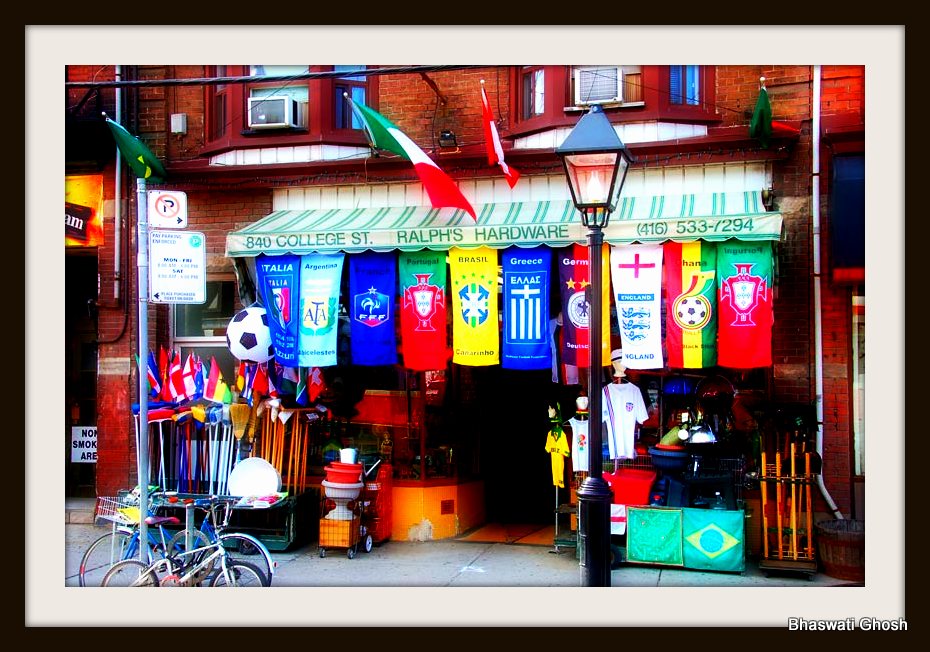
world-cup-2010_02Flags. They had become the latest automotive displays, fluttering atop cars – sedans and pickup trucks, SUVs and smart cars – in crazy abandon. The tiny flags caught my eyes in the summer of 2012, as I drove around Mississauga, the Toronto suburb that was my home. Canada Day, the official holiday to celebrate the unification of three colonies into a single country called Canada, was still nearly a month away. So the sudden show of patriotism puzzled me.

As more flag-bearing cars cruised along in the days to come, I discovered not all sported the red maple leaf of Canada against a snow-white backdrop. If anything, the colours and images of the flags far outnumbered the colours or breeds of the cars that flew them with pride. That’s when the reality – its transience – of Euro Cup struck me. Admittedly a provisional vexillologist for the period of the tournament, I turned to Google with curious search terms – ‘Red and white flag with pigeon,’ and ‘Red and green flag with emblem on top.’

As the Euro soccer mania gained momentum, television news channels in Toronto didn’t have to send correspondents to different European countries to get viewer reactions. Nor did they pick up news feed from international agencies. That’s because Europe itself lives in Toronto – people of European descent form the largest bloc of immigrants in the city. When Italy entered the tournament’s final, the TV channels needed to do little more than to place a camera in Toronto’s Little Italy, where all hell had broken loose as fans erupted to celebrate their home team’s victory over Germany in the semi-finals.

My own move to the land of abundant maple syrup and universal healthcare marked a diagonal shift in more ways than one. From the sun-dappled mountains of San Francisco, California, my husband and I decided to come to Canada as landed immigrants. ‘You will like it in Canada,’ he had reassured the writer in me, while we were still contemplating the move. His observation alluded to his comparison of the US west and east coasts (the latter being closer to Toronto). Occasional work-related trips to certain parts of New York exposed him to the thriving diversity there, manifesting in a rainbow of costumes in the streets, words from different languages drifting into one’s ears as well as the vibrancy of the region’s arts and literature scene.

Read the rest of the essay here.

Of Martyrs, Marigolds and Mayhem (Book Review)

Of Martyrs and Marigolds

Aquila Ismail

Create Space

Available at: http://www.amazon.com/Martyrs-And-Marigolds-Aquila-Ismail/dp/1463694822

Sixty-five years ago, India was freed of two centuries of British rule. The freedom, however, came with massive human tragedy. The country was divided into what is present-day India and Pakistan, on the basis of religion. The Partition of India resulted in some of the heaviest bloodshed witnessed in the history of the subcontinent. More than 12 million people were displaced as a result of the division. Sadly, the bloodletting that started at the time of Partition did not die down with the passage of time. In the years and decades to follow, the monster of communal tension assumed numerous sinister faces across the subcontinent and continues to rear its head to this day.

One manifestation of this simmering tension was the 1971 war between India and Pakistan, triggered by the Liberation War–a conflict between the Pakistani army and East Pakistanis. The actual war lasted only 13 days, making it one of the shortest wars in history. But the events leading up to it had started long before, culminating in the formation of a new country called Bangladesh. These events and their consequences–tragic and irreversible–are at the core of Aquila Ismail’s debut novel, “Of Martyrs and Marigolds.”

The novel narrates the story of a young girl, Suri, and her family–Urdu-speaking Muslims who had moved to East Pakistan from India at the time of Partition. It is estimated that between 2,000,000 and 3,000,000 civilians were killed in Bangladesh, and as many as 400,000 women were raped by the Pakistani armed forces. The conflict led a further eight to ten million people from the erstwhile East Pakistan seek refuge in neighbouring India.

The story of Bangladesh is mired in geographical, ethnic and linguistic complexities. In the division of India and Pakistan, the latter got parts of Punjab and Bengal, separated from each other by more than a thousand miles. Language emerged as a major bone of contention, with the majority East Pakistani population demanding Bengali to be made an official language. The language resistance that saw students becoming martyrs forms the backdrop of “Of Martyrs and Marigolds” as the story of Suri’s love affair with Rumi, a Bengali Muslim boy, unfolds.

The narrative, through rich detailing, reveals the liberal outlook of Suri’s father, a civil servant in the Pakistani administration. All through, Suri’s family remains supportive of the legitimate democratic movements in East Pakistan and critical of the high-handed and arbitrary ways of the West Pakistan leadership, which eventually unleashes military action upon its own people in East Pakistan. Numerous novels and short stories have brought to light the horrors of the atrocities committed by the Pak army on Bengalis.

In March of 1971, the tables turned with the same army conceding defeat to the Indian army. Along with freedom to Bengalis in the form of the new country of Bangladesh, this also brought reprisals against non-Bengalis, many of whom were believed to have colluded with the Pakistani military. However, as is the sad fallout in any conflict involving two communities, a lot of innocent civilians bore the brunt of the backlash too. Suri’s family represents one of many such Urdu-speaking units that got caught in the crossfire and were rendered helpless and homeless overnight.

“Of Martyrs and Marigold” impresses with its flourish of imagery–the verdant landscape of East Bengal, its folk songs, and cuisines happily share the pages with the Western influences–English literature, baseball, the Beatles to name a few–in Suri’s life. Remarkable too is the sensitivity with which a delicate subject that continues to generate strong reactions among people within the Indian subcontinent and outside it has been handled. The author’s sincere narrative stays away from vitriol or any suggestion of hate mongering, relying instead on a helpless victim’s heartfelt questioning of her fate.

The descriptions of reprisals against Urdu-speaking East Pakistanis are vivid to almost a disturbing effect. As in most conflicts, women are the worst sufferers, as they face both ends of the sword–the wrath inflicted upon those being targeted and a further sexual violence in the form of rape and physical torture. Ismail depicts instances of such violence with chilling workmanship. A few chapters towards the end present these horrors with excruciating details that continue to haunt the reader long after the book has been put down.

Some of the dialogues in the novel sound stilted and the pace of action slows down in the middle. The multiplicity of characters sometimes makes it difficult for the reader to follow the storyline, but this gets easily overlooked by the overall force of the story. “Of Martyrs and Marigolds” definitely instills hope in the reader for more such moving tales from Aquila Ismail’s pen.