On-field Trash

Q Everyone wants to know exactly what he said…

A: They were very serious things, very personal things.

Q About your mother and your sister?

A: Yes. They were very hard words. You hear them once and you try to move away.

But then you hear them twice, and then a third time… I am a man and some words are harder to hear than actions. I would rather have taken a blow to the face than hear that.

Soccer fans will know what the above snippet of conversation refers to. It’s just an effort to dissect an infamous moment of impulsiveness as was demonstrated by the legendary Zinedine Zidane, the former French football captain. The occasion, an important one—the finals of the World Cup—acquired a greater degree of relevance since it was also the last time Zidane was being seen on the professional soccer field. The man, loved by fans and soccer players across the world, must have dreamed of making the finals an enduring swan song, possibly with him lifting the coveted trophy. That was not to be.

A brief provocation, resulting in one of the most aggressive physical outbursts altered the course of the match once and for all. Minutes before the final game would slip into penalty shoot outs, the French maestro delivered a savage headbutt to his Italian opponent, Marco Materazzi. There was no way Zidane could have escaped a red card. As he exited the field, ignominy and a red blot on career accompanying him, French fans knew, the game could have a radically different outcome. Suffices to say, Zidane was aware of the results of his action himself. Yet, apparently, he couldn’t restrain himself. As for Materazzi, who is believed to have pushed the Frenchman to limits by making offensive remarks about his mother and sister, the desired effect—to distract Zidane in a game-altering way—was superbly achieved.
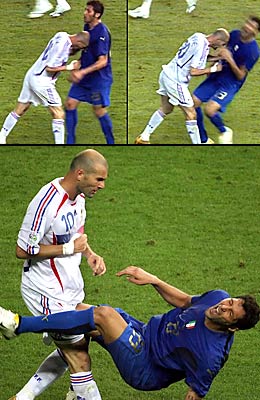
Image source: The Daily Telegraph

And that’s exactly what trash-talk or sledging in sports aims to achieve. It’s an ancient and tested tactic used to weaken the opposition psychologically. Almost all team sports make use of verbal abuses and insults in some way or the other.

I first became familiar with sledging while watching live telecasts cricket matches, the sport that makes India crazy. Cricket is to India what football is to Brazil and perhaps baseball to America. During cricketing season, every Indian corner, from polished living rooms to atmospheric bazaars sports a festive look. One would often find huddles of impassioned cricket lovers, either watching the game on television or listening to radio commentary. And just as the game itself causes waves of emotions to rise and fall, sledging between players results in tempers flaring up.
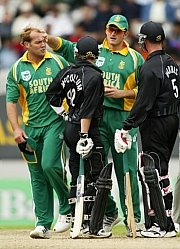
Image source: http://www.cricketnet.co.za
Cricket, slightly similar to baseball, is a contest between batsmen and bowlers. You would occasionally see a bowler making remarks at the batsman, trying to distract and provoke him. A lot of batsmen tend to retort, some look the other way, and a few really smart ones, whack the ball to the boundary at the next delivery. There’s no microphone attached to the shirts of the players, and what they say isn’t ever audible to the audience or the commentators. Much the same as what happened between Materazzi and Zidane. The only way one would learn about the actual exchange of words was to rely on the players’ version once the game was over.

So what exactly do players say to opponents to crack their psyche? Here’s a random sampling from the world of cricket sledging:

Australian wicket-keeper Rod Marsh, to English batsman Ian Botham: “So how’s your wife and my kids?” The reply “The wife’s fine, the kids are retarded”

Australian pace bowler Glenn McGrath to Zimbabwean Eddo Brandes after Brandes had played and missed at a McGrath delivery: “Oi, Brandes, why are you so f*****g fat?” to which Brandes replied: “Cos every time I f*** your wife she gives me a biscuit!” Apparently even the Australian slips were in hysterics.

In the 1980’s Ian Botham returned early from a tour of Pakistan, and on radio joked Pakistan is the sort of country to send your mother-in-law to.” Needless to say the Pakistanis did not find this amusing, and when Pakistan defeated England in the 1992 World Cup Final, Aamer Sohail told Ian Botham “Why don’t you send your mother-in-law out to play, she cannot do much worse.”

Perhaps the most famous sledge is reported to have taken place during the epic World Cup Super Six clash between Australia and South Africa. South Africa looked on course to a routine victory with Australian captain Steve Waugh at the crease and on 56. At that stage, Waugh clipped the ball in the air straight to South African fielder Herschelle Gibbs. In his haste, Gibbs dropped the ball when attempting to throw it in the air in celebration as he had not fully controlled it. As he passed him, Waugh is said to have asked Gibbs: “How does it feel to have dropped the World Cup?” Waugh carried on to make an unbeaten 120 and Australia posted an unlikely win and won the World Cup a few days later. Waugh has denied that quote, instead claiming that he said “looks like you’ve dropped the match”.

[Source: Wikipedia]


I find it somewhat unfair that while physical outbursts such as the one Zidane displayed are reason enough to penalize the player, verbal assaults, carried out repeatedly in the course of the play mostly go unheeded. This is not to condone physical attacks by the way. That’s not done, and Zidane himself admitted that, apologizing to any children watching the game. However, is it a fair deal for players to use racial slurs (Zidane has been at the receiving end of such taunts throughout his career because of his Algerian roots) or tasteless personal insults to the point of provoking the opponent to extreme physical reaction? Not in my book. A little banter here and there never harmed anyone, but insults directed at one’s family or place of origin are downright offensive and unforgivable as far as I am concerned.

Isn’t it ironical that while children are taught to cut back on swearing and verbal abuses all the time, adults get away with those same things on the sporting field? Agreed Zidane didn’t set up such a fine example for budding soccer players, but did Materazzi set a better example either?

Why expend so much energy when even a glare followed by a real smart sporting move can do the trick?

, , , ,

7/11, Mumbai, India


This isn’t new for Mumbai citizens or for Indians in general. It still churns your stomach, however, to see visuals of mangled train coaches, disjointed limbs scattered amid the wreckage, and blood-splattered victims waiting for help.


For me, the enduring images following the blasts were these, though:

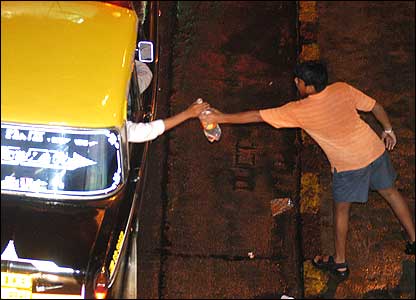
A boy hands water bottles to passengers passing by in vehicles on the day of the blast.

Image source: http://news.yahoo.com/photos


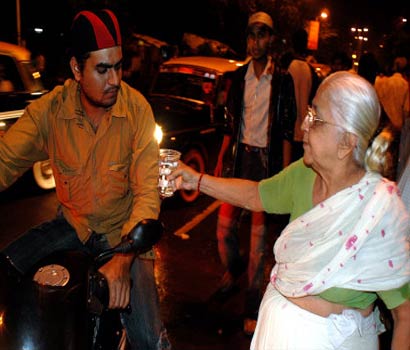
A lady providing water to commuters passing by.

image source: www.timesofindia.com
A young man donates blood at a Mumbai hospital on the day of the blast.

Image source: http://news.yahoo.com/photos

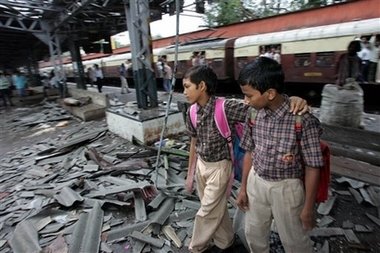
Children walk to school through the wreckage the morning after the blasts

Image source: http://news.yahoo.com/photos


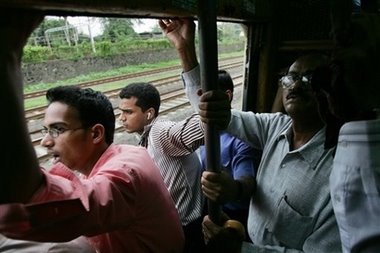
Mumbaikars board local trains and get back to work the morning after the blasts.

Image source: http://news.yahoo.com/photos


11 minutes
8 blasts
200 dead
(and counting)
700 plus injured
One city
Bleeding
Mourning
Bouncing
back.

Please take a moment and light an e-candle by clicking this CNN-IBN link. For every candle lit (no money required), the news channel will donate a rupee toward the relief of the blast victims. Thanks.

,

I never knew…

That our blogs had a dual, in some cases even a dubious identity. Presenting an anagarammatic version of the blogs listed on At Home, Writing. Enjoy the wacky, inane, intelligtent, perfect, outrageous second identities. I hope I covered all blogs linked here. Sorry if I missed any. Oh wait, maybe you are happy I missed yours!


webuser:
At Home, Writing
sternest: Now irate might.

webuser: Of Chapters and Reels
sternest: Sharp, saner cold feet.

webuser: Hard to Want
sternest: To and wrath.

webuser: Musings
sternest: Smug sin.

webuser: While I am thinking of it
sternest: I’m a white-hot if inkling.

webuser: The Clarity of Night
sternest: Fetching, throatily.

webuser: Tales at Twilight
sternest: Little aghast wit.

webuser: An Innocent A Blog
sternest: Not. Cannibal gone.

webuser: Flash Flood
sternest: Shod of fall.

webuser: The Prose Nest
sternest: Sternest hope.

webuser: And nothing else matters
sternest: Handiest angel torments.

webuser: A reader’s words
sternest: Swearers or add.

webuser: The Write thing
sternest: The tighter win.

webuser: Heaven tree
sternest: Veneer hate.

webuser: Kappa no he
sternest: Happen oak.

webuser: Lotus Reads
sternest: Lust adores.

webuser: Midnight Writings
sternest: Trim singing width.

webuser: Southern Expressions
sternest: Oh No! Sexiest spurners.

webuser: Peregrinas
sternest: Paris green.

webuser: Writer’s Edge
sternest: Sweeter grid.

webuser: Fireflies in the cloud
sternest: Chief, fluent idoliser.

webuser: Jamieford.com
sternest: Major of medic.

webuser: John Baker’s Blog
sternest: Blob gnash joker.

webuser: So you want to be a writer
sternest: Beauty! Traitors owe now.

webuser: Remaindered Random Musings
sternest: Domineering and mass-murder.

webuser: Blogdangit
sternest: It gang bold.

webuser: No rules. Just write.
sternest: Slow injure truest.

webuser: Enter the laughter
sternest: The gentle urethra.

webuser: A newbie’s guide to publishing
sternest: Dubious weighting plebeians.

webuser: Bengali Literature
sternest: Alert able intrigue.

webuser: Cancer Mom
sternest: Corn cam me.

webuser: Abhinav Aima Rants
sternest: Aha! Vibrant manias.

webuser: In the Middle
sternest: The idle mind.

webuser: Benjamin Solah’s Blog
sternest: Jam on slobbish angel.

webuser: Life as it happens
sternest: In filth appeases.

webuser: No rules. Just write
sternest: Slow injure truest.

webuser: Terrorism News
sternest: Sworn, merriest.

webuser: The empire falls
sternest: Fill sheep-tamer.

webuser: Stones in the field
sternest: Not idle heftiness.

webuser: Hot Diggity
sternest: Hog tidy git.

webuser: Outside my window
sternest: O My! Is wounded wit.

webuser: Shameless words
sternest: Wordless shames.

webuser: Writing after dark
sternest: Tawdrier king fart.

webuser: Writings and musings of Paul West
sternest: Satanists win powerful smudging.

webuser: NVNC ID VIDE, NVNC NE VIDES
sternest: Vend ‘n’ scenic ‘n’ vivid vend.

webuser: Blue Speckled eggs
sternest: Speckles leg debug.

webuser: Liv’s life
sternest: I’ve fills.

webuser: Loving Twilight
sternest: Vigil light town.

webuser: Lima Beans and Delhi Chaat
sternest: Am headiest ball and chain.

And just in case you are wondering if I’ve had too much time on my hands lately, no, that’s not the case. I am no anagram champion either. I was introduced to these hidden identities of our blogs here. So you see, I am not to blame!

,

The Path to Walk on, by Rabindranath Tagore

This, indeed, is the path to walk on.

It has wound its way through the woods to the fields, through the fields to the riverbank, next to the banyan tree; then it courses its way through the villages. As it moves further, beside the lush fields, amid the shadows of the mango orchards, by the bank of the Padma River, I cannot tell in which village it would wind up.

So many have passed by me on this path, some joining my company, others seen from afar; some with a veil over their heads, others without any; some walking to fetch water, others returning with water.

II

The day has retreated and darkness descends.

Once this path had seemed personal, intimately mine; now I see I carried a summon to walk on it only once, no more.

Past the lime trees, the pond, the riverbank, the cowsheds, the paddy mounds, the familiar glances, the known words, the acquainted circles, there won’t be any returning to say “Hey, there!”

This is the path to walk on, not one to return from.

This hazy evening, I turned back once and found the path to be an ode to many a forgotten footstep, all entwined in the notes of Bhairavi.

This path has summarized the stories of all its travelers in a single dirt trail; the one track that traverses between sunrise and sunset, from one golden gate to another.

III

“Dear walking path, don’t keep all the stories you have accumulated through the ages tied quietly into your dust strand. I am pressing my ears against your dust, whisper them to me.”

The path remains silent, pointing its index finger toward the dark curtain of night.

“Dear walking path, where have the worries and desires of all the travelers gone?”

The mute path doesn’t talk. It just lays down signals between sunrise and sunset.

“Dear walking path, the feet that embraced your bosom like a shower of wildflowers, are they nowhere today?”

Does the path know its end—where forgotten flowers and silent songs reach, where starlight illumines a Diwali of resplendent pain.

Translated by: Bhaswati Ghosh

,

Connecting the Dots

Jason’s Midnight Road contest–a marvelous feast of flash fiction–came to an end last Friday. Elisha Bridges bagged the top honours for the supernal entry, Jimmy Crick. There were four other winners, with excellent pieces to their credit. Congratulations to all the winners and runners up!

Be sure to check out the newest blogger interview at FlashFlood this Monday. It’s the turn of Fringes, the author of the blog Life As A Sarcastic Fringehead, on the hot seat this time.

Scott shared his moment of glory a few days back, when he posted the news of his story, Damned Carnival, winning the first prize in a contest from among 80 participants. The win also leads him to his first publishing credit. Don’t forget to applaud Scott on this fabulous accomplishment. Here’s hoping this is the first in the line of many more publishing victories, Scott 🙂

Lisa’s blog renovation coincided with her great interview of romance writer, Susan May Warren. In this delightful conversation, Warren shares her insights as a writer with a strong connection to Christian principles.

Happy weekend!

At Home and Beyond

A nice little review of this blog greeted me as I opened my inbox this morning. Helena Jeffrey said in her review at RealBook.com:

While surfing through author blogs this one caught my eye simply because of the beautiful blooming sunflower up in the corner. It made me turn my head and look out into my garden and appreciate the amazing colorful flowers blooming so far this summer. The blog in question is the blog of Bhaswati Ghosh, a published non-fiction writer from New Delhi, India.

Bhaswati gives us a taste of another world in her blog as she writes about different culture issues such as Indian culture, Latin American culture and FOOD. Yes, that’s right folks. Food. Seeing the delicious food Bhaswati posted about on June 1st is making my mouth water. For now, I’m off to get some lunch, but I urge you all to check out the blog of Bhaswati called At Home Writing on blogspot.

Thanks for the kind words and the mention, Helena. It’s a moment of joy for At Home, Writing.

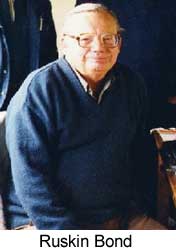
Author Profile: Ruskin Bond

The AW Chain continues into round two. Forbidden Snowflake wrote a post about ghosts and mentioned an experience of a slightly paranormal kind. Speaking of ghosts, whether we believe in them spirits or not, who doesn’t enjoy a spell-binding ghost story told on a rainy night? And one has to give credit to the writers who make our hearts race and our pulse soar with such chilling tales. One such Indian author is Ruskin Bond. However, he is not just a ghost story writer. Rather, this versatile wordsmith has also penned some ghost stories, along with novels, short stories, travelogues, and poetry.

Image courtesy: Indian Saga

A writer of Anglo-Indian descent, Bond is the quintessential Indian writer in English and a lifelong lover of India. Born in pre-independence India, he has lived through more than seventy autumns. The love of books and writing started early for him, thanks to his father, himself a bibliophile. Young Ruskin or Rusty as he was called, found encouragement from his father to scribble along in a small note book. Bond senior would often take Ruskin on nature trails, and wild flowers, trees, birds and other nature’s wonders became a permanent part of Bond junior’s psyche. These elements would become inseparable from his writing, too.

In 1944, as the Second World War still raged on, Ruskin’s father passed away, succumbing, not to the war, but to malaria. Rusty, along with his siblings and mother, had to move to England. During the four years he was there, a terrible homesickness for India overtook him. Yet, there wasn’t any feasible means of crossing the sea once more. Young Ruskin continued writing, though.

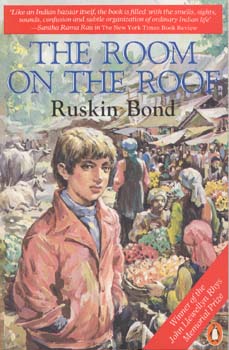
He was seventeen when The Room on the Roof, his first novel came out. The book won the John Llewellyn Rhys Prize. The book’s advance, 50 pounds, helped him buy a ticket to return to India—his home forever.

Upon returning, Bond set up base in the hills in north India. He chose the charming landscape of Dehra Dun to begin his career as a freelance writer. Here was someone, who only wanted to write, refused to be bound by the dreariness of a nine-to-five job, and who dared to eke out a living off freelance writing at a day and age when such a vocation was risky, bordering on eccentricity. Yet, he did it successfully through all these years—long hand and a rickety typewriter aiding him loyally.

Any day now, I shall have to shut up shop and join the ranks of salaried clerks or teachers. Any day now, I shall find that I no longer make a living as a freelance. Any day now…

I’ve had this dread for the past five years, but somehow, just when the going gets really rough and my bank balance touches rock-bottom, something does in fact turn up…and if I can go on writing, not always in the way I want to—because, if cheques are to be received, deadlines and editorial preferences must be met—but pretty much as I want to.

Any day now…

[From My Notebook, Ruskin Bond]

The books continued getting published, too. Vagrants in the Valley picked up from where The Room on the Roof trailed off. A series of short stories came along too, most of them marked by a stunning simplicity of language and an innate intimacy with nature.

People often ask me why my style is so simple. It is, in fact, deceptively simple, for no two sentences are really alike. It is clarity that I am striving to attain, not simplicity…Of course some people want literature to be difficult. And there are writers who like to make their readers toil and sweat. They hope to be taken more seriously that way. I have always tried to achieve a prose that is easy and conversational. And those who think this is simple should try it for themselves.

[Introduction: The Best of Ruskin Bond]

His novella, A Flight of Pigeons, set against the backdrop of the 1857 Sepoy Mutiny, the first Indian rebellion against the British Empire portrays human emotions and passions with a sensitive touch. Adapted for the silver screen as Junoon by acclaimed director Shyam Benegal, the book recounts the story of a young British woman whose father, a clerk working for the British authority in India, is killed in the Sepoy Mutiny.

About half a dozen novels and novellas, hundreds of short stories and essays, and more than thirty children’s books later, Bond’s pen is far from retirement. Settled in the quiet charm of Landour, a hill station in the lap of Himalayas, he doesn’t have any dearth of story material. A lifelong bachelor, Ruskin Bond doesn’t live alone. He is surrounded by the mirth of his adopted family (he adopted a boy from the hills and has since graduated to become a proud foster grandfather). Indeed, he is more Indian than many of “pure” Indian descent can claim to be.

It must be the land itself that holds me. But so many of my fellow Indians have been born (and reborn) here, and yet they think nothing of leaving the land. They will leave the mountains for the plains; the villages for the cities; their country for another country…

But it’s more than the land that holds me. For India is more than a land. India is an atmosphere. Over thousands of years, the races and religions of the world have mingled here and produced that unique, indefinable phenomenon, the Indian; so terrifying in a crowd, so beautiful in himself…

Race did not make me an Indian. Religion did not make me an Indian. But history did. And in the long run, it’s history that counts.

[At Home In India, Ruskin Bond]

Ruskin Bond touches a cord in me the same way as Wordsworth and Tagore do. For, his heartwarming relationship with nature and the spectacular simplicity of his words never fail to remind me of the magnificent beauty a glistening dew drop or the song of a skylark hold.

And the natural thing for me to do now would be to lead you all to Matt, the next link in the AW chain. Follow the trail…

Loving Twilight
Forbidden Snowflake
At Home, Writing
Fireflies in the Cloud
The Road Less Traveled
Mad Scientist Matt’s Lair
Jennifer Sando
Youth – Our Most Valuable Natural Resource
Peregrinas
Organized Chaos
Flying Shoes
Kappa no He
Untainted Enrapturement
The Secret Government Eggo Project

, ,

Latin America: A Journey Inside Out

The Duo Hits the Road

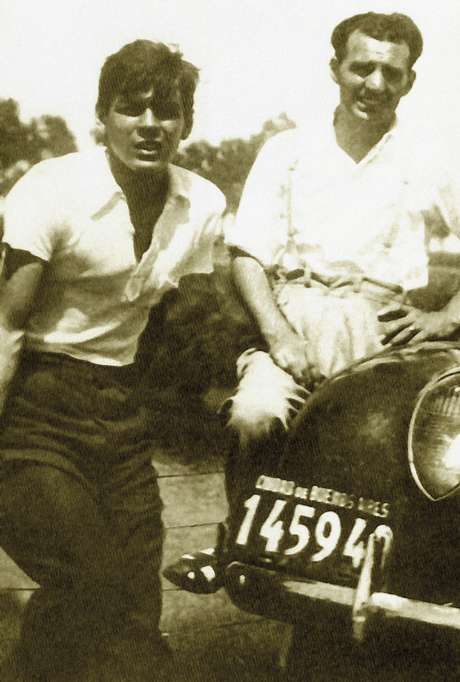
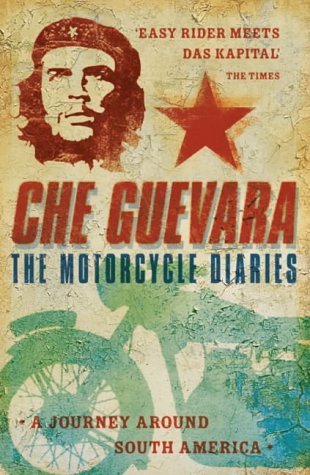
Two friends, bitten by the itinerant bug and armed with little more than a Norton 500 motorcycle and the carefree craze of youth, embark on a journey across a continent. Nothing exceedingly extraordinary about that. The human spirit of adventure has seen a lot of heroic trips being undertaken by daredevil travellers. Yet, what is it about the journey of these two Latin American friends that pulls curious onlookers like me to follow their trail to this day?

What is it about The Motorcycle Diaries that makes such a lasting impression on me and so many others? The fact that it isn’t just a travelogue, nor is it just another memoir of youthful impulsiveness; but that it’s a man’s inner journey happening hand in hand with the outer sojourn. It’s also your own journey—as a reader and as a person. A bit surreal to describe in words.

This is not a story of incredible heroism, or merely the narrative of a cynic; at least I do not mean it be. It is a glimpse of two lives that ran parallel for a time, with similar hopes and convergent dreams.

[From The Motorcycle Diaries, by Ernesto ‘Che’ Guevara]

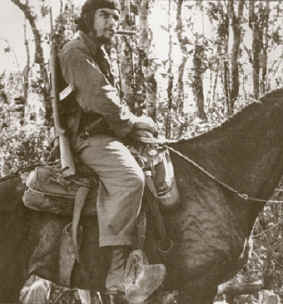
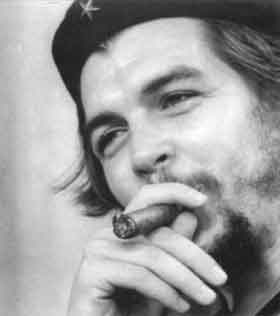
Indeed, Ernesto Guevara hits the nail on the head there, at the beginning of the book. When I first read The Motorcycle Diaries some three years ago, I knew little about Guevara. He was this t-shirt and poster figure, the epitome of “revolution.” I only knew him as a left-inclined man who stood and fought for the rights of the oppressed. In hindsight, it’s a good thing that The Motorcycle Diaries, and not one of his political pieces, was the first Guevara writing I came across. The book surprised me. For, here I saw a 23-year-old young man, going on 24, just like any other of his age—bursting with restless energy and the spirit of quest. I saw this young man poking fun at himself, his older pal, and their often unfriendly motorcycle. I found little or none of the political rhetoric that Ernesto Guevara came to be associated with, just a few years since making this defining road trip. And layer by layer, chapter by chapter, I saw the young man changing, until the end of the nine-month journey, when he seemed to have come of age and matured way beyond he could have imagined at the outset.

On Celluloid

And then last month, just like he had done three years ago with the book, my brother gave me the DVD of The Motorcycle Diaries. I had pestered him a lot to bring home the movie. Yet, when it finally arrived, I didn’t show any urgency to watch it. I let it lie until my brother rang an alarm bell saying the DVD was a friend’s and had to be returned. That’s when I finally watched it.

Why this lack of interest? Did I think the film would be boring? No. I just felt sceptical about the movie because I wasn’t so sure the book could be adapted for celluloid without a measure of documentary-like info-dumping. And even though the book is written chronologically, it still has this scattered and fragmented persona, which I thought would make a film made from it less cohesive.

And this is why they say, don’t think about it based on what you read. Go, watch the film.

The silver screen version of The Motorcycle Diaries moved me just as much as Guevara’s own words had. In fact, there couldn’t be a better rendition of the book in film format than the one we now have from Director Walter Salles. It stands out for all the elements that define fine filmmaking. Besides being technically slick, it impacts the viewer at a very human level. That is where it’s real victory lies. It entertains you wholeheartedly yet leaves you uneasy by posing difficult but nagging questions through young Ernesto’s observations.


http://www.motorcyclediariesmovie.com/home.html

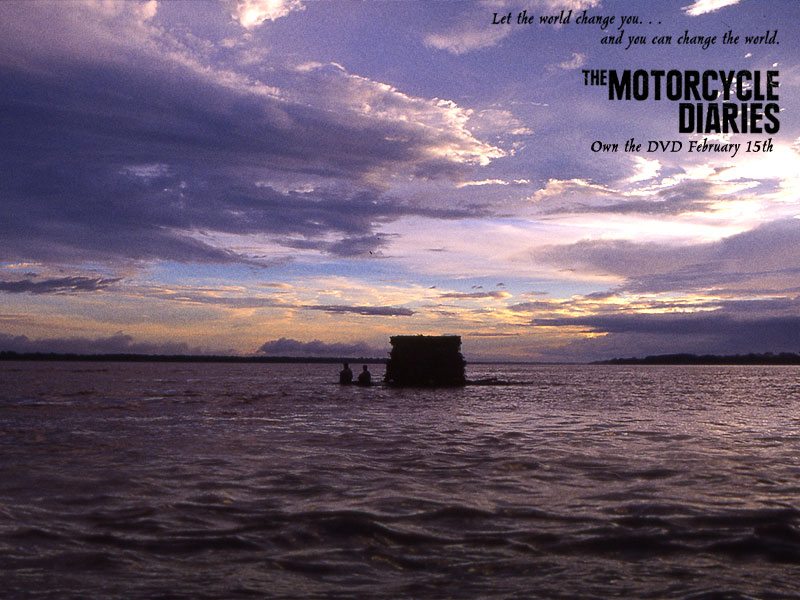
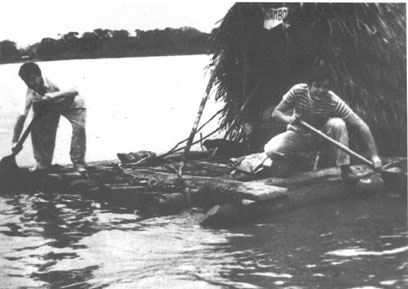
The breathtaking scenery first. Guevara himself does a fantastic job of describing the spots he and Alberto Granado pass by and visit during their epic journey through five South American countries—Argentina, Chile, Peru, Colombia, and Venezuela. The manner in which he shows a human intimacy with the immediate landscape can put a lot of fiction writers to shame. He talks of the sea as his confidant and friend that can absorb all secrets and offers the best advice, if only you carefully listen to its various noises.


http://www.motorcyclediariesmovie.com/home.html

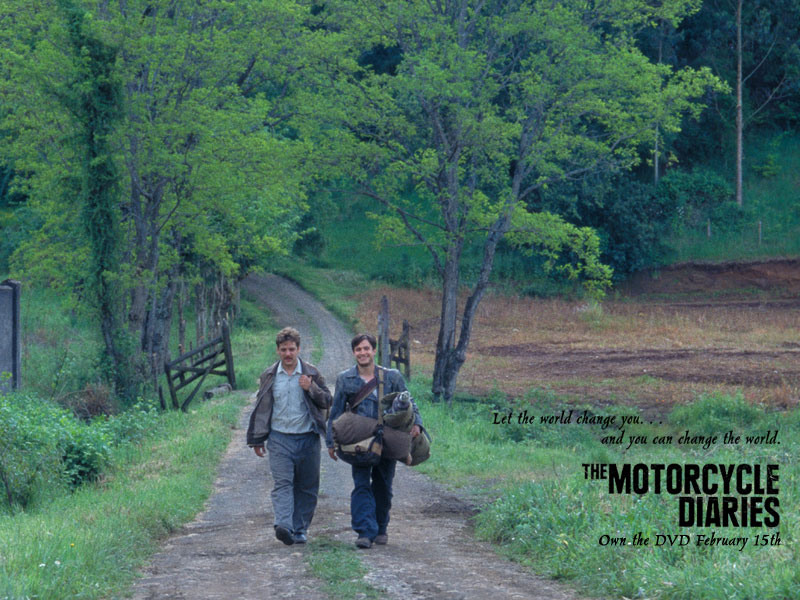
That the filmmakers chose to shoot the film at the exact locations where the journey took place doesn’t just enhance its credibility, but also makes for exhilarating visual treat. Cinematographer Eric Gautier superbly captures the scenic charm of the places on his camera, often giving the viewer the feeling of being there with Ernesto and Alberto. And the landscapes covered are magnificently diverse—from the green of Argentina, to the Atacama Desert in Chile, to Peru’s mountain tracks. I seriously want to see Latin America based on what the film portrays.

The Light Side

The Motorcycle Diaries is a testimony of Guevara’s brilliant sense of humour, something he is said to have possessed until the very end, even when he turned into a hard-boiled guerrilla fighter and a mass leader.

Alberto, unmovable, was resisting the morning sun’s attempt to disturb his deep sleep, while I dress slowly, a task we didn’t find particularly difficult because the difference between our night wear and day wear was made up, generally, of shoes.

[From The Motorcycle Diaries by Ernesto ‘Che’ Guevara]

Toward the end of the book, Ernesto lays out a neatly chalked-out “anniversary” routine he and his friend had devised to manage some food off unsuspecting people. The five-step program started with the two friends talking loudly with some local twang thrown in to pique the curiosity of those around them. A conversation would ensue, and our peripatetic friends would subtly enumerate their hardships on the road and then one of them would ask what date it was. As soon as someone told them the date, the other friend would let out a massive sigh, saying softly it had been a year since they started their journey, and they couldn’t even celebrate, they were so broke. Their “victim” would then offer some money, which the duo would refuse, before finally accepting it with reluctance. Their host then treats them to drinks. After the first drink, Ernesto refuses another one. The host persists, asking why he wouldn’t have another one, and after much requesting, Ernesto confesses that according to a custom in Argentina, he can’t drink without eating alongside.

In the film, actors Gael García Bernal (Ernesto) and Rodrigo de la Serna (Alberto) portray the “anniversary” act hilariously before a couple of Chilean girls, about their age. I was in splits watching the duo performing their antic, mischievous innocence and the desperation to fulfil their stomach’s cries leading them to stand-up comedy brilliance.

The Humanist Emerges

However, what set both the book and the film completely apart are the pertinent and often not-so-easy questions about the human condition. As Guevara and Granado travel farther and deeper, they have a close brush with the lives of the poor and exploited. This becomes possible because of the tramp-like nature of their journey for the greater part of the trip, since their bike breathes its last at a location in Chile. As they hitchhike their way through the Latin American landscape, a lot of times aboard trucks laden with indigenous people, Ernesto realises the tremendous humiliation meted out to poor people across the continent—whether it be a mining couple they meet in Chile who are persecuted for the man’s “communist” leanings, or the abject conditions to which Peru’s native mountain tribes are relegated, or the hapless state of leprosy patients they visit at the San Pablo leper colony in Peru. Every instance of coming across such injustice pains young Guevara and his anger and frustration is reflected throughout the book. Director Salles brings out this sense of pain very well in the film.

It isn’t unnatural for a human to feel moved or sad at the plight of a fellow human. Most of us would feel the same emotions that Ernesto does. However, there are a few human beings, for whom the pain becomes so intense they can’t remain silent about it. Even though the book is primarily a record of Guevara’s and Granado’s journey, you can see Ernesto belongs to that rare breed of empathising human beings.

The book carries tell-tale signs of the man he was to become later. The man who would galvanise poor peasants across Latin America to take up armed struggle for the life of dignity to which they had a birth right yet which was denied to them for lifetime after lifetime. And underlying the most violent of approaches he undertook as a guerrilla commandant was his deep love for human lives that had been rendered powerless through centuries of unjust subjugation. The Motorcycle Diaries—the book and the film–reveal this loving, soft-hearted man time and again. We see Ernesto’s vision of a United Latin America, when at a party thrown by the staff and patients of the San Pablo leper colony to celebrate his twenty-fourth birthday, he delivers a speech saying “the division of Latin America into unstable and illusory nations is completely fictional.”

Yet, the maturity doesn’t happen overnight. The self discovery happens layer by layer, and here, the filmmakers pull it off with great sensitivity, without the slightest trace of sensational exaggeration.

The symbolic nine-month journey is also a tale of immense physical grit. The two friends brave harsh blows of nature—from walking through a completely uninhabited stretch at pitch dark, to trekking their way through forests and the Atacama Desert, even as Ernesto falls prey to a series of asthma attacks (he was chronic asthmatic).

The Motorcycle Diaries includes a few letters Guevara wrote to his parents. These lend a fresh dimension to the book, reflecting his close bonding with family members with whom he freely shares his disenchantment with the appalling conditions of the poor across Latin America.

Chillingly Prophetic…

Although it’s difficult and unfair to pick sections of the book as favourite, the parts I found the most chilling were those in which Guevara envisions a future for himself exactly as it unfolds years later. Early in the book he says his destiny is to travel. Indeed, in the succeeding years, right up to his death, he travels and travels—across the world—from Russia to Asia and Africa. Only now he is shorn of youthful indulgence and is a champion for the voice of the proletariat.

And again at the end of the book, in the very last chapter, “A Note in the Margin,” Guevara gave me goose bumps, when he predicted his death.

“…I knew when the great guiding spirit cleaves humanity into two antagonistic halves, I would be with the people…I see myself, immolated in the genuine revolution, the great equalizer of individual will, proclaiming the ultimate mea culpa.”

[From The Motorcycle Diaries by Ernesto ‘Che’ Guevara]

As insensitive as it may sound, perhaps it was only fitting that Guevara died young. He remains a youth icon through generations, although it’s sadly ironical that the ideals he stood for are now mere footnotes in history for the very people who use merchandise bearing his image.

Ernesto Guevara would be 78 today (June 14). In my opinion, people like him don’t die. Only their bodies perish. Happy birthday, Che.

And a useless bit of trivia: Ernesto Guevara shares his birthday with yours truly. How old am I? Let’s hope like Che, forever young.

, , ,

An AW Project and a Horror Mag

This post is part of an Absolute Write (AW) project, where certain AW members who signed up for the project are linked together in a chain. Every blogger in the chain takes a cue from the previous participant and writes a new post. Find more on this interesting event here.
My predecessor, Forbidden Snowflake, mentioned a fascination for horror films. Since the subject has come up, I thought I should introduce you to a terrific horror magazine that’s receving rave reviews from critics and readers alike. It’s Surreal I am talking about. This quarterly magazine is engrossing mind candy for those interested in dark tales. It features top notch fiction, incisive non-fiction, and is even publishing a serialised story in comic format for the past two issues now. Despite being new, Surreal has set high standards for itself and its peers when it comes to content.

Surreal isn’t limited to being just a print magazine, though. It has two websites, one that gives you information about the magazine, authors guidelines, and advertising information; and another one called Surreal Interactive that gives you a peek into future issues, what with flash-powered trailers and minisites. Surreal has grown a dedicated community for itself, too, as can be inferred from the vibrant discussions on its forums, which even give you the chance to interact with the magazine’s editors directly. I find that rather cool.

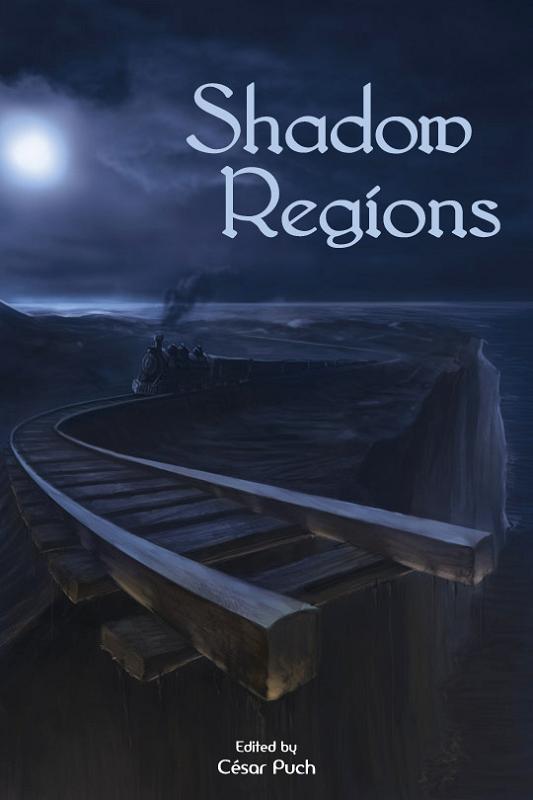
This year, Surreal goes a step further with the launch of Shadow Regions, an anthology of stories that reflect the supernatural. These 20 stories promise to be rivetting reads, as they throw a perfectly normal scheme of things out of order with the invasion of something weirdly extraordinary. The anthology even features a story by the horror maestro, Gary A. Braunbeck. Find more on this potentially gripping anthology here. Beware, it’s due out very soon.

So what’s stopping you from getting Surreal?


, ,