Cricketing Sagas — Imprinted

Cath, who passed me the AW chain baton, mentioned how it was during her first vacation without her family that she took to writing seriously. Evidently, she was in England with a group of friends when the incurable writing malady infected her. And alongside writing and frolicking with friends, Cath’s post also talks about her watching county cricket.

Aha! Cricket. One of those words that make me smile naturally. For, the game of cricket is one of the biggest loves of my life. As I write this post on the eve of India‘s Independence Day, I can proudly say being passionate about cricket adds as much to my Indianness as the food I eat and the language I speak do.

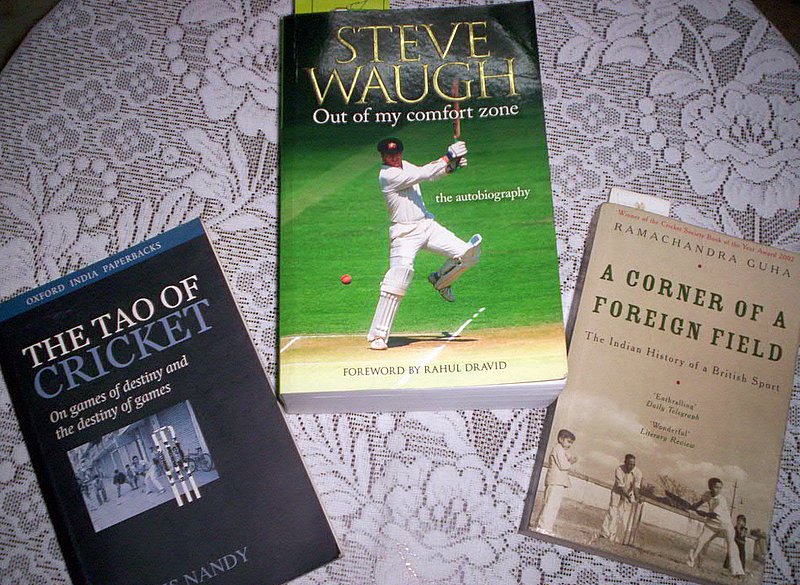
The sport has become so integral to the Indian ethos, that in his book, The Tao of Cricket, eminent sociologist, Ashis Nandy, professes Cricket is an Indian game accidentally discovered by the British…

So when my brother recently handed me this hefty tome as a belated birthday gift, I was elated beyond measure. Steve Waugh, the former Australian cricket captain, had remained my favourite for most of his cricketing career. Not just because of his skill with the game, but for his indomitable mental toughness and his commitment to social causes, which includes his work with an institute in India that is a haven for children of leprosy patients. I would always be stunned by his ability to singlehandedly rescue his team from near-losses. His record as captain is no less spectacular. Under his leadership, the Australian team became an impenetrable wall of attack, which no team in the world could match in terms of either flair or tactics.

That’s about what I’ve managed to read of the book thus far. Admittedly, I am a slow reader and bulky books always intimidate me. But Waugh does a great job telling his life story—he maintains a conversational tone, is admirably honest, and gives a fascinating glimpse into facets of his personality that remained masked by cricket. For who could ever tell, this gritty player, who even came across as a cold and calculated strategist while leading his side, detested being in the spotlight? Or that he wrote long, wistful letters to his teenage love (and later his wife), while on his first tour outside home in England? Steve Waugh is also candid about the uneasy and somewhat strained relationship with his twin Mark, who himself was part of the same squad his brother captained, and has an illustrious track record to his credit.

Hopefully, I would finish the Waugh treatise in a few months. I must, because I also have to read the other two books you see in the picture. I am particularly interested in A Corner of a Foreign Field, which presents “The Indian history of a foreign sport.”

What sports do you like? Does its history draw you? Or the life stories of its legends?

A sport teaches us so much, even if we don’t play it.

And now, may I pass the baton to Matt at Mad Scientist Matt’s Lair.

The entire chain:

Peregrinas

Pass the Torch

The Road Less Travelled

Fireflies in the Cloud

Even in a Little Thing

The Secret Government Eggo Project

Curiouser and Curiouser

At Home, Writing

Mad Scientist Matt’s Lair

I, Misanthrope – The Dairy of a Dyslexic Writer

Beyond the Great Chimney Production Log

Flying Shoes

Everything Indian

The Hal Spacejock Series

Organized Chaos

Of Chapters and Reels

Just a Small town girl

Midnight Muse

Kappa no He

, , , ,

Guest Blog – Bhupinder Singh

At Home, Writing is pleased to welcome its wonderful readers to the first Guest Blog. I am excited at the opportunity to learn from the perspective of fellow bloggers. I hope you all would enjoy interacting with these discerning guests too.


We begin with Bhupinder Singh’s review of:

Santa Evita
By: Tomás Eloy Martínez

In the short span of six years between 1946 to 1952, Eva Perón, the wife of the Argentinean dictator and founder of the Perónist party, Juan Perón, won over the Argentinean people so much so that her popularity was said to rival, if not exceed, that of Juan Perón himself. Having risen from obscurity, the youngest daughter of an unwed mother, her rise had been all the more spectacular.

Tomás Eloy Martínez’s Santa Evita could have been termed as a biographical account Eva Perón’s life had the author chosen to write about her short but eventful life.

Instead, he has chosen to write about her corpse.

Eva Perón’s body, like Lenin’s, was embalmed after she died of cancer at the age of 33, at the height of her popularity. However, before the corpse could be housed in a mausoleum for public display, Juan Perón was overthrown in a military coup, and thus began the after- life journey of Eva Perón, as the incumbent military government wondered what to do with the embalmed body.

To bury the corpse could have, they feared, incited the loyal Perónists and even the masses. And Eva dead was perceived as more dangerous than the living one.

Even a few replicas were created to mislead any followers, and attempts were made to bury them. For over a decade, the corpse and the replicas changed hands and locations, traversing within Argentina and to Europe- one replica was buried in Bonn and the actual corpse in Milan, Italy from where it was finally recovered and returned to Juan Perón after his return from exile in Spain.

Martínez recounts the stories of all those that came in contact with the corpse, and the often calamitous ends that they came to. Insidious accidents awaited those entrusted with the corpse.

Some were haunted till death, some met with inexplicable accidents and others were relentlessly followed by a mysterious person called the ‘Commander of Vengeance’.

It is characteristic of Martínez to write a novel that takes the after- life of Eva Perón rather than her not less eventful life as its theme. He does show us slices of her life too, but often as flashbacks and in recollections of those that he meets with.

In a sense, therefore, he underlines the persona that outlived Eva Perón herself.

This is akin to his previous novel, the redoubtable The Perón Novel, where he focused not so much on Peron’s politically active years, but the seemingly innocuous journey of an exiled dictator returning to his home country in old age.

Santa Evita is a novel within a non- fictional account where Martínez goes out in search of information about Eva Perón’s corpse- the story emerges as he interviews people associated with Eva or later with her restless corpse.

He makes the reader an accomplice in this journey of discovery- it becomes very much like a mystery in which the reader has as many, and more often as few, clues as the writer. This makes the novel extremely readable, if not racy.

Santa Evita turned out to be unputdownable, and I finished it within a week. Along with The Perón novel, it has been one of my best reads from Latin America in the last one year.

Note:Bhupinder Singh is the author of a reader’s words–a blog encompassing a wide spectrum of the literary world. From Dalit literature to Latin American authors, and from regional Indian writers to Leftist writings, Bhupinder covers it all. His blog is not limited to just books and authors, though. The subtitle–comprising keywords such as literature, left, liberal, socialism, globalization, dalit, books, Urdu poetry, south Asia, Indiais indicative of the inclusive nature of his blog.

, , , , ,

See the New Skies

The results of the final round of the memoir contest I mentioned two weeks ago came out this morning. Of the seven finalists, one memoirist’s tale got selected for being read by the editors of three top publishing houses. No, I am not the winner. But then I didn’t expect to be. As I went through the amazing life stories of the other finalists, I felt my entry didn’t deserve to win. Not selling myself short here. Only saying some of the other stories were almost crying out to appear in print. I am glad the judges chose one such story.

But that’s not the point of this post.

Over the past couple of months, I have participated in five writing contests, including Jason’s Midnight Road flash carnival. Of these, I didn’t make the cut in one. In another one, my entry was accepted for publication in an anthology. Yet another one saw me competing against six talented memoir writers. The results of the other two are awaited. So in terms of results you could say I have had some “gains” by entering these contests. But the real gain has been far, far greater than winning or placing.

Each one of the contests saw me taking up a challenge, whether it was writing with precision, condensing memories into something readable, writing letters that would evoke emotions in the reader or pitching a story for a prestigious anthology. Each contest let the writing bird within me flap its wings to stretch them a bit more, ready to discover unseen skies.

Along with the writing side of the challenge came the discipline it entailed. That’s one thing this memoir contest taught me really well. Once the first-round results were announced, the finalists had just one week to turn in another 2,800 odd words from their proposed memoir along with a 500-word synopsis. For me, who didn’t have the wildest idea of making it through the first round, this was an excruciatingly tight deadline. I had to conceive a whole book out of the clouds in just a week? Then I also had to write nearly 3,000 words from it? And even draft the dreaded synopsis? Well, yes to all. And I did it. Whether my entry was up to the mark or not is another question, but at least I didn’t back out of the challenge. There was no scope for that.

My greatest gain from entering these contests has been the feedback I’ve received from the judges and fellow contestants. Both Jason’s contest as well as the memoir one were interactive in nature, making it possible for each entrant to read their competitors’ works. There’s tremendous positive energy in contests organized in this format. With all contestants encouraging and vibing for each other, while at the same time sharing thoughts about their writings, the contests acquire almost a festive spirit of bonding between fellow writers on individual journeys.

That can never be too bad.

Mirror Thy Name

No, that’s not a narcissistic expression. Look carefully, and you will notice it’s an ambigram. If you turned the lettering upside down, it’ll still read my name. The creator is the talented Balaji. His blog of ambigrams says, “Ambigrams are words of symmetry.They look the same when read upside down also.There are many types of ambigrams.I try to make ambigrams that look the same when rotated and ambigrams that read the same even on a mirror.”
Balaji is passionate about creating ambigrams and does them free of cost if you request him. Do check him out.

Contest Finalist

This is beyond my wildest imagination.

My memoir piece has been chosen as one of the seven finalists for a contest organized by The Memoirists Collective.

Hundreds of entries, huge talent pool, diverse subjects. I feel overwhelmed and humbled to have even placed.

The winner, chosen from among these finalists, will have his/her proposal read by the top editors of three major publishing houses–Harper Collins, Hyperion and Holt. No guarantee of the proposal being accepted for publication, but a huge opportunity nonetheless.

There will be another round, with the finalists expanding their entries and doing a workshop with the organizers. A great learning experience all in all.

You can read my entry here. Please feel free to post comments.

Special thanks to Bernita for helping me polish the piece for submission. 🙂

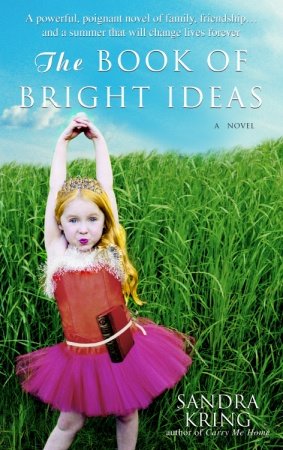
The Book of Bright Ideas

Bright Idea #96: When you go on a trip to buy a special surprise for your best friend, sing “You Are My Sunshine” and think of all the big people and the little people who are your sunshines. Then look at the old houses you pass, and think about the people who lived in them, and hope that they were somebody’s sunshine too.

[From The Book of Bright Ideas, by Sandra Kring]

That idea is the heart of this book. That there are times when some spark—a person, an incident, or both—enter your life like soft rays of sunshine gliding through an ajar window. And not only do these sparks brighten up the dark clefts within and without you, they actually turn out to be catalysts in transforming you into a bundle of sunshine. The Book of Bright Ideas celebrates these sparkling agents of change.

The narrator, nine-year-old Evelyn Peters, or Button as we better know her in the book, doesn’t have the faintest idea of the extent to which her life would change with the arrival of two strangers in their town. Twenty-something Freeda Malone and her sister, Winnalee, the same age as Button, enter the rural Wisconsin township like a sudden gust, threatening to blow over the steady but mechanical lives of the Peters family. The summer of 1961, the year these two ladies make this place their home, undoubtedly emerges as the biggest and wildest summer in the life of Button and her family. It is the summer when the timid nine-year-old would find a voice she can call her own, the time when her stiff and perfectionist mother would “loosen up” quite a bit, the year when her living dead father would find his music and his life back. And while all this happens, two little girls would pen down a book together. It’s their Book of Bright Ideas.

It’s a good thing Sandra Kring introduces the two strangers in the book’s first chapter. With them in place, the reader gets to see the whole range of characters—the book’s strongest aspect. Uptight Button versus buoyant, untamed Winnalee, huge-sized and giant-hearted Aunt Verdella vis-à-vis skinny, insecure Jewel–Button’s Ma, easy-going Uncle Rudy in contrast with sedate and dreary Reece Peters–Button’s dad. The characters are so real they almost leap out of the pages and share the living, breathing space with you. Button, all of nine years old, has already a lot to deal with—her mother’s missionary-like strictures, the idea of being ugly like her mother, the apathy of her father. No wonder the child grows up timid to the extent where she copes with her fears by chewing on her gums often to the point of bleeding. Jewel herself is seen to struggle with complexes of being ugly and inadequate fostered during her childhood. She masks them under a cover of perfectionist stiffness, the very feature that distances the two people who should be closest to her—Button and Reece. The same two people who are equally drawn to the household of Rudy and Verdella Peters—a couple embodying love and the joy of carefree spirit.

Then there’s the fiery Freeda and the dazzling Winnalee. The latter, moved around from one place to the other by her older sister, ends up being Button’s first “best friend.” From the very start we see her carrying the two most important things in her life—a vase containing her dead mother’s ashes and a bright leather-bound book. This book is the vine that twines the novel together, for in it Winnalee and Button note down the bright ideas they come across through their experiences. Winnalee believes when they have a hundred bright ideas, they would have figured out all the clues to life.

A series of episodes—from a community cookout to a stormy outburst by Jewel toward Verdella—lead to a complete reversal of the scheme of things. Just like her daughter, Jewel Peters finds a best friend, too—in Freeda Malone, the young woman she had detested initially. And Verdella and Rudy? Do they change? Why yes, they become more of themselves—more loving, more joyful.

The Book of Bright Ideas shines, not only with its amazing cast, but also with the charming atmosphere of a rural small town. In this second book of hers, Kring brings about the same community spirit that marked her brilliant debut novel, Carry Me Home. The coming together of the townsfolk for a cookout with food, drinks, and a wagonload of gossip; the animated community sales, where the selling of knick knacks brings those extra pennies all working families so appreciate; the 4th of July “Marty Graw” celebrations that sees the Peters and Malones letting their hair down in true American style and spirit.

Kring is the kind of writer who sweeps a large number of readers with her words. A big reason behind this is her use of strikingly simple and conversational language to tell complex stories. In both her books, the protagonists are children, who observe and present facts much as they happen, without colouring them. Yet, within that simplicity rests the intricacies of human nature, the wisdom that comes from appreciating life as it is, and the conviction that even the worst of blows can’t trample the peace and beauty that dwells in the human heart.

The Book of Bright Ideas surprised me at many a bend, with the plot throwing up unexpected twists, compelling me to keep moving without putting the book down. I remember keeping awake until four in the morning on one occasion, closing the book only when I felt reassured that the characters were safe and there was no reason to worry. How naïve I was. Yes, the worry might have been over, but not the surprises. While the story itself has a spell-binding effect, what nourishes the reader the most is the heartwarming transformation of the characters. It all happens naturally, none of it is forced. Therein lies the triumph of this book and the message it caries. That long after the agents of change are gone, the newness you acquire because of them remains unblemished. And then, you yourself become an agent of change in other people’s lives.

This is indeed one bright book.

My Bright Idea #1: If after switching off the lights once the final page of a book has been turned over, you feel your eyes are wet but your inside is smiling with a big-sized “happy,” don’t forget to share the gift with other book-loving friends.

, , ,

On-field Trash

Q Everyone wants to know exactly what he said…

A: They were very serious things, very personal things.

Q About your mother and your sister?

A: Yes. They were very hard words. You hear them once and you try to move away.

But then you hear them twice, and then a third time… I am a man and some words are harder to hear than actions. I would rather have taken a blow to the face than hear that.

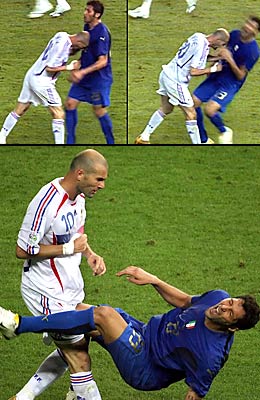
Soccer fans will know what the above snippet of conversation refers to. It’s just an effort to dissect an infamous moment of impulsiveness as was demonstrated by the legendary Zinedine Zidane, the former French football captain. The occasion, an important one—the finals of the World Cup—acquired a greater degree of relevance since it was also the last time Zidane was being seen on the professional soccer field. The man, loved by fans and soccer players across the world, must have dreamed of making the finals an enduring swan song, possibly with him lifting the coveted trophy. That was not to be.

A brief provocation, resulting in one of the most aggressive physical outbursts altered the course of the match once and for all. Minutes before the final game would slip into penalty shoot outs, the French maestro delivered a savage headbutt to his Italian opponent, Marco Materazzi. There was no way Zidane could have escaped a red card. As he exited the field, ignominy and a red blot on career accompanying him, French fans knew, the game could have a radically different outcome. Suffices to say, Zidane was aware of the results of his action himself. Yet, apparently, he couldn’t restrain himself. As for Materazzi, who is believed to have pushed the Frenchman to limits by making offensive remarks about his mother and sister, the desired effect—to distract Zidane in a game-altering way—was superbly achieved.

Image source: The Daily Telegraph

And that’s exactly what trash-talk or sledging in sports aims to achieve. It’s an ancient and tested tactic used to weaken the opposition psychologically. Almost all team sports make use of verbal abuses and insults in some way or the other.

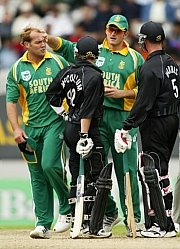
I first became familiar with sledging while watching live telecasts cricket matches, the sport that makes India crazy. Cricket is to India what football is to Brazil and perhaps baseball to America. During cricketing season, every Indian corner, from polished living rooms to atmospheric bazaars sports a festive look. One would often find huddles of impassioned cricket lovers, either watching the game on television or listening to radio commentary. And just as the game itself causes waves of emotions to rise and fall, sledging between players results in tempers flaring up.

Image source: http://www.cricketnet.co.za
Cricket, slightly similar to baseball, is a contest between batsmen and bowlers. You would occasionally see a bowler making remarks at the batsman, trying to distract and provoke him. A lot of batsmen tend to retort, some look the other way, and a few really smart ones, whack the ball to the boundary at the next delivery. There’s no microphone attached to the shirts of the players, and what they say isn’t ever audible to the audience or the commentators. Much the same as what happened between Materazzi and Zidane. The only way one would learn about the actual exchange of words was to rely on the players’ version once the game was over.

So what exactly do players say to opponents to crack their psyche? Here’s a random sampling from the world of cricket sledging:

Australian wicket-keeper Rod Marsh, to English batsman Ian Botham: “So how’s your wife and my kids?” The reply “The wife’s fine, the kids are retarded”

Australian pace bowler Glenn McGrath to Zimbabwean Eddo Brandes after Brandes had played and missed at a McGrath delivery: “Oi, Brandes, why are you so f*****g fat?” to which Brandes replied: “Cos every time I f*** your wife she gives me a biscuit!” Apparently even the Australian slips were in hysterics.

In the 1980’s Ian Botham returned early from a tour of Pakistan, and on radio joked Pakistan is the sort of country to send your mother-in-law to.” Needless to say the Pakistanis did not find this amusing, and when Pakistan defeated England in the 1992 World Cup Final, Aamer Sohail told Ian Botham “Why don’t you send your mother-in-law out to play, she cannot do much worse.”

Perhaps the most famous sledge is reported to have taken place during the epic World Cup Super Six clash between Australia and South Africa. South Africa looked on course to a routine victory with Australian captain Steve Waugh at the crease and on 56. At that stage, Waugh clipped the ball in the air straight to South African fielder Herschelle Gibbs. In his haste, Gibbs dropped the ball when attempting to throw it in the air in celebration as he had not fully controlled it. As he passed him, Waugh is said to have asked Gibbs: “How does it feel to have dropped the World Cup?” Waugh carried on to make an unbeaten 120 and Australia posted an unlikely win and won the World Cup a few days later. Waugh has denied that quote, instead claiming that he said “looks like you’ve dropped the match”.

[Source: Wikipedia]


I find it somewhat unfair that while physical outbursts such as the one Zidane displayed are reason enough to penalize the player, verbal assaults, carried out repeatedly in the course of the play mostly go unheeded. This is not to condone physical attacks by the way. That’s not done, and Zidane himself admitted that, apologizing to any children watching the game. However, is it a fair deal for players to use racial slurs (Zidane has been at the receiving end of such taunts throughout his career because of his Algerian roots) or tasteless personal insults to the point of provoking the opponent to extreme physical reaction? Not in my book. A little banter here and there never harmed anyone, but insults directed at one’s family or place of origin are downright offensive and unforgivable as far as I am concerned.

Isn’t it ironical that while children are taught to cut back on swearing and verbal abuses all the time, adults get away with those same things on the sporting field? Agreed Zidane didn’t set up such a fine example for budding soccer players, but did Materazzi set a better example either?

Why expend so much energy when even a glare followed by a real smart sporting move can do the trick?

, , , ,

7/11, Mumbai, India


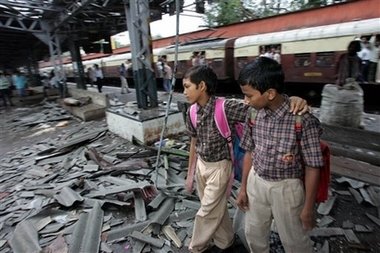
This isn’t new for Mumbai citizens or for Indians in general. It still churns your stomach, however, to see visuals of mangled train coaches, disjointed limbs scattered amid the wreckage, and blood-splattered victims waiting for help.


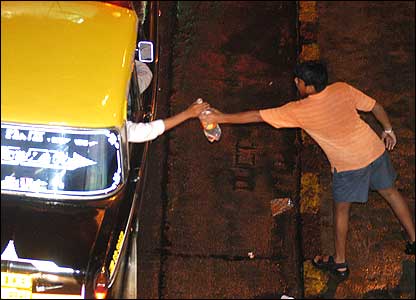
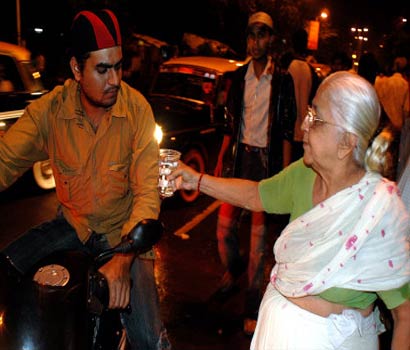
For me, the enduring images following the blasts were these, though:

A boy hands water bottles to passengers passing by in vehicles on the day of the blast.

Image source: http://news.yahoo.com/photos


A lady providing water to commuters passing by.

image source: www.timesofindia.com
A young man donates blood at a Mumbai hospital on the day of the blast.

Image source: http://news.yahoo.com/photos

Children walk to school through the wreckage the morning after the blasts

Image source: http://news.yahoo.com/photos


Mumbaikars board local trains and get back to work the morning after the blasts.

Image source: http://news.yahoo.com/photos


11 minutes
8 blasts
200 dead
(and counting)
700 plus injured
One city
Bleeding
Mourning
Bouncing
back.

Please take a moment and light an e-candle by clicking this CNN-IBN link. For every candle lit (no money required), the news channel will donate a rupee toward the relief of the blast victims. Thanks.

,