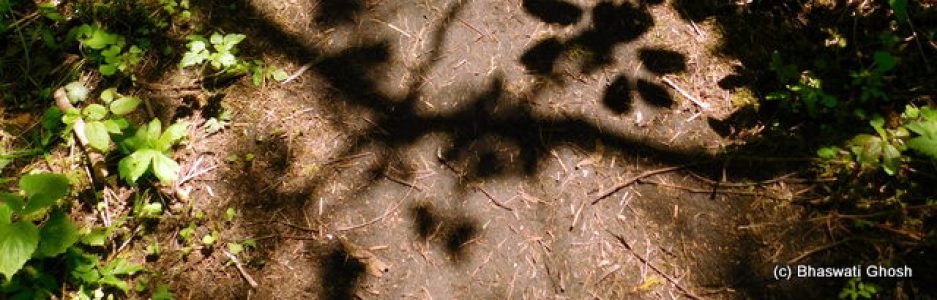
Song of the Red Road

An unbound auburn road bears songs not washed away by the gust of time; songs the sage poet sang to extol the road’s hypnotic effect on the weary traveler’s mind. The road lives, the songs live, too. The road and its songs are one now.

That ruddy road down the village makes my heart stray.
Who does the hand reach out to, only to roll over the dust?


The road makes its own way, unrestricted and haphazard and comes to meet its friend, the giant banyan tree. She knows the sun likes to play behind it, splashing its gleam through the banyan’s curtains.

When I first met that banyan tree, its leaves were the green color of spring. The sky’s fugitive light would flash through its gaps and embrace earth’s shadows on the grass. After that ashadh’s rain came; like the clouds its leaves became somber. Today the pile of leaves is akin to the mature intelligence of the elderly, no outside light can pervade its gaps… This morning, she said to me, dangling her enormous emerald necklace, “Why are you sitting with all those bricks and stones on your head? Come all out in the open like me!”


After sharing her pleasure-pain tales with the banyan, the red road curves toward the shal forests. There, inebriated trees oscillate on the wayward wind’s notes.

How rapturous, this dance of light on leaves
The wild storm in the shal forest makes my heart quiver.
Following the trail of the red road, folks dart to the haat
A little girl sits by the dusty path and spreads out her toys
These scenes that I bear witness to strike the cords of my heart’s veena.


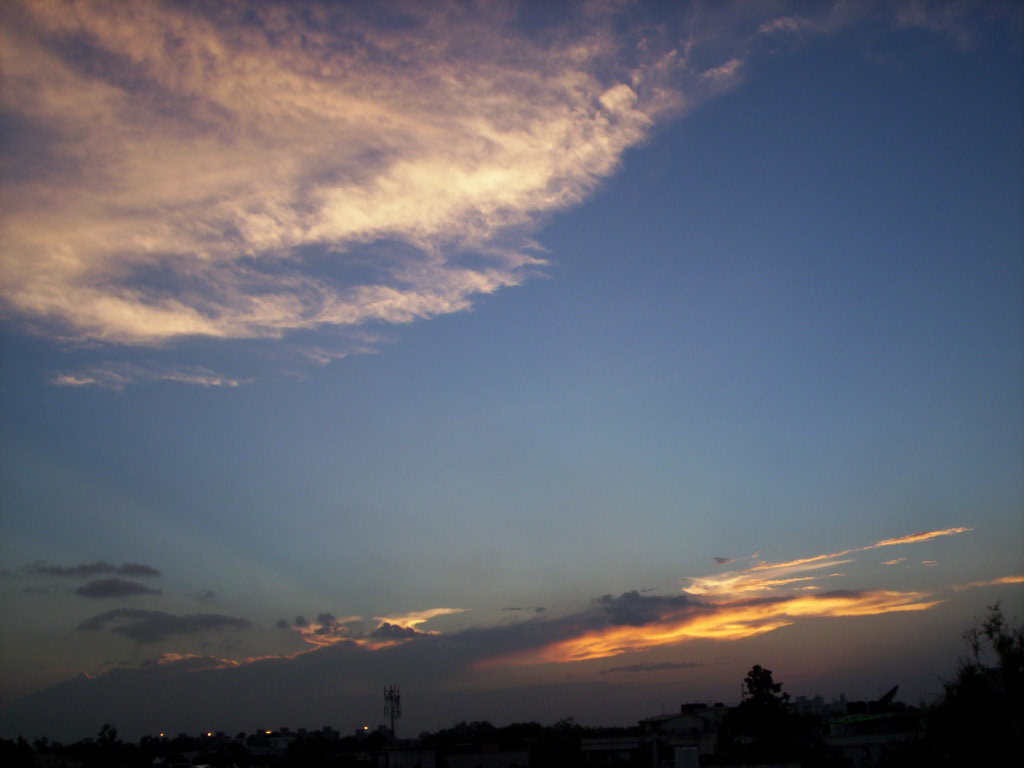
The sun has stopped its play for the day. Dusk joins the red road as she makes her way to commune with her people—those who know the soil and the forests as dear friends. Santhal villagers greet the road with their earthy smile and rustic songs.

The Santhal girl comes and goes
through the pebble-strewn road by the Shimul tree.
A thick sari tightly wraps her dark, slim body.

One of god’s absent-minded artisans

must have lost his way while creating a black bird

and perusing ingredients from monsoon’s clouds and lightning

fashioned that woman.


Then night comes—with the glow of intermittent fireflies flickering through the invisible marshes along pale green ponds. The auburn road doesn’t stop. It continues to sing—all out in the open—where day and night, past and present, work and play are enmeshed with the One.

All of the above is a languid reminiscing of my journey to Shantiniketan in March.

Note: All quoted text written by Rabindranath Tagore, translated by Bhaswati Ghosh.

Oh Calcutta!

On April 1, our 25-day heart-stirring in parts and disappointing in places Bengal trip came to an end. During the voyage:

I learned what it is like to travel by air. When those machine birds fly overhead, I don’t look up in awe and wonder any more. Now I look to them with a knowing smile.

I learned even though Delhi, my city of birth, holds the notorious distinction as the city of thugs, deception of gullible tourists by smart city agents is a universal phenomenon. Dear Kolkata is no exception to the rule. (The taxi driver who took us from the airport to my uncle’s house in south Calcutta drove us long enough to charge us nearly double the actual fare.)

I learned rude station officials make me lose patience faster than the quickest running train on the network.

I learnedthe exhilaration of train trips across Bengal’s countryside hasn’t worn down for me through all these years.

I learned even though the ethos created and nurtured by Rabindranath Tagore at the inception of Shantiniketan has eroded beyond measure, the place still reverberates with Tagore’s “echoing green” spirit. The chord that keeps pulling me back to it.

I learned that affable rickshaw-wallahs in Shantiniketan more than make up for the rude station officials of Kolkata. Anwar, our rickshaw-puller-cum-guide became a friend in three days.

I learned part of me hurts to be enjoying a journey through lush green fields tilled with the farmer’s labour and love when police firing kills villagers trying to hold on to their land. (The Nandigram firing incident happened on the day we reached Shantiniketan.)

I learned that looking wide-eyed at endless stretches of paddy fields across Bengal is an activity I will never tire of. While traveling through these landscapes I for once wished the journey would never end. I was in no hurry to arrive at the destination.

I learned that some of the tourist lodges run by the West Bengal government need major overhauling—both in infrastructure as well as in the management’s outlook.

I learned popular Indian pilgrimages can make for the worst of travel destinations. I am not pious enough to overlook lack of hygiene, obnoxious pandas (touts swarming religious places), and the histrionics of overzealous devotees.

While visiting the terracotta temples of Bishunupur, I learned in awe how sound architectural wonders were built in 17th century within the constraints of that time. It’s no surprise as to why these temples have held their ground not just architecturally, but also as exquisite works of art.

I learned the weaver creates a piece of fine Baluchari silk sari after painstaking days on the loom, but in the end earns just a small piece of the fat income his employer gets.

I learned Kolkata is truly a foodie’s paradise. If you love eating, make money in a place that has a higher per capita income. Then go spend your savings on food in Kolkata.

I learned Kolkata is in general a safe place for women, and I admired that. Sadly, I cannot say the same about the city in which I live.

I learned there’s not a single soul in Kolkata that’s not passionate about cricket. From vegetable vendors to book sellers in College Street and coffee drinkers at Coffee House, everyone was seen discussing detailed ramifications of the World Cup points table.

I learned no matter which city we live in or how different it is from other places, we are still the same everywhere. We are one in the final tally. And that’s all that counts.

I learned.

Hason Raja’s Songs

A while back, I wrote about the timeless appeal of Kabir. What is it that makes any creation timeless? The most obvious answer would be that the creation continues to make an impact long after it’s first created. However, another facet of ageless works is that they continue to hold relevance even when seen outside their original context; they fit into any and every life situation and require no knowledge of the backdrop in which they were created.


I say this as I contemplate on the songs of Hason Raja, a 19th-century mystical poet from Bengal. I first heard the songs some six or seven years back, when my brother brought a couple of audio tapes from a trip to Bangladesh. The songs had a distinct folk identity, marked by earthy tunes and simple, everyday language. A few of them touched me instantly.


Roop dekhilam re noyone
Aaponar roop dekhilam re

Amar majh to bahir hoyiya

Dekha dile aamare

I saw my own reflection
In your eyes.
You revealed yourself to me
By emerging from within me.


The reason I mentioned context in the beginning of the post is that once I read facts about Hason Raja’s life, I was nearly bowled over. His songs reflected a Sufi-inspired minstrel who spent his life celebrating the oneness of all creation and seeing the divine in everything. On reading his life story, I found the reverse was true, at least as far as his youth was concerned. Like most members of the affluent class, he spent his youth in the company of dancing women, financial and material indulgence and with symbols associated with the hereditary rich of 19th-century India (Bengal was still a part of undivided India at the time). In his later life, however, he turned away from the material way of life and became mystically inclined. He wrote hundreds of songs using simple language, most of which underscore the undivided nature of all life—an idea that seems increasingly relevant and important.


“Tumi ke aar ami ba ke
tai to ami bujhi naa re.

Eke bina dwitio ami

Onyo kichhu dekhi naa re.”

I cannot fathom
Who you are and who I am.
I fail to see
Any second thing apart from the One.


To listen to the first song referred to in this post, visit this link.


Booklane: Remembered, revisited

The roads are narrow and the mass of fellow humans overwhelming. Jostling one’s way through this intractable crowd is a skill only acquired with repeated visits to the place. I didn’t do badly, considering it was only my second trip. Revisiting the pavement book bazaar in Daryaganj, situated in Old Delhi or the other face of the city I call home, brought back snapshots of a winter morning tucked away in the memory files. Nearly a decade ago, I had visited the place for the first time with a co-worker friend. I had been instantly besotted with Booklane.
On that sunny January morning (or was it December?), my friend had gifted me a trip to this booklover’s promised land. I remember my sense of wonder on seeing this never-ending strip of book stalls, the 200-odd sellers displaying their collections neatly on the pavement and producing your requested book in a jiffy. We spent hours and hours scouring through the books, a lot of them secondhand. One is free to read, not just browse through books in this leisurely atmosphere.
The sun had warmed our feet, the books our hands and hearts, the prices our pockets. The Sunday book bazaar is popular because of the availability of good, even rare books at cheap prices. The memory has faded a bit, but I do remember returning home with a Seamus Heaney anthology and a book of plays, biographies and other interesting details, put together by the National School of Drama or NSD. Both prized possessions to this day. Without a doubt, that winter’s day happened to be one of the brightest in my life.
My visit to Booklane last Sunday wasn’t as merry, though. The area for the book bazaar seemed to have shrunk a bit, and this time, it was really a battle to make one’s way through the crowd. Even when my feet landed at a spot that would let me look at the books, the view was anything but happy. Most of the stalls were packed with textbooks of all sorts. Students thronged the place, picking up fat books at cheap prices. The fiction lover was virtually non-existent. Coin lovers weren’t, though, because this is also a great venue to buy old coins dating back to the era of the British Raj.Although the trip to Booklane wasn’t all that satisfying, the jaunt to Old Delhi was immensely fulfilling. For here is a world sheltering a culture and a history that has almost ebbed out of the modern city life I witness every day. And amid all the crowd and congestion lies a charm that keeps calling you to the place again and again. Yes, more trips planned to the walled city.

Special thanks to Bhupinder for making me Booklane bound.

First Sorrow by Rabindranath Tagore

The path by the shadow of the forest is now covered with grass.

On that deserted road, someone called me from behind.

“Don’t you recognise me?”

I turned back to look at him.

“I remember you, but do not recall your name.”

He said, “I am the sorrow who came to you when you were twenty-five.”

The corner of his eyes revealed a spark of ray, just like moonlight on a lake.

I stood there, surprised.

“Back then, you appeared like a dark monsoon cloud. Now, you look like a golden idol. Have you lost the tears of that day?” I asked.

He didn’t say anything, just smiled. I realized everything was contained in that smile.


The clouds of the rainy day had learned to smile like bright sunny days of the summer.

I asked him, “Have you preserved my youth of twenty-five?”

“Yes, I made it my necklace. Not even a single petal of the spring’s garland had fallen.”

I said, “See, how I have shriveled with age. But my youth is still adorning your neck, as fresh as ever.”

He slowly put that necklace around my neck and said, “Do you remember, that day you had said, you don’t need consolation, you only want sorrow?”

I shrugged a little. “Yes, I did. But it has been so long; I had forgotten about it.”

“But the one within you hadn’t forgotten. Now, you must accept me,” he said.

I held his hand and said, “How wonderful you look!”

He smiled and said, “That which was once sorrow, is now peace.”

Translated by Bhaswati Ghosh

Morning Marvels

Every morning, I go for a walk on my terrace. The stretch of open space has proven to be the most hassle-free exercising venue for an undisciplined soul like me. I don’t need to sport special attires since technically it’s part of my house. I usually climb my way up when the morning manifests itself fully. This means I don’t start my day with the first rays of the sun, but only when the soft rays mature into a generous splash of tropical sunshine spread across at least a section of the terrace land.
My mornings on the terrace have introduced me to a whole bunch of friends and events.

The All-India Avian Congress is hard to ignore, what with the volume of its esteemed members’ throats. Crows clearly appear to dominate the proceedings, even as pigeons prefer playing the part of silent board members. They leisurely take up their positions atop building roofs or electric poles, barely putting up with their cacophonic counterparts.

At times the meetings don’t end on a peaceful note, leading to a show of strength with regard to territorial rights. Again, the agile crows take the lead, often scaring me with their ominously low flights, marked by agitated wind flapping. Are these birds known to have higher blood pressures? I suspect so; especially since a couple of them attacked me during a park walk around a year ago.

The crowing supremacy cowers into a resigned defeat, however, when kites appear on the horizon. Where the crows and pigeons vie for slices of the sky, the kite claims the entire pie with a single sweep of its magnificent flight. My walk stops momentarily as I look up, transfixed to see this breathtaking stretched-wings wonder spanning across the blue canvas.

Soon the chirpy parakeets rush in, restless to get on with business as soon as possible. The business being picking on the fresh guavas off our tree in the backyard. They do get some competition from the home mynas, who are already found soaking in the comfort of a cozy nest amid the foliage of the guava tree. Although the parakeets are almost always too swift for my reflexes with the camera, they make me smile. Not just for their alacrity, but also because folklore tells me guavas bitten off by a parakeet turn out to be the sweetest of the lot.


Then there are the canine friends who are the kings and queens of the park behind our house. Seeing them send out vociferous warning messages to any outsider dog is being witness to the act of maintaining the security of one’s sovereign regime.


My walks have also unraveled to me an ancient scientific understanding. Just as the sunlight ambles over to the spot where the homemade pickle jars are kept, I can tell it’s 11 am (did I not tell you I walk really late in the morning?). Amazing to know how accurate the earliest experts in astrophysics had been.

This morning, as I was ready to climb down the stair, the flight of two pigeons caught my glance. I couldn’t help stopping for a moment and be in awe. On more than one occasion I’ve suddenly noticed my footsteps gathering momentum automatically the second a catchy song is played on the phone radio I carry during my terrace jaunts. As the pigeons flew overhead this morning, I found their flight to be effortlessly synchronized to the song that was playing.


Pure joy.

Kabir: Timeless Tapestry

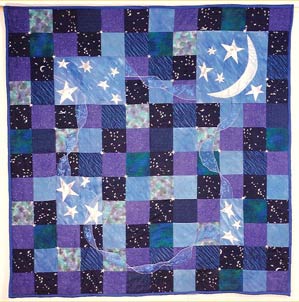
http://studio.margotlovinger.com/quilts_pillows/bedquilts/

Alakh Elahi ek hai, nam darya do
Ram Rahim ek hai, naam darya do
Krishna Karim ek hai, naam darya do
Kashi Kaba ek hai, ek Ram Rahim

Alakh (the Invisible) and Elahi (the Lord) are one, with two names
Ram and Rahim are one, with two names
Krishna and Karim are one, with two names
Kashi and Kaaba are but one, with two names.

That’s how inconspicuously Kabir entered my life — as this song my mother often sang. In the years since, the 15th-century poet-seer has remained a constant, always in the background but permeating the spirit like the air around me. Kabir weaved himself in quite easily into the open, boundary-less fabric of our house, forged by two humanist grandparents.

At a time when the traditional Indian society was largely conservative when it came to mainstream Hindu and Muslim faiths, Kabir, an unlettered weaver, declared that Kashi and Kaaba, the two holiest pilgrimages for the Hindus and Muslims respectively, were actually one, only called by different names. So were Ram and Rahim, Krishna and Karim—Hindu and Islamic deities.

The refrain continued through school, only the words changed, like in the case of Ram and Rahim.

Tum Ram kaho, woh Rahim kahen
Dono ki garaz Allah se hai

You say Ram, they say Rahim
Both are concerned with Allah

The reason Kabir, despite erasing the man-made lines between religions and sects (he denounces most of them in his songs and couplets or dohas), continues to make his presence felt is precisely because of that. Deep within we all realize we are one, free, unbound. We realize there’s no sense to all the carnage that goes on in the name of religion. 

http://www.chennaimuseum.org/

Is ghat antar baag bagiche
Isi mein sirjanhara

WITHIN this earthen vessel are bowers and groves, and within it is the Creator.
(Translation: Rabindranath Tagore)

This beautiful song about everything being encompassed within this physical shell of our bodies came to me in my college years. I heard it in a cassette produced by Sahmet, an organization working against communal forces through creative expressions such as song, visual arts, theater, and dance. The rest of the song translates to:

Within this vessel are the seven oceans and the unnumbered stars.
The touchstone and the jewel-appraiser are within;
And within this vessel the Eternal soundeth, and the spring wells up.
Kabîr says: “Listen tome, my Friend! My beloved Lord is within.”

Kabir is not just about breaking the shackles of religious fanaticism; Kabir is a whole way of life. When Kabir breaks free, he does so totally:


Haman hai ishq mastana
Haman ko hoshiyari kya
Rahen azad ya jag mein
Haman duniya se yaari kya

I am bursting with love,
Why do I need to be careful?
Being free in the world,
What of the world’s friendship do I need?

This song became an anthem from the moment I listened to it. What an expression of being whole and free without needing any of the “stuff” we keep clinging to! Liberation in its truest sense.

Ud Jayega Huns Akela,
Jug Darshan Ka Mela
Jaise Paat Gire Taruvar Se,
Milna Bahut Duhela
Naa Jane Kidhar Girega,
Lageya Pawan Ka Rela
Jub Howe Umur Puri,
Jab Chute Ga Hukum Huzuri
Jum Ke Doot Bade Mazboot,
Jum Se Pada Jhamela
Das Kabir Har Ke Gun Gawe,
Wah Har Ko Paran Pawe
Guru Ki Karni Guru Jayega,
Chele Ki Karni Chela

The Swan will fly away all alone,
Spectacle of the world will be a mere fair
As the leaf that falls from the tree
Is difficult to find
Who knows where it will fall
Once it is struck with a gust of wind
When life span is complete
Then listening to orders, following others will be over
The messengers of Yama are very strong
It’s an entanglement with Yama
Servant Kabir Praises the attributes of the Lord
He finds the Lord soon
Guru will go according to his doings
The disciple according to his.

Yama = The God of death in Hindu mythology.

(Courtesy: http://groups.google.com/group/rec.music.indian.classical)

,

Holiday Preparations by Rabindranath Tagore

Translated by: Bhaswati Ghosh

Puja holidays draw near.
Sunshine is draped in the colour of Champa.
The air ripples with dew,
the Shiuli’s fragrance lingers
like the delicate caress of someone’s cool hands.
White clouds make the sky lazy—
seeing which, the mind relaxes.

Mastermoshai continues to teach
the primitive story of coal
A student sits on a bench and paddles his feet,
his mind awash with images—
The cracked ghat of Kamal pond,
And the fruit-laden custard apple tree of the Bhanjas.
And he sees in his mind’s eyes, the zigzag path
that leads from the milkmen’s neighbourhood

by the side of the haat,
into the tishi fields, next to the river.

At the economics class in college
the bespectacled, medal-winning student
jots down a list–
which recent novel to buy,
which shop will give on credit—
the sari with the “Do Remember” border,
shakha washed in gold,
a pair of red velvet chappals, handcrafted in Dilli
and a silk cloth-bound poetry book,
printed on antique paper—
the title of which eludes him.

In the three-storied Bhawanipore hosue
Thin and heavy voices converge in confabs —
Will it be Mount Abu or Madurai this time
Or perhaps Dalhousie or Puri
Or shall it be the tried and tested Darjeeling.

And I see on the auburn road
leading to the station
kid goats on lease from the city
five or six of them — tied with ropes.
Their futile cries rend the
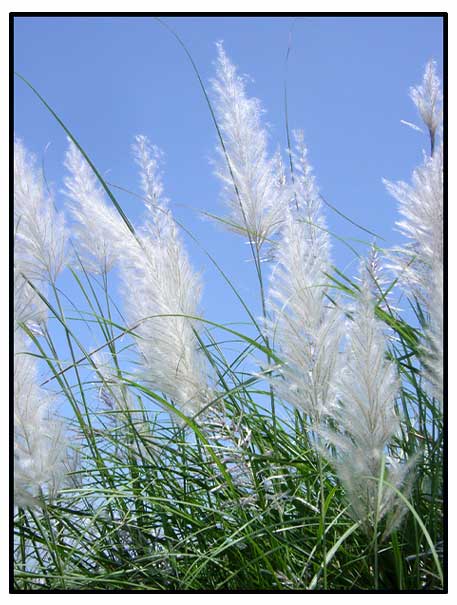
kaash tasselled silent autumn sky.
As if they have somehow sensed
their puja holidays are near.

                        ~

Mastermoshai = Respectful term for teacher (Bengali)
Champa, Shiuli = Flowers
Ghat = Bank
Haat = Weekly village market
Tishi = Linseed
Shakha = White bangle made of a particular stone. Is worn by married Bengali women.
Chappal = Footwear

 ~~~~~~~~~~~~~~~~~~~~~~~~~~~~~~~~~~~~~~~~~~~~~~~~~~~~~~~~~~~~~~~~~~~~~~~~~~~~~~~~~~~~~~~~~~~~~~~~~~~~~~~~~

ছুটির আয়োজন

কাছে এল পূজার ছুটি।
রোদ্‌দুরে লেগেছে চাঁপাফুলের রঙ।
হাওয়া উঠছে শিশিরে শির্‌শিরিয়ে,
শিউলির গন্ধ এসে লাগে
যেন কার ঠাণ্ডা হাতের কোমল সেবা।
আকাশের কোণে কোণে
সাদা মেঘের আলস্য,
দেখে মন লাগে না কাজে।

মাস্টারমশায় পড়িয়ে চলেন
পাথুরে কয়লার আদিম কথা,
ছেলেটা বেঞ্চিতে পা দোলায়,
ছবি দেখে আপন মনে–
কমলদিঘির ফাটল-ধরা ঘাট
আর ভঞ্জদের পাঁচিল-ঘেঁষা
আতাগাছের ফলে-ভরা ডাল।
আর দেখে সে মনে মনে তিসির খেতে
গোয়ালপাড়ার ভিতর দিয়ে
রাস্তা গেছে এঁকেবেঁকে হাটের পাশে
নদীর ধারে।

কলেজের ইকনমিক্‌স্‌-ক্লাসে
খাতায় ফর্দ নিচ্ছে টুকে
চশমা-চোখে মেডেল-পাওয়া ছাত্র–
হালের লেখা কোন্‌ উপন্যাস কিনতে হবে,
ধারে মিলবে কোন্‌ দোকানে
“মনে-রেখো’ পাড়ের শাড়ি,
সোনায় জড়ানো শাঁখা,
দিল্লির-কাজ-করা লাল মখমলের চটি।
আর চাই রেশমে-বাঁধাই-করা
অ্যাণ্টিক কাগজে ছাপা কবিতার বই,
এখনো তার নাম মনে পড়ছে না।

ভবানীপুরের তেতালা বাড়িতে
আলাপ চলছে সরু মোটা গলায়–
এবার আবুপাহাড় না মাদুরা
না ড্যাল্‌হৌসি কিম্বা পুরী
না সেই চিরকেলে চেনা লোকের দার্জিলিঙ।
আর দেখছি সামনে দিয়ে
স্টেশনে যাবার রাঙা রাস্তায়
শহরের-দাদন-দেওয়া দড়িবাঁধা ছাগল-ছানা
পাঁচটা ছটা ক’রে।
তাদের নিষ্ফল কান্নার স্বর ছড়িয়ে পড়ে
কাশের-ঝালর-দোলা শরতের শান্ত আকাশে।
কেমন ক’রে বুঝেছে তারা
এল তাদের পূজার ছুটির দিন।

, ,

See the New Skies

The results of the final round of the memoir contest I mentioned two weeks ago came out this morning. Of the seven finalists, one memoirist’s tale got selected for being read by the editors of three top publishing houses. No, I am not the winner. But then I didn’t expect to be. As I went through the amazing life stories of the other finalists, I felt my entry didn’t deserve to win. Not selling myself short here. Only saying some of the other stories were almost crying out to appear in print. I am glad the judges chose one such story.

But that’s not the point of this post.

Over the past couple of months, I have participated in five writing contests, including Jason’s Midnight Road flash carnival. Of these, I didn’t make the cut in one. In another one, my entry was accepted for publication in an anthology. Yet another one saw me competing against six talented memoir writers. The results of the other two are awaited. So in terms of results you could say I have had some “gains” by entering these contests. But the real gain has been far, far greater than winning or placing.

Each one of the contests saw me taking up a challenge, whether it was writing with precision, condensing memories into something readable, writing letters that would evoke emotions in the reader or pitching a story for a prestigious anthology. Each contest let the writing bird within me flap its wings to stretch them a bit more, ready to discover unseen skies.

Along with the writing side of the challenge came the discipline it entailed. That’s one thing this memoir contest taught me really well. Once the first-round results were announced, the finalists had just one week to turn in another 2,800 odd words from their proposed memoir along with a 500-word synopsis. For me, who didn’t have the wildest idea of making it through the first round, this was an excruciatingly tight deadline. I had to conceive a whole book out of the clouds in just a week? Then I also had to write nearly 3,000 words from it? And even draft the dreaded synopsis? Well, yes to all. And I did it. Whether my entry was up to the mark or not is another question, but at least I didn’t back out of the challenge. There was no scope for that.

My greatest gain from entering these contests has been the feedback I’ve received from the judges and fellow contestants. Both Jason’s contest as well as the memoir one were interactive in nature, making it possible for each entrant to read their competitors’ works. There’s tremendous positive energy in contests organized in this format. With all contestants encouraging and vibing for each other, while at the same time sharing thoughts about their writings, the contests acquire almost a festive spirit of bonding between fellow writers on individual journeys.

That can never be too bad.

7/11, Mumbai, India


This isn’t new for Mumbai citizens or for Indians in general. It still churns your stomach, however, to see visuals of mangled train coaches, disjointed limbs scattered amid the wreckage, and blood-splattered victims waiting for help.


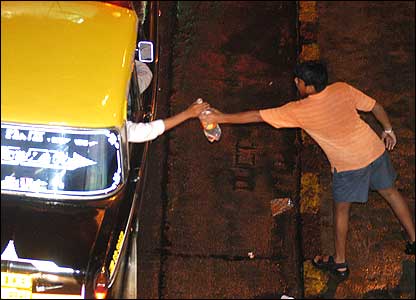
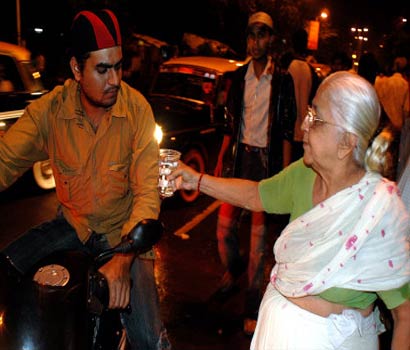
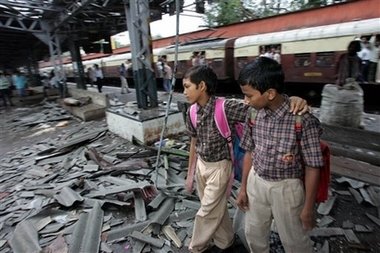
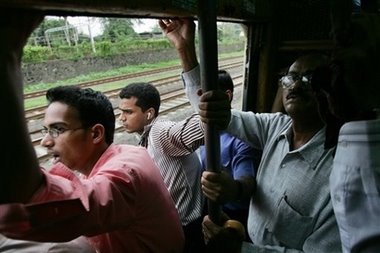
For me, the enduring images following the blasts were these, though:

A boy hands water bottles to passengers passing by in vehicles on the day of the blast.

Image source: http://news.yahoo.com/photos


A lady providing water to commuters passing by.

image source: www.timesofindia.com
A young man donates blood at a Mumbai hospital on the day of the blast.

Image source: http://news.yahoo.com/photos

Children walk to school through the wreckage the morning after the blasts

Image source: http://news.yahoo.com/photos


Mumbaikars board local trains and get back to work the morning after the blasts.

Image source: http://news.yahoo.com/photos


11 minutes
8 blasts
200 dead
(and counting)
700 plus injured
One city
Bleeding
Mourning
Bouncing
back.

Please take a moment and light an e-candle by clicking this CNN-IBN link. For every candle lit (no money required), the news channel will donate a rupee toward the relief of the blast victims. Thanks.

,