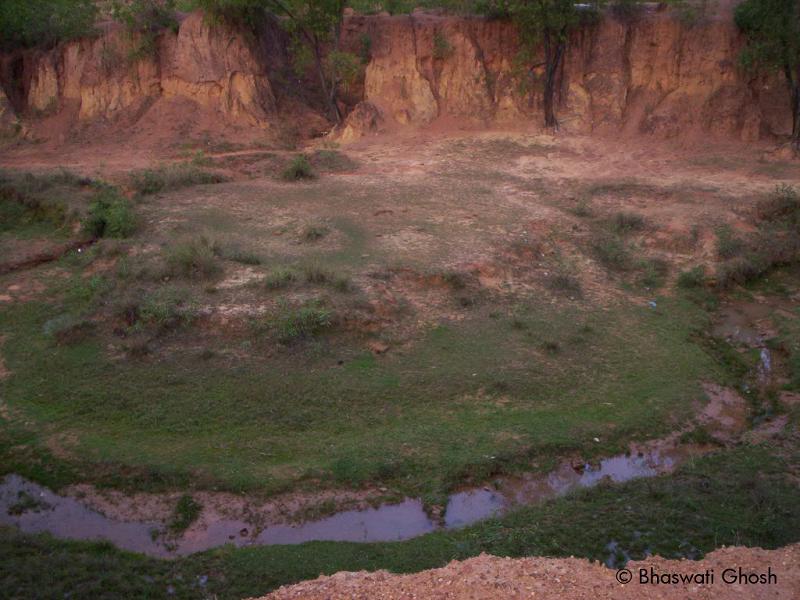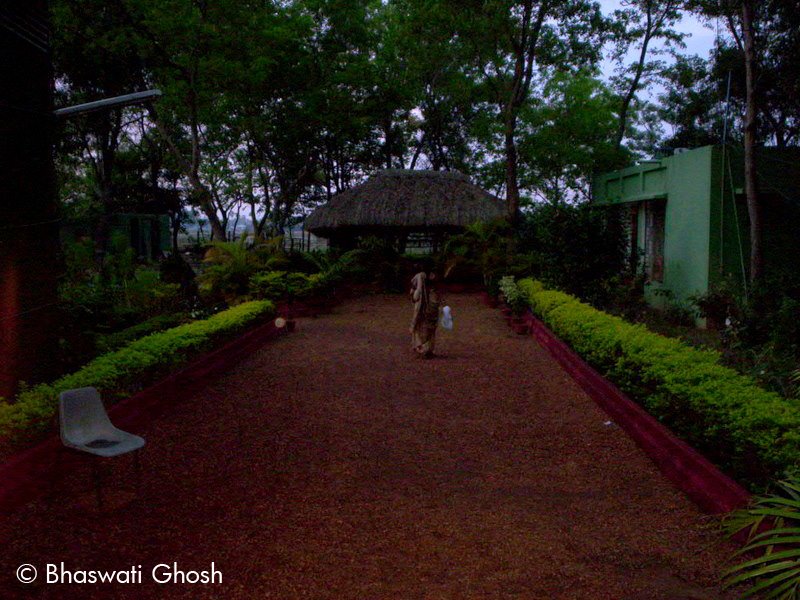
The Full Circle

Circa 3rd Century B.C.

Armed with sticks as his only tools, curiosity as his propeller and experiment as his navigator, a man discovers an exciting truth–that the earth may not be what it appears to be–flat.  Quizzed by the appearance of a shadow in one geographical location, while none at a farther distance, this man of many parts conducted a simple experiment with sticks and not only realized the roundness of the earth, but even calculated its circumference with amazing accuracy.

I got introduced to Eratosthenes and his fascinating discovery through a book called Cosmos, authored by Carl Sagan. I was in high school then. As I read about this pivotal discovery in the realm of astrophysics, I felt drawn to the site of Eratosthenes’s experiment–Alexandria. But there was more to arouse my wonder. Cosmos informed me that both Eratosthenes and the city of his work held a magnificent amount of wealth within them. The man in question wasn’t just a scientist/astronomer as has been revealed; he was also a historian, geographer, philosopher, poet, theatre critic and mathematician.

Alexandria, “the greatest metropolis of the age,” boasted of the most eclectic milieu possible. Living with each other were “Macedonian and later Roman soldiers, Egyptian priests, Greek aristocrats, Phoenician sailors, Jewish merchants, visitors from India and sub-Saharan Africa – everyone, except the vast slave population…” Though bothered by the last bit–the exclusion of slaves–I would still love to visit such a city. Even more because of what comes next…

…the city’s library and its associated museum. Cosmos says, “The Alexandrian Library is where we humans first collected, seriously and systematically, the knowledge of the world.” However, the book also records with despair that, “Of that legendary library, the most that survives today is a dank and forgotten cellar of the Serapeum, the library annex, once a temple and later reconsecrated to knowledge. A few moldering shelves may be its only physical remains.”

Not the pyramids, not the mummys, it was Egypt’s second-largest city, its extraordinarily rich  past, and one man’s curiosity-driven discovery that made me long to visit that country.
Jan-Feb 2011 A.D.

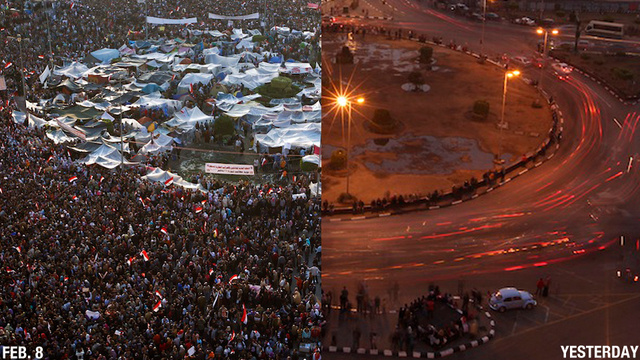
Armed with no more than hands, feet and an intense will to live free, people all over Egypt come to an astonishing discovery–that they can reclaim their lives, their dignity and their country–if only they  don’t relent. Millions–toddlers; young men and old women;  wealthy and  destitute;  religious and non-believers–smashed through their caged lives to descend on the streets of Cairo, Suez. And Alexandria.

Bolstered by neighbouring Tunisia, where a people’s revolt had just ousted an oppressive dictator, Egypt’s people took to their own streets with the same intent–to overthrow the tyrannical autocrat who had reigned for three decades–longer than all the years some of the protesting youth had spent on earth. Sparked by a common interest to see the dictator gone, the protesters forgot the differences they apparently had–of religion, sex or social position. Within hours a frenzy of revolt seized the people and spilled forth, stunning the world.

The more I saw these fearless men, women and children on television news and on the internet, the more I felt pulled to their struggle, which defied not only adversity, but even logic. For the regime they were seeking to remove pulled every dirty trick out of its closet to repress, even silence the resistance. Tear gas, water canons, rubber bullets. And then actual bullets, armed thugs, Molotov cocktails, unlawful detentions, beatings, threats, torture deaths…

The protesters did not budge.

Not for a day or two, or a week. They did not budge for nearly two-thirds of a month. Eighteen days, to be precise. Not even when the wider world turned skeptical, not when their own people pointed to the plunging economy and the threatened tourism business. Indeed, it seemed to me that they were chanting to each other this part of The Great Dictator’s speech:

“Soldiers! Don’t give yourselves to brutes – men who despise you and enslave you – who regiment your lives – tell you what to do – what to think and what to feel! Who drill you – diet you – treat you like cattle, use you as cannon fodder. Don’t give yourselves to these unnatural men – machine men with machine minds and machine hearts! You are not machines! You are not cattle! You are men! You have the love of humanity in your hearts. You don’t hate, only the unloved hate – the unloved and the unnatural!”

Everyday, ordinary Egyptians refused to be treated as cannon fodder, notwithstanding the precious, full-of-promise lives that bled and were buried. For eighteen days, humanity smiled and blossomed across that country–doctors set up roadside clinics, people shared food on the cold, hard asphalt that became their liberation square–and not just in Cairo’s Tahrir. For the first time in years, maybe in their entire lives, they sang. Of freedom.

I wished I could sing along. Right there, with them.

Not the mummys, Pharaohs, pyramids; Egypt’s people’s passion-driven heartwarming, blood-surging uprising  and its remarkable present make me long to visit that country.

Image courtesy: Gawker.com

Night Light

With the breeze of a sudden night
Comes the news of your arrival.
As I dive into the sea of slumber
You wake up,
Fusing the conscious with the unconscious.

The night goes silent, draping a blanket of darkness.
You radiate
In your own light, intrinsic glory–
A star.

At dawn, I wake up,
My feet touch the ground
There too, I see you—
In soft, full smile.
Footloose, the night’s star and the earth’s dust
Embrace, sway each other.

I bow down, pick you up,
To give meaning to my worship.

Note: Every autumn, as Durga Puja, the biggest festival of Bengalis, approaches, a certain delicate flower blooms quietly in the night, spreading its soft fragrance all over. Since my childhood, this tropical bloom has awed me with its magical essence. In Bengali, we call the flower Shiuli or Shefali.

Disclaimer: I am not a poet and don’t claim this is poetry. It’s just a spontaneous expression, triggered by memory.

Séraphine and the Source of all Sparks

The other night as sleep eluded me, I requested my husband to tell me a story. Though juvenile, the exercise was definitely enjoyable. He started narrating a tale in which the protagonist was a small car. The story took me through this little car’s journey into the big, bad, puzzling world–about its getting lost in the woods, feeling lonely and scared, and finally being brought back to its mother, a truck. A story suitable for all children, including the occasional one like myself. It was a rather well-crafted story with all components fitting well with each other and flowing logically. At the end of it, I wondered where did he, who insisted on being a reader, not a writer, get the brainwave for this story? And that brought me to the bigger question–where do well all get our ideas from? From life around us, some would say. Of course, that’s true, but what plants a particular story seed in one’s brain in the first place? The answer remains one big mystery and has been so for quite a while since humans embarked upon adventures in creative expression.

Rabindranath Tagore, toward the end of his life said something to the effect that he never wrote anything of his colossal body of work. He meant that all his writing had “been written,” that it wasn’t something he could claim as his deed. His refrain is echoed by Mirza Ghalib, one of the greatest and most revered of Urdu poets. Ghalib condenses his creative process in a couplet where he says:

Aate hain ghaib se yeh mazaami khayal mein

Ghalib sareer-e khaamah nawaa-e sarosh hai

Loosely translated, it means

These flourishes of imagination come to me from (nowhere)

These words are the ones uttered by the archangel.

And in the book on the legendary Indian sculptor-painter, Ramkinkar Baij that I translated, the artist says in one place:

“A lot of times, one doesn’t know what form the painting will acquire. You understand? The image comes alive on its own. It inspires awe. Completely stuns you. Then I think intoxicated, where does that man, who quickly drew the picture by keeping me standing like a mute witness, live? “

I like to think the mystery of creative spark is what endows it with so much excitement. When you start off, it’s not a known path you take, it’s not a less-known one either; it simply is one that unfolds in real-time, moment by moment. And nothing brought home this aspect of creativity to me more than a film I watched recently.

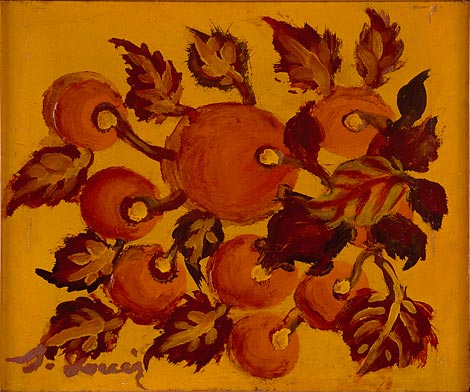
Séraphine, a 2008 film, tells the story of a self-taught French painter, Séraphine Louis or Séraphine de Senlis (Séraphine of Senlis) who was born in the late 19th century, and died in 1942. When I read the film’s synopsis, I took it to be fictional. For it is hard to believe the extraordinary life of this artist and the events that punctuated it. Orphaned by the age of seven, Séraphine grew up to a life deficient in comforts of the material kind, but rich in imagination and nature’s marvels. After spending years working as a shepherdess and a maid, she got hired as a servant by the nuns of a convent when she was eighteen. Pious and hardworking, she spent two decades with the convent, before returning to her role of a maid to keep her stomach palette filled. This is the role–of an ageing maid–that the film Séraphine opens with. We see a zaftig and somewhat eccentric spinster in the houses of aristocrats in the French town of Sinlis.

She is like any other maid one might have come across at that time–earnest, diligent, careful with her money. Except, she is not any other maid of her time. Yes, she is earnest in her chores of floor-mopping, cloth-washing, dish-cleaning, but her real sincerity lies elsewhere. She is most diligent in answering the commands of her masters and mistresses; but it’s nothing compared to the command she truly cares for. And the prudence she shows with expending her meagre earnings is not to indulge herself, except for her life’s passion.

Early on, along with portraying the rigours of her job as a maid, the film establishes her love of nature. Next, it is revealed that the pennies she so painstakingly earns and haggles for with her employers are not for buying bread, but art materials–paints and brushes–from a local store. She is even shown to sneak oil from church lamps, except her god knows this is no pilferage. For, in the course of the film we learn that Séraphine‘s foray into the world of painting was prompted by a command she received from her guardian angel. We see her painting furiously, squatting on the floor of her cramped, untidy room, even as she fails to pay rent. Her subjects are typically drawn from the natural world–trees and birds she would claim to “talk to”, fruits and vegetables, animals and the sky.

“Séraphine is a visionary in the powerful sense of the word. She let herself be carried by something that was stronger than she was, that she did not control, at the risk of destroying herself.”

[From an interview with Director, Martin Provost]

It’s not long before the film as well as Seraphine’s life story take a decisive turn–with the entry of Wilhelm Uhde, a German art collector. He rents an apartment in Senlis, where Séraphine does cleaning work. By sheer chance, he comes across one of her paintings at a dinner invitation. Struck by the creative vitality, Uhde immediately takes her under his wings. Even as his encouragement bolsters the artist inside Séraphine, the scimitar of World War I slashes their association–the art collector has to flee Senlis as his house is raided. Thirteen years later he returns to France and, once again, is faced with Séraphine–through a painting of hers he sees at an exhibition of local artists’ works.

One of the most touching parts of the film is when Uhde traces his steps to Seraphine’s creaky room and assures her of supporting her painting career–by this time, the old maid is even older, and weighed down by age and its annoyances, she cuts down on her house assignments, focusing instead on her heart’s calling–painting. Soon, thanks to the provision of art materials and a monthly allowance, set up by Uhde, the self-taught artist begins painting with an intensity greater than before. We see her causing an explosion of colours on huge canvases, even as her lifestyle too improves. This burst of creativity wouldn’t last too long either. This time, her own mind would be at war with Séraphine. Hallucinated and “hearing voices,” she scares her neighbours and is finally taken to a mental asylum. Almost immediately, she gives up painting. Forever. Three years after her death, Uhde would organize an exhibition devoted entirely to Séraphines works in Paris. Ironically, during the last phase of her painting life, this is what Séraphine desperately wished for–a solo exhibition.


As exceptional as Séraphine Louis’s life story is, the film achieves in conveying it with outstanding maturity. The strongest element in this is Yolande Moreau, who is Séraphine in the film. She appears so natural–both physically and in her mannerisms–that it’s hard to believe she is acting in a film and not living her actual life. However, what makes the film all the more powerful is the deftness with which the director, Martin Provost, has turned almost every frame into what could be a painted canvas or a brilliant photograph–works of art. Whether it be the fields or streams Séraphine passes through or the night when the terror of war booms through Senlis streets with cannon shots or Séraphine’s imaginations bursting forth on to a canvas–the scenes are rich with eloquent detail. Yet, none of it is loud that would scream for attention.

“Whether it be for the costumes, the sets, or the lighting, we were intent on making sure that everything was a bit “withdrawn.” A general desire for sobriety and discretion; the least amount of effects.”

[From an interview with Director, Martin Provost]

Even as Séraphine‘s story intrigues me, it brings me back to the exciting mystery that spawns creativity, while also stuffing me with bagfuls of inspiration.

“Séraphine was a simple cleaning lady—worse, a handy woman—who painted extraordinary things in secret and who was the butt of all jokes. She represented at the time what was the lowest on the social ladder. But she didn’t care. Nothing stopped her. She was able to preserve her autonomy in spite of everything, her inner life’s abundance in the secret of her little room, even if it meant accepting performing the most thankless jobs.”

[From an interview with Director, Martin Provost]

Do watch this film if you can. You won’t regret it.

Martin Provost interview source: http://www.seraphinemovie.com/

Pagol or Madman by Rabindranath Tagore

Translated by Bhaswati Ghosh

A small town in the west. At an end of the big street, five or six palm trees rise above thatched roofs like a mute man making signs to the sky. Next to a derelict house, an ancient tamarind tree puffs up its dense, glistening foliage like clumps of green cloud. Young goats move about on the ground of this roof-less house. Behind them, the lushness of the forest range spreads across the horizon of the afternoon sky.Today, rain has completely withdrawn its dark cloak off this town’s head.

I have a lot of important things to write—those remain unwritten. I know this would be a cause of regret in the future; let that be; I would have to accept that. One can never know or stay prepared for the moment when or the form in which wholeness emerges, but when it does, one can’t welcome it empty-handed. At that moment, the one who discusses loss and gain must be a smart accountant and would do well in the world; but dear vacation of light in the midst of glum ashadh (1), in front of your momentary bright, cloud-less glimpse, I put to dust all my important activities—today, I won’t make calculations about the future—I am sold off to the present.

One day follows another, none of them demands anything of me; the calculations all add up, work happens smoothly. At such times, life progresses by linking one day to the next, one task to another, making everything uniform. Suddenly, when a special day appears without notice, like a prince from across the seas; a day unlike any other, the trail of all the days past is lost in an instant—on that day, it becomes difficult for routine work to proceed.

Such a day, though, is our big day—a day of irregularity, of ruining work. A day that arrives to defeat our everyday is our day of joy. The other days are for the intelligent, the careful. This one day is for giving ourselves completely up to madness.

Mad isn’t a hateful word to us. We worship Nimai (2) because of his craziness; Maheshwar (3) too is our lunatic god. The West is debating as to whether talent is only a form of developed craziness—but here (in the East), we don’t feel ashamed to accept this as true. Inspiration is, of course, craziness, it is an exception to the rule, it comes only to upset order—it emerges all of a sudden—like today’s haphazard day—and destroys all the work of working people—some curse it, some others go crazy, dancing and delighting with it.

Bholanath (4), who remains as the joyful one in our scriptures, is one such oddity among all deities. I see that mad lord amidst the flood of sunshine shining through this day’s washed blue sky. His tabour plays steadily within the heart of this thick afternoon. Today, death’s naked pure face stands still in the middle of this work-filled world—with beauty and peace.

Bholanath, I know you’re strange. In every moment of life, you’ve appeared with your begging sack. and completely wrecked all calculations and measurements. I’m familiar with your Nandi (5) and Bhringi (6). I can’t say that they haven’t given me a drop of your intoxicating beverage; these drops have inebriated me, everything has been upset—today nothing is in order for me.

I know that happiness is an everyday item, but bliss is beyond every day. Happiness remains constricted, fearing it may get dirty; bliss rolls over dust and shatters its separation with the universe; that is why to happiness, dust is inferior, but for bliss, dust is an ornament. Happiness is afraid of losing something; bliss is delighted to relinquish everything; for this reason, to happiness, emptiness is poverty, but to bliss, poverty is abundance. Happiness carefully protects its grace within the confines of order; bliss openly expresses its beauty in the freedom of destruction; this is why happiness is bound to outward rules, but bliss breaks those bounds to create its own rules. Happiness waits for nectar to arrive; bliss drinks the poison of sorrow with ease. For this reason, happiness is partial to only good, but for bliss, good and bad are no different.

There’s a madman in all of this creation who brings in everything that is inconceivable for no reason at all. He’s the centrifugal force who is forever pulling the universe outside rules. The god of rule is always trying to put all the world’s paths into a neat orbit, and this madman overturns that and twists it into a coil. At his whim, this madman creates birds in the clan of snakes and man in the family of apes. There’s a desperate attempt in the world to permanently protect all that has occurred and all that is; he plunders all of that to carve paths for what is not yet there. His hands don’t hold a flute, harmony isn’t his tune; his pinak (7) rumbles, all orderly yagna (8) is ruined, and out of nowhere, something wonderful appears on the scene. Craziness and talent, both are his creations. The one whose string breaks at his pull goes mad, and the one whose string plays in an unheard melody becomes gifted. Mad people are outside the range of the ordinary, and so it is with talented people. The mad, however, remain on the fringe only, while the gifted take ordinary people into a new realm, thereby increasing their rights…

It’s not as if this mad lord of ours appears only at certain moments; in creation, his madness is always at work; we only get a glimpse of it in certain moments. Death is forever making life new, bad is brightening good, and the inconceivable is giving value to the trifle. When we get such a glimpse, the freedom within the form becomes evident to us.

Today, amid this cloudless light, I see that amazing face. The road across, the thatched-roof provisions store, the broken house, the narrow by-lane, the trees and vegetation—I used to see all these with the pettiness of everyday familiarity. That’s why these had confined me—kept me in house arrest within these daily images. Today, all of a sudden, all the pettiness is gone. On this day I see that for so long as I had been viewing the unknown as familiar; my seeing wasn’t clear at all. Today, I can’t finish looking at all these. Today, all of these things surround me, yet they don’t imprison me, they all make way for me. My madman was here only—that spectacular, unknown wonder, who did not ignore this thatched-roof provisions store—only, I didn’t have the light before my eyes with which to view him. What is amazing about today is that these nearby images have acquired for me the glory of a far-off place. The impenetrability of the snow-capped Himalayas and the impassability of the wave-ridden ocean express their fraternity with the madman.

In this way, one day we suddenly realise that the one with whom we had established a familial relationship remains outside our family. The one whom we had taken to be readily available in every moment is actually rare and hard to get. Those, around whom we had drawn a boundary thinking we knew them well, appear to have acquired a marvellous mystery by crossing all boundaries. The same one who, when viewed from the side of rules and balance, appeared rather small, quite regular, very familiar, when viewed from the side of breach, from the angle of that graveyard-roaming madman, turns me speechless—amazing! Who is that! The one whom I have always known is now this, who! The one who is part of the home on one side belongs to the heart on the other. The one who is important to work on the one hand is completely outside all necessities on the other. The same one whom I touch on the one hand is, on the other, beyond all grasp. The one who has managed to fit well with everyone is, at the same time, a total misfit, absorbed in self.

Today I saw the one whom I don’t see every day. In so doing, I gained freedom from every day. I thought I was bound by the everyday rules within the fence of familiarity surrounding me. Today I see, I have been forever playing on the lap of grand wonder. I thought that I had been making my daily calculations under the sharp gaze of a big officer in the office. Today, at the roaring laughter of the miscalculating madman—who is bigger than the big officer—reverberating through water, land, sky, air and the entire universe, I heave a sigh of relief. My workbook remains untouched. I lay down the pile of my important work at the feet of that capricious madman—let the blow of his Tandava (9) smash it into pieces and blow it off as dust.

1. Ashadh: A month of the Hindu calendar

2. Nimai: A prominent saint of medieval Bengal and the founder of Bengal Vaishnavism. Also known as Chaitanya Mahaprabhu.

3. Maheshwar: Another name for Shiva, a major Hindu deity. The god of destruction.

4. Bholanath: Alternative name for Shiva.

5. Nandi: Shiva’s vehicle, a bull.

6. Bhringi: Originally a demon who was transformed by Shiva into a humble devotee and admitted into his force as a commander of his armies.

7. Pinak: Shiva’s bow.

8. Yagna: A Hindu ritual, dating back to Vedic times, carried out to please gods. Oblations are poured into sacrificial fire, as everything that is offered into the fire is believed to reach the gods.

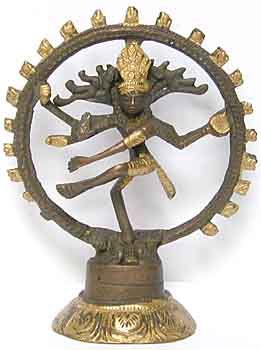
9. Tandava: In Hindu mythology, Shiva’s Tandava is a vigorous dance that is the source of the cycle of creation, preservation and dissolution.

Echoing Rendezvous

I came to see you. Yes, there was work, but does one need work to come and see you? As I told fellow train passengers the reason of my meeting with you, I smiled inwardly at the flimsiness of it all. Aren’t you both the context and pretext for every visit of mine?

Upon reaching, I looked for a familiar face among the milling, hollering mass of heads floating before the eyes. I searched for Anwar, the rickshaw-puller, who hadn’t only acquainted me with you, but had also helped me know you so intimately. I couldn’t find Anwar, but you hadn’t forgotten me.

As I came along, you embraced me–wide-armed and ever so charming. Thereafter, you winked every time I looked at the faces of the countless rickshaw-pullers, hoping to see Anwar’s mask on one of them. All along, you never left my hand, caressing me through wild meadows, neatly trimmed gardens, haphazardly scattered bamboo bushes, and those closest to you—the people of the soil, treading by with their sun-burnt bodies and folksy smiles. As I passed by Khoai, I couldn’t help feeling awed at this magnificent rock site that you still dote on so tenderly, just as you do with those earth-people.

And then, when it rained even as evening’s dark cloak couldn’t soak all that outpour, there, at the craft shop, miles and miles away from where we were staying, you sat with me and nudged me to enjoy the rain with you. For monsoons take on such an electric aura in your company. And I remember the worry in my heart dissolved in that torrent, even as it washed through the meadow, the garden, and those swaying bamboo poles.

On the day of my farewell, Anwar showed up at the door. Not for a moment during my courtship with you could I predict you had stored this mischief for the day of my departure. As Anwar’s yellow teeth gleamed through his unkempt mustache, I could see you winking once more. As I stepped on to his rickshaw, you stood by at every stop of mine—the baul neighbourhood, the bookstore, the street-side jewelry shops.


Leaving you wasn’t easy, but who said I did? Shantiniketan, dearest, you remain alive, green, and invigorating right here, no matter how far I am from you in terms of space. Or time.

The Year’s End by Rabindranath Tagore

Today as I reached the silent peacefulness of this place, away from the clamor of the capital’s human assembly, the sky was covered in evening’s glow. Cloud clusters had lent a soft hue to the green of the forest by placing shadows on it; had I stayed in the capital, I couldn’t have seen this face of the year’s last day with the clarity that I did here. There, a covering of whirlwind encircles everything; that covering hides the united form of beginning and end in creation. The music of human life needs to pause for returning to the start again and again. But amid the cacophony of crowd one feels taan* after taan play on without pausing to return to the first beat. There, man moves with the crowd’s push; that movement is devoid of rhythm…

When evening descends on a city, it can’t reveal itself, the day’s noise barges in to choke its voice. Daytime’s labor looks for crude excitement in evening’s leisure. Tired of body and mind, I had thought I wouldn’t gain entry into the year’s last day today. Suddenly, thick clouds caressed the woods; the expansive bliss spread across the horizon didn’t appear as emptiness but as beauty. I see this evening filled to the brim with the wholeness that rests within the endless stream of the world’s work. In meditation I realized, that which I know to be the end in the outside world hides the seeds of new life in this place.


In every moment I see that life’s entire prosody is contained within conclusion. Without pause, rhythm would lose its identity…In mankind’s history, several civilizations have vanished after a period of grandeur. The reason was that those civilizations had lost the pause; they only scattered their enterprise, didn’t care to pick up the same…So the rhythm broke. The first beat came back in the wrong place, and it wasn’t cessation; it was destruction.

It is my good fortune to have come here today. In the city I returned from, the evening’s face is one of frenzy, not of well-being. There, death’s identity has lost its solemnity. Human habitations make every effort to deny death. That’s the reason one can’t see the truth of death in such places…May the end show us that face of liberation, which contains wholeness.

Calmly I say, “Dear End, within you resides the infinite. I see in your eyes a trace of tear on this last day of the year; separation, dejection, and weary melancholy eclipse dusk’s darkness. Despite that, assimilating and crossing over all those, I hear your voice within and without. Om. The heart’s pain has only lent it beauty—tears haven’t dulled it, yet made it gentler. Every evening, death reveals its calm and graceful face across the immense star-draped sky. Embracing it, we lay down—relieved—all the day’s burdens.

At the end of the year, I see that same vast face resting on the untiring, imperishable throne of darkness. I pay my obeisance to it.”

* Taan is a virtuosic technique used in the performance of a vocal raga in Hindustani classical music. It involves the singing of very rapid melodic passages on the syllable “a.” It is similar to the technique ahaat, used in Arabic music. [From Answers.com]

Humility


When the moon and the stars loom up there
You glow on the universe of your foliage–
As the world goes to sleep.


Silently you come, without a fuss;
No announcement, no flaunting of beauty
Not any attempt to hold the passerby spellbound.


In the morning, before the world rubs its bleary eyes,
You silently drop down,
No clinging, no worrying
about getting crushed under walking feet.


Yet, you draw us–
By your plain scent,
Your unassuming beauty,
Your amazing way with stopping passersby,
Bringing them down to their knees,
To pick you up gently.

You just smile, silently.

Note: Every autumn, the Shiuli, a small flower with white petals and orange stalk, blooms in different parts of India. This delicate flower blooms in the dead of night and by morning, drops off the branches. It has a soft, mild fragrance and heralds the biggest Bengali festival, Durga Puja.

On a Cloudy Day by Rabindranath Tagore

All our days are filled with work and people. At the end of each day, one feels the day’s work and exchanges have said all that needed to be said. One doesn’t find time to grasp that which remains unsaid.
This morning, cluster upon cluster of cloud has covered the sky’s chest. There’s work to be done today as well, and there are people milling about. But there’s a feeling that all that lies inside cannot be exhausted on the outside. Humankind has crossed seas, scaled mountains, dug holes under the ground to steal gems and riches, but the act of transmitting one person’s innermost thoughts and feelings to another—this, humans could never accomplish. PartlyCloudy
On this cloudy morning, that caged thought of mine is desperately flapping its wings inside me. The person within says, “Where is that forever friend who will rob me of all my rain by exhausting my heart’s clouds?”
On this cloud-covered morning I hear the voice inside me rattling the closed door’s fetters again and again. I wonder, what should I do? Who is the one at whose call my words will cross work’s barrier to journey through the world with a lamp of song in my hands? Where is the person whose one look would string together all my beads of pain into a garland of joy and make them glow in a singular light? I can only give this pain to the one who begs it of me with the perfect note. At the bend of which road stands that ruinous beggar of mine? My inner ache wears a saffron robe today. It wants to emerge into a path, which, like the innocent single string of an ektara, chimes within the ‘heart’s person.’
Translated by Bhaswati Ghosh

The Impressions Didn’t Die

Anyone got a writer in the family? Other than yourself I mean. I ask this because as I dive deeper into the writings of my maternal grandmother, I find myself in the midst of an amazing discovery.

She died when I was fifteen—an age when much of my sensibilities had already shaped by the influences around me. Titti, as I called my grandma, was a major influence. This had to do more with her personality than with the fact that she was a writer. While in school I had taken a liking to writing and was encouraged by some teachers in that direction. It was natural for me to look up to Titti, the writer. But for the growing me, Titti, the loving grandma, who understood the language of our generation, came first. When she was alive, I barely read any of her writing—fiction or nonfiction. Two years before her death, while shuffling some of her stories in her file she told my mother, “Tutun will get my writing published one day.” She couldn’t have been more prophetic. All these years after her death I seem to have found a small but committed publisher in Calcutta who appreciates her work and has shown interest in publishing them. During her lifetime, Grandmother had had limited publishing success. The main cause of this was her lack of proximity to the Bengali publishing world; living in New Delhi, she didn’t have the easy connectivity with prospective publishers that writers living in Bengal did.

These days I am taking out her ink-fading, paper-withering stories and typing them in Bangla so as to get them ready for the publisher. I feel ashamed to admit this is pretty much the first time I am reading most of her writing. And it is through this process that I am getting to know her deeper, while at the same time reliving the warm atmosphere she embodied as a living person. Writer friend Sandra Kring used to tell me no matter what writers write, all their works contain bits of them. I understand the real meaning of that now.

Titti, the person as I saw her, was compassionate. She cared deeply for people around her. Even as she struggled to bring food on the table for her family, she didn’t stop providing lunch to the domestic help who worked in our house. The maid worked in half a dozen homes in our neighborhood, yet my grandmother was the only employer who fed her a full-scale afternoon meal. I remember, on days when Titti had to go out to the bank or post office, she would put the food she had freshly cooked onto a plate, cover it and ask me to serve it to the maid once she was done with her chores. Titti was also highly aware of what went about in the world—be it regarding politics, sports, or entertainment. A great conversationalist, she gelled with people of all age groups, because of her ability to talk about any subject. The country’s politics interested her a lot, and she would often be seen engaged in intense debates with my grandfather who remained rigid about his political affiliations for as long as he lived. Titti, on the other hand, was a rationalist. “I will love those who love my country,” she would say, never attaching herself to any particular party or ideology. And in the end, my grandmother was modern—a woman way ahead of her times—in thoughts, not appearances. Born and brought up in rural Bengal amid village customs and superstitions, she didn’t care much for rituals. Seeing how much venom had been spewed in the name of religion, she felt the world would perhaps be a better place without organized religion of any kind.

Now, as I read her works, I find I knew but a tiny fraction of her when she shared the living space with us. Her writing reveals all the above facets of her persona—but with so much more depth. In her story about a batch of East Bengal refugees living in a government home in New Delhi following the Partition, I get to see her compassion as her real-life role of the home’s administrator enters the narrative, which, though written in fiction format, is hardly fictitious in terms of content. I see, my eyes getting soggy, how deeply she empathized with the refugee women who had lost so much—land, children, husbands—even when they poured their wrath on her. In her story about the lives of women working as domestic help, I see her journalist-like eye to detail, her dispassionate yet sincere voice, which hits the reader, even when it’s not overly sentimental. Something within me stirs when I read her story featuring two soldiers posted on the frontier, where the senior one can’t make sense of the wars he’s fought, especially when he compares them to the “everyday war” his mother and wife fight in their struggle to lead a life of dignity.

I am only in the initial phase of putting together Titti’s writings for the publisher. Yet, I sense I am bonding with her in a way I never did when she was alive. I can see how all her works contain the person she was. It’s hard to describe, but after all these years, I suddenly don’t feel the void that pained me for a long time after Titti passed away.

For, she kept herself intact in those wilting sheets.

The Wait

I waited for you.

I waited through days that won’t turn into nights.

I waited even as others fled, unable to bear the separation.

I waited with the still, suffocating air that drained out my senses.

For you I survived, barely alive, yet expectant, when others died.

I waited when the prophets said you would take a long time coming.

And then, you came.

You brought the cool brush of night right into the day.

You embraced me with a smile; my reward for not deserting you.

You changed the very complexion of the air with your every stance.

You put life back into dead, parched souls with your lush strokes.

You came for me, defying the prophets.

You came.


Dearest Rain.