At Ramkinkar’s House with Shakti (Memoir) by Samir Sengupta

Translated from the Bangla by Bhaswati Ghosh

First published in Parabaas

It must have been the middle of the 60s decade—or was it the beginning? I don’t remember the year, only that the days were of intense spring. The festival of colours had ended just a few days ago.

Shakti said to me, “Samir, let’s go to Santiniketan. The Khoai area is ablaze with Palash now.” Shakti had just crossed 30 and was neck deep in his Birbhum phase. Every year, his presence at the Kenduli baul fair was almost a given. He didn’t just have a personal relationship with the bauls who came to the fair, as Chandi Lahiri has written, he was intimately in touch with their family affairs, joys and tribulations. Nabanidas (Purnadas Baul’s father) was still alive at the time; after retiring from the post of peon in Sultanpur Sriram High School, he had built his akhra at the outskirts of Siuri town. Shakti would run to that place on a whim and return only after spending a few days there. He was dear to Nabanidas. Shakti was not acquainted with Meenakshi yet. He said to me, “Let’s go—I haven’t met Kinkarda in a while. We will spend a night with him; then go to Siuri.”

In those days, it used to take a long time to reach Santiniketan. There weren’t too many good trains, land prices in Santiniketan hadn’t started shooting up as yet, the rich of Kolkata hadn’t begun occupying Khoai to build houses.

By the time we reached the place, the afternoon had nearly slipped away. Just before Cinematola, there used to be a country liquor shop called Akorshoni; Shakti stopped the rickshaw there and grabbed a couple of bottles.

Next, he stopped the rickshaw in front of Ramkinkar’s house and said, “Wait; we won’t let go of the rickshaw yet. Let’s check if Kinkarda is there or not.” He used to go away to Jugipara at times. Acting like a detective, I said, “The door is ajar; he must be there…” Shakti looked at me and said with a smile, “Kinkarda never locks the door.”

“What? He goes away to his village without locking his door?”
“He doesn’t have any lock; Kinkarda, O Kinkarda…” Shakti started yelling from the rickshaw itself. A barefoot Kinkarda came out, tending to his lungi. “Arre, poet, you are here—come, come, I hope you have got something for me? Who’s that with you?”

As he picked up the jute bag from the rickshaw base, Shakti laughed and said, “I have brought stuff, Kinkarda. This is my friend, Samir.”
“Does he write poetry?”

I quickly folded my hands and said, “No, Kinkarda, I don’t write any poetry.”

Kinkarda rolled his eyes and said, “Then why have you come here?”

My hands still folded, I said, “To give company to Shakti and to see you.”

He just said, “Oh” and then completely oblivious to my presence, took Shakti inside the room, almost in a warm embrace. I guess he remembered me while crossing the door; he looked back and said briefly, “Come.”

I entered the house. The famous house that has been described by so many. The signs of poverty were everywhere. On one side was a string cot with dull, faded bedding. On top of the bedposts lay a folded, dirty, almost blackened mosquito net. A few painted canvases lay above the net. We learned that it had rained a few nights ago and water was leaking through a hole on the roof. An irritated Ramkinkar had woken up; put a few canvases atop the mosquito net and gone back to sleep. If water had to drip, it would fall on the canvases.

Ramkinkar squatted on the floor; we followed suit. Butt-ends of bidis were strewn everywhere. Kinkarda pulled out a few earthen tumblers from beneath the cot. As he used his seasoned hands to remove the tar-sealed cap, he called out, “Mungri, O Mungri…” A good-looking adivasi girl came and stood at the rear door. Ramkinkar uttered some instructions to her in a language unknown to us; the girl disappeared. He looked at Shakti and said, “I sent her to her village to check if she could fetch us some grilled pork.”

It was almost three in the afternoon. He never asked if we had any lunch or not; food arrangements meant that pork meat, if available. He poured the liquor into the tumblers with great care and presented them to us in a manner befitting a Japanese tea ceremony host.

The pork came and vanished; a rickshaw-puller was made to bring two more bottles, along with some roasted chickpeas; those were gobbled up in no time. Two more were brought by paying a premium—it was past ten in the night. I don’t remember anything after that. I just remember endless country liquor, endless bidi smoke, endless talk, endless songs of Tagore, sung in broken voices.

I don’t know what time of the night it was when my consciousness returned, triggered by severe thirst. The early summer heat of Santiniketan’s Chaitra, coupled with limitless tumblers of undiluted country liquor might have been nothing unusual for Kinkarda and Shakti. I was sheer lucky not to have suffered dehydration.

For a while, I kept sitting quietly. It was pitch dark and the place unfamiliar to me. I extended my hand and felt Shakti, sleeping unconsciously beside me. I couldn’t spot Kinkarda. But it seemed as if my life would ebb away without water—the body was so dry. Where could I find some water?

While still sitting I felt the darkness melting away a bit. How did that happen? Was dawn approaching? I turned back and figured a light in the shape of a small rectangular door—a lantern must have been lit somewhere inside. Could I find water there?

As I started getting up, extreme dizziness gripped me—it was impossible to stand. I sat down. The moment I moved a bit, the unknown world around me started swaying. But I had to drink some water. After a while, I gathered enough strength to crawl towards the door.

The door led to a verandah; on the left, with his back to the door, at approximately a thirty-degree angle sat Kinkarda on a stool, stark naked. He hadn’t noticed his lungi slip off his waist. Before him, on a high stool (I don’t remember if it was a turntable or not) stood an unfinished clay sculpture; the lantern was hung on a bamboo support fixed to the ceiling. His right hand held a small fistful of clay. Sitting on the stool, Ramkinkar stared at his work—motionless. A million mosquitoes were clouding around him, but he didn’t seem to notice. His eyes had a strange, blank expression—he looked on, but didn’t seem to see with his physical eyes. It was more of what Ramakrishna had called a yogi’s eyes—he had said that when a bird sits on her eggs, the look in her eyes suggests that she was looking, but not really seeing anything; all her focus remains concentrated on her eggs. Ramkinkar had the same look in his eyes.

Even in my semi-conscious state I realized I had trespassed. I had no business there; even if I died of thirst, this wasn’t a place to ask Ramkinkar for water. And even if I did, he wouldn’t be able to offer me any. I crawled back to the room and lay down with my parched throat.

It must not have been more than a minute. I saw Ramkinkar only that one time, nearly fifty years ago—yet it is one of the few visual memories that remain immortal in my petty life. After my death, if God asks me what I saw in the world of dust and clay, I will be able to say, “I saw your contender, immersed in his art of creation.”

Translated from Amar Bondhu Shakti (আমার বন্ধু শক্তি) by Samir Sengupta; published published by Parampara, Kolkata in 2011.

Immigrant’s postcard (mini) – Four days in Québec City — Part 2

Read other Immigrant’s Postcards here.

Day 3: Wet-weather friends

DSC05593It’s a rainy day.

Since morning, we haven’t accomplished much, other than eating brunch, visiting the observatory, and walking to the bank to draw cash. After a mostly sleepless night, my zombie feet refuse to dance in the rain anymore without a burst of caffeine.

We keep dragging ourselves through the soaked streets of this still-much-foreign city, desperately looking for a café. It’s nearly three in the afternoon on Canada Day, and many cafes and bistros have downed their shutters.

Discouraged, we keep plodding towards our hotel when a 24/7 and “Ouvert” sign flashes before me. We walk in – it looks like a big sports bar – hockey plays on multiple TV screens as I take a seat and put down my drenched umbrella. My husband walks over to the counter to place our order of coffee and baklava.

“Bonjour,” the cashier, a young Francophone, greets him. “Where are you from?” He asks my visibly tourist husband.

“We’re from Ontario,” B says. The answer is less than satisfactory.

“No, I mean where are you from originally?”

“Oh. India.”

“Namaste,” says the cashier, offering a knowing smile and not a handshake but a full-blown namaskar.

He has more to offer.

“Naam kyea haie?” He asks B.

“Bhupinder. Aapka naam kya hai?”

“Francois.”

On a soggy afternoon, three people fleetingly enter a spot of friendship over steaming coffee and the sticky sweetness of baklava in a mostly empty sports bar.

DSC05913-001Day 4: Lead kindly light

We’ve just been to the unabashedly gorgeous Montmorency waterfalls. Soaking wet in the fall’s mists, as we sit back in the dry comfort of the car, my husband tells me of a religious shrine that’s among the region’s attractions.

And so we alight in front of the impressive Basilica of Sainte-Anne-de-Beaupré , moments later. After clicking the customary outside photos, we walk in. The church’s magnificence — in scale, splendour and decoration — enthralls me. I gesture to my husband to take our seats in a pew.

The sanctum is abuzz with activities and devotees keep streaming in. B uses the time to click photos of the stained glass windows, sculpted walls and spectacular ceiling. An elderly man is seen walking towards the pews, talking to people. He soon comes to us and asks B,

“Bonjour, Francais?”

“English,” B says.

“Oh. French – not yet?” The gentleman says, the possibility in that question perceptible in his hopeful affection and playful smile. “They are going to have a Mass in five minutes. No cameras during that time, please. You can take all the photos you want after that. Welcome to Sainte-Anne-de-Beaupré.”

When the service begins a few minutes later, we see the same man attired in full priestly robes – he is the Father of the church.

And so we sit through an hour-long Mass without understanding a word of it (all French), yet enveloped in organ music and stirring singing, soft light, burning candles and incense smoke, prayer chants and the Father’s impassioned address from the pulpit.

Is it because we want to take photos afterwards (we don’t end up taking that many)? Maybe. But I believe it’s more because of a priest’s gentle voice and kindly smile.

What we experience can’t be photographed anyway.
Read Part 1

Immigrant’s postcard (mini) – Four days in Québec City — Part 1

Read other Immigrant’s Postcards here.

Day 1:  The Sisters

DSC05665After a 10-12 km walking tour of the fortified city and along the river, we sit down on a bench at the foot of the majestic Château Frontenac hotel to catch our breath.A stream of people—mostly tourists, some office goers, a few elderly folks—pass us by.

A group of three Chinese women (sisters? friends?)—probably in their fifties—arrives. We can’t decipher their animated conversation. But two of them take their cameras out to photograph the third lady, who is only too happy to pose.

She stands next to a bench facing us, holding an arm up. “Hold on, I’m not done yet,” she seems to say to her friends while swiftly moving up the hill behind the bench. There, she takes her position, raising an arm and a leg even as she prods the other two women to click fast.

Passersby pause in their walk to take in this unique scene; some explode into laughter.

And although there is no sea in sight, all I’m reminded of is the comradeship of the widowed sisters-in-law in Tapan Sinha’s “Nirjan Saikate.”

Day 2: Pocket change 11707794_10153519566065087_1302432540971826171_o

Back from a lush and soothing ferry ride across the St. Lawrence River, we buy crepes from a mother-daughter stand at a local artisan fair. We walk into a park to consume the supper.

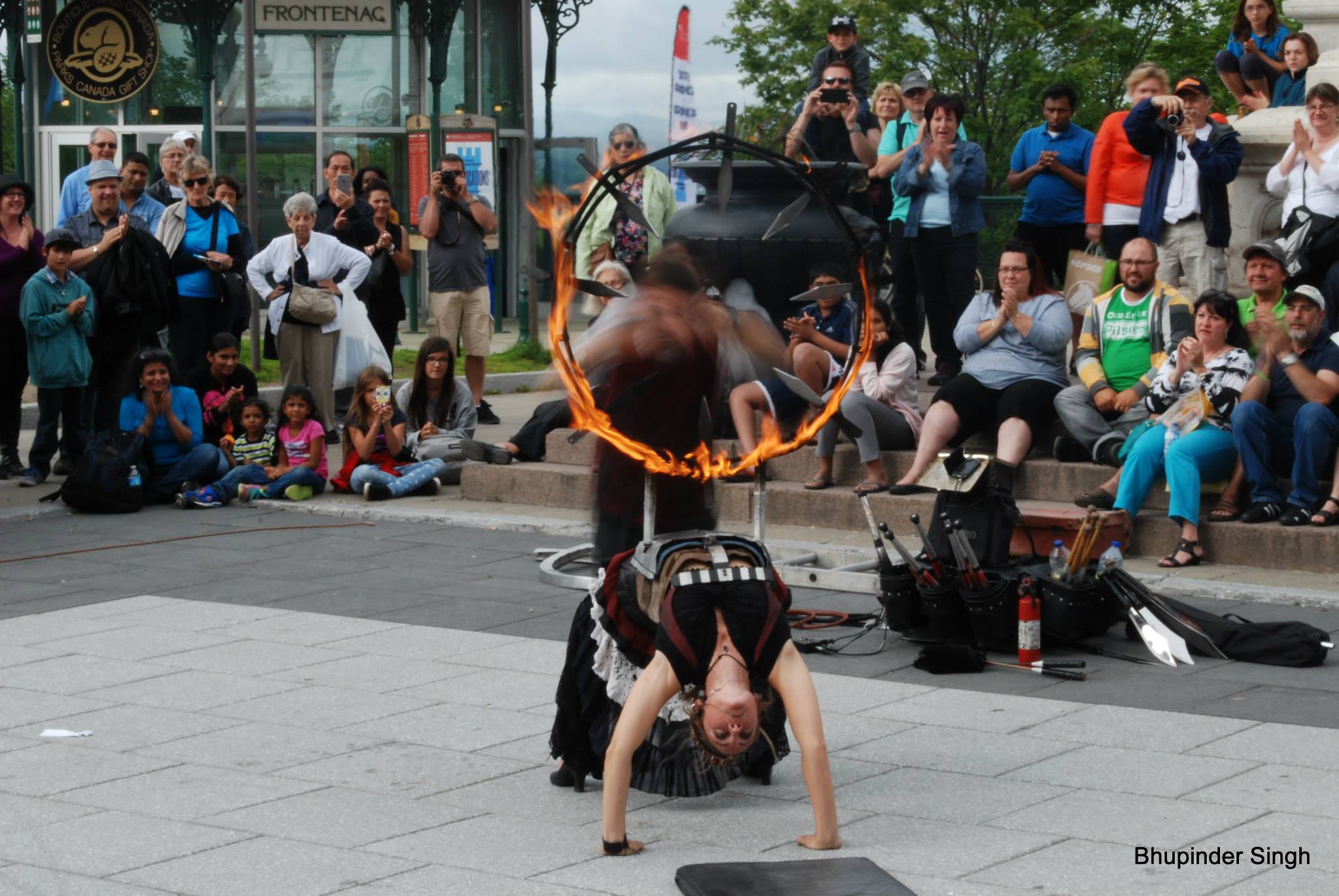
A couple of young musicians emerge to set up their arrangements even as snatches of a conversation between two members of the audience floats over to my ears. The man is telling his female partner/friend about the man-woman busker team we saw perform at the Château Frontenac square yesterday.

As with every street performance, the daring duo had requested the gaping, near-voyeuristic audience to make donations at the end of the show.

Our man in the park today talks about his chat with the male busker. “I asked him how much money do people actually put in your hat after the show?

“He told me most people put pocket change – the quarters, nickels and loonies. Very few – maybe one or two people – actually put five or ten dollar bills.

“And so that’s what you give after watching a 45-minute show in which the performers risk their lives. And right after that, you spend $200 on dinner.”

I can validate what he is saying. Yesterday, when I sheepishly carried two five-dollar bills to put in the buskers’ hat, I noticed those were the only non-coin currency items in the hat.

Suddenly, I don’t feel so bad about eating crepes clumsily in the park instead of dining at a fancy restaurant.

Read Part 2

Immigrant’s Postcard: White is White (even when it isn’t)

Read other Immigrant’s Postcards here.

My husband has a visit scheduled for his vision test. The optometry is close to his workplace. A couple of days before his appointment, the doctor leaves him a voicemail to confirm the time, date and location. The message is an elaborate one; short of reciting the exact map, the doctor makes sure his patient has all the necessary information to show up for the test. At the appointed time, my husband finds the doctor to be an octogenarian, as he had imagined him to be by the tone of his voice and his laboured speech in the voicemail.

The oculist smiles widely on seeing my husband. “So you are a Sikh.” My husband acknowledges with a soft smile as the doctor goes on to tell him of his English lineage. On hearing B’s date of birth, he says, “Oh, so you were six months old when I moved to Canada.” “Have you been to Goa?” He asks my husband. “Yes.” The affirmative response encourages the elderly specialist to share the story of his friendship with a man from Goa. “He had a Portuguese heritage. For some reason, he was dark skinned even when everyone else in his immediate family had a light, Caucasian skin tone.” In between applying eye drops and asking my husband to stick his eyes into machines the ophthalmologist has to use but doesn’t seem to have much faith in, he regales him with how his Goan friend, a fellow ophthalmologist, travelled around the world in a ship. “I can’t tell you all his stories, but I can tell you one today.” This is the story goes on to narrate.

DSC_2190-001

The Goan oculist once visited South Africa to attend a conference on ophthalmology. Those were the apartheid years. After the conference, the group of ophthalmologists he was travelling with went to dine at a restaurant. Everyone but the oculist from Goa was allowed inside the “Whites only” restaurant. The man accepted the decision and made as if to leave the spot. He had barely stepped out of the restaurant’s precincts when a woman, a member of the restaurant staff, came running to him. “Sir, please wait a minute,” she said. The man turned around, half surprised. “Sir, please come in,” the lady huffed. “We have been able to confirm that you are white.” The dark-skinned Goan man of Portuguese descent walked in to join his colleagues, as sanguine as he was moments ago when he was denied entry into the restaurant.

Alien Winter — IV

White seizes the city.
Peace blows
into pieces.
Chaos is kicked around
and shoveled.
On a walk to the library
two foggy eyes
sunk inside a snow-hollowed face
accost you.

“Do you have a fu–ing nickel?”
You walk on,
frosty, quiet.
At the crossing,
the doped beggar marches on,
leaving you with,
“You are a fu–ing nigger,”
before accosting his
next potential
fu–ing benefactor.

Below your feet,
the ice takes
forever to melt.
Flurries go about
their business, settling
like drandruff on walkers’
coats, car tops,
a pigeon’s wings.

Guarding a hotel is
a pine tree
bi-polar —
half-covered in
snow moss.


Summer and Winter — two poems

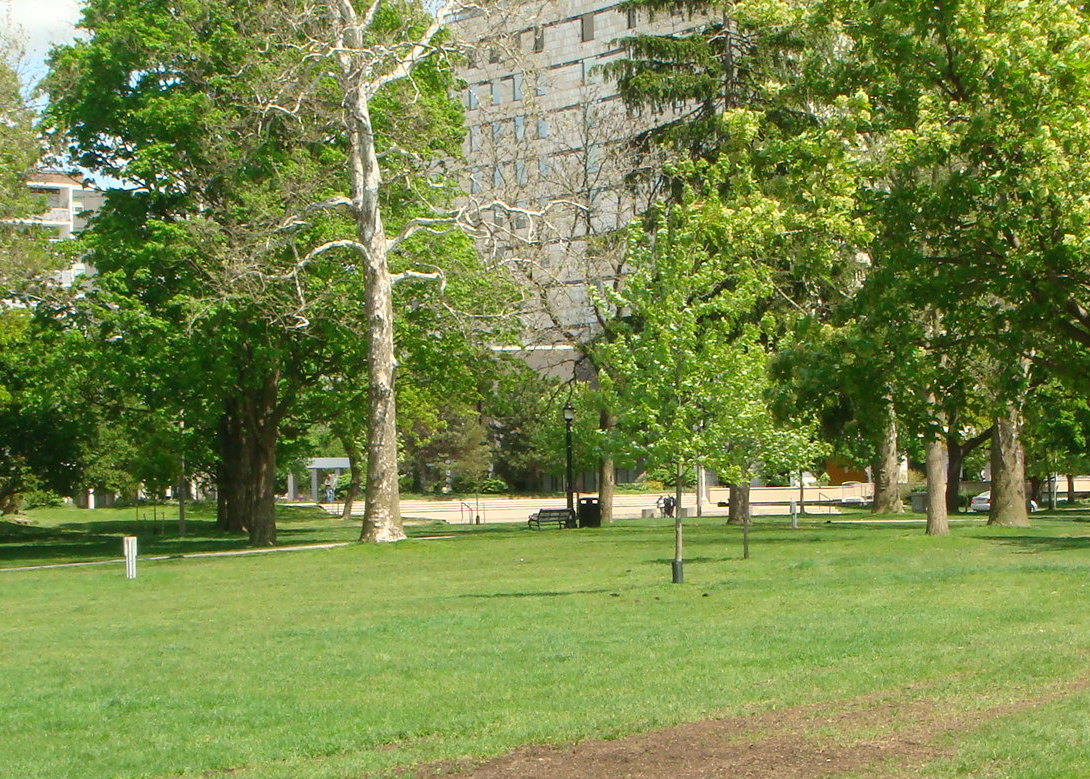
Summer at Victoria Park

Originally published in The Boston Coffee House

DSC00497

Lopsided cut-outs
dare oak trees,
shiny lights freckle
cardboard stalls,
red and white flags swirl around
ice creams and screams.

The park’s a weekend museum;
a Ferris wheel of
half-spent desires.

Stuffed tigers, candyfloss—
extant signposts of
childhood—a station
one keeps circling around.

Songs float in.
The office window’s
a truant whisperer.
It pre-empts
a school boy’s and
an office girl’s secret
desire;
the weekend.

                                                                                                                       ~~~~~~~~~~

Winter Outside a Grocery Store

Originally published in Two Cities Review

021

The road is a messy
half-eaten casserole.
The weekend sun, a limp
slice of lemon.
It sneaks out without a whimper.
and is not missed.

I sit in the car, waiting
for you to return
with vegetables,
their attendance
necessary for updating
the week’s meal roster.

Three young men emerge
with their acquisitions.
Bottles of wine, local and exotic.
Another, a store helper,
battles the stabbing
arctic chill to
push a fresh batch of carts,
left behind by shoppers.

The store’s sliding doors open,
a mother and son come out
bearing yellow bags. Their
tired feet scurry through
the snow.

An old lady
droops under the weight of two
bags–the weekly cross
she must bear for
still living.

Not everyone’s Saturday
evening
is the same.

Remembering U. R. Ananthamurthy

URAM-portrait@800The year, 1997. Me, a freshly-pressed journalism graduate, itching to join the Indian print media. A dream that wouldn’t come to fruition. But I would get to scribble a few odd stories as a freelance writer. Ratnottama Sengupta, Times of India’s arts editor, would assign me stories on culture and literature–a “soft” beat I happily lapped up.

One of those stories was on Sahitya Akademi’s translation awards. U.R. Ananthamurthy was the Akademi’s chairperson at that time. What follows next is as hazy as the darkness of that early (or was it late) winter evening that swept the outside once the award ceremony was over. But not without light following it.

I don’t remember if it was part of my brief to interview him following the awards or if that was something I wanted to do. Nor do I remember how that interview was set up–did I ask him personally on the awards evening? Did I make a phone call to fix the appointment?

All I remember is I got some time to speak to him the next morning–he invited me to join him for breakfast at IIC–the awards venue and also his place of stay in Delhi. As I sat across him at the breakfast table, URA had enlisted his latest admirer. Given his stature, his manner of speaking–soft, respectful, involved–moved me at once. A light breakfast fare–idlys, coconut chutney, small uttapams, diced papaya–lay in the small table between us. He insisted I have some, despite my polite resistance. Introductions and breakfast over, we moved to his room for the interview. I had no recorder with me so longhand note-taking would have to do.

My knowledge of translations then was as limited as my knowledge of languages is now. As indicated above, my memory of our conversation is blurry. I do remember, however, the lambent beam of light streaming in through the window and the lush cover of green beyond it. When URA started speaking, his words seemed engulfed in a similar beam–gentle, yet radiant with insights and committed interest.

I remember him lamenting the fact that a lot of translation of Indian language works have to happen through a link language like English or Hindi. He wished there were more direct translations–from Kannada to Bengali, Marathi to Kashmiri and so on. His eyes lit up when he shared his vision of a day when school-going children in one region would learn a language from another region. And I wondered why wasn’t this happening already? Why could I not learn Malayalam or Assamese in school? And even then I understood, this wouldn’t just be about learning a new language, but also about making friends with a new culture and its people, if only through the solitary medium of books.

At the end of our conversation, I touched his feet (a mark of deference I  extend with considered discretion). He smiled and said, “We need more bright people like you.Thank you so much.” Even though I didn’t believe that about myself, the warmth and sincerity of his tone, the genuine spark of hope in his eyes made those words credible to me.

So long then, Sir.

 
Image source: http://kvsas.by2coffeefilms.com/blog

City Nights

i

Like a friend who DSC00451
drops by
without notice,
night comes easy–
arriving early,
staying late,
swathing rivers of cars,
lonely alleys
and bodies of lovers
staring at the moon.


DSC01658

ii

After the revelry,
the street–
a night commuter’s
forlorn lover.

Winds beat down
on the asphalt
mocking the drums
that blared moments ago.

The carnival
is over.