When speaking, may I utter the bare minimum When speaking, may I never say the maximum May it be so little that on a particular day I keep repeating one thing over and over again like a koel whistling in a loop before suddenly hushing.
May everyone know my maximum silence as the silence of that which wasn’t uttered, of all that was said. My eternal, tiny silence, small, flickering, against mighty mountains, the sky, the sun, the moon.
In the stunning stillness when unrighteousness is attacked My lone silence The lull of a gun before it’s fired.
And the silence of my unceasing hope of the peace from a gun that never went off.
The silence of a lamp kept carefully aglow under the vast quietude of a banyan.
Protected from being trampled by the cacophony of a crowd this silence of mine, the silence of me saving my words when speaking amid a procession of my own people.
बोलने में कम से कम बोलूँ / विनोद कुमार शुक्ल (१९३७ – २०२५) बोलने में कम से कम बोलूँ कभी बोलूँ, अधिकतम न बोलूँ इतना कम कि किसी दिन एक बात बार-बार बोलूँ जैसे कोयल की बार-बार की कूक फिर चुप ।
ग़लत पर घात लगाकर हमला करने के सन्नाटे में मेरा एक चुप- चलने के पहले एक बंदूक का चुप ।
और बंदूक जो कभी नहीं चली इतनी शांति का हमेशा-की मेरी उम्मीद का चुप ।
बरगद के विशाल एकांत के नीचे सम्हाल कर रखा हुआ जलते दिये का चुप ।
भीड़ के हल्ले में कुचलने से बचा यह मेरा चुप, अपनों के जुलूस में बोलूँ कि बोलने को सम्हालकर रखूँ का चुप । [Translation, mine]
Gargi Kalita reviewed my debut poetry collection, NOSTALGIC FOR A PLACE NEVER SEEN in East India Story. Read the review:
Bhaswati Ghosh’s Nostalgic for a Place Never Seen is a debut poetry collection that maps the evocative terrain of belonging. It explores how home is a terrain of the mind, a pulse of longing bridging the intimate and the global. A review by Gargi Kalita.
Nostalgia is never merely a return to the past—it is a tender reimagining, a delicate reconstruction of moments and emotions that memory alone can no longer fully contain. Home, in this sense, is not merely a geographical fixity but a terrain of the mind, a pulse of longing that beats through time, language, and loss. It is within this evocative terrain that Bhaswati Ghosh situated her debut poetry collection Nostalgic for a Place Never Seen ,a volume that reads like a cartography of belonging drawn from within the self and across shifting geographies. Ghosh, a bilingual writer and translator based in Canada,with roots in New Delhi, belongs to the lineage of Indian diasporic poets whose work bridges the intimate with the historical, the local with the global.
Some places are etched not in geography, but in remembrance—borne across generations like heirlooms wrapped in stories, scents, and silence. Bhaswati Ghosh’s Nostalgic for a Place Never Seen traces an emotional landscape, where her grandmother’s lost Barisal finds a home in verse.This poetry collection, imbued with reflections on migration, memory, and identity, is organized into eight thematically rich sections— “Dwellings: Temporary and Permanent”, “Places, Faces, Traces”, “Scents, Tastes, Textures”, “Seasons of the Heart”, “Water, Earth, Air, Fire”, “The Humming Octave”, “The Wordsmiths”, and “Movements in and Out of Time”. Across 72 poems of the collection, Ghosh explores personal and historical landscapes of belonging shaped by displacement, capturing the tension between the fleeting and the lasting, and inviting readers to find home in language and memory.
At the heart of Nostalgic for a Place Never Seen is a poignant reflection on memory, identity, displacement, cultural inheritance, and longing that extends beyond personal history. Bhaswati Ghosh’s poetry weaves internal and external landscapes, capturing the emotional geography of diasporic consciousness—a yearning not just for a place, but for the sense of rootedness it once held.
The title poem, “Nostalgic for a Place Never Seen,” which lends its name to the collection, forms the emotional nucleus of the book. Drawing on Ghosh’s inherited memory of her grandmother’s forced migration from Barisal in East Bengal (now Bangladesh) to post-Partition Delhi, it reflects the vivid presence of places never personally visited but deeply felt through intergenerational storytelling. This aligns with Marianne Hirsch’s concept of “postmemory”—the transmission of trauma and displacement across generations. Ghosh captures this poignantly in both “Nostalgic for a Place Never Seen” and “Native Dialect.”
In a video about Sugandha, I see a mother
combing her daughter’s hair. Before I know it,
the daughter turns into my grandma
and breaks into a song.
‘Why don’t you come anymore?’ she asks.
— Nostalgic for a Place Never Seen
When her little sister visited
and Grandma broke into their
Barisailya patois, I heard songs
of home in the words. Of boat
races and river markets. Of a
home I’d dreamt of in past
lives amid simulated
nostalgia.
— Native Dialect
In the opening section, Dwellings: Temporary and Permanent, poems like “Sleeping at My Mother’s House” and “Displaced Persons’ Colony” do not merely reconstruct domestic spaces; they evoke the invisible sediment of emotion—love, loss, security, fragility, displacement —that inhabits these spaces. These dwellings become mnemonic devices, where physical architecture merges with psychological and ancestral landscapes.
Likewise, in Places, Faces, Traces, the poet functions as a flaneuse of memory, fluidly moving through places like Lajpat Nagar, Buenos Aires, and Mukteshwar—each becoming a site of introspection and remembrance.These locations act less as physical sites and more as emotional landscapes, forming a metaphorical map. Ghosh suggests that memory is borderless, bound more to emotion than to nation, language, or place. The poems wrestle with the impermanence of space and the persistent search for anchorage amidst flux.
Perhaps the most evocative section of the book is Scents, Tastes, Textures, which serves as a visceral archive of cultural identity. In poems like “Cooking Hilsa” and “Cumin,” food becomes a tactile memory, carrying heritage on the tongue and in the body. These sensorial evocations act as gateways to lost homes and forgotten rituals, echoing Roland Barthes’s idea of the “grain” in language—where meaning is felt rather than just stated. For Ghosh, food is not merely sustenance; it is survival, nostalgia, and resistance. As she writes in “Cumin”:
Taste is the original rebel. It resists being caged in
closed jars or steaming woks.
In the later sections—Seasons of the Heart and Movements In and Out of Time—Ghosh turns inward, tracing the subtle shifts of self and emotion. Poems like “Learning, Unlearning” and “Debts to Pay” reflect on growth and changing roles, offering a sense of becoming rather than just loss or nostalgia. Ghosh shows that belonging is fluid, woven through memory and choice, and this quiet evolution is captured in “Learning, Unlearning”, where she writes:
She learns to pause more on the
page. I unlearn the stiffness of knowing it all.
A central thread in the collection is Ghosh’s nuanced exploration of “home”—Is home a physical dwelling, a landscape of memory, a sound, a scent or even a fleeting feeling? Ghosh’s poems move through Delhi, ancestral villages, and diasporic spaces, revealing home as both grounding and elusive. Echoing Edward Said’s “imagined geographies,”as she shows that places are shaped more by memory and feeling than by maps. The collection also explores identity and belonging from a female perspective, as Ghosh reclaims her grandmother’s story—giving voice and agency to women often sidelined in Partition narratives.
Stylistically, Ghosh’s poetry is defined by a quiet musicality that emerges not from ornamentation but from emotional authenticity. Yet, within this understated lyricism lies a deft command of literary craft—her metaphors, imagery, and structure deepen each poem’s emotional resonance. In “Fading Colour,” letters losing their hue become haunting emblems of histories dimmed by time and silence. In “Pickling Language,” the simple act of preserving becomes a vessel for memory and identity, where ancestral syntax ferments quietly in jars.
Ghosh’s lyrical minimalism resists excess, favouring the resonance of ordinary moments—stillness, observation, memory—each imbued with metaphorical richness. Subtle threads of Bengali and Hindustani lend her lines a textured intimacy, anchoring the diasporic experience in language. Eschewing nostalgia, she crafts verses of precision and clarity, conjuring cities like Delhi, Mexico City, and Buenos Aires not through maps, but through mood, rhythm, and metaphor. The result is poetry both introspective and worldly—rooted in the particular, yet open to the universal.
In an age where identity is continually redefined by movement and loss, Nostalgic for a Place Never Seen reminds us of the power of poetry to anchor us—to a language, a scent, a home, even if that home exists only in memory. Traversing continents and generations through everyday rituals and stories, Ghosh explores cultural heritage, displacement, and belonging, evoking empathy and prompting reflection on our own ties to memory and place.
There are certain spaces the soul longs for—not merely to dwell in, but to truly belong. Amid the scattered rhythms of postmodernity, this yearning becomes a search for rootedness not in geography, but in presence—a place deeply felt, where one is the place, and the place is the self. And that is what Bhaswati Ghosh’s Nostalgic for a Place Never Seen ultimately embodies—making it a vital literary contribution to Indian English poetry, diasporic literature, and memory studies.
Sabyasachi Nag, Poetry Editor for The Artisanal Writer, a Canadian journal and literary arts collective exploring, inquiring and celebrating the craft and practice of writing, interviewed me. We discussed by debut poetry collection, NOSTALGIC FOR A PLACE NEVER SEEN (Copper Coin Publishing) and other aspects of my poetic journey.
Sabyasachi Nag (SN): Congratulations on your first poetry title? How did you arrive at the collection, did you conceive of it first and went about constructing the poems or did the poems coalesce at some point into the collection? How did you settle on the title? Could you tell us a bit more about the voice of the narrator? Is it intended as a singular narrator or many: one consistent voice or polyphony?
Bhaswati Ghosh (BG): The poems in Nostalgic for a Place Never Seen came about in a spontaneously serendipitous way. Until a few years ago, I was primarily a prose writer — dabbling mostly in creative non-fiction and the occasional short story. In August 2020, my debut novel, Victory Colony, 1950 was published.
In the spring of 2021, a friend who hosts a poetry-writing collective every April for the National Poetry Writing Month, invited me to join. This was at the peak of the COVID-19 pandemic — we were housebound — and true to the cliches associated with poetry and solitude, the moment lent itself well to self-reflection. I enjoyed writing poetry in a collective — we read and shared feedback on each other’s works. This not only provided me with creative stimulus, it also brought camaraderie and connection at a time when we were dealing with isolation, anxiety and tragedy on an epic scale.
This exercise of writing a poem daily for a month for three years gave me enough poems to think of a collection while also allowing me to hone my craft and learn from fellow poets. Eventually I could see certain patterns and themes in the poems. The book’s title derives from one of the poems in the collection bearing the same title.
I would hesitate to pin a singular voice to the poems in this collection. More than a narrator expressing them, I feel poems breathe with their own life force and the poet is more like a vehicle bringing them to the surface.
SN: Although the book is sectioned in seven parts: dwellings; faces; scents, tastes and textures; seasons; elements; music; words and movements – there is a thematic circularity as it starts with displacement and ends in displacement. Is that intentional? The title alludes to a place never seen – so obviously this is a book about places – but is that place a reconstruction or recollection – is it a real place or a place from mythology?
BG: It’s less intentional than it appears to be. Many of the poems in the collection were written using prompts from various sources. When bringing them together, it seemed like a good idea to segment the poems thematically to help readers move through the collection with ease. Think of these as signs along a hiking trail in a forest. As one reader noted in her review of the book, “Thankfully the book is divided into sections, giving context and guidance as the poet shares the universe of memories and impressions that her senses have gathered and her mind synthesized.”
Many of the poems in the book do deal with the idea of location — both temporal and figurative. This made the idea of being nostalgic for a place that’s not merely physical but encompasses more — histories, memories, dreams, longings — pertinent.
SN: The book is wonderfully peppered with non-English words (mainly Bengali, your mother tongue). Is it about getting the voice right? Could you talk a bit about your process guiding your syntactic choices in this collection? Are you guided by meaning, and is there a point where you stop translating words from the mother tongue? Or do you arrive at a poem with a certain sound construct that you then look for the language and settle on words that evoke that sound?
BG: When writing poetry, one works within certain frameworks — in terms of form and structure but also atmosphere and aesthetics. In doing so, I occasionally leaned on words from Bengali or Hindustani to evoke a particular sense of the local. I see these insertions as both geographical signposts and emotive sparks that flow into a poem. They carried a spirit all of their own and had to be left there.
It’s difficult to put a finger on what triggers such word choices — it could be the intonation or musical texture peculiar to a word or phrase, but it could also be a very specific and indelible memory associated with a word, its pre-history and the sensory response it generates — not only within the poet but also among those who might be familiar with that expression. As a reader, being part of a world that’s more interconnected than ever, these interventions make poetry even more exciting and attractive to me.
In his essay Bringing Foreign Language to the Poem, Eric Steinger writes, “As poets, I believe we should take advantage of our available resources. Doing so can make poems interesting, nuanced, authentic, and contribute to the poem’s/poet’s voice.” This resonates with how some of the music-themed poems in Nostalgic for…evolved, using terms from traditional North Indian classical music systems.
SN: Several poems revolve around central characters – the grandmother (there are almost 20 references), mother (approximately 25 references) and father (10 references)…how much of this collection is autobiographical?
BG: I think that of all genres, poetry is probably the most autobiographical, as if by default. Even when a poem itself is not derived from one’s life arc, it’s a distillation of the poet’s inquiry into the subject at hand. That said, a fair bit of Nostalgic for…is indeed autobiographical — it’s an exploration of places, relationships, displacement — the last of these is perhaps the most pronounced of all the themes in the collection, heightened even more by my experience as an immigrant in Canada, my home since for almost a decade and a half now. As I made this long-distance journey to North America from India following my marriage, I began to sense, for the first time, the loss my grandmother might have felt when she’d been uprooted from her home in East Bengal (now Bangladesh) at the time of India’s independence in 1947 when the country was divided into India and Pakistan. Her stories of displacement and the trauma that accompanies it were no longer abstract tales for me; they became real as I too began experiencing the twinges of separation from home (New Delhi in my case), my family and loved ones.
SN: The narrator alternates between participant, witness and celebrant – is this collection a spoken record and oral testimony a conversation with history or a response to a “place never seen” and hence a void?
BG: It’s all of these descriptors you refer to — I couldn’t have said it better. The poems were written at different points in time and in disparate geographical settings, which might explain the switch between the voices. Quite a few of them came to me during my travels to Latin America, a region that fascinates me endlessly. My visits to places such as Mexico City (Mexico), Havana (Cuba), Cartagena (Colombia) and Buenos Aires (Argentina) have uncannily filled me with a sense of homecoming, owing perhaps to, the tropical climate, general chaos, and a profusion of colour, music and bustle of these places.
Then there are poems (Native Dialect, Nostalgic for a Place Never Seen, Milking Green Blessings) that relate to my grandmother’s loss of her homeland to the tragic event of India’s Partition I mentioned earlier.
The poems on music are deeply personal reflections of my responses to particular ragas (a melodic framework for composition, consisting of a specific set of notes and associated with certain emotions, times of day, or seasons).
There are poems on sensory delights such as food or scents, textures and sounds. In all of these explorations, the underlying quest is that of finding home as an antidote to the various types of voids I might be experiencing or holding within.
SN: How do you think the work responds to the questions it raises in the context of the timeand place the work is situated in?
BG: A lot of the poems in the collection relate to physical spaces — dwellings, markets, villages, cities, hills — straddling between continents, atmospheres, cultures and time periods. They raise questions like whether dislocating from one place and relocating to another can really be permanent, except maybe in material terms. The collection contemplates on city life with all its paradoxical oddities and inexplicable pulls. It wrestles with the manner in which the demands of the here and now contend with the salve and cushion of memory. It unlatches the many dimensions of love and takes in with curiosity its lessons for the soul. It observes movement and seeks to inhabit the in-betweenness of journeys.
As an example, I wrote the poem, Sunset on the Malecón, after returning from a visit to Havana, Cuba in 2017. This was a city that held a lot of fascination for me, given the history of the Cuban Revolution, the tiny island’s resistance to US imperialism, its association with the former Soviet Union, the lionized personas of Fidel Castro and Che Guevara. My stay in Havana in a post Soviet world, however, left me with more questions than answers. I found it a city in a time warp — unable to discard the past and yet desperate to step out of it in some ways.
Cars, once shiny, wrecks now, tire the streets.
On balconies, old men mask sighs with
cigarette smoke and loud confabs.
The morning that arrived many suns
ago ducked out like friends whose
empires collapsed overnight.

(From Sunset on the Malecón)
SN:Did you have an intended audience for the book?
BG: I didn’t have any audience in mind when writing the poems — that process is deeply personal for me. When I compiled the poems for preparing the manuscript, my hope was that the collection would find readers who can join the journeys — external and internal — the poems voyage along. There’s great satisfaction in hearing from reader friends about how a poem from the book took them back to their grandparents or reminded them of the various addresses they’ve lived at. So to answer the question, instead of aiming to reach particular audiences, I tried to put my faith in the book finding its own reader tribe.
SN: In pushing your work beyond your first title what were you most conscious of? Whatwere/are you trying to achieve with this book in terms of your literary career?
BG: As I mentioned in a previous answer, this book happened in the most unexpected of ways — I had no expectations from it beyond that the poems within would touch those who read them. Writing can be a contradictory practice — at once allowing one to engage with and yet also disconnect from the busy, sad and often horrific world we find ourselves in. I’m ambivalent about the word “career” as a definition for any work, but literary work in particular. Like the travels through the places in Nostalgic for a Place Never Seen, writing, for me, is a road trip — staying open and curious through the drive and pausing at pit stops to rest and reflect.
SN: What was the most satisfying aspect about writing this book (other than perhaps thesatisfaction of finishing it)?
BG: The best part about writing the poems for this collection was the freedom to write them without knowing they could end up between the covers of a book. Participating in National Poetry Writing Month in April for the past four years has meant an entire month of writing poetry every day — and while that seemed daunting in the beginning, I was surprised to see how quickly that nervousness transmuted into joy and creative learning.
Writing with other poets was a bigger treat as it exposed me to a diversity of voices and styles while allowing me to find my own. Another element that made writing poetry immensely satisfying was the thrill of the unknown. A poem often begins with a kernel and not as a fully fleshed-out edifice. It can be quite an adventure to see how it emerges bit by bit and the point at which it’s deemed complete. This mystical element makes poetry very dear to me — both the reading and writing of it.
SN: How would you like this book to be taught – as a historical document, socio-political document or as a document about a certain kind of taste in writing or particular aesthetic, genre, literary style or something else?
BG: I see Nostalgic for a Place Never Seen as a synthesis of all those elements — it has family stories that bounce off the history of the Indian sub-continent, the politics of forced migration intersecting with urban anxieties, and an immigrant’s uneasy existence in parallel universes.
In the collection, I’ve also attempted to cross linguistic barriers with the hope that the poems are fluid enough for readers to enjoy them while partaking of certain flavours that might be unfamiliar at first. What’s exciting about having a book out in the world is the many meanings it then reveals. If this collection is ever used for teaching, I’d like it to make all those meanings available and perhaps be in conversation with each other.
Read this review of NOSTALGIC FOR A PLACE NEVER SEEN by Sayan Aich in Cha: An Asian Journal
Nostalgia is humanity’s Janus-faced companion—simultaneously looking back and forward, with someone or something perpetually tugging at us from behind. Yielding to it is not a mere indulgence but, at times, a necessity—offering the wisdom to understand who we are, shaped by the “roots” and “routes” that define our journeys. In a world increasingly fraught with conflict and displacement, it is only natural that narratives exploring these two R’s—roots and routes—should continue to emerge. For the people of the Indian subcontinent, whose shared and traumatic histories of Partition and the Bangladesh Liberation War remain deeply embedded in cultural memory, nostalgia serves as both a fertile and essential motif in the collective psyche and fiction. Stories born from survival and resettlement must be preserved and passed down to new generations of readers and listeners, lest they be erased by the official historiography of the nation. Since time immemorial, the world has progressed and endured through storytelling—the foundational thread of every community, woven through acts of telling and retelling across generations.
Bhaswati Ghosh’s debut poetry collection, Nostalgic for a Place Never Seen, encapsulates all of this—and more. Having grown up in New Delhi and now residing in Canada, Ghosh traverses and inhabits multiple worlds—the cities of her childhood and adulthood, the towns she has visited in her travels, and the villages she has never set foot in but knows intimately through the vivid recollections of her grandmother’s storytelling. In her poetry, time and space coalesce, overlap, and blur, mirroring the way memory itself operates—fluid, unpredictable, and untethered to rules or chronology. The past and the imagined intertwine, shaping a landscape where nostalgia is not merely a longing for what was, but for what could have been.
It was the middle of the month of Bhadra. With the onset of autumn, the dark nimbus of the monsoon had left the sky. Clouds came in brighter tones as did sunshine. After the previous year’s drought and poor crop, this year’s rainfall had been abundant. The paddy on the fields had a dark green hue and looked thick and healthy. A serene mood prevailed all around. Families of householders were busy with Durga puja preparations that began with the most laborious and important of them all — plastering the walls with mud. This was to be followed by painting alpona designs at the threshold using white and red chalk, roasting rice into puffed and popped rice, and preparing sweets like naadu and mudki. There was no end to the chores related to puja.
“That woman has ten hands, along with those of her children and retinue; how could we two-handed ones match her strength?” Ginni, the matron of the Chatterjee family thought aloud.
Today their house was going to receive the first coat of mud. The artisans had arrived at the chandimandap to start working on the idol.
Red clay had been dissolved in a bucket of water. The daughters-in-law and maids were ready — with their saris tied to their waist and their gold bangles covered with rags — to witness the plastering of the idol’s frame with mud.
“Dear, can one of you go and check how long it’s going to take?” Chatterjee Ginni asked the women. “Where are all the boys?”
“They are all at the puja site,” one of the girls said.
That — the chandimandap — was exactly where the boys had gathered. Kumareesh, the elderly idol maker was busy arguing with the watchman, “Will you donate your prize money to me? Why should I do your work?”
Kalachand, the watchman said, “Hey, why are you getting worked up? Do they let you grab that soil so easily? Have you seen how they curse you and chase you away?”
“Why, couldn’t you get some on the sly during your night patrolling? Or did you skip your routine last night?”
“How can I skip my duty? I have to go for at least one round. How would I know that you’ll be here today? Forgive me, please.”
Approaching the door, Chatterjee Ginni asked, “O, Kumareesh, are you done yet? The girls are waiting with the mud batter. How long will you keep brabbling here?”
Kumareesh was a short, frail man. His limbs, narrow like the hands and legs of puppets, moved as swiftly. His walk was equally agile. Even before Chatterjee Ginni could finish speaking, he began shouting at the top of his voice, “What do I even tell you, Ma; I can’t work with this Kalachand anymore. He makes no effort, has no brains, no hands, no legs, nothing — what can I do, you tell me?”
Even as he yelled out those words, he drew closer to the matron and bowing before her said in a calmer voice, “Are you doing well, Ma? And your children? All the Babus? And the dear sisters and Bou-Mas, is everyone fine?”
Ginni-Ma smiled and said, “Yes, everyone is fine. How about your children…”
Snatching words off others’ mouths was Kumareesh’s old habit. He began ruefully, “Where do I begin Ma, measles, stomach upset, fever are all playing hopscotch. Doctors and boddis have turned me into a pauper.”
Then, in a quieter tone, he said, “I heard that Chhoto Babu is back, I’m so happy to hear that. Why don’t you bring Bou-Ma, our dear daughter-in-law now? That will fix everything. His blood is young after all, he made one mistake…everything will be all right.”
Putting a lid to the subject, Ginni-Ma said, “What’s taking you so long to get started? The girls are all waiting with the wet mud; when will they take a bath?”
Kumareesh said, “Everything is ready, we just need the soil from the prostitutes’ quarters…”
How rapturous, this dance of light on leaves The wild storm in the shal forest makes my heart quiver. Following the trail of the red road, folks dart to the haat A little girl sits by the dusty path and spreads out her toys These scenes that I bear witness to strike the cords of my heart’s veena. (Rabindranath Tagore)
I listened to that song. As a child. As an adult. Somewhere along the line, I started singing it. To be inside a shalbon or Shorea Rubusta forest for real remained a distant dream for me. The opportunity to witness these forests finally materialized in 2007, when I began freelance work in Delhi and could pick my own holidays. Along with my mother, an alumni of the Visva-bharati University at Santiniketan, I headed to Bolpur, the city in West Bengal where the university — Rabindranath Tagore’s gift to learners of all stripes — is located. Vishwabharati Fast Passenger, the train we took from Kolkata’s Howrah station, sped past unending tracts of green towards Bolpur.
As we stepped down the station at Noon, a heavy downpour received us. “It’s been raining non-stop for the past two days, Didibhai,” Anwar, our rickshaw-wallah told me. I sighed. We had only three days to spend amidst this verdant, semi-rural landscape. Anwar promised to return to our lodge at 4 p.m. to take us on a rickshaw jaunt.
Shortly after we finished lunch—a filling platter of rice, lentils, jhuri aloo bhaja (finely julienned potato fries) and fish curry—the clock struck four. The rain had stopped. Anwar waited outside. “Come, Didibhai, I will show you a few things around here today. You have come such a long way, from Delhi. How can you miss gramchhara oi ranga matir poth, Khoai, or a Santhal village?”
My review-essay of the Pakistani film Jago Hua Savera (The Day Shall Dawn) in American Kahani.
Night falls on a river. The village around it thickens with darkness. Not the river. On its breast, distant lights flicker like inextinguishable fireflies. The glow comes from the boats of the fishermen sailing on its waves. A majhi (boatman) sings a drawn-out tune and the river’s water folds into its haunting essence with every splash of the oar. This is how the Pakistani film, “Jago Hua Savera” (The Day Shall Dawn) unfolds as does “Padma Nadir Majhi” (The Boatman of Padma), the novel it’s adapted from.
An enthralling flute amplifies the aural impact of the film’s opening scene, holding the viewer in a delicate trance. A synthesis of the work of stalwarts like Faiz Ahmed Faiz who wrote the songs, dialogues and story; music director, Timir Baran and Academy award-winning cinematographer, Walter Lassally – this first scene establishes the tenor of the film’s sensitive and neo-realist aesthetic.
Amala couldn’t resist the urge to try out some of these new finds and took out a five-rupee note from her wallet to buy shahjeera, a darker and slimmer variety of cumin the shop owner told her to use in rich meat dishes and kababchini; small black globules that looked exactly like whole black pepper but apparently had a different aroma, stronger and warmer. A minute later, Amala and Manas joined the crowds drifting out of the market area.
‘There’s a special place I want to show you today,’ Manas said as he approached a taxi.
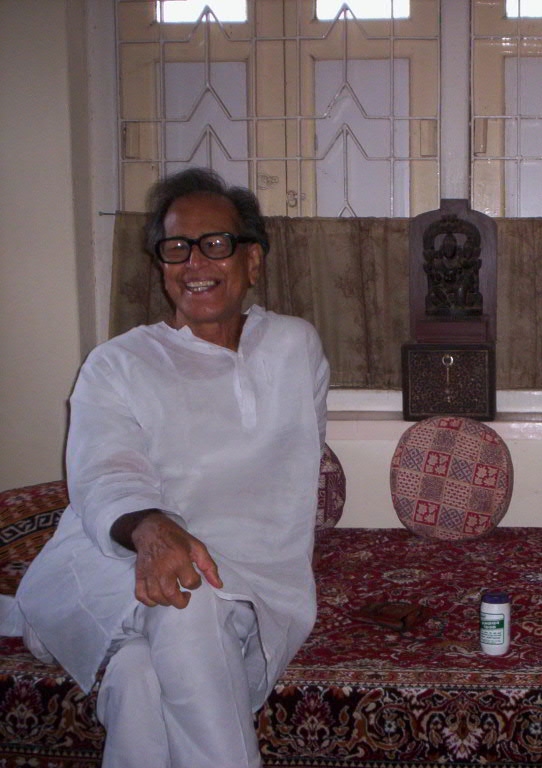
Prof. Somendranath Bandyopadhyay taught Bengali Language and Literature in Visva-Bharati, Santiniketan during 1957–1991. His subject was mainly Rabindranath Tagore. He wrote several books on Bengali poetry, art, philosophy and literature. In 2011, the Rabindra Bharati University, Kolkata awarded him the D. Litt. The following is my personal tribute to him.
1986 — A teacher’s visit
I am in Class 7 and we have moved to Chittarajan Park, South Delhi’s very own Bengali pocket, only a year ago. It’s 7 or perhaps 7:30 in the evening, a busy time for our family of six. I and Dada, my brother, are hunched over our schoolwork — homework, preparing for a class test and such. Dadubhai, my grandfather, is coaching me as usual. In the kitchen, my grandmother and mother, both tired from a day’s work at their respective offices, are hustling to get dinner ready. Suddenly, there’s a knock on the door. We have no telephone (cell phones haven’t been born yet) and aren’t expecting any visitors in particular. When the door is opened, two tall gentlemen, one of them in pristine white dhuti and panjabi, are found standing. The gentleman in white, the older of the two, asks for my mother, and when she comes to the door, she, and the rest of us, are startled beyond words. Professor Somendranath Bandopadhyay, her teacher from Visva-Bharati, Santiniketan, where Ma went to study for her MA in Bengali, has come to visit her. The last time the two of them had seen each other was more than a couple of decades ago, while my mother was his student. Back in her student days, he had shown extraordinary compassion to help her get through a difficult academic patch.
They had kept in touch through letters, and that year, as a student of class 7, when I witnessed this incredible moment, I realized why my mother held this teacher in such high regard. Professor Bandopadhyay was visiting relatives in Chittaranjan Park and mentioned that he wanted to meet his former student, who also lived in the neighbourhood. The conversation that followed through the evening is a blur to me, but I remember helping my mother sift whole wheat flour through a soft cotton cloth in the kitchen to ‘make’ refined flour as Ma and Grandma got busy making luchi, a delicacy that had to be served to a special guest. I remember my grandfather, a man of few words, expressing amazed delight that a teacher had taken the trouble of tracing his student’s house and visiting her. I remember that we were all amazed. I remember how a teacher’s visit had changed the complexion of a weary city evening. Over the next many decades, we would receive letters from him on postcards with beautiful line drawings depicting flowers, leaves, and nature on them.
After working for many different bosses for more than a decade, I finally decide to work for myself and become a freelance writer-editor. Working my own hours gives me the reward of finding more time to do the things that bring me joy — write, cook, travel. I plan a long vacation to West Bengal with my mother. We spend the bulk of our time in Kolkata, but also have Santiniketan and Bishnupur on our itinerary. At Santiniketan, when we seek accommodation at the in-campus guest house, we’re turned away, with no vacancy offered to us by way of explanation. We put up at a lodge close to the campus. That evening, when Ma and I visit Professor Bandopadhyay, now Somen Mama to me, she tells him about our lodging woes, and he chides her saying she should have called him right from the guest house. He asks us how long we plan to stay for, and when he learns it would be the next three days, he calls up the guest house to get us a room there. We move back into the campus, a pilgrimage for me, where she would wake up to, as she did in her days as a student, to the calls of doel, the oriental magpie and bou-kotha-kao, the Indian cuckoo. I would discover mornings that sounded sweeter than anything I’d ever experienced in my existence as a city-bred.
At Somen Mama’s house for breakfast one morning, his affectionate wife, Boudi to all students, and Maami to me, treats us to a deliciously elaborate spread, complete with luchi, torkaari, chop (croquettes), mishti and her signature vanilla pound cake that I’ve come to relish. We sit at the low jol-chowkis in the dining area of this aesthetically pleasing and inviting house as Mama talks to us about Tagore’s worldview and the radical relevance of the Buddha’s teachings. Now and again, a humorous vein emerges, and he breaks into a laughter — resonant, uninhibited, completely disarming. We drift back to the living room for tea and more stimulating conversation. He then brings a copy of his latest book — Shilpi Ramkinkar Alaapchari — that he signs for my mother as a gift. He gives me a beautiful pair of polished burgundy wooden chopsticks that he’d gotten from his visit to Japan. I spend some quiet moments in their beautiful garden outside, soaking in the prettiness of flowers — clusters of Ashok and hibiscus in several colours.
Back in Delhi, my mother reads the book and keeps nudging me to do the same. I politely keep telling her I will, until I can’t put it off any longer. I’m barely into the first paragraph when I realize I wouldn’t be able to put it down before devouring every last sentence, every last word of it. The book’s format is deceptively everyday — it’s a series of conversations between two neighbours. Only, in this case, both the interviewee — the artist-sculptor Ramkinkar Baij and his interviewer — Somendranath Bandopadhyay are so much in synchronicity that the reader couldn’t ask for two better conversationalists.
Shilpi Ramkinkar Alaapchari
By simply describing the living quarters of the renowned artist who he found as his neighbour, Somen Mama, draws me in. I am transported to the Santiniketan of Baij’s student and work life, to his world of mud and plaster, of studying from other artists, both at home and globally, of his interactions with Rabindranath Tagore who encourages him to chart his own course without looking back, of deeply empathizing with and drawing inspiration for his work from the Santhal Adivasis living in the area, and most of all, of living a passionate, feisty, and fiercely creative life on his own terms. The book is not merely a gift to my mother, to us, I realize; it’s a gift to all who can read the Bengali language. I am so taken by it that I want to tell the world about it and excitedly write a blog post and translate a few favourite parts. Later that year, I send my proposal for translating this remarkable book to an international translation fellowship. It gets accepted.
2008-2012 — A teacher for life
I am back in Santiniketan with Ma to meet with Somen Mama, to give him the good news, to seek his permission to translate the book. He talks about having heard of a certain blogger from Delhi who had translated parts of the book; then he realizes that person is me. So far he’s only known me by my pet name, so it has taken him a while to make the connection. While we’re here this time, I ask Somen Mama, now my author, lots of questions regarding the book’s technical aspects. He takes out big tomes from his study and patiently answers each one of my queries. I also spend my time looking more closely at Ramkinkar Baij’s sculptures spread across the open campus — Sujata, Santhal Family, Mill Call. My seeing is now informed by the history and context of these iconic works, captured with vivid sincerity by Somen Mama.
I travel to Norwich, UK, the site of my fellowship and complete translating the book. Over the next year, I look for publishers for the book and fortunately, the book finds a home. A journey that began with my mother’s master’s education in Santiniketan comes full circle as my name appears below his on a book cover. Shilpi Ramkinkar Alaapchari becomes My Days With Ramkinkar Baij in English.
2022 — The final adieu
On a March day, we receive the sad news of Somen Mama’s final departure. It’s still difficult to think of him in the past tense. As I reflect on this wonderful human being and the fullness of his life that enriched so many of us, I know what I will remember of and receive as blessings from him the most — humility and grace, a childlike zeal for exploring new realms, and above all, a deep, empathetic compassion for those around us.




 Bhaswati Ghosh