"I relived my last 25 years while writing this book"

Interview with Abhay K, author of River Valley to Silicon Valley. To visit Abhay’s blog, click here:

What inspired you to write River Valley to Silicon Valley? Please share the experience of writing the book with us.

AK: I had made a promise to myself that I should have my own book before I turn 25. I was going to turn 25 on 1st March 2005 and I was so anxious to tell the world that how Indian democracy and economic reforms that are taking place in India are bringing real and concrete changes in the Indian society by citing example of three generations of my own family. I wanted to write this book at this stage of my life and not later because I feared that I’ll lose my innocence and simplicity after getting immersed into the bureaucratic world of which I had become a part after passing the Civil Services Exam in 2003. I also wanted to share my family’s story with millions of young Indians who were in the schools, colleges and universities and inspire them to dream big. I wanted to gift a book to my young friends in India and abroad who struggle every day for a better tomorrow, who do not have a level playing field, who want to move forward overcoming all obstacles.

I wrote this book between November 2005 and February 2006 in Moscow, mostly post mid-night when the city went off to sleep, and I could peacefully take a journey back in time. Those days I was learning the Russian language at the Center of International Education at the Moscow State University and I had to do a lot of assignments everyday. The only spare time I was left with was after the mid-night. I wrote this book almost regularly for four months except the last ten days of December 2005 and a few days in the beginning of January 2005 when I was traveling in Europe with my friends.

There is a saying that writers live twice and I completely agree with that. I relived my last 25 years while writing this book, as flashes of my past played in mind and turned into words on my notebook. Just to add, I was highly inspired by “The Outsider” by Albert Camus and “The Old Man and the Sea” by Ernest Hemingway, not only by the content of these books but also by their size. Both these books have around 100 pages each and are easy to read and carry. I too wanted a small book that was easy to read so that a normal reader would not get scared just looking at its size and had the psychological satisfaction of finishing the book in a few days. Somehow, unnecessary details in some novels irritate me and make the whole experience of reading a very boring for me. What really attracts me is a rich story with a flow without unnecessary details unconnected with the story. This is what I wanted to bring out in my book. I must share with you how overjoyed I felt the day I completed my book even while I had no idea whether it will ever be published. I felt triumphant as perhaps there is no greater joy in life than the joy of creating something. Writing itself can be such a joy if it comes from inside, if one has the feeling that one must write.

I felt the book should be read by every young Indian who dares to dream big. What feedback have you received from the book’s young readers? This would include your brother and your friends.

AK: I have received very encouraging comments and reviews about the book from across the globe. In fact I have collected their comments and reviews like precious diamonds and put them together on my website (www.abhayk.com) for readers. One may read all the comments by clicking on the following link-
http://rivervalleytosiliconvalley.blogspot.com/2007/05/readers-comments-about-river-valley-to.html

Link for the Book Reviews- http://www.abhayk.com/Books.php

Have your parents read the book? If yes, what did they have to say?

AK: The book is dedicated to my great father who passed away in July 2006, but he knew all along about this book. In fact, he is the silent narrator of first few pages as all that I came to know about the life of the first and the second generation of my family was through him. He was a great story teller like my grandma. Sadly, he could not see its publication and release.

My mother is waiting for the Hindi translation of the book to read it. Professor Pushpesh Pant from JNU is working on the Hindi translation, and it should be ready by the end of this year.


How are you marketing the book?

AK: These days I am posted in St. Petersburg as Consul of India, far away from my country and I have left it to the publishers to market the book. A thousand copies of the first edition of the book was printed out of which 500 copies have already been sold.
The book can be ordered from anywhere in the world from Linuxbazar.com clicking at the following link http://www.linuxbazar.com/index.php?main_page=product_info&cPath=33_82&products_id=18713
The book can also be purchased from the major bookshops in the big cities of India or can be ordered by writing to Bookwell India at the following address- 24/4800,Ansari Road,Darya Ganj, New Delhi-110002, India, Ph-91-1123268786.

I am thinking of bringing out a second edition of the book with a different publisher by the beginning of the next year. I would welcome suggestions from readers to market “River Valley to Silicon Valley” in a better way.

What other writing/publishing projects are you working on these days?

AK: I have written more than a hundred poems during the last two years of my stay in Moscow. I have sent publishing proposals to a number of Poetry publishers in UK, USA and India. I am still waiting for their reply.

Currently, I am working on two books. They deal with different themes. The first book is based in India and tells the chilling story of a young girl from the beginning to the end. The second book is based in the post-Soviet Russia and explores the psychological undercurrents of the Russian society in recent years.

How did you get your book published?

AK: First time writers have always difficulties in publishing their work, and I had to wait for more than a year after writing the book to get it published. I sent the manuscript of my book to many publishers in India who are still kind enough to receive the book directly from the authors unlike in UK or USA where they only receive manuscripts through literary agents. Most of the publishers in India and literary agents in UK turned it down because they could not find anything sensational in my book. Finally, Bookwell India decided to publish 1,000 copies for of the book in April 2007.

The publishing industry has its own business interests in mind. so for them good writing or average writing do not make a difference if the writing can bring in good money. Thus, today the world may never get to know many good writers and poets whose precious works keep biting dust for years until they are discovered or forever if not discovered. The influence of big budget publishing houses do distort the writing trend in the world as more and more people want to write that has the commercial value and not essentially humane values.

How is “River Valley to Silicon Valley” being received outside India?

AK: The book has been translated into Russian and soon a thousand copies will be printed for young Russian readers.
The book has generated interest in UK, USA, Australia, Poland and South Korea. It is also being translated into Korean by a young Korean who wants to share this Indian story with young South Koreans.

Wole Soyinka

Came across a good interview of Wole Soyinka in The Hindu. The Nigerian Nobel laureate makes a couple of thought-provoking points. One: Real writers write, no matter the circumstances they are in or their state of mind at any given point of time. And two, intellectual analysis of a writer’s isolation or persecution often becomes an exercise in fantasizing reality.

He also makes an interesting, if debatable, point on responding to violence with violence.

Read the full interview here.

Subodh Ghosh: Master of Shorts

Great storytellers often tell stories that can be adapted for big and small screens. Some write with that idea in mind, others just spin the yarns they must. While the unceasing debate on how sincere the moving picture adaptation is to the written work carries on, I have to admit, I came to know quite a few writers via the moving images. Subodh Ghosh is one of them.
As a regular follower of a televised series of short stories by different Bengali writers aired on one of the Bengali channels here, I noticed the stories that particularly drew me had one thing in common—their author. Subodh Ghosh’s stories would prick the psyche for days, even while other stories had an impression life of just a few hours. Thhagini or The Con Girl was the first of these stories. When I saw it, the story stunned me for its original approach to the oft-done theme of deception. In the story, a father-daughter duo lives off deceiving unsuspecting victims. Their trick is simple—they pose as a family facing abject penury, the father unable to wed his very marriageable daughter. They keep changing neighbourhoods, carrying along the same story. In every area, some kind man takes pity to their situation, and the girl gets married, usually to a prosperous man. Within the next couple of days, she smartly flees the place, not without the cash and jewelry she begets as the new bride. This keeps happening, and even as the police are desperate to catch the father and daughter, Sudha, the girl, actually falls prey to the love of her third “husband”. In bittersweet irony, she flees again and deceives again—only this time, she runs with her husband and cheats no one else, but her father.

Although I thought Thhagini was the first Subodh Ghosh story that moved me to read more of his work, it turns out he had made an impression on me long ago. In the form of Ijazat, Gulzar’s sensitive adaptation of Ghosh’s Jatugriha (Lac House). Later, of course I would watch the Bengali screen version of the film directed by Tapan Sinha, starring Uttam Kumar, equally sensitive and closer to the original story. And years before that, the thoughtful Bimal Roy made one of the finest films out of Sujata, a novel by Ghosh of the same name. To date, Sujata, the film, remains one of my favourites for its perceptive handling of the issue of caste prejudice and for Roy’s delicate portrayal of a woman’s emotions.

Not just Tapan Sinha, Bimal Roy, and Gulzar, but even Ritwik Ghatak turned to Subodh Ghosh’s work for one of his films—Ajantrik. As little as I have read of Bengali literature, Subodh Ghosh got my vote, thanks to the wonderful screen adaptations of his stories by these brilliant directors.

As I read through an anthology of Subodh Ghosh stories, I am impressed by the realism, the extraordinary insight into the quirks of human nature and the way they play out in relationships, and one of the best weapons of a writer–a deft touch of irony.

Upendrakishore Ray: Bangla Literature’s Hans Andersen

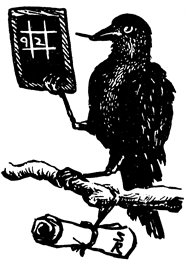
A twittering bird, tiny of frame but weighty of mind always won battles that defied her puny physical stature. She would often flap her wings by the window of my childhood and delight me with her sharp wit. I related so well to Tuntuni, the little bird. Perhaps because I was petite and shy myself, but not as dim as some of my teachers thought me to be.

Tuntuni’s tales filled up the phantasmic canvas around me with magical hues. The thin book carrying records of her victories, complete with bright images that lent credence to the words, became my good friend.

All those years ago, I didn’t know who created adorable Tuntuni. Her presence was enough to make my heart soar. All these years later, little Tuntuni still smiles through my window. And it’s time to thank her creator, too.

In a sense, Upendrakishore Raychowdhury (U Ray) was the first children’s writer in Bengali. This gifted writer and block-making expert devoted a large chunk of his writing life to creating fascinating stories for children. Before him, there was no established form of Bengali children’s literature. Most of the stories children heard were mythological or religious tales recounted by grandparents. These would almost always carry moral messages and examples. U Ray blazed a new trail by writing stories for kids that were pure fun, replete with strokes of humor, fantasy, and idiomatic peculiarities.

This pioneering writer didn’t just limit his children’s writing basket to Tuntuni’s stories. He rewrote the two Indian epics of Ramayana and Mahabharata to bring them closer to children. The simple language he used for these was in keeping with the tradition of elders telling bedtime stories to children.

In 1913, U Ray started Sandesh (the name of a traditional Bengali sweet), a children’s magazine. The magazine, filled with his writings and illustrations became a hit with young people and remained that way through generations as his illustrious son, Sukumar Ray and grandson Satyajit Ray managed its affairs after his death. I grew up devouring Sandesh month after month and thoroughly enjoyed the stories, poems, quizzes, along with the scientific and cultural facts the magazine packed within its pages.

Tuntuni has remained with me even through my growing years as have other stories of U Ray, one of them (Goopi Gayen, Bagha Bayen) having been immortalized by Satyajit Ray on the silver screen.

Smart and witty Tuntuni will come greeting you soon. Keep an eye on that window of yours.


Salil Chowdhury: Awakening Strains

November 19 is Salil Chowdhury’s birth anniversary. Although this multi-layered artist passed away in 1995, his stamp of exclusivity continues to sustain his livingness. A majority of Indians know Chowdhury (popular among his admirers as Salilda) as a virtuoso music composer. So did I, for a good many years, leading into my college life. His s music was hard to ignore for any lover of vintage-era Hindi film music. The earthy notes in Do Beegha Zameen (based on a short story by Chowdhury) or the Indianised version of a Hungarian folk tune in Madhumati; the poignancy of a day wearing down in Anand’s Kahin dur jab din dhal jaye or the strains of Middle Eastern music in Kabuliwallah—music, which didn’t slot Salil Chowdhury into any musician’s club, but established him in a league of his own. His versatility, the ability to make music that was internationally-influenced yet India-rooted, and his knack for getting the very best out of his singers easily made him stand out among his peers.
One day, during my college years, Salil Chowdhury stunned me again. This time, with a side of his that had remained unknown to me all this while—as a poet-composer of songs of protest and mass awakening.

Bicharpoti tomar bichar korbe jara
Aaj jegechhe shei jonota…

The people who will judge you
Have woken up, Your Honour.
Your guns and hangings, your prison tortures
Will be crushed by their weight.

Salil wrote this song in 1945, two years before India’s independence. It was a diatribe against the farce that was often carried out in the name of judicial hearing of Indian freedom fighters. The 1940s was also the decade when Salil Chowdhury joined the Indian Peoples Theatre Association or IPTA, an organisation of artistes and writers, born to address the conscientious role of the artistic community. As part of IPTA, Salil wrote many songs, beseeching his fellow countrymen to take power into their hands and rebel against exploitation by those in power. He wrote in simple Bengali, using words village folk spoke and voicing issues that concerned them.

O aayre, o aayere
Bhai bondhu, chal jaire…

Come, o’ brother,
Let’s cut the paddy and
Stock the harvest in our granaries.

Thus went his anthem for poor peasants who were perennially robbed off the rewards of their toil by shrewd, profiteering landlords. The poet-composer didn’t stop at his creation, though. He took these songs to villages, and soon these became people’s songs in the truest sense.

It’s easy to see what inspired Chowdhury to feel for the disadvantaged members of his community. As a young boy, he grew up in the tea gardens of Assam, where his father was a doctor. Chowdhury senior would routinely have the poorly paid coolies of the tea gardens to organise and stage plays against British exploitation. He also took part in many anti-British rallies, quite an audacious feat when the British were still ruling India.

Although in the mid 1950s this brilliant song-writer-musician matured into an exceptional self-taught composer with the onset of his professional career in film music, he never lost touch with the man within who dreamt of a classless society and envisioned an India that wasn’t touched by religious differences. He wrote his last mass song in the early 1990s, shortly after the demolition of the Babri Mosque by Hindu fundamentalist forces.

O aalor potho jatri, E je ratri
Ekhane themo na
E balur chore ashar
Toroni tomar jeno bendho na

O’ traveller of light
Don’t stop in this dark of night
Don’t anchor your boat of hope
On this slippery shore.

For more information and recordings of Salil Chowdhury’s brilliant compositions, visit The World of Salil Chowdhury.

Images:

The World of Salil Chowdhury
People’s Democracy

Writing as Resistance: The indomitable Art of Mahasweta Devi

This post was written as a guest entry for a reader’s words, the blog of the perceptive and literary-inclined Bhupinder Singh.

Writers are often cited as perceptive observers of the prevailing human condition. Some of the greatest writers have used the power of their written word to bring across the struggles and sufferings of the exploited before a wider audience. There exists a small section of writers, however, which feels compelled to act as more than mere spectators and reporters of the human condition. They throw themselves into the fight, as it were, of deprived people.

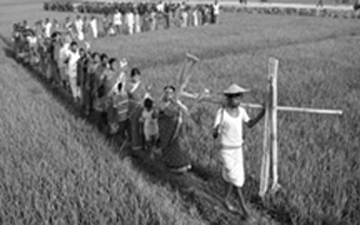
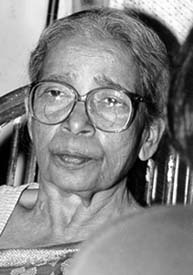
This trailblazer of a writer is arguably the finest example of activist writers in India. For more than a quarter of a century now, she has been actively working with tribals in certain Indian states. She fights for their basic rights, helps them unite and become self-reliant, and writes about their life, often reduced to a sub-human level by the rich and powerful. A prolific writer, most of her recent work draws from her association with these marginalized communities.

The Person:

Mahasweta was born in undivided India in 1926, about two decades before India’s independence. The daughter of Manish Ghatak, a poet and novelist, and Dharitri Devi, a writer and social worker, Mahasweta probably had literary activism in her genes. It was community service that emerged on the scene before writing, though. As a college student, Mahasweta joined her friends for providing relief to the victims of the infamous man-made Bengal famine (1942-44). They would distribute food, check through dead bodies lying in street to reach out to those still alive, feed them and take them to relief centres. This direct, raw brush with suffering became the seed of Mahasweta’s empathizing disposition.

Marriage came early, at the age of 20, when she tied the knot with Bijon Bhattacharya, a renowned Bengali playwright. Her husband was also a member of the Communist Party of India (CPI), and at the time the couple was establishing its marital life, communists often became the targets of persecution. As a result, it became tough for Bhattacharya to support his family, extended with the birth of their son, Nabarun, two years after their marriage. Mahasweta did several odd jobs to keep the hearth burning—selling dye powder, supplying monkeys for research to the U.S., teaching at a school, private tuitions—before she finally got a government job at the Post and Telegraph department. But this job was not to last for too long either. Someone dropped a few books of Marx, Lenin, and Engels in her office drawer, and Mahasweta was terminated on the charge of being a communist.

The Writer:

This is when she took to the pen—mainly to supplement family income. She started with light fiction for literary magazines. Her first book-length work appeared in 1956. Jhansir Rani or The Queen of Jhansi was a fictional account of the life of Lakshmi Bai, an Indian woman ruler who valiantly led her forces to fight the British, before being killed by them at age 22. Even as a first-time author, Mahasweta showed the impractical sincerity that distinguishes true writers of historical fiction. She borrowed money from family and friends to travel to the Bundelkhand region in north India, where Lakshmi Bai ruled, and walked her way through remote villages and deserts, collecting oral history, folklores, and ballads. Interestingly, this same seriousness of approach in collecting data for her stories would be seen years later, during the activist phase of her life.

The debut book brought Mahasweta recognition as a writer, and thus started her ascent in the world of Bengali literature. She authored several books, adding the pennies toward sustaining her family, while at the same time mirroring the prevailing social atmosphere. This promising writer went through a period of personal turmoil, during which time her marriage broke apart, and she suffered from acute depression. Bouncing back soon, she completed her master’s degree in English and served as a lecturer of English literature for two decades. This was also the period when she came up with her seminal novel, Hajar Churashir Ma (The Mother of 1084), which deals with the Naxalite movement in West Bengal that saw many young lives ending before their prime. The book captures the sad realities of the movement through the eyes of the mother of one such young boy. In her attempt to understand the violent movement, this mother comes face to face with her sense of estrangement from the double standard-ridden bourgeois society to which she belongs. Poignant, yet shorn of overt sentimental elements, the novel made a big impact on readers across India and was recently taken to the silver screen by director Govind Nihlani.

The Activist:

Over the next few years, Mahasweta’s pen took a decisive turn. She started integrating history into her storytelling. This wasn’t the conventionally disseminated history though; this was forgotten history, a part of the past that had been conveniently kept under the wraps. She wielded the power of narrative to document as well as spread stories of tribal resistances against the British and other social exploitations in books such as Aranyer Adhikar (Right to the Forest), and Chotti Munda O Tar Teer (Chotti Munda and his Arrow), among others. Here was a writer who truly wrote what she knew. Her vocation wasn’t divorced from her writing. She is amongst the foremost activists working for a better life for India’s tribals. Not content to stay cosy within her writing room, she ventured deep into the forests to live and work with tribal people.

She founded India’s first bonded-labour organization in 1980, bringing together thousands of bonded labourers to give them an organised platform for raising their voice against forced labour. A year before this, she turned Bortika, a literary periodical edited by her, into an open forum in which tribal people, peasants, factory workers, and rickshaw pullers wrote about their day-to-day experiences and problems.

This effort of hers is groundbreaking, since it records the issues of the underprivileged in their own words, unadulterated and unadorned. She went on to create a tribal welfare society for the Kheria and Shabar tribes, which are among the poorest in India. In 1986, this untiring champion of the voiceless founded the Adim Jaati Aikya Parishad or Ancient Tribes Union, a forum of 38 West Bengal tribal groups.

Nine years ago, at 71, Mahasweta received the Ramon Magsaysay Award for “her compassionate crusade through art and activism to claim for tribal peoples a just and honorable place in India’s national life.” While accepting the award, she said, “I will have a sense of fulfillment if more and more young writers took to unbeaten tracks. My India still lives behind a curtain of darkness. A curtain that separates the mainstream society from the poor and the deprived. But then why my India alone? Cannot one say the same for so many countries and societies today? As the century comes to an end, it is important that we all make an attempt to tear the curtain of darkness, see the reality that lies beyond and see our own true faces in the process.”

Images:
Delirium
The Hindu
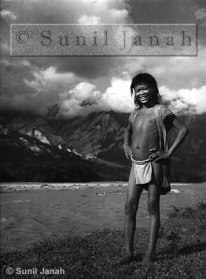
Sunil Janah’s Site


, , ,

In Memoriam: Naguib Mahfouz

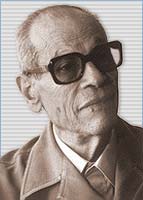
Naguib Mahfouz (1911-2006)

With the passing away of Naguib Mahfouz, Egypt‘s Nobel laureate, the literary world has lost an entire epoch. This 94-year-old writer wasn’t only a pillar of Arabic literature, but the central figure who brought this literature on to the world stage. Someone influenced as much by his Islamic mother’s tolerance for all humanity as by the ancient history of his country, his writing corpus matches the vastness of Egypt‘s heritage. From the reigns of pharaohs to the socio-political state of modern-day Egypt, Mahfouz’s writing captured the entire gamut of this ancient and vibrant culture. A writer who deeply loved his land and never stepped out of it, not even to attend the Nobel ceremony in 1988, his vision was never constrained by any man-made boundaries—geographical or otherwise.

My position on everything I have read throughout my life — and my readings include the Ancient Egyptian and Arabic heritage as well as English and French creative works — was, as far as possible, a neutral, unbiased, one. This in the sense that all these cultures are, in the last analysis, human cultures, produced by man, and I am as entitled to the English [literary] heritage as I am to the Pharaonic heritage. In other words, all these cultures belong to me in my capacity as a human being. And if you were to ask me to enumerate my favourite works in order, you might find among them an Ancient Egyptian work, a French one, a third that is Arabic and a fourth that is English. When I read I allow my self to love what seems worthy of love, regardless of nationality.

~ Naguib Mahfouz, in an interview with Ibrahim Mansour


More on Mahfouz in Egypt’s Al-Ahram Weekly.


,

Making Sense, Nonsensically: Sukumar Ray

As the AW Chain Ship (see sidebar) sails its way through the fifth round, it’s landed at my dock after crossing BK 30’s harbour. BK wrote about how you can never trick her into exercising or dieting, unless you mask those evil things as something else. Makes complete sense to me. Her post is hilarious. If you are in need of a laugh, go read it.
I admire people who can make you laugh with their writing. It requires a special skill and the ingenuity to view the world in a skewed manner. Writers who trigger a tickle in the funny bone time and again are, in my view, geniuses. And no, I don’t use that term lightly. The writer we meet today is a master of those funny missiles. He is the versatile, uproarious, and nonsensical Sukumar Ray—Bengali literature’s very own Lewis Carroll.

I am so glad I learned reading Bengali as a child. Otherwise, I would have been denied the magic of this master of nonsense. My first brush with his strange worldview took place when I was a toddler. That was around the time I was made to learn by heart some poems from Abol Tabol or Gibberish, Ray’s repository of nearly 50 balderdash verses. I didn’t hate memorizing these poems; if anything, the converse was true. To the innocent and unbridled mind of the little me, such weirdness was delicious and worth getting serious about.

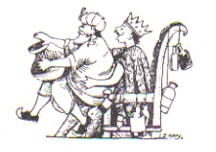
For, who would not delight to learn about the activities of the royal folks and subjects of Bombagarh, a fictitious kingdom, where the king keeps dried mango candy framed on his walls, the queen roams around with a pillow tied to her head, the citizenry does cartwheels on catching a cold, the king’s aunt plays cricket with pumpkins, and the minister beats an urn while sitting on the king’s lap?

In Gaaner Gunto or Musical Knock, he talks about the voice of the great Bhishmalochan Sharma—who starts singing on a scorching summer day—traveling from Delhi to Burma. People fall off and die by the dozens, unable to survive the “good vibrations” rampaging through the streets. Scores of animals fall prey to this thunderous singing session too, until a crazy goat knocks Bhishmalochan down with its menacing horns. That’s when his savage vocal chords are finally laid to good rest.

Sukumar Ray becomes a child’s friend in the most effortless way, just as Lewis Carroll or Edward Lear do. For here is someone who gives them the license to not only ponder on nonsense, but also to have limitless fun with it.

Ha Ja Ba Ra La or Mumbo Jumbo is a novelette peopled by strange creatures who are governed by even more outlandish rules. This complete nonsensical story is often compared to Alice’s Adventures in Wonderland in style and presentation. Yet, Ha Ja Ba Ra La, which is actually a random ordering of six Bengali consonants, remains peculiarly Bengali in its idiom and rendition.

While in your childhood, Sukumar Ray and his creations entertain you as dear friends, as an adult, you begin noticing the subtle satirical undertones in his works. He takes a dig at corrupt politicians in Ha Ja Ba Ra La, pokes fun at non-laughing pseudo intellectuals in the poem Ramgarurer Chhana (Ramgarur’s Offspring), and even some of the images in Bombagarher Raja insinuate the lack of activity that leads members of the royalty to find inane vocations to busy themselves with.

Over the course of the next few posts, I will introduce you to Dashu, a character created by Sukumar Ray. Be alarmed; Dashu is a bundle of surprises, accidents, and craziness. If you don’t like laughing, you may not be interested in knowing about him. But otherwise…stay tuned!

And now, keeping this a strictly funny business, may I anchor the AW Chain Ship at Andrea’s port, situated in the charming town of Southern Expressions.

Note: Illustrations by Sukumar Ray

, , , , ,

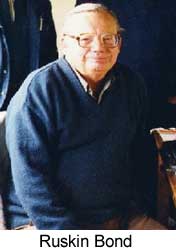
Author Profile: Ruskin Bond

The AW Chain continues into round two. Forbidden Snowflake wrote a post about ghosts and mentioned an experience of a slightly paranormal kind. Speaking of ghosts, whether we believe in them spirits or not, who doesn’t enjoy a spell-binding ghost story told on a rainy night? And one has to give credit to the writers who make our hearts race and our pulse soar with such chilling tales. One such Indian author is Ruskin Bond. However, he is not just a ghost story writer. Rather, this versatile wordsmith has also penned some ghost stories, along with novels, short stories, travelogues, and poetry.

Image courtesy: Indian Saga

A writer of Anglo-Indian descent, Bond is the quintessential Indian writer in English and a lifelong lover of India. Born in pre-independence India, he has lived through more than seventy autumns. The love of books and writing started early for him, thanks to his father, himself a bibliophile. Young Ruskin or Rusty as he was called, found encouragement from his father to scribble along in a small note book. Bond senior would often take Ruskin on nature trails, and wild flowers, trees, birds and other nature’s wonders became a permanent part of Bond junior’s psyche. These elements would become inseparable from his writing, too.

In 1944, as the Second World War still raged on, Ruskin’s father passed away, succumbing, not to the war, but to malaria. Rusty, along with his siblings and mother, had to move to England. During the four years he was there, a terrible homesickness for India overtook him. Yet, there wasn’t any feasible means of crossing the sea once more. Young Ruskin continued writing, though.

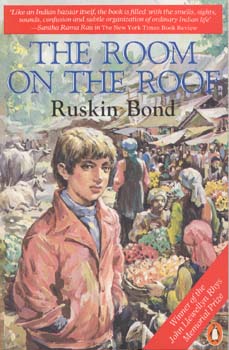
He was seventeen when The Room on the Roof, his first novel came out. The book won the John Llewellyn Rhys Prize. The book’s advance, 50 pounds, helped him buy a ticket to return to India—his home forever.

Upon returning, Bond set up base in the hills in north India. He chose the charming landscape of Dehra Dun to begin his career as a freelance writer. Here was someone, who only wanted to write, refused to be bound by the dreariness of a nine-to-five job, and who dared to eke out a living off freelance writing at a day and age when such a vocation was risky, bordering on eccentricity. Yet, he did it successfully through all these years—long hand and a rickety typewriter aiding him loyally.

Any day now, I shall have to shut up shop and join the ranks of salaried clerks or teachers. Any day now, I shall find that I no longer make a living as a freelance. Any day now…

I’ve had this dread for the past five years, but somehow, just when the going gets really rough and my bank balance touches rock-bottom, something does in fact turn up…and if I can go on writing, not always in the way I want to—because, if cheques are to be received, deadlines and editorial preferences must be met—but pretty much as I want to.

Any day now…

[From My Notebook, Ruskin Bond]

The books continued getting published, too. Vagrants in the Valley picked up from where The Room on the Roof trailed off. A series of short stories came along too, most of them marked by a stunning simplicity of language and an innate intimacy with nature.

People often ask me why my style is so simple. It is, in fact, deceptively simple, for no two sentences are really alike. It is clarity that I am striving to attain, not simplicity…Of course some people want literature to be difficult. And there are writers who like to make their readers toil and sweat. They hope to be taken more seriously that way. I have always tried to achieve a prose that is easy and conversational. And those who think this is simple should try it for themselves.

[Introduction: The Best of Ruskin Bond]

His novella, A Flight of Pigeons, set against the backdrop of the 1857 Sepoy Mutiny, the first Indian rebellion against the British Empire portrays human emotions and passions with a sensitive touch. Adapted for the silver screen as Junoon by acclaimed director Shyam Benegal, the book recounts the story of a young British woman whose father, a clerk working for the British authority in India, is killed in the Sepoy Mutiny.

About half a dozen novels and novellas, hundreds of short stories and essays, and more than thirty children’s books later, Bond’s pen is far from retirement. Settled in the quiet charm of Landour, a hill station in the lap of Himalayas, he doesn’t have any dearth of story material. A lifelong bachelor, Ruskin Bond doesn’t live alone. He is surrounded by the mirth of his adopted family (he adopted a boy from the hills and has since graduated to become a proud foster grandfather). Indeed, he is more Indian than many of “pure” Indian descent can claim to be.

It must be the land itself that holds me. But so many of my fellow Indians have been born (and reborn) here, and yet they think nothing of leaving the land. They will leave the mountains for the plains; the villages for the cities; their country for another country…

But it’s more than the land that holds me. For India is more than a land. India is an atmosphere. Over thousands of years, the races and religions of the world have mingled here and produced that unique, indefinable phenomenon, the Indian; so terrifying in a crowd, so beautiful in himself…

Race did not make me an Indian. Religion did not make me an Indian. But history did. And in the long run, it’s history that counts.

[At Home In India, Ruskin Bond]

Ruskin Bond touches a cord in me the same way as Wordsworth and Tagore do. For, his heartwarming relationship with nature and the spectacular simplicity of his words never fail to remind me of the magnificent beauty a glistening dew drop or the song of a skylark hold.

And the natural thing for me to do now would be to lead you all to Matt, the next link in the AW chain. Follow the trail…

Loving Twilight
Forbidden Snowflake
At Home, Writing
Fireflies in the Cloud
The Road Less Traveled
Mad Scientist Matt’s Lair
Jennifer Sando
Youth – Our Most Valuable Natural Resource
Peregrinas
Organized Chaos
Flying Shoes
Kappa no He
Untainted Enrapturement
The Secret Government Eggo Project

, ,