Review of ‘Nostalgic for A Place Never Seen’ in East India Story

Gargi Kalita reviewed my debut poetry collection, NOSTALGIC FOR A PLACE NEVER SEEN in East India Story. Read the review:

Bhaswati Ghosh’s Nostalgic for a Place Never Seen is a debut poetry collection that maps the evocative terrain of belonging. It explores how home is a terrain of the mind, a pulse of longing bridging the intimate and the global. A review by Gargi Kalita.

Nostalgia is never merely a return to the past—it is a tender reimagining, a delicate reconstruction of moments and emotions that memory alone can no longer fully contain. Home, in this sense, is not merely a geographical fixity but a terrain of the mind, a pulse of longing that beats through time, language, and loss. It is within this evocative terrain that Bhaswati Ghosh situated her debut  poetry collection Nostalgic for a Place Never Seen ,a volume that reads like a cartography of belonging drawn from within the self and across shifting geographies. Ghosh, a bilingual writer and translator based in Canada,with roots in New Delhi, belongs to the  lineage of Indian diasporic poets whose work bridges the intimate with the historical, the local with the global.

Some places are etched not in geography, but in remembrance—borne across generations like heirlooms wrapped in stories, scents, and silence. Bhaswati Ghosh’s Nostalgic for a Place Never Seen traces an emotional landscape, where her grandmother’s lost Barisal finds a home in verse.This poetry collection, imbued with reflections on migration, memory, and identity, is organized into eight thematically rich sections— “Dwellings: Temporary and Permanent”, “Places, Faces, Traces”, “Scents, Tastes, Textures”, “Seasons of the Heart”, “Water, Earth, Air, Fire”, “The Humming Octave”, “The Wordsmiths”, and “Movements in and Out of Time”. Across 72 poems of the collection, Ghosh explores personal and historical landscapes of belonging shaped by displacement, capturing the tension between the fleeting and the lasting, and inviting readers to find home in language and memory.

At the heart of Nostalgic for a Place Never Seen is a poignant reflection on memory, identity, displacement, cultural inheritance, and longing that extends beyond personal history. Bhaswati Ghosh’s poetry weaves internal and external landscapes, capturing the emotional geography of diasporic consciousness—a yearning not just for a place, but for the sense of rootedness it once held.

The title poem, “Nostalgic for a Place Never Seen,” which lends its name to the collection, forms the emotional nucleus of the book. Drawing on Ghosh’s inherited memory of her grandmother’s forced migration from Barisal in East Bengal (now Bangladesh)  to post-Partition Delhi, it reflects the vivid presence of places never personally visited but deeply felt through intergenerational storytelling. This aligns with Marianne Hirsch’s concept of “postmemory”—the transmission of trauma and displacement across generations. Ghosh captures this poignantly in both “Nostalgic for a Place Never Seen” and “Native Dialect.”

In a video about Sugandha, I see a mother

combing her daughter’s hair. Before I know it,

the daughter turns into my grandma

and breaks into a song.

‘Why don’t you come anymore?’ she asks.

— Nostalgic for a Place Never Seen

When her little sister visited

and Grandma broke into their

Barisailya patois, I heard songs

of home in the words. Of boat

races and river markets. Of a

home I’d dreamt of in past

lives amid simulated

nostalgia.

— Native Dialect

In the opening section, Dwellings: Temporary and Permanent, poems like “Sleeping at My Mother’s House” and “Displaced Persons’ Colony” do not merely reconstruct domestic spaces; they evoke the invisible sediment of emotion—love, loss, security, fragility, displacement —that inhabits these spaces. These dwellings become mnemonic devices, where physical architecture merges with psychological and ancestral landscapes.

Likewise, in Places, Faces, Traces, the poet functions as a flaneuse of memory, fluidly moving through places like Lajpat Nagar, Buenos Aires, and Mukteshwar—each becoming a site of introspection and remembrance.These locations act less as physical sites and more as emotional landscapes, forming a metaphorical map. Ghosh suggests that memory is borderless, bound more to emotion than to nation, language, or place. The poems wrestle with the impermanence of space and the persistent search for anchorage amidst flux.

Perhaps the most evocative section of the book is Scents, Tastes, Textures, which serves as a visceral archive of cultural identity. In poems like “Cooking Hilsa” and “Cumin,” food becomes a tactile memory, carrying heritage on the tongue and in the body. These sensorial evocations act as gateways to lost homes and forgotten rituals, echoing Roland Barthes’s idea of the “grain” in language—where meaning is felt rather than just stated. For Ghosh, food is not merely sustenance; it is survival, nostalgia, and resistance. As she writes in “Cumin”:

Taste is the original rebel. It resists being caged in

 closed jars or steaming woks.

In the later sections—Seasons of the Heart and Movements In and Out of Time—Ghosh turns inward, tracing the subtle shifts of self and emotion. Poems like “Learning, Unlearning” and “Debts to Pay” reflect on growth and changing roles, offering a sense of becoming rather than just loss or nostalgia. Ghosh shows that belonging is fluid, woven through memory and choice, and this quiet evolution is captured in “Learning, Unlearning”, where she writes:

She learns to pause more on the

page. I unlearn the stiffness of knowing it all.

A central thread in the collection is Ghosh’s nuanced exploration of “home”—Is home a physical dwelling, a landscape of memory, a sound, a scent or even a fleeting feeling? Ghosh’s poems move through Delhi, ancestral villages, and diasporic spaces, revealing home as both grounding and elusive. Echoing Edward Said’s “imagined geographies,”as  she shows that places are shaped more by memory and feeling than by maps. The collection also explores identity and belonging from a female perspective, as Ghosh reclaims her grandmother’s story—giving voice and agency to women often sidelined in Partition narratives.

Stylistically, Ghosh’s poetry is defined by a quiet musicality that emerges not from ornamentation but from emotional authenticity. Yet, within this understated lyricism lies a deft command of literary craft—her metaphors, imagery, and structure deepen each poem’s emotional resonance. In “Fading Colour,” letters losing their hue become haunting emblems of histories dimmed by time and silence. In “Pickling Language,” the simple act of preserving becomes a vessel for memory and identity, where ancestral syntax ferments quietly in jars.

Ghosh’s lyrical minimalism resists excess, favouring the resonance of ordinary moments—stillness, observation, memory—each imbued with metaphorical richness. Subtle threads of Bengali and Hindustani lend her lines a textured intimacy, anchoring the diasporic experience in language. Eschewing nostalgia, she crafts verses of precision and clarity, conjuring cities like Delhi, Mexico City, and Buenos Aires not through maps, but through mood, rhythm, and metaphor. The result is poetry both introspective and worldly—rooted in the particular, yet open to the universal.

In an age where identity is continually redefined by movement and loss, Nostalgic for a Place Never Seen reminds us of the power of poetry to anchor us—to a language, a scent, a home, even if that home exists only in memory. Traversing continents and generations through everyday rituals and stories, Ghosh explores cultural heritage, displacement, and   belonging, evoking empathy and prompting reflection on our own ties to memory and place.

There are certain spaces the soul longs for—not merely to dwell in, but to truly belong. Amid the scattered rhythms of postmodernity, this yearning becomes a search for rootedness not in geography, but in presence—a place deeply felt, where one is the place, and the place is the self. And that is what Bhaswati Ghosh’s Nostalgic for a Place Never Seen ultimately embodies—making it a vital literary contribution to Indian English poetry, diasporic literature, and memory studies.

Book Details:

Review of NOSTALGIC FOR A PLACE NEVER SEEN in Cha

Read this review of NOSTALGIC FOR A PLACE NEVER SEEN by Sayan Aich in Cha: An Asian Journal

Nostalgia is humanity’s Janus-faced companion—simultaneously looking back and forward, with someone or something perpetually tugging at us from behind. Yielding to it is not a mere indulgence but, at times, a necessity—offering the wisdom to understand who we are, shaped by the “roots” and “routes” that define our journeys. In a world increasingly fraught with conflict and displacement, it is only natural that narratives exploring these two R’s—roots and routes—should continue to emerge. For the people of the Indian subcontinent, whose shared and traumatic histories of Partition and the Bangladesh Liberation War remain deeply embedded in cultural memory, nostalgia serves as both a fertile and essential motif in the collective psyche and fiction. Stories born from survival and resettlement must be preserved and passed down to new generations of readers and listeners, lest they be erased by the official historiography of the nation. Since time immemorial, the world has progressed and endured through storytelling—the foundational thread of every community, woven through acts of telling and retelling across generations.

Bhaswati Ghosh’s debut poetry collection, Nostalgic for a Place Never Seen, encapsulates all of this—and more. Having grown up in New Delhi and now residing in Canada, Ghosh traverses and inhabits multiple worlds—the cities of her childhood and adulthood, the towns she has visited in her travels, and the villages she has never set foot in but knows intimately through the vivid recollections of her grandmother’s storytelling. In her poetry, time and space coalesce, overlap, and blur, mirroring the way memory itself operates—fluid, unpredictable, and untethered to rules or chronology. The past and the imagined intertwine, shaping a landscape where nostalgia is not merely a longing for what was, but for what could have been.

Read the rest in Cha: An Asian Journal

Alice Munro: Marathons in Sprint

I wrote this when Alice Munro won the Nobel Prize in Literature in 2013.

In Boys and Girls, Alice Munro accomplishes the perfect storyteller’s feat–instilling in the reader feelings of delight, shock, surprise, suspense, and dejection, all over the course of a single short story. The narrator is a young girl whose father raises foxes in a pen for selling their fur to traders in wintertime. She helps out her father with the job by bringing water to the foxes twice a day in the summer and raking the grass and money-musk that her father would cut.

As she performed these chores under his supervision, little dialogue was exchanged between the two. The girl, however, took great pride in being able to shoulder his labour, even if in a minimal way.

One time a feed salesman came down into the pens to talk to him and my father said, “Like to have you meet my new hired hand.” I turned away and raked furiously, red in the face with pleasure. (Boys and Girls, Alice Munro)

https://6a4d59d4f89612f50a161d6252909ac4.safeframe.googlesyndication.com/safeframe/1-0-40/html/container.html

Working for her father is one of the ways in which this young protagonist fights the gender stereotypes she is supposed to comply with, even as her flashes of rebellion provoke the ire of her mother and grandmother. In a clever sub-plot, Munro allows this child flights of fancy in which she rescues people in danger from a bombed building, shoots rabid wolves and undertakes other such heroic endeavours with the noble intent of saving others. These situations represent the polar opposite of her actual station in life, where her gender must always precede her will or wish.

However, a moment arrives during the imminent execution of an old (female) horse, for the purpose of its meat being supplied as food to the foxes, when our young narrator has an opportunity to live her imagination. Entrusted with closing the house gate by her father when Flora, the horse, breaks loose from the clutches of her executioners, the eleven-year-old girl lets the horse escape by keeping the gate wide open. The only witness to her defiant act is Laird, her younger brother.

At dinner that night, Laird proudly describes how he saw his father and his farm hand capture the frenzied horse after giving her a chase in their van and cut its body into pieces. He also reveals how his big sister had let the animal escape earlier in the day. The story ends with the father telling everyone present, “Never mind. She’s only a girl,” and his daughter’s ignominious acceptance of what that taunt implied.

As I delved into the universes Munro constructs with an architect’s precision and an interior designer’s aesthetic charm, her ability to zoom lens–be it on a character, situation or even the interior landscape of a person–kept me immersed in her stories, one after the other. Munro’s tales are not snapshots–seen now and forgotten then; they are alleys we have all trodden in our own lives–as perpetrators or victims of cruelty, in happiness and despair, while concealing deceit and guilt. It is this universality of her themes, despite the affectionate localization of her stories, many of them set in Southern Ontario, where I now live, that makes Munro both appealing and important.

In a true mirroring of life, Munro’s stories steer clear of delivering verdicts or solutions to predicaments and miseries. Often the one relating the agony of the victim–whether it be the schoolgirl who bullies her classmate or the husband who contemplates a new relationship even as he assumes a caregiver’s role for his dementia-afflicted wife– is the one responsible for it, usually not by design, but a strange concoction of circumstances, societal expectations and personal quirks.

When Alice Munro won the Nobel Prize last week, I was delighted. Not just because she has enviably mastered the art of seizing entire universes within the scope of short fiction. Nor because of her neuroscientist-like ability to get inside the minds of young adults and their tribulations. Not because the locales in which she sets her stories are now part of my personal geography. Or because of her mature portrayal of the internal drama the human mind loves to engage in.

“Her voice on the (answering) machine was different from the voice he’d heard a short time ago in her house…A tremor of nerves there, an affected nonchalance, a hurry to get through, and a reluctance to let go.” (The Bear Came Over the Mountain, Alice Munro).

I was delighted because like her protagonist in Boys and Girls, Munro held the gate to a world she believed in–that of short stories–wide open. And won.

In remembrance: Somendranath Bandopadhyay

Somendranath Bandyopadhyay (1926-2022)
Prof. Somendranath Bandyopadhyay taught Bengali Language and Literature in Visva-Bharati, Santiniketan during 1957–1991. His subject was mainly Rabindranath Tagore. He wrote several books on Bengali poetry, art, philosophy and literature. In 2011, the Rabindra Bharati University, Kolkata awarded him the D. Litt. The following is my personal tribute to him. 

1986 — A teacher’s visit

I am in Class 7 and we have moved to Chittarajan Park, South Delhi’s very own Bengali pocket, only a year ago. It’s 7 or perhaps 7:30 in the evening, a busy time for our family of six. I and Dada, my brother, are hunched over our schoolwork — homework, preparing for a class test and such. Dadubhai, my grandfather, is coaching me as usual. In the kitchen, my grandmother and mother, both tired from a day’s work at their respective offices, are hustling to get dinner ready. Suddenly, there’s a knock on the door. We have no telephone (cell phones haven’t been born yet) and aren’t expecting any visitors in particular. When the door is opened, two tall gentlemen, one of them in pristine white dhuti and panjabi, are found standing. The gentleman in white, the older of the two, asks for my mother, and when she comes to the door, she, and the rest of us, are startled beyond words. Professor Somendranath Bandopadhyay, her teacher from Visva-Bharati, Santiniketan, where Ma went to study for her MA in Bengali, has come to visit her. The last time the two of them had seen each other was more than a couple of decades ago, while my mother was his student.  Back in her student days, he had shown extraordinary compassion to help her get through a difficult academic patch.

They had kept in touch through letters, and that year, as a student of class 7, when I witnessed this incredible moment, I realized why my mother held this teacher in such high regard. Professor Bandopadhyay was visiting relatives in Chittaranjan Park and mentioned that he wanted to meet his former student, who also lived in the neighbourhood. The conversation that followed through the evening is a blur to me, but I remember helping my mother sift whole wheat flour through a soft cotton cloth in the kitchen to ‘make’ refined flour as Ma and Grandma got busy making luchi, a delicacy that had to be served to a special guest. I remember my grandfather, a man of few words, expressing amazed delight that a teacher had taken the trouble of tracing his student’s house and visiting her. I remember that we were all amazed. I remember how a teacher’s visit had changed the complexion of a weary city evening. Over the next many decades, we would receive letters from him on postcards with beautiful line drawings depicting flowers, leaves, and nature on them.

2007 — Visiting a teacher

The author in Santiniketan; Photo © Bhaswati Ghosh

After working for many different bosses for more than a decade, I finally decide to work for myself and become a freelance writer-editor. Working my own hours gives me the reward of finding more time to do the things that bring me joy — write, cook, travel. I plan a long vacation to West Bengal with my mother. We spend the bulk of our time in Kolkata, but also have Santiniketan and Bishnupur on our itinerary. At Santiniketan, when we seek accommodation at the in-campus guest house, we’re turned away, with no vacancy offered to us by way of explanation. We put up at a lodge close to the campus. That evening, when Ma and I visit Professor Bandopadhyay, now Somen Mama to me, she tells him about our lodging woes, and he chides her saying she should have called him right from the guest house. He asks us how long we plan to stay for, and when he learns it would be the next three days, he calls up the guest house to get us a room there. We move back into the campus, a pilgrimage for me, where she would wake up to, as she did in her days as a student, to the calls of doel, the oriental magpie and bou-kotha-kao, the Indian cuckoo. I would discover mornings that sounded sweeter than anything I’d ever experienced in my existence as a city-bred. 

At Somen Mama’s house for breakfast one morning, his affectionate wife, Boudi to all students, and Maami to me, treats us to a deliciously elaborate spread, complete with luchi, torkaari, chop (croquettes), mishti and her signature vanilla pound cake that I’ve come to relish. We sit at the low jol-chowkis in the dining area of this aesthetically pleasing and inviting house as Mama talks to us about Tagore’s worldview and the radical relevance of the Buddha’s teachings. Now and again, a humorous vein emerges, and he breaks into a laughter — resonant, uninhibited, completely disarming. We drift back to the living room for tea and more stimulating conversation. He then brings a copy of his latest book — Shilpi Ramkinkar Alaapchari — that he signs for my mother as a gift. He gives me a beautiful pair of polished burgundy wooden chopsticks that he’d gotten from his visit to Japan. I spend some quiet moments in their beautiful garden outside, soaking in the prettiness of flowers — clusters of Ashok and hibiscus in several colours.

Flower arrangement at Somen Mama’s house; Photo © Bhaswati Ghosh

Back in Delhi, my mother reads the book and keeps nudging me to do the same. I politely keep telling her I will, until I can’t put it off any longer. I’m barely into the first paragraph when I realize I wouldn’t be able to put it down before devouring every last sentence, every last word of it. The book’s format is deceptively everyday — it’s a series of conversations between two neighbours. Only, in this case, both the interviewee — the artist-sculptor Ramkinkar Baij and his interviewer — Somendranath Bandopadhyay are so much in synchronicity that the reader couldn’t ask for two better conversationalists. 

Shilpi Ramkinkar Alaapchari

By simply describing the living quarters of the renowned artist who he found as his neighbour, Somen Mama, draws me in. I am transported to the Santiniketan of Baij’s student and work life, to his world of mud and plaster, of studying from other artists, both at home and globally, of his interactions with Rabindranath Tagore who encourages him to chart his own course without looking back, of deeply empathizing with and drawing inspiration for his work from the Santhal Adivasis living in the area, and most of all, of living a passionate, feisty, and fiercely creative life on his own terms. The book is not merely a gift to my mother, to us, I realize; it’s a gift to all who can read the Bengali language. I am so taken by it that I want to tell the world about it and excitedly write a blog post and translate a few favourite parts. Later that year, I send my proposal for translating this remarkable book to an international translation fellowship. It gets accepted. 

2008-2012 — A teacher for life

I am back in Santiniketan with Ma to meet with Somen Mama, to give him the good news, to seek his permission to translate the book. He talks about having heard of a certain blogger from Delhi who had translated parts of the book; then he realizes that person is me. So far he’s only known me by my pet name, so it has taken him a while to make the connection. While we’re here this time, I ask Somen Mama, now my author, lots of questions regarding the book’s technical aspects. He takes out big tomes from his study and patiently answers each one of my queries. I also spend my time looking more closely at Ramkinkar Baij’s sculptures spread across the open campus — Sujata, Santhal Family, Mill Call. My seeing is now informed by the history and context of these iconic works, captured with vivid sincerity by Somen Mama. 

I travel to Norwich, UK, the site of my fellowship and complete translating the book. Over the next year, I look for publishers for the book and fortunately, the book finds a home. A journey that began with my mother’s master’s education in Santiniketan comes full circle as my name appears below his on a book cover. Shilpi Ramkinkar Alaapchari becomes My Days With Ramkinkar Baij in English. 

2022 — The final adieu

On a March day, we receive the sad news of Somen Mama’s final departure. It’s still difficult to think of him in the past tense. As I reflect on this wonderful human being and the fullness of his life that enriched so many of us, I know what I will remember of and receive as blessings from him the most — humility and grace, a childlike zeal for exploring new realms, and above all, a deep, empathetic compassion for those around us. 

‘Jago Hua Savera’: Recalling a Cinematic Manifesto for the Dawn of Hope

First published in The Wire

Night falls on a river. The village around it thickens with darkness. Not the river. On its breast, distant lights flicker like inextinguishable fireflies. The glow comes from the boats of the fishermen sailing on its waves. A majhi (boatman) sings a drawn-out tune and the river’s water folds into its haunting essence with every splash of the oar.

This is how the 1959 Pakistani film, Jago Hua Savera (The Day Shall Dawn) unfolds as does Padma Nadir Majhi (The Boatman of Padma), the novel it’s adapted from. An enthralling flute amplifies the aural impact of Jago Hua Savera’s opening scene even more, holding the viewer in a delicate trance. A synthesis of the work of stalwarts like Faiz Ahmed Faiz who wrote the songs, dialogues and story; music director, Timir Baran and Academy Award winning cinematographer, Walter Lassally – this first scene establishes the tenor of the film’s sensitive and neo-realist aesthetic.

That the night isn’t pitch-black isn’t insignificant. Like the Padma itself, it is mysterious and pregnant with possibility. Of light. Of dawn. It has to be that way. For the Padma is as unforgiving to the fisherfolk edging its banks as it is giving.

When Manik Bandopadhyay wrote Padma Nadir Majhi, his sparkling novel chronicling the lives of East Bengal’s fishermen, India was under British rule and the Second World War was still three years away. When director A.J. Kardar adapted it for the screen, Partition had split India, and Faiz’s reworked story reflected the region’s altered geopolitics. Filmed on location at Saitnol on the banks of the Meghna River in what was then East Pakistan, the film’s story marks a significant, and arguably necessary, departure from the novel.

The biggest change is also the most awkward one – the fisherman’s tongue. Instead of the regional Bangla dialect of the book, the characters in Jago speak in colloquial Hindustani. It’s not an A for B transposition, though. For me, a Bengali married to a Sikh, the ingenious workaround Faiz and Kardar employed to get around the language hurdle struck a personal resonance. Despite speaking fairly respectable Hindi all my unmarried life in Delhi, my hometown, with my husband, I started speaking in a deliberately incorrect tongue, upturning verb conjugations – a pattern absent in Bengali.

The fishing villagers of Jago speak a similar broken Hindustani, their vocabulary sparse and uncluttered. When the viewer is least expecting it, fragments of Bengali float into her ears – a kid begging his father to spare “duto poisa,” another telling his uncle, “Miyan boddi anchhe,” (the miyan has brought a traditional doctor), and then a full exchange in Bangla between two sisters, Tripti Mitra playing the younger of them.

An idiom for celluloid

One would be mistaken, however, in attempting to locate the film’s vocabulary in a particular vernacular. From the first scene to the concluding one, the elements that dominate both the stylistic and utilitarian purposes of Jago are wordless – the music, the ambient sounds, the silence. In the opening scenes, the viewer gets a sense of a sound peculiar to Padma’s boatmen as Bandopadhyay describes it:

“From the heart of the river afar, a call is heard, a faint sound of human voice…This is a language known only to the boatmen of East Bengal. There are no words in this language, only undulating vocalization. Across unbounded horizons spreading over the river, this sound travels long distances, becoming fainter in volume, but unchanged in its ripples.” [From Padma Nadir Majhi, translated by the author.]

The depth and breadth of Timir Baran’s prowess as a composer are on full showcase here, not just in the three songs that a boatman sings, all carrying the resilient poise of Faiz’s poetry, but also in the music director’s unusual choice of the classical veena – to overlay everyday village scenes with a sedate composure.

Then there are atmospheric sounds – the Padma’s waves, of course, but also the chatter of kids playing on its banks, the cawing of crows, the buzz of a bustling fish market and, later in the film, the big city’s honking automobiles, hawking porters and tinkling bicycles – that lend the narrative a compelling immediacy.

Lassally’s mature camerawork makes it even easier for the director to stick to verbal minimalism in the film. From the first frame, the camera moves with eloquence to capture both nature and man. While the Padma’s expanse and excitability are made almost palpable for the viewer, the close-ups of the characters’ faces strike one as archives of an ancient sadness.

In Jago, the majority of the villagers are Muslims as opposed to the Hindus in the novel. The characters and the plot are a lot less complex, too, making this nearly an original story, written for a new audience.

Most noticeable among the revised characters is that of Bandopadhyay’s Hossain Miya, an enigmatic man of wealth who could be caring or ruthless, depending on the situation. In Jago, he becomes the unidimensional Lal Miyan, a moneylender like any other, stripped of complexities.

The other big character swap is that of the protagonist’s sister-in-law’s. The novel’s Kapila is Mala in the film, played with sensual charm by Tripti Mitra. As in the book, she retains her flirtatious ways, but instead of enticing Miya, her brother-in-law, is seen to attract the attention of Kasim, Miya’s brotherly friend. Bangladeshi acting legend, Khan Ataur Rahman not only plays the role of Kasim with self-assurance, but also sings the film’s songs with tender facility. Particularly enduring is his rendition of “Beet chali hai raat/ab chhoro gham ki baat,” (The night is about to end, my friend/Let go of your songs of sorrow), a spirited nazm by Faiz that Baran has set – to an electrifying effect – to a traditional bhatiyali tune.

Of deprivation and the dawn of hope

There is less gossip and innuendo in the film, too, the extent of it being Lal Miya pointing fingers at Kasim and Mala’s open show of affection for each other. Yet, despite all these deviations, the film remains faithful to Bandopadhyay’s work in a fundamental way – in its politics.

At the core of Padma Nadir Majhi is the social discrimination, ostracism and extreme poverty the fishermen suffer. Their destitution is naked, for they have little to cover it with. But it’s still not without dignity. Miya pulls a fragile cover over his newborn son and helps his invalid wife lie down beside him with the gentlest touch. When his daughter’s leg is fractured, Kasim lifts her in his arms and takes her for treatment to the city hospital – a long and arduous journey he undertakes without a blink. Ganju, obsessed with buying a new boat off Lal Miyan, saves every penny for it despite seeing tuberculosis sniffing the life out of him.

Despite its affirmative title, Jago Hua Savera is rooted in reality. Ganju will acquire his boat but not live long enough to enjoy it. Miya will not be able to buy it, not even after collecting all his life’s savings, including the money his wife has been saving for their daughter’s wedding, the pennies in his son’s piggy bank and Kasim’s offered savings. Wistfully, and in his torn vest, he’ll keep his gaze on the treasured boat as it floats on Padma’s bosom.

And still the fisherfolk will wrest their dawn from the night – the Padma will hold them in her sway again, Miya will approve of Kasim’s relationship with Mala, and Kasim and Miya will return to the fishing boat. And the glow of its lantern.

This is a dawn that’s as unremarkable as the fishermen’s’ lives. It is still a savera, nonetheless.

Jago Hua Savera is a landmark film, not only because of its international cast and crew or the way it draws inspiration from the best of world cinema. But because it reinvents a classic in its own, cinematic, idiom.

[The Day Shall Dawn (1959) was selected as the Pakistani entry for the Best Foreign Language Film at the 32nd Academy Awards, but was not accepted as a nominee. It was also entered into the first Moscow International Film Festival where it won a Golden Medal. Days before the film was to premier, the new government of Pakistan (under Ayub Khan) asked the film’s producer, Nauman Taseer not to release the film. The writer, Faiz Ahmad Faiz, was later imprisoned by the government for his communist beliefs. Anjum Taseer, son of the producer, had the film fully restored in 2010.]

The Whore as a Metaphor for a City

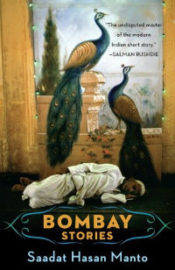
Bombay Stories by Saadat Hasan Manto 
Translated by Matt Reeck and Aftab Ahmad
Vintage International

First published in The Beacon

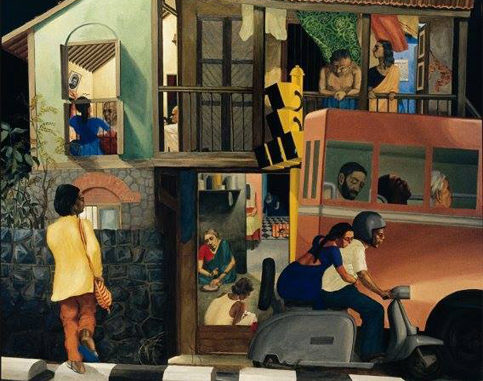
Sudhir Pattwardhan. “Street Corner” 1985

Mention Saadat Hasan Manto’s name and a landscape of tragedy unravels in all its grotesqueness. That he has become almost a Siamese twin of the Partition stories he wrote is a minor tragedy in itself. In both age and disposition, there is an altogether different Manto who predates his avatar as a chronicler of the Partition. Bombay Stories introduces one to this earlier Manto, and with him, the city that built his reputation as a writer. The same city that enabled him to become an indubitable annotator of “lowlifes.”

Manto’s Bombay (yes, still very much Bombay), part of pre-independence India, boils with cosmopolitan chaos. As a pot that melted extremes, the city became a home for everyone, from the business tycoon to the migrant labourer and the prostitute. The last group drew Manto’s literary imagination with an intensity bordering on obsession. Nearly every tale in Bombay Stories features a prostitute, even if she isn’t the central character. The skin-brushing proximity Manto evinces in projecting the lives of sex workers raised many an eyebrow in his lifetime. He had been accused of employing obscenity in his stories. One can see why. Manto presents the prostitute in her grimy and broken hovel, stripping her of exaggerated fancies of glamour and lust. The realism apart, the bigger surprise Manto packs in these stories is his not-so-hidden feminist agenda.

When Kanta opens the door to him stark naked, Khushiya, a pimp, is shocked and asks why she doesn’t have any clothes on.

          Kanta smiled. “When you said it was you, I thought, what’s the big deal? It’s only my Khushiya, I’ll let him in…”

The woman’s brazenness hits Khushiya as a whack of insult. It torments him that she could consider him so insignificant as to think nothing of appearing naked in front of him. This weird conflict in the pimp’s mind is a projectile of writerly brilliance. Who would think that a prostitute’s nudity — her most lascivious and prized offering — could be turned on its head and into a weapon to injure the male ego?

Manto’s prostitutes are the axiomatic flesh-and-blood, but they are more. They have beautiful minds of their own, which they exercise despite the compulsion of being tied to the body to pay for food.

The most visceral demonstration of this happens in The Insult, where Saugandhi, a sex worker kicks patriarchy in its shins instead of remaining in its bubble wrap of faux security. Ironically, Saugandhi’s provocation comes not from sexual exploitation but rejection from a potential customer. A man with whom her pimp sets her up says “Yuhkk,” in apparent revulsion and dashes away in his car. In the man’s single meaningless utterance, Saugandhi (literally, fragrant-smelling) decodes a lifetime of humiliation that masculinity has heaped on her. It is in her getting even that Manto concentrates the story’s greatest force. Shortly after the rejection episode, Madho, Saugandhi’s leeching “lover” reappears with his need for money. She rips his photos from her walls and throws them out of the window uttering, “Yuhkk. That is how she seizes her moment of showing Madho — and through him, every man — his place.

In Ten Rupees, Sarita, a young girl, is forced into prostitution by her mother. The story breaks one’s heart before enthralling and finally healing it — with twists as sharp as the ones Kifayat, the driver in the story – makes his car swerve to. Ten Rupees is evidence of the perversion of depraved men looking to sexually exploit a young girl. It is also proof of what the alchemy between a writer’s masterly imagination and his sensitivity can do to kindle the softest core of the human heart, no matter how savage. Ten Rupees is a fantastical story, electrifyingly so because of a young girl who is just that and the Hindi film songs she breaks into unbidden. It’s also an extraordinary story. Although almost a fairy tale, over the brief wingspan of its flight, it holds out the hope of coming true somewhere at some point in time.

In his depiction of prostitutes, Manto is somewhere between an exploiter and a benefactor – more like an ally. His vision has a diving mask that takes him beyond the prostitute’s essential physical territory. Accompanying him to their shanties allows the reader to see them, really see them — the way they live and dream, quarrel with or negotiate their fate. It isn’t difficult to find in Manto’s whores a metaphor for the Bombay of the 1940s. Like her, the city welcomed in a businesslike way anyone willing to pay for the pleasures it offered them. There were no strident calls for keeping outsiders out and the place teemed with characters from different regions, religions and communities.

Only one other character could possibly make the prostitute envious with the consistency of its appearance in Bombay stories. That of Manto’s. Most of the stories are in the first person, and the narrator refers to himself simply as Manto. It is tempting to take this as the author’s real-life persona, but one is well advised to read this character within the fictional framework of the stories. As translator, Matt Reeck informs us in his detailed notes, the Manto of the stories isn’t really a mirror image of the real-life Manto. Still, this self-depreciating, temperamental persona is close enough to the real Manto, one suspects. This is particularly true when he shares vignettes from the Hindi film industry, where he worked as a writer. He delights the reader with an insider’s view of the film industry, at once an enigma and an imperishable field of gossip fuel.

Consider this principle from a ten-point list Narayan, who works in the film industry draws up for working in the studio. #3: If you fall in love with an actress, don’t waste time dilly-dallying. Go meet her in private and recite the line, “I, too, have a tongue in my mouth.” If she doesn’t believe you, then stick the whole thing out. And#6, which rings so true, one could have written it today. Remember that an actor has an afterlife too. From time to time, instead of preening before a mirror, get a little dirty. I mean, do some charity work.” [Janaki]

The translators, Matt Reeck and Aftab Ahmad have rendered these stories into English with compelling credence without over-anglicising the text. The distinct Indian-ness of the narration is well preserved for the most part as is Manto’s signature sarcasm and wry humour.

One reads Manto not just for the stories he wrote but also because of the way he embalms each story with his deep humanity, his acerbic wit and his near-allergic impatience for masks — semantic or societal. In Mozelle, technically the only “Partition” story in the collection is also arguably the most brilliant in form, content and technique. It depicts the horrors of the communal tensions of the time with such vividness and neurotic pace that the reader is stunned into a suffocating silence. This one story is also an eerie foreboding of the departure of Manto himself from his beloved Bombay, which he had to leave following Partition and from the pluralistic freedom it offered him.


Bombay Stories
 is therefore, is an important collection to understand not only a city but its author who, tragically, died not in but of Partition.

The Art of Solitude: In Rabindranath Tagore’s letters, the gifts of a life in solitude

First published in Scroll

After a week of rain, hail and non-seasonal arctic chills, a balmy sunshine and a breeze carrying whispers of spring indulge us in the Southern Ontario suburb where I live with my husband. With a book in my hand, I step out into the backyard and find it to be the venue of an unrehearsed celebration of this climatic turnaround. All our immediate neighbours are out – the daughters of our next-door neighbours yell hellos to their school friends in the backyard across theirs; our other next-door gardener neighbour is busy tending to her perennials; my husband readies the soil for his impending vegetable garden.

Human hums and giggles enter me along with the constant chirp of the backyard birds. As I open my book Chhinnapatrabali – Rabindranath Tagore’s collection of letters, written for the most part to his niece, Indira Devi Chaudhurani, I don’t miss the rare synchronicity this moment brings, especially in our current physically distanced world. The cover of my reading material is beginning to tear up, evidence of the book’s confidant-like association with me through the decade of my life outside India.

Tagore wrote a lot of these letters from his family estate in East Bengal, which he’d been tasked to manage in his youth. While opening a window to his literary talent and creative process, the letters also serve as a manifesto of living in and celebrating solitude and its many gifts. A shift away from the human-centric way of life is one of these gifts. In letter after letter, Tagore speaks of how, whenever he lands in the rural environment of his estate from the industrially-rushed Calcutta, he senses centrifugalism of the humankind. “There’s less of man and more of earth here,” he notes in a letter and adds, “when in the village, I cease to see man as an independent entity,” likening mankind’s journey to that of rivers coursing their way through forests and cities.

Chhinnapatrabali also endears itself to me because of the way it reveals the everyday Rabindranath, shorn of his career accolades and their accompanying weight. With gentle humour and uncensored vulnerability, the letter writer brings out his deepest loves and anxieties, his humanism shining through them like the sun gleaming in our rain-sodden backyard.

In reading the letters nestled in this volume, I learn, recurrently, the need to take a pause from the staged antics of a mechanized life. For, as Tagore shows, true viewing – whether of blackbirds and squirrels in my backyard, or the rivers and trees, boatmen’s songs and women’s banter, cows chasing flies away with their tails, a silent full moon night in a Bengal village – calls for rest and repose. Not only of the outer eye that sees. But of the inner eye that makes, out of one, a seer.

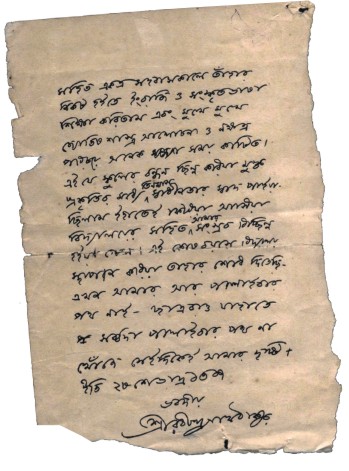
Letter photo source: The Daily Star

A People Ravaged: Peeling off the Many Layers of Partition Trauma

First published in The Wire

Literature, Gender, and the Trauma of Partition: The Paradox of Independence
Debali Mookerjea-Leonard
Routledge, Taylor & Francis Group, 2017

In writing my first novel, whose protagonist is a young refugee woman from East Pakistan, I employed the device of coincidence to achieve a happy ending. Doing so wasn’t a sudden rush on my part to end what had become a protracted writing project but a well thought-out conclusion. It was not to be. When they read it, two of my trusted beta readers quashed it summarily, citing it as lazy and escapist. Even though incredible incidents can happen in real life, one of them advised, in a work of fiction, coincidences are hard to pull off convincingly.

An incident Debali Mookerjea-Leonard mentions in the preface to Literature, Gender and the Trauma of Partition: The Paradox of Independence starkly bears out this paradox.

Shortly after the All India Muslim League’s call for Direct Action in Calcutta in 1946, the author’s grandfather was stranded in Howrah station as public transport had been suspended in the wake of the sectarian clashes. He eventually got a ride from a kind Muslim family who had a private car, but had to climb on the footboard as the vehicle was full. To ensure his safety, he was given a flag of the Muslim League and advised to shout “Pakistan Zindabad” when passing through Muslim neighbourhoods. He did, and reached his home safely.

The insanity that gripped the subcontinent a year later when India was partitioned has been arduously chronicled in historical archives. In the privileging of journalistic reportage and record-keeping, personal histories surrounding the traumatic event haven’t received much attention until recently. The initiatives of Urvashi Butalia, Ritu Menon, Kamla Bhasin, and Jashodhara Bagchi, among others come to mind.

Mookerjea-Leonard’s book is an important intervention in this regard, not only because of its meticulous research and compelling arguments but because it sits in that nebulous middle – a no man’s land if you will – of fact and fiction. The author examines with incisive rigour fictional works on Partition and juxtaposes them against factual information and recent recordings of oral histories. As someone not directly affected by the event, hers is a lens that is both objective and earnest.

The works discussed in Literature, Gender and the Trauma of Partition are mostly from Bengal, which the author calls the “neglected shelves” of Bengali literature, written by writers from both sides of the Radcliffe divide. As she mentions in the Preface, this book is her tribute to her city, Calcutta. It is also a conscious effort to shine a light on the sufferings of those at the eastern end of the divide, as the tragedy of Partition in Bengal has been either underrepresented or misrepresented when compared to Partition in Punjab. This could well be attributed to, as Mookerjea-Leonard is cognisant of, the predominant and recurrent theme ofdisplacement in the east as opposed to that of horrific violence in the west.

Read the rest in The Wire.