Book News!

Senior journalist (with the Indian news channel, IBN7) and former colleague, Prabhat Shunglu’s book, “Yahan Mukhaute Bikte Hain” (literally meaning “Here Masks are on Sale”) is due to be released around mid-June, 2010.

The book, a collection of articles in Hindi on politics, personalities and society, has been divided into three segments–सियासत (Politics), शख्सियत(Personalities), समाज(Society)। As the title suggests, the book, through its bouquet of articles, attempts to unmask the Indian political system and to expose the loopholes in the country’s governance. There are about 45 articles, covering subjects such as media and Kargil. Some of the essays are political satires.

Antika Prakashan
is bringing out the book.

I look forward to reading this one. Sending best wishes to the author.

Pagol or Madman by Rabindranath Tagore

Translated by Bhaswati Ghosh

A small town in the west. At an end of the big street, five or six palm trees rise above thatched roofs like a mute man making signs to the sky. Next to a derelict house, an ancient tamarind tree puffs up its dense, glistening foliage like clumps of green cloud. Young goats move about on the ground of this roof-less house. Behind them, the lushness of the forest range spreads across the horizon of the afternoon sky.Today, rain has completely withdrawn its dark cloak off this town’s head.

I have a lot of important things to write—those remain unwritten. I know this would be a cause of regret in the future; let that be; I would have to accept that. One can never know or stay prepared for the moment when or the form in which wholeness emerges, but when it does, one can’t welcome it empty-handed. At that moment, the one who discusses loss and gain must be a smart accountant and would do well in the world; but dear vacation of light in the midst of glum ashadh (1), in front of your momentary bright, cloud-less glimpse, I put to dust all my important activities—today, I won’t make calculations about the future—I am sold off to the present.

One day follows another, none of them demands anything of me; the calculations all add up, work happens smoothly. At such times, life progresses by linking one day to the next, one task to another, making everything uniform. Suddenly, when a special day appears without notice, like a prince from across the seas; a day unlike any other, the trail of all the days past is lost in an instant—on that day, it becomes difficult for routine work to proceed.

Such a day, though, is our big day—a day of irregularity, of ruining work. A day that arrives to defeat our everyday is our day of joy. The other days are for the intelligent, the careful. This one day is for giving ourselves completely up to madness.

Mad isn’t a hateful word to us. We worship Nimai (2) because of his craziness; Maheshwar (3) too is our lunatic god. The West is debating as to whether talent is only a form of developed craziness—but here (in the East), we don’t feel ashamed to accept this as true. Inspiration is, of course, craziness, it is an exception to the rule, it comes only to upset order—it emerges all of a sudden—like today’s haphazard day—and destroys all the work of working people—some curse it, some others go crazy, dancing and delighting with it.

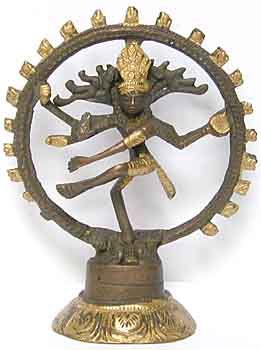
Bholanath (4), who remains as the joyful one in our scriptures, is one such oddity among all deities. I see that mad lord amidst the flood of sunshine shining through this day’s washed blue sky. His tabour plays steadily within the heart of this thick afternoon. Today, death’s naked pure face stands still in the middle of this work-filled world—with beauty and peace.

Bholanath, I know you’re strange. In every moment of life, you’ve appeared with your begging sack. and completely wrecked all calculations and measurements. I’m familiar with your Nandi (5) and Bhringi (6). I can’t say that they haven’t given me a drop of your intoxicating beverage; these drops have inebriated me, everything has been upset—today nothing is in order for me.

I know that happiness is an everyday item, but bliss is beyond every day. Happiness remains constricted, fearing it may get dirty; bliss rolls over dust and shatters its separation with the universe; that is why to happiness, dust is inferior, but for bliss, dust is an ornament. Happiness is afraid of losing something; bliss is delighted to relinquish everything; for this reason, to happiness, emptiness is poverty, but to bliss, poverty is abundance. Happiness carefully protects its grace within the confines of order; bliss openly expresses its beauty in the freedom of destruction; this is why happiness is bound to outward rules, but bliss breaks those bounds to create its own rules. Happiness waits for nectar to arrive; bliss drinks the poison of sorrow with ease. For this reason, happiness is partial to only good, but for bliss, good and bad are no different.

There’s a madman in all of this creation who brings in everything that is inconceivable for no reason at all. He’s the centrifugal force who is forever pulling the universe outside rules. The god of rule is always trying to put all the world’s paths into a neat orbit, and this madman overturns that and twists it into a coil. At his whim, this madman creates birds in the clan of snakes and man in the family of apes. There’s a desperate attempt in the world to permanently protect all that has occurred and all that is; he plunders all of that to carve paths for what is not yet there. His hands don’t hold a flute, harmony isn’t his tune; his pinak (7) rumbles, all orderly yagna (8) is ruined, and out of nowhere, something wonderful appears on the scene. Craziness and talent, both are his creations. The one whose string breaks at his pull goes mad, and the one whose string plays in an unheard melody becomes gifted. Mad people are outside the range of the ordinary, and so it is with talented people. The mad, however, remain on the fringe only, while the gifted take ordinary people into a new realm, thereby increasing their rights…

It’s not as if this mad lord of ours appears only at certain moments; in creation, his madness is always at work; we only get a glimpse of it in certain moments. Death is forever making life new, bad is brightening good, and the inconceivable is giving value to the trifle. When we get such a glimpse, the freedom within the form becomes evident to us.

Today, amid this cloudless light, I see that amazing face. The road across, the thatched-roof provisions store, the broken house, the narrow by-lane, the trees and vegetation—I used to see all these with the pettiness of everyday familiarity. That’s why these had confined me—kept me in house arrest within these daily images. Today, all of a sudden, all the pettiness is gone. On this day I see that for so long as I had been viewing the unknown as familiar; my seeing wasn’t clear at all. Today, I can’t finish looking at all these. Today, all of these things surround me, yet they don’t imprison me, they all make way for me. My madman was here only—that spectacular, unknown wonder, who did not ignore this thatched-roof provisions store—only, I didn’t have the light before my eyes with which to view him. What is amazing about today is that these nearby images have acquired for me the glory of a far-off place. The impenetrability of the snow-capped Himalayas and the impassability of the wave-ridden ocean express their fraternity with the madman.

In this way, one day we suddenly realise that the one with whom we had established a familial relationship remains outside our family. The one whom we had taken to be readily available in every moment is actually rare and hard to get. Those, around whom we had drawn a boundary thinking we knew them well, appear to have acquired a marvellous mystery by crossing all boundaries. The same one who, when viewed from the side of rules and balance, appeared rather small, quite regular, very familiar, when viewed from the side of breach, from the angle of that graveyard-roaming madman, turns me speechless—amazing! Who is that! The one whom I have always known is now this, who! The one who is part of the home on one side belongs to the heart on the other. The one who is important to work on the one hand is completely outside all necessities on the other. The same one whom I touch on the one hand is, on the other, beyond all grasp. The one who has managed to fit well with everyone is, at the same time, a total misfit, absorbed in self.

Today I saw the one whom I don’t see every day. In so doing, I gained freedom from every day. I thought I was bound by the everyday rules within the fence of familiarity surrounding me. Today I see, I have been forever playing on the lap of grand wonder. I thought that I had been making my daily calculations under the sharp gaze of a big officer in the office. Today, at the roaring laughter of the miscalculating madman—who is bigger than the big officer—reverberating through water, land, sky, air and the entire universe, I heave a sigh of relief. My workbook remains untouched. I lay down the pile of my important work at the feet of that capricious madman—let the blow of his Tandava (9) smash it into pieces and blow it off as dust.

1. Ashadh: A month of the Hindu calendar

2. Nimai: A prominent saint of medieval Bengal and the founder of Bengal Vaishnavism. Also known as Chaitanya Mahaprabhu.

3. Maheshwar: Another name for Shiva, a major Hindu deity. The god of destruction.

4. Bholanath: Alternative name for Shiva.

5. Nandi: Shiva’s vehicle, a bull.

6. Bhringi: Originally a demon who was transformed by Shiva into a humble devotee and admitted into his force as a commander of his armies.

7. Pinak: Shiva’s bow.

8. Yagna: A Hindu ritual, dating back to Vedic times, carried out to please gods. Oblations are poured into sacrificial fire, as everything that is offered into the fire is believed to reach the gods.

9. Tandava: In Hindu mythology, Shiva’s Tandava is a vigorous dance that is the source of the cycle of creation, preservation and dissolution.
Peep Peep Don’t Sleep: Book Review

Peep Peep Don’t Sleep
By: Ajay Jain
Kunzum
Non-fic (Travel)
Price: INR 350, US $19.95, UK £11.95

Available at: Ajay Jain’s Blog

We thought travel was about visiting places, soaking in new territories, and relishing the journey. Who could have known Road Signs could be part of the travel entertainment package as well? Yes, Road Signs, those inevitable pointers that we take no more seriously than empty coke cans strewn across the terrains we travel through.

Welcome then, to the world of Border Roads Organisation (BRO), the Indian agency responsible for construction and maintenance of all roads in areas along India’s borders with Pakistan, China, Nepal, and Bhutan. For, BRO, with its BROtherly (even fatherly at times) attitude, can turn the toughest of driving trips along India’s edges into the funniest. Many a traveler journeying through these often rugged stretches must have enjoyed a smirk or four reading BRO’s imaginative Road Signs. Author-journalist Ajay Jain has, however, done a favour to those of us who are yet to grab the fun for ourselves. With his book, Peep Peep, Don’t Sleep.

Jain drove more than 10,000 kilometers, all by himself, through Indian highways for more than a year to photograph some of the most hilarious, and at times, indecipherable Road Signs and advertisements. He didn’t stop there, though, but went on to add witty captions to these images, along with some chuckle-provoking commentary.

Ready for some sampling?

“I am curvaceous, be slow.” Relax, this is no porn movie dialogue; it’s just a hilly road in Ladakh, nudging you, the driver, to go easy with the wheels. And if you still don’t get the message, you are again poked to just “Feel the curves (do) not test them.”

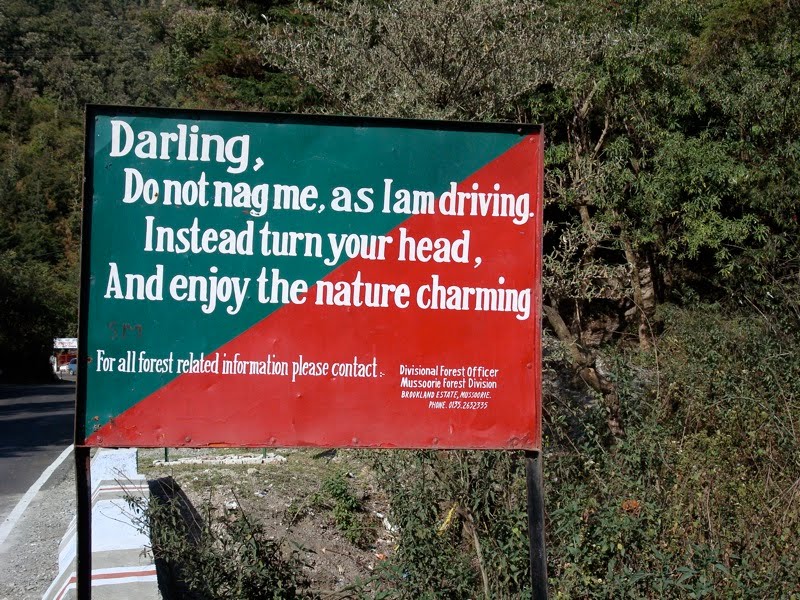
The extent to which BRO can go to encourage drivers to play it safe is amazing. On a road from Dehradun to Mussoorie, a sign speaks thus for a distressed husband:


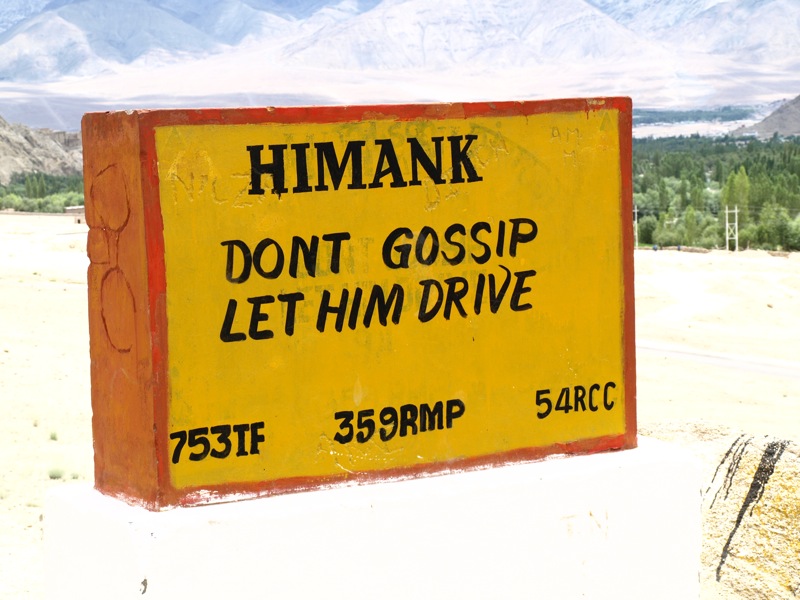
But BRO can’t place such a sign in just one place. And so they warn female partners again at another spot to not gossip as their male companions control the steering.

Jain’s caption to that image can’t stop wondering though, “…Do only ladies gossip?” My question too.

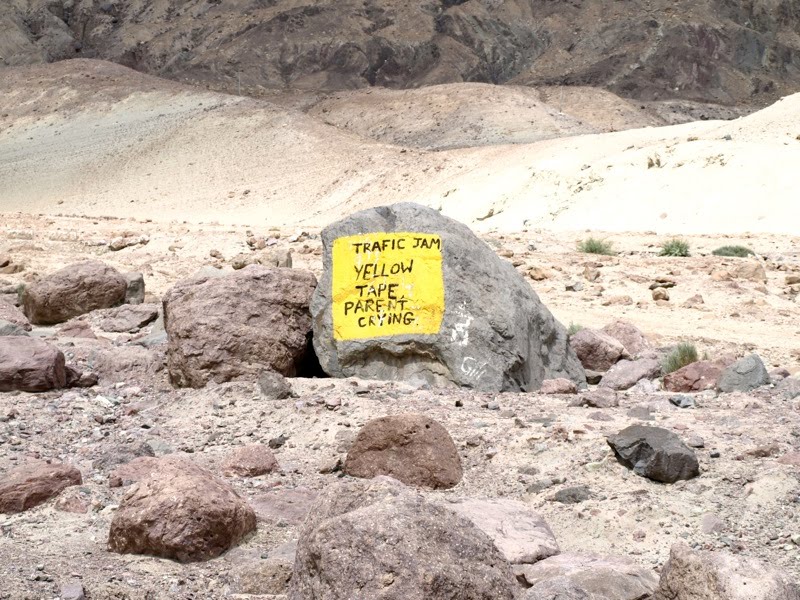
Then there are the cryptic signs. Ones that instead of making you more cautious with your feet on the accelerator will likely leave you scratching your head. Like the following sign. If you can decipher it, kindly do the author and me a favour by letting us know what it means.


And while you are at it, please crack this one too:


By now, you can make out how earnest BRO is in its aim to keep a check on travelers, especially drivers. If one still fails to heed its message, though, one must be prepared to face embarrassment at some point. With a message that says, “Cution. Short cuts may cut shorts.” With such a warning, one can never take any chances, can one? And if the driver still doesn’t listen to the BRO, well, he or she might have to contend with the deadliest of outcomes:


Ajay Jain didn’t just compile funny, inane, and quirky Road Signs in these 200-odd pages. He also went on to put together some of the most bizarre advertisements found across India. A lot of these he found in Dharamsala, the sanctuary of the Dalai Lama and a large number of his followers. His commentary on this section of the book says it all, “Welcome to the Dharamsala School of Quick Learning… You can find enlightenment and knowledge being sold—fast food style—all over Dharamsala…”


Did you know shopping discounts led to tension? So if you are in Dharamsala, spare yourself needless anxiety by shopping at:


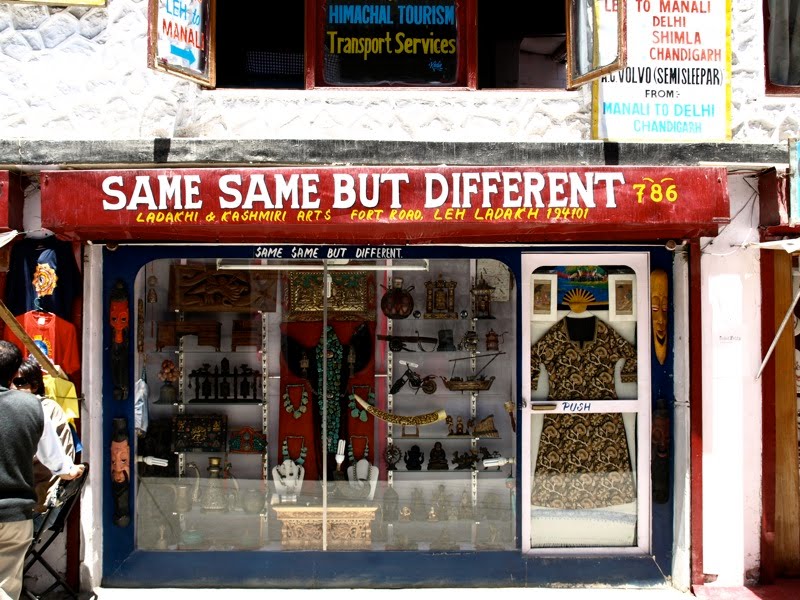
In case you thought all shops selling similar stuff are the same, think again. Or rather, know for yourself by visiting this store in Ladakh:


In the short space of a review, it’s hardly possible to capture the amount of fun “Peep Peep Don’t Sleep” (one of the Road Signs in the book, by the way) packs. As I laughed, smirked and found myself bewildered through Peep Peep’s pages, I also realized this excellently produced book is a keeper. Not only is it a testament to what can happen when the English language is twisted albeit inadvertently, it’s also a manifesto of the BRO’s sincere, if a bit over-the-top aim of cautioning the (sometimes) sleepy, reckless, or drunken driver.

All photos © Ajay Jain

Cross posted at: A Reader’s Words

Echoing Rendezvous

I came to see you. Yes, there was work, but does one need work to come and see you? As I told fellow train passengers the reason of my meeting with you, I smiled inwardly at the flimsiness of it all. Aren’t you both the context and pretext for every visit of mine?

Upon reaching, I looked for a familiar face among the milling, hollering mass of heads floating before the eyes. I searched for Anwar, the rickshaw-puller, who hadn’t only acquainted me with you, but had also helped me know you so intimately. I couldn’t find Anwar, but you hadn’t forgotten me.

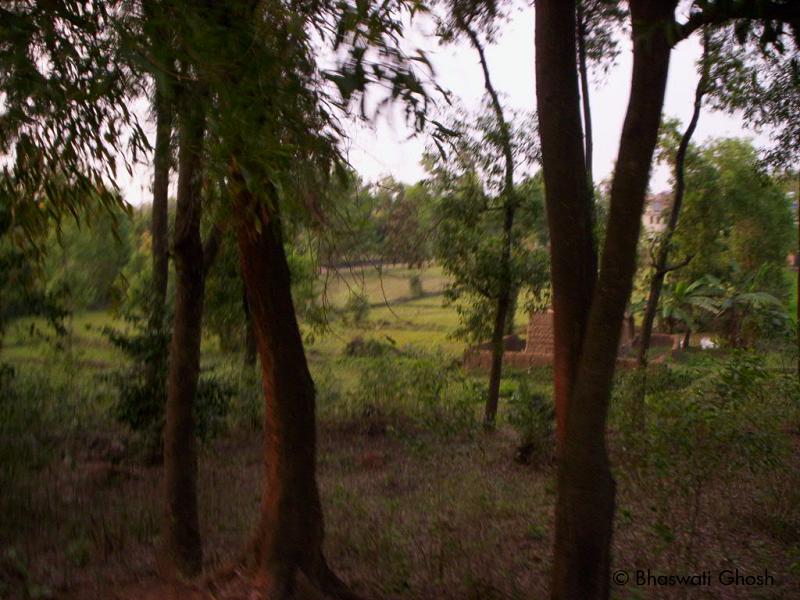
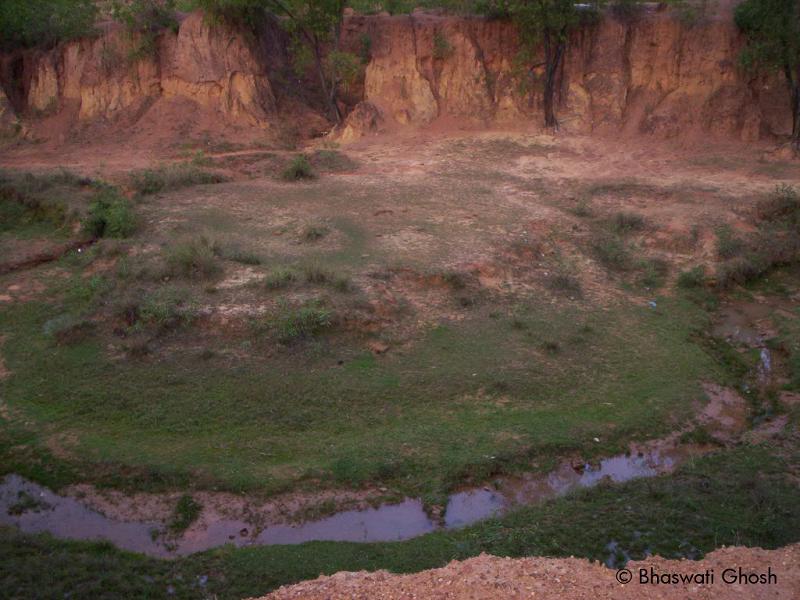
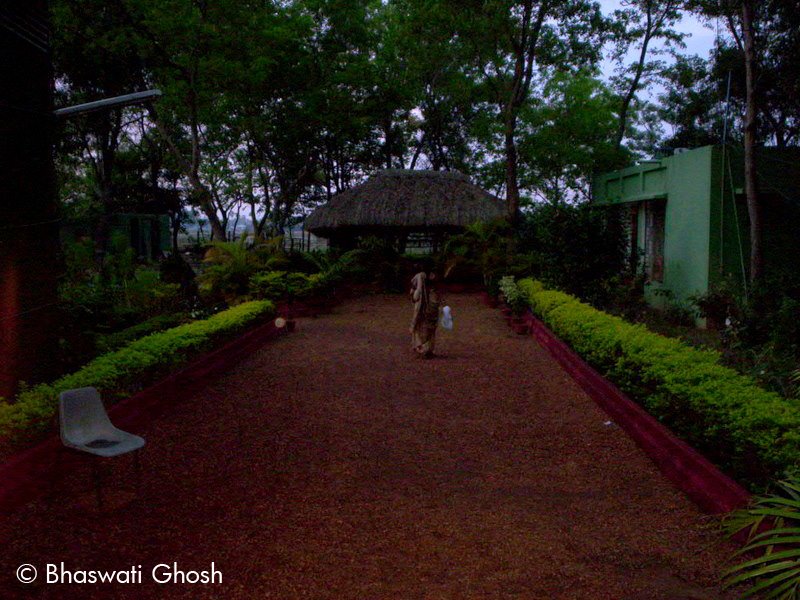
As I came along, you embraced me–wide-armed and ever so charming. Thereafter, you winked every time I looked at the faces of the countless rickshaw-pullers, hoping to see Anwar’s mask on one of them. All along, you never left my hand, caressing me through wild meadows, neatly trimmed gardens, haphazardly scattered bamboo bushes, and those closest to you—the people of the soil, treading by with their sun-burnt bodies and folksy smiles. As I passed by Khoai, I couldn’t help feeling awed at this magnificent rock site that you still dote on so tenderly, just as you do with those earth-people.

And then, when it rained even as evening’s dark cloak couldn’t soak all that outpour, there, at the craft shop, miles and miles away from where we were staying, you sat with me and nudged me to enjoy the rain with you. For monsoons take on such an electric aura in your company. And I remember the worry in my heart dissolved in that torrent, even as it washed through the meadow, the garden, and those swaying bamboo poles.

On the day of my farewell, Anwar showed up at the door. Not for a moment during my courtship with you could I predict you had stored this mischief for the day of my departure. As Anwar’s yellow teeth gleamed through his unkempt mustache, I could see you winking once more. As I stepped on to his rickshaw, you stood by at every stop of mine—the baul neighbourhood, the bookstore, the street-side jewelry shops.


Leaving you wasn’t easy, but who said I did? Shantiniketan, dearest, you remain alive, green, and invigorating right here, no matter how far I am from you in terms of space. Or time.

The Year’s End by Rabindranath Tagore

Today as I reached the silent peacefulness of this place, away from the clamor of the capital’s human assembly, the sky was covered in evening’s glow. Cloud clusters had lent a soft hue to the green of the forest by placing shadows on it; had I stayed in the capital, I couldn’t have seen this face of the year’s last day with the clarity that I did here. There, a covering of whirlwind encircles everything; that covering hides the united form of beginning and end in creation. The music of human life needs to pause for returning to the start again and again. But amid the cacophony of crowd one feels taan* after taan play on without pausing to return to the first beat. There, man moves with the crowd’s push; that movement is devoid of rhythm…

When evening descends on a city, it can’t reveal itself, the day’s noise barges in to choke its voice. Daytime’s labor looks for crude excitement in evening’s leisure. Tired of body and mind, I had thought I wouldn’t gain entry into the year’s last day today. Suddenly, thick clouds caressed the woods; the expansive bliss spread across the horizon didn’t appear as emptiness but as beauty. I see this evening filled to the brim with the wholeness that rests within the endless stream of the world’s work. In meditation I realized, that which I know to be the end in the outside world hides the seeds of new life in this place.


In every moment I see that life’s entire prosody is contained within conclusion. Without pause, rhythm would lose its identity…In mankind’s history, several civilizations have vanished after a period of grandeur. The reason was that those civilizations had lost the pause; they only scattered their enterprise, didn’t care to pick up the same…So the rhythm broke. The first beat came back in the wrong place, and it wasn’t cessation; it was destruction.

It is my good fortune to have come here today. In the city I returned from, the evening’s face is one of frenzy, not of well-being. There, death’s identity has lost its solemnity. Human habitations make every effort to deny death. That’s the reason one can’t see the truth of death in such places…May the end show us that face of liberation, which contains wholeness.

Calmly I say, “Dear End, within you resides the infinite. I see in your eyes a trace of tear on this last day of the year; separation, dejection, and weary melancholy eclipse dusk’s darkness. Despite that, assimilating and crossing over all those, I hear your voice within and without. Om. The heart’s pain has only lent it beauty—tears haven’t dulled it, yet made it gentler. Every evening, death reveals its calm and graceful face across the immense star-draped sky. Embracing it, we lay down—relieved—all the day’s burdens.

At the end of the year, I see that same vast face resting on the untiring, imperishable throne of darkness. I pay my obeisance to it.”

* Taan is a virtuosic technique used in the performance of a vocal raga in Hindustani classical music. It involves the singing of very rapid melodic passages on the syllable “a.” It is similar to the technique ahaat, used in Arabic music. [From Answers.com]

Humility


When the moon and the stars loom up there
You glow on the universe of your foliage–
As the world goes to sleep.


Silently you come, without a fuss;
No announcement, no flaunting of beauty
Not any attempt to hold the passerby spellbound.


In the morning, before the world rubs its bleary eyes,
You silently drop down,
No clinging, no worrying
about getting crushed under walking feet.


Yet, you draw us–
By your plain scent,
Your unassuming beauty,
Your amazing way with stopping passersby,
Bringing them down to their knees,
To pick you up gently.

You just smile, silently.

Note: Every autumn, the Shiuli, a small flower with white petals and orange stalk, blooms in different parts of India. This delicate flower blooms in the dead of night and by morning, drops off the branches. It has a soft, mild fragrance and heralds the biggest Bengali festival, Durga Puja.

Writing Strengths Meme

Lately I had been thinking of writing a those-were-the-days post, reminiscing my days of youthful blogging—of learning from erudite fellow bloggers, of “wish-I-wrote-that” moments, of unconsciously smiling upon coming across a slice of a blogger friend’s life, of discovering new friends, and of being discovered. Of feeling humbled for coming across vastly more knowledgeable and perceptive bloggers who took the time to read my posts, and of keeping in touch with old pals splintered off a writing site that saw a sad demise.

Just when I was contemplating that post, Onipar, a gifted (I don’t say that lightly) horror writer and one of the most inspiring writing buddies I have seen spared me the sentimental outpour by tagging me for the Writing Strengths meme. The brief guideline for the meme is this:

Make a list of five strengths that you possess as a writer/artist. It’s not really bragging, it’s an honest assessment (forced upon you by this darn meme). Please resist the urge to enumerate your weaknesses, or even mention them in contrast to each strong point you list. Tag four other writers or artists whom you’d like to see share their strengths.

I laughed at first. Like many other aspiring authors, I wondered if I had even three strong points as a writer. In the end, I could think of five, though. Here they are:

1) Faith: This isn’t just a strong sense of hope that I will be a published writer some day. This is deeper. It’s the heart’s connection with my writing itself. Faith in what I write and what it means to me. When I write drafts, the writing quality may be (and usually is) pathetic, the style stilted, the grammar unsure. But in the midst of all that I see a reflection of my inner world, merging at once with the world around me. I guess this is the most important element of my writing life.

2) Perseverance: Oni calls it courage. I will go with the more conventional term. All true writers persevere; it’s not really an option for them, it’s just part of the game. The odds are high and keep going higher, rejections come slamming on your face, finances play hide-n-seek with you, and you are in an arena even more uncertain than gambling or lottery. But you plug on, driven by a strange rush, aiming for a star many galaxies away.

3) Voice: Most of the feedback I have received on my writing has mentioned this facet. It’s a fusion of the social milieu I come from and the cultural sensibilities I have absorbed over the years. I write what I know; my lack of international experience makes my English writing a translated rendition of the Indian life I have known and seen.

4) Humanity: This isn’t to imply my writing is humane. It’s just to say my writing is mostly drawn from life—mine and of those falling within my immediate, extended, or distant environment. The best of writers, those who have told stories of ordinary people and their trials and triumphs are not preachers trying to teach the basics of a just society to the world at large. Nor are they messiahs, offering solutions for the repressions they witness. They are mirrors, reflecting us just the way we are—fair or ugly (not in the literal sense, of course).

5) Student: I am a lifelong learner when it comes to writing. Having a student’s outlook helps me remain open to advice and smart enough to glean benefit from even not-so-positive feedback. I have seen the results over the years; they aren’t too bad.

So there. I can now officially thank Oni for bringing me out of my self-imposed blog exile. Writing is the reason this blog is facing neglect. I am choking with freelance work and other assignments to the extent where I only find scraps of time to work on my personal writing projects. Since the blog is less demanding than those pesky projects, it waits patiently. Until a friend nudges me to return to it. 

Who do I tag? Lisa, Alicia, Bob, and John Baker.

"I relived my last 25 years while writing this book"

Interview with Abhay K, author of River Valley to Silicon Valley. To visit Abhay’s blog, click here:

What inspired you to write River Valley to Silicon Valley? Please share the experience of writing the book with us.

AK: I had made a promise to myself that I should have my own book before I turn 25. I was going to turn 25 on 1st March 2005 and I was so anxious to tell the world that how Indian democracy and economic reforms that are taking place in India are bringing real and concrete changes in the Indian society by citing example of three generations of my own family. I wanted to write this book at this stage of my life and not later because I feared that I’ll lose my innocence and simplicity after getting immersed into the bureaucratic world of which I had become a part after passing the Civil Services Exam in 2003. I also wanted to share my family’s story with millions of young Indians who were in the schools, colleges and universities and inspire them to dream big. I wanted to gift a book to my young friends in India and abroad who struggle every day for a better tomorrow, who do not have a level playing field, who want to move forward overcoming all obstacles.

I wrote this book between November 2005 and February 2006 in Moscow, mostly post mid-night when the city went off to sleep, and I could peacefully take a journey back in time. Those days I was learning the Russian language at the Center of International Education at the Moscow State University and I had to do a lot of assignments everyday. The only spare time I was left with was after the mid-night. I wrote this book almost regularly for four months except the last ten days of December 2005 and a few days in the beginning of January 2005 when I was traveling in Europe with my friends.

There is a saying that writers live twice and I completely agree with that. I relived my last 25 years while writing this book, as flashes of my past played in mind and turned into words on my notebook. Just to add, I was highly inspired by “The Outsider” by Albert Camus and “The Old Man and the Sea” by Ernest Hemingway, not only by the content of these books but also by their size. Both these books have around 100 pages each and are easy to read and carry. I too wanted a small book that was easy to read so that a normal reader would not get scared just looking at its size and had the psychological satisfaction of finishing the book in a few days. Somehow, unnecessary details in some novels irritate me and make the whole experience of reading a very boring for me. What really attracts me is a rich story with a flow without unnecessary details unconnected with the story. This is what I wanted to bring out in my book. I must share with you how overjoyed I felt the day I completed my book even while I had no idea whether it will ever be published. I felt triumphant as perhaps there is no greater joy in life than the joy of creating something. Writing itself can be such a joy if it comes from inside, if one has the feeling that one must write.

I felt the book should be read by every young Indian who dares to dream big. What feedback have you received from the book’s young readers? This would include your brother and your friends.

AK: I have received very encouraging comments and reviews about the book from across the globe. In fact I have collected their comments and reviews like precious diamonds and put them together on my website (www.abhayk.com) for readers. One may read all the comments by clicking on the following link-
http://rivervalleytosiliconvalley.blogspot.com/2007/05/readers-comments-about-river-valley-to.html

Link for the Book Reviews- http://www.abhayk.com/Books.php

Have your parents read the book? If yes, what did they have to say?

AK: The book is dedicated to my great father who passed away in July 2006, but he knew all along about this book. In fact, he is the silent narrator of first few pages as all that I came to know about the life of the first and the second generation of my family was through him. He was a great story teller like my grandma. Sadly, he could not see its publication and release.

My mother is waiting for the Hindi translation of the book to read it. Professor Pushpesh Pant from JNU is working on the Hindi translation, and it should be ready by the end of this year.


How are you marketing the book?

AK: These days I am posted in St. Petersburg as Consul of India, far away from my country and I have left it to the publishers to market the book. A thousand copies of the first edition of the book was printed out of which 500 copies have already been sold.
The book can be ordered from anywhere in the world from Linuxbazar.com clicking at the following link http://www.linuxbazar.com/index.php?main_page=product_info&cPath=33_82&products_id=18713
The book can also be purchased from the major bookshops in the big cities of India or can be ordered by writing to Bookwell India at the following address- 24/4800,Ansari Road,Darya Ganj, New Delhi-110002, India, Ph-91-1123268786.

I am thinking of bringing out a second edition of the book with a different publisher by the beginning of the next year. I would welcome suggestions from readers to market “River Valley to Silicon Valley” in a better way.

What other writing/publishing projects are you working on these days?

AK: I have written more than a hundred poems during the last two years of my stay in Moscow. I have sent publishing proposals to a number of Poetry publishers in UK, USA and India. I am still waiting for their reply.

Currently, I am working on two books. They deal with different themes. The first book is based in India and tells the chilling story of a young girl from the beginning to the end. The second book is based in the post-Soviet Russia and explores the psychological undercurrents of the Russian society in recent years.

How did you get your book published?

AK: First time writers have always difficulties in publishing their work, and I had to wait for more than a year after writing the book to get it published. I sent the manuscript of my book to many publishers in India who are still kind enough to receive the book directly from the authors unlike in UK or USA where they only receive manuscripts through literary agents. Most of the publishers in India and literary agents in UK turned it down because they could not find anything sensational in my book. Finally, Bookwell India decided to publish 1,000 copies for of the book in April 2007.

The publishing industry has its own business interests in mind. so for them good writing or average writing do not make a difference if the writing can bring in good money. Thus, today the world may never get to know many good writers and poets whose precious works keep biting dust for years until they are discovered or forever if not discovered. The influence of big budget publishing houses do distort the writing trend in the world as more and more people want to write that has the commercial value and not essentially humane values.

How is “River Valley to Silicon Valley” being received outside India?

AK: The book has been translated into Russian and soon a thousand copies will be printed for young Russian readers.
The book has generated interest in UK, USA, Australia, Poland and South Korea. It is also being translated into Korean by a young Korean who wants to share this Indian story with young South Koreans.

River Valley to Silicon Valley: Book Review

RIVER VALLEY TO SILICON VALLEY: Story of three generations of an Indian family
By Abhay K.
Bookwell
Available at: bookwell@vsnl.net.in

Dreamers abound this world. In lands spread over all the habitable continents, people dream of living lives bigger than their circumstances allow them. Some dreams are material in nature, some more romantic and soul-filling. I reckon the world is a better place for the dreamers it holds. For, in most cases, dreams, those intangible pieces of impossible ideas, are what lead to the most awesome of deeds. In River Valley to Silicon Valley, Abhay K proves that.

As the book’s subtitle says, it’s the “story of three generations of an Indian family.” Although focused on Abhay’s family, it also tells the story of India’s changing social-scape. Beginning with the tale of the writer’s grandfather and his rural farm life in newly-independent India, the book moves on to recounting his father’s extraordinary determination to receive education and ameliorate village conditions. The book finally brings readers face to face with Abhay and his elder brother as they step out of the village to script their twin destinies in India’s capital—Abhay as an Indian Foreign Service diplomat and his brother as an executive in a multinational corporation.

On the face of it, River Valley to Silicon Valley is just a portrayal of a middle class Indian family’s passage from agriculture to modern vocations, and from breaking barriers within the village to touching stars outside its boundaries. The book, however, is a lot more than that. It’s a testimony of what unflinching self-belief and stubborn focus can lead to—living one’s dream, no matter how far-fetched it may appear in the beginning. As it narrates the story of Abhay and his family in a simple, unpretentious voice, the book stealthily plants the seeds of dreaming big in the reader. Not a bad bargain, that.

The book may not score highly in the show-vs-tell or grammar department. But it is a book with a soul. For this reader, River Valley to Silicon Valley is any day a better pick than soulless books with perfect grammar.

Thanks for writing this honest, inspiring gem, Abhay.

Coming Up: An interview with Abhay K. Stay tuned!