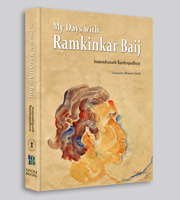
MY Days with Ramkinkar Baij

Twenty Andrews Palli. Kinkarda lives in this house now.

He sits in the room adjoining a small veranda. He lives in this room; it is his living room as well as bedroom. The door is ajar; it is always like that.

[From My Days With Ramkinkar Baij]


I found the way to that door about five years ago. As it was ajar, I entered, though not without some measure of diffidence. The world of a towering genius called Ramkinkar Baij, Kinkarda to his loved ones, had opened up to me, but was I capable enough to navigate it? Gladly, printed words, not the actual, near-mythical persona of Kinkarda, paved my pathway. The hesitance started fading, like the lifting of a soft mist off an enormous mountain. This monumental (I don’t use the word lightly) sculptor-painter had me entranced–with his works, life. And words.

Yes, words, because My Days with Ramkinkar Baij, which I read as Shilpi Ramkinkar Alaapchari in Bengali, is Ramkinkar’s life in his own words. From a timid reader, I turned into a zealous admirer. In the five years that followed, the book took me to Norwich, UK (I received the Charles Wallace India Trust Fellowship to work on the translation of this book); I got married and moved to the U.S. and then to Canada; became a translator; my translation of Shilpi Ramkinkar Alaapchari found a publisher and became My Days with Ramkinkar Baij.

Even as author Somendranath Bandyopadhyay, through his smooth and sensitive narrative–based on his closeness to Ramkinkar–recounted his days with the awe-inspiring artist, the past five years enabled me to experience My (own) Days with Ramkinkar Bai–vibrant, many-hued, at times tumultuous.

For this, I couldn’t be grateful enough.

Immigrant’s Postcard: “Open to Close”

A series on my experiences as an immigrant to Canada

On my way back from a job interview, I wait for my bus to return home. Direction-challenged, I wonder if the stop is the right one for me. In a while, a short, curly-haired black lady arrives. She is wearing black goggles and greets me with a broad smile. I seize the opportunity and ask her if the bus I am waiting for will take me to the desired place. She confirms it will. A little later, she chirps,

“It’s going to rain!”

“It does look like that,” I say, coiling my hands inside the jacket’s pockets.

“But we can’t complain, can we,” she says with a thick accent, adding, “after all, God gave us a brilliant summer this year.”

I nod.

She points her fingers up and says, “That guy up there, he is very smart, you know. If he wanted, there would be blackout this very instant. So we got to respect his judgment.”

I continue nodding with a wan smile. Silence joins us soon.

Not for too long. The lady looks at me chirps again, “You going for work!”

It’s past lunch time. “No, I am going home!” I say with some emphasis.

She laughs and says, “You look so good, I thought you goin’ to work.” I feel a bit uncomfortable and notice, for the first time, her long, yellowed nails.

After learning that I am still looking for work, she has much to tell me.

“This is a bad time for new people to come in. There are no jobs,” she warns. I nod and try to maintain a neutral face.

“I’ll tell you what to do,” she reassures me and continues, “when you get on the bus, I will show you a new store they are constructing. You should apply there.”

This is followed by an insider’s lowdown. How they “don’t pay too well, only the minimum wages,” but how that is better than not having anything.

The bus comes, and my bus-stop friend takes the seat next to mine. True to her word, she points out to me the under-construction Wal-art.

“They have all kinds of shift–early morning, afternoon, all-night. So when you fill in your shift preferences, choose ‘open to close’. That way they will know you are really interested.”

People around us are looking at me; I am beginning to get annoyed, but keep up a smiling face. And the nods.

“And if at all they don’t take you for the counter, you can also opt for stocking. That means putting things on the shelves. Ya gotta take whatever comes your way,” my friend continues. I take in all the suggestions with total silence and utmost seriousness.

A few minutes later, we both get down at the same stop.

The chirping lady just says, “Well, good luck. Bye.”

I thank her quietly and say a little prayer for all of those like her–surviving on minimum wages, but not short of concern and hands-on tips for a new immigrant.

Occupy your city can wait. Occupy Wal-art first. Where it’s “Always Low Prices.” Of the employees even.

READ ALL IMMIGRANT’S POSTCARDS HERE

Immigrant’s Postcard: Bhasha, Basha, Bari

A series on my experiences as a new immigrant in Canada.

The title of this post is in Bengali:

Bhasha = Language, Basha = Temporary residence, Bari = Home (usually long-term, ancestral).

We had been in Canada for just a few weeks when B, my husband, nearly complained of having to speak too much Punjabi. Having lived in the US for a number of years, he found his mother tongue akin to a distant cousin — there in memory, but not in presence. I, on the other hand, would have given anything to find a soul with whom to converse in Bangla, my mother tongue. In our Mississauga neighbourhood, that possibility seemed to elude me, what with the profusion of Punjabis–from both sides of the border (India and Pakistan).

The opportunity came my way in the strangest of ways.

On Canada Day, one of B’s friends offered to take us on a strawberry-picking jaunt. His mother and wife–a second-generation Canadian Punjabi–were part of the group. Their invitation extended to a brunch of stuffed paranthas at their house post filling up our strawberry baskets. R, the wife of B’s friend got busy in the kitchen making the paranthas with the help of her mother-in-law. Once they had all been rolled out, aunty came and sat with us in the living room.

Earlier that morning, PK, B’s friend had mentioned that his mother knew Bengali. As we all chatted away–mainly in English, with splashes of Hindi, PK poked me and his mother alike. “How come you two are not speaking in Bengali? Come on, how can you keep yourself from doing it already?” Aunty smiled and her wink reflected permission for me. I immediately started off; in an instant, “aunty” became “mashima” for me. I learned that though a Punjabi herself, she had picked up Bengali from neighbours in Jamshedpur, where she grew up and later spent her married life. Till date, her Bengali remains spotless and free of any accentual adulteration. I was thoroughly impressed. And delighted to find my first mother language friend in the city.

Some more weeks passed. B found work, and his long commute presented a fresh set of priorities before us–buying a car and finding a house closer to the station from where he caught a train to work. While B continued to speak more Punjabi, my Bengali remained buried somewhere under the mental debris of car models to choose from, jobs to apply for, and potential rental ads to shortlist. While talking on phone with the poster of one ad, I caught a clear Benglish accent. All formality flew off, and I blurted, “Aapni Bangali? You are a Bengali, aren’t you?” And so we went to see his house. Obviously.

As K, the Bengali young man looking to rent his apartment led us in, we met his wife, infant daughter and the spartan interiors. After two years of his stay in Canada, K’s professional project had come to an end, and it was time to return to India.

“Are you from Calcutta?” I asked his chirpy wife.

“Totally from Calcutta,” she beamed.

“Ah, so you must be happy to pack up.”

“Oh yes, you can imagine what it is to go home just before Durga Puja.” She could barely hold her smile now.

That’s when it struck me. The word home. In India, I spent all my unmarried life in Delhi, the city of my birth. And yet, during a post-marriage trip to Kerala , when a man asked me where I was from, I said, “Bengal.” Where in Bengal was the next question, and I just said, “Delhi.” I remember the perplexed look on his face.

So what is home, I wonder. Is it a place? Or is it more likely a language? One from which B has strayed a bit. And one I pine so badly to belong to.

MORE OF IMMIGRANT’S POSTCARD:

Immigrant’s Postcard: At the Guru’s Door

A series on my experiences as a new immigrant in Canada.

“This place feels just like Chandigarh,” my husband remarked, walking around our Mississauga neighbourhood. He had spoken more Punjabi within just two weeks of being here than possibly in twenty years, he would observe. Though exaggerated, that observation wasn’t all that inaccurate. We know people, a lot of them from our parent’s generation, who have managed to live in the Toronto area for decades without knowing any language except Punjabi.

Major banks have signs in Punjabi and even some staff communicating in that language. You will find “Moga Pizza” not in Moga, Punjab, but in a swanky Toronto suburb. Hakka Chinese restaurants here have “Ludhiana Chicken” on their menu.

Logic dictated that we should visit one of the many gurdwaras in our vicinity. Our proddings were many. To begin with, we were unemployed and had as much time as our prospective employers wanted before taking us in. Then there was the genuine concern of friends and well-wishers. “You know, many new immigrants actually rent accommodation near a gurdwara. That way, you at least save on food expenses,” advised a well-meaning friend. Our good-natured and caring landlady too encouraged us in the same direction. In fact, I goaded my husband too. “We should at least go and pray for a job,” I suggested, though neither of us is particularly religious.

It wasn’t his disinclination for prayer, but the bus route to the most recommended gurdwara that discouraged my husband. “It’s a long walk from the bus stop. We’ll go there once we get a car.” Which, I knew, meant, once one of of us found work. So as searing summer days lazed by in what was one of Toronto’s warmest summers, we conveniently pigeon-holed inside our basement apartment.

Until an offer letter dragged us out–almost straight to the car dealer’s office. Providence smiled. Right next to the dealership was a gurdwara. We had reached it by bus after all. It was almost as if a benign “guru” had granted our prayer and gently brought us to his doorstep.

The door that almost inevitably leads to the langar hall–the common dining room in most gurdwaras. “I don’t go to pray there; I go to eat,”  admitted a chuckling friend who couldn’t stop gushing about the delicious feast on offer in gurdwaras.

A tradition started by Guru Nanak, the first of Sikh gurus, and later institutionalized by Guru Amar Das, the third guru, langar feeds people irrespective of their social, economic, religious or any other status. Works well for me.

Late one afternoon, after looking at several cars and chewing over the math for each one of them, we plodded our way to the gurdwara, hungry and exhausted. Once inside, we entered a corridor, the walls of which were lined with paintings related to Sikh history. When my husband had finished telling me the stories behind them, we entered the prayer room, knelt down, prayed and dropped our offerings into the donation box. We were walking back in the corridor, when an elderly Sikh man started following us. He called us and led us back inside the prayer room, where he offered us the delicious karah prasad.

He then said to us, “Take the steps and go down. You will be led into the langar hall; go toward the kitchen and take some dal from one of the saucepans, then take some rotis from a box next to it.” We had been wondering where the langar hall was and if we could still find some lunch at that late hour. It was as if the gentleman had appeared just to lead us to the source of food.

The dal and roti had gone cold as it was way past lunch time.

Ever since spotting that first gurdwara, we have been to three. Each time, we have returned with a satiated heart and stomach, filled in good measure with sizzling pakoras, tea, sweets, freshly-cooked curries, dals, rice puddings and hot chapattis.

But the taste of that cold dal-roti meal lingers in my mouth. And that old, wrinkled face in my heart.

MORE OF IMMIGRANT’S POSTCARD:

Gastronomic Empathy

Manto and A Car

Ten-day Fast (Short Story)

By Harishankar Parsai

Translated by Bhaswati Ghosh

(Courtesy: http://bahatidhara.blogspot.com )

January 10

Today I told Bannu, “Look Bannu, the times are such that Parliament, laws, the constitution, judiciary—all have become useless. Big demands are getting met by threats of fasting and self-immolation. The democracy of twenty years has become so sick that the fates of fifty crore people are decided by the threat of one man going hungry or dying. I say the time is ripe for you too to sit on a fast for that woman.”

Bannu became thoughtful. For years, he has been after Radhika babu’s wife, Savitri. He even received thrashing once for trying to persuade her to elope. He can’t get her to divorce her husband because Savitri hates Bannu.

After some pondering he said, “But can one go on a fast for this?”

I said, “Right now, one can fast for anything. Just recently Baba Sankidas got a law enacted by fasting that makes it mandatory for every man to keep his hair knotted without ever washing it. All heads are reeking of stench. Yours is a small demand—just a woman.”

Surendra was there as well. He said, “Yaar, what are you saying! Fasting to snatch someone else’s wife? We should have some shame. People will laugh.”

I said, “Arre yaar, big-time fasting saints didn’t feel any shame. We are, after all, ordinary folks. As far as laughing is concerned, people all over the world have laughed so hard over the cow-saving movement that their stomachs are hurting now. No one is in a position to laugh for another ten years. Anyone who does will die of stomach ache.”

Bannu said, “Shall I find success?”

I said, “That depends on how you make the issue. If it’s made well, you will get the woman. Come, let’s go to the ‘expert’ to seek guidance. Baba Sankidas is a specialist. His practice is running well. These days, four people are fasting under his guidance.”

We went to Baba Sankidas. After listening to us he said, “All right. I can take up this issue. You just have to follow what I say. Can you threaten to immolate yourself?”

Bannu trembled. Said, “I am scared.”

“You don’t have to burn, dear. Just threaten to.”

“Even the idea scares me.”

Baba said, “Okay, then you go on a fast. We will make the ‘issue’.”

Bannu shook again. “I won’t die, would I?”

Baba said, “Smart players don’t die. They keep one eye on the medical report and the other on the mediator. You don’t worry. We will save you and also get you that woman.”

January 11

Today Bannu sat on a fast unto death. Incense and lamps are burning inside the tent. One party is singing a bhajan—‘May the lord grant good sense to all.’ The atmosphere has turned pious from the very first day. Baba Sankidas is an expert in this art. The statement he has got published and distributed on Bannu’s behalf is rather strong. In it, Bannu says, “My soul has awakened and proclaimed that it is incomplete. My other half lies in Savitri. Either conjoin both the soul parts and make them one or give me freedom from this body. I am fasting unto death for conjoining the two soul parts. My demand is that Savitri be made mine. If I don’t get her, I will free this soul part from my mortal body by fasting. I am fearless because I am on the side of truth. Victory to truth!”

Savitri came, full of rage. She asked Baba Sankidas, “This scoundrel is fasting for me, isn’t he?”

Baba said, “Dear lady, don’t use abusive language. He is on a sacred fast. He might have been a scoundrel earlier. Not anymore. He is fasting.”

Savitri said, “But he should have at least asked me. I spit on him.”

Baba calmly said, “Lady, you are only the ‘issue’. How can one ask the ‘issue’? The people who took part in the Cow-saving movement never asked the cow whether to have a movement or not to save it. Lady, you may go now. My advice is for you or your husband not to come here. In a day or two, public opinion will be formed, and the public won’t tolerate any insults from you.”

She went away, mumbling.

Bannu became sad. Baba assured him, “Don’t worry. Victory will be yours. Truth always wins in the end.”

Jaunary 13

Bannu easily gives in to hunger. Today, on just the third day of the fast, he began groaning. Bannu asked, “Has Jayaprakash Narayan come yet?”

I said, “He usually comes on the fifth or sixth day. That’s his norm. He has been informed.”

He asks, “What did Vinoba say on this issue?”

“Baba said, “He has resolved the issue of means and ends, but his words can be twisted a bit to use them in our favour.”

Bannu closed his eyes. Said, “Bhaiya, please get Jayaprakash babu quickly.”

Journalists also came today. They were wracking their brains.

They began asking, “What is the purpose of the fast? Is it in the public’s favour?”

Baba said, “Purpose isn’t the matter now. Right now, it is critical to save his life. Sitting on a fast is such a huge self-sacrifice that the purpose automatically becomes sacred.”

I said, “This will only serve the public. So many people want to grab the wives of other people, but don’t know how to. If this fast is successful, it will guide the public.”

January 14 

Bannu has become weaker. He is threatening to break the his fast. This will publicly humiliate us. Baba Sankidas reasoned with him.

Today, Baba executed another miracle. He has managed to get the views of a certain Swami Rasanand published  in newspapers. Swamiji claimed that observing religious austerities has granted him the power to look into anyone’s past and future. He has come to know that in his past life, Bannu was a saint called Vanmanus, and Savitri was his wife. He has assumed a human form after three thousand years. His relation with Savitri goes back to many eons. The fact that an ordinary man such as Radhika Prasad is keeping a saint’s wife in his house, amounts to blasphemy. He appealed to all god-fearing people to oppose this profanity.

This opinion has had a good effect. Some people were seen chanting slogans of “Victory to truth!” One crowd was sloganeering in front of Radhika babu’s house…

“Radhika Prasad is a sinner! Woe to the sinner! Victory to truth.”

Swamiji has organized prayers for saving Bannu’s life across temples.

January 15 

At night stones were pelted at Radhika babu’s house.

Public opinion has been formed.

Our agents have heard men and women and saying this…

“Poor thing has been hungry for five days.”

“Hats off to such devotion.”

“But it didn’t melt the heart of that hard woman.”

“Her husband is so shameless too.”

“I believe he was a saint in his past life.”

“Didn’t you read Swami Rasanand’s opinion?”

“It’s a sin to keep a saint’s wife in one’s home.”

Today, eleven married women carried out Bannu’s aarti.

Bannu was delighted. His heart leaps at the sight of married women.

The newspapers are filled with the news of the fast.

Today a crowd went to the Prime Minister’s house to demand his intervention and save Bannu’s life. The prime minister refused to meet the people.

We will see how long he refuses to meet.

Jayaprakash Narayan came in the evening. He was unhappy. Said, “How many lives must I save? Is this my job? Every day someone or the other sits on a fast and screams for their life to be saved. If he wants to save his life, why doesn’t he eat? Why do we need a mediator to save lives? The sacred weapon of fasting is being used to snatch someone else’s wife.”

We reasoned with him, “This issue is of a different nature. It was his soul’s cry.”

He calmed down. Said, “If it is the soul’s cry, I will take it up.”

I said, “Moreover, the feelings of scores of truth-loving people are associated with this.”

Jayaprakash babu agreed to mediate. He will first meet Savitri and her husband, then the prime minister.

Bannu kept looking at Jayaprakash babu pathetically.

Later we told him, “You, idiot, don’t look so worn down. If they sense your weakness, any leader will pour sweet lime juice down your throat. Don’t you see how many politicians are moving about with sweet limes in their shoulder bags?”

January 16

Jayaprakash babu’s mission has failed. Nobody is willing to listen. Prime Minister said, “Our sympathies are with Bannu, but we can’t do anything. Let him break his fast, then we can find a solution by engaging in peaceful talks.”

We were frustrated. But Baba Sankidas wasn’t. He said, “At first, everyone rejects the demands. This is the norm. Let’s make the movement stronger. We have to convey through newspapers that a lot of “acetone” is showing up in Bannu’s urine. That his condition is serious. We must publish views that ask for saving his life at all costs. Is the government just going to sit and watch? It must urgently take steps to save Bannu’s precious life.

Baba is an amazing man. He has so many tricks up his sleeve. He says, “The time has come to include the issue of caste in this movement. Bannu is a brahmin and Radhika Prasad a kayasth. Provoke brahmins and kayasths alike. A Brahmin Association minister is going to contest the next elections.

“Tell him this is his opportunity to get the collective votes of brahmins.”

Today a proposal came from Radhika Babu for Bannu to have a rakhi tied by Savitri.

We turned it down.

January 17 

Today’s newspaper headlines–

“Save Bannu’s Life!”

“Bannu’s Condition Serious!”

“Life-saving Prayers in Temples!”

In one of the newspapers we paid advertisement rates to publish this–

“Prayer of crores of truth-loving people—Save Bannu’s Life! Bannu’s death will have dire consequences!”

The view of the minister from Brahmin Association was also published. He has made this a matter of brahmin pride and has threatened direct action.

We have hired four goons for throwing stones at kayasth houses.

After dealing with that, the same people will throw stones at brahmin houses.

Bannu has paid them the advance.

Baba feels that by tomorrow or day after curfew should be imposed. At least imposing Article 144 is definitely in order. This will strengthen our “case.”

January 18 

Last night, stones were thrown at brahmin and kayasth residences.

This morning, a serious clash ensued between two separate brahmin and kayasth groups.

Article 144 has been clamped in the city.

The air is tense.

Our representative group met the prime minister. He said, “This will have legal hurdles. We would need to modify the marriage act.”

We said, “So please modify it.  Issue an ordinance. If Bannu dies, fire will erupt in the whole country.”

He said, “First you make him break the fast.”

We said, “The government must agree with his demand in principle and set up a committee that will show Bannu the way to acquire that woman.”

The government is monitoring the situation. Bannu must endure more pain.

The situation hasn’t changed. There’s a “deadlock” in the talks.

Minor conflicts are erupting.

Last night we got stones pelted at the local police station. This had a good impact.

Today, the “Save life” demand became more vociferous.

January 19 

Bannu has become very weak. He is scared he may not make it.

He has been muttering that we trapped him into this. If perchance he publicly airs his opinion, we will be “exposed.”

Something must urgently be done.  We have told him that if he now gives up his fast, the public will kill him.

The representative group will go for another meeting.

January 20 

“Deadlock.”

Only one bus could be burnt.

Bannu is still being difficult.

We are continuing to say on his behalf, “He will die, but not bend!”

The government looks worried.

The Ascetics Association has given its support to the demand today.

The Brahmin Society has given an ultimatum: Ten Brahmins will immolate themselves.

Savitri tried to commit suicide, but was saved.

There are long queues for Bannu’s darshan.

A senior UN official has been notified via telegram today.

Prayer meetings took place in different locations.

Dr. Lohia has said that as long as this government is in power, lawful demands will not be fulfilled. Bannu should abduct this government instead of Savitri.

January 21 

The government has accepted Bannu’s demand in principle.

A committee has been formed to resolve practical problems.

Amid bhajan and prayers, Baba Sankidas fed fruit juice to Bannu. The leaders’ sweet limes dried up in their shoulder bags. Baba said public sentiment must be respected in a democracy. The emotions of scores of people were linked to this issue. It is a good thing that the issue was peacefully resolved. Otherwise, a violent revolution would have flared up.

The brahmin legislative candidate has struck a deal to have Bannu participate in his campaign. He has paid a fat amount. Bannu’s price has gone up.

To the men and women touching his feet Bannu said, “All happened by God’s grace. I am only His medium.”

Slogans rent the air—Victory to Truth!

Immigrant’s Postcard: Manto and a Car

A series on my experiences as a new immigrant in Canada.

B, my husband, and I go to buy our first car since landing in Canada. The finance guy is a young man with Javaid as his second name. His first name sounds like an Americanized version of his original name.

J: So sir, where are you from?

B: We’re from India.

J: Oh great, where in India?

B: She is from Delhi, I am from Chandigarh, Punjab.

J: Oh that’s wonderful. Actually I’m also from Punjab. I was born in Lahore…our family came to Pakistan from the Indian side of Punjab.

“I see,” I say with a slight smile.

J: Yes, they moved to Toba, you know Toba Tek Singh?

Manto’s invisible presence is suddenly felt in the cramped cubicle.

“B’s father is also from Lahore,” I say.

“He was born there, too,” B adds.

J: Oh, good, good. See sir, it’s always good to come here and find Pakistanis, Indians…your own community.

Yes, in the land of immigrants, it helps to be one community if you are from India or Pakistan.

Sometimes, it also helps seal car deals.

PS: Listen to a superb telling/reading of Toba Tek Singh by Zia Muhiuddin.

MORE OF IMMIGRANT’S POSTCARD


Immigrant’s Postcard: Gastronomic Empathy

A series on my experiences as a new immigrant in Canada.

For the little more than two months we’ve been walking around, past, next to it, this modest-looking West Indian restaurant in our neighbourhood in Mississauga has been teasing us. We would see other immigrants, most of them presumably from the Caribbean, going in. We didn’t follow suit.

“We will have a treat here once one of us has a job,” my husband kept assuring, and the flickering orange ember peeking out from the restaurant’s counter became a silent sentinel of our pledge.

Yesterday evening, on our way back from our customary evening walk, we stepped inside Jerkies. The place wasn’t a cramped hole in the wall–there were five or six tables, enough to seat around 25 people. A crime serial on the lone TV mounted to the wall had two engrossed viewers–a black mother and her young daughter, seated on one of the tables. Right across them was the counter, behind which stood a sanguine black man. When we looked at the menu behind him, written on a blackboard with chalk, there was only one item we were sure of ordering–jerk chicken, and no marks for guessing that. We wondered what the other item should be; I suggested to my husband in Hindi that he ask our sanguine friend. No sooner than he had sought the man’s recommendation, emerged the words, “goat curry.” The confidence on his face and in his baritone sealed his suggestion as our second choice.

As we sat down at a table, waiting for our meal to arrive, Dear Husband (DH) and I whispered to each other about the conviction in Sanguine Friend’s voice while advising us to go for goat curry. “It’s one immigrant’s innate understanding of another,” DH said, referring to a West Indian’s confidence in suggesting mutton curry to an Indian.

A little later, the red-haired lady who had been so absorbed in watching the crime serial brought us a plate full of rice and beans, salad and jerk chicken. “Who’s having this?” She asked. When I told her it’s me, she put the plate before me and handed me a napkin wrapping the fork and knife. I had barely dug in and given top marks to the very well done jerk chicken when DH’s plate of goat curry with rice-beans and salad came. A few bites and we knew Sanguine Friend’s recommendation totally hit the spot. Tender to the point of falling off the bones, the curry had been spiced in a manner that it could have been cooked by an Indian. Along with our respective dishes, the lady also brought us fried plantains, complimentary. Nice!

What looked like too much food when it arrived on the table had been diminished to bare bones within half an hour; such was the fury and enthusiasm of the two eaters.I guess one of them did find a job after two months.

“How was the food?” Sanguine Friend asked when we went to pay the bill. “We’ll be back,” DH said with a smile.

MORE OF IMMIGRANT’S POSTCARD:

Dispatch: Love in Hyderabad

This personal essay first appeared in Global Graffiti magazine’s “Cities” issue.

“…She would always remember Paris as the most beautiful city in the world, not because of what it was or was not in reality, but because it was linked to the memory of her happiest years.”

Gabriel García Márquez, Love in the Time of Cholera.

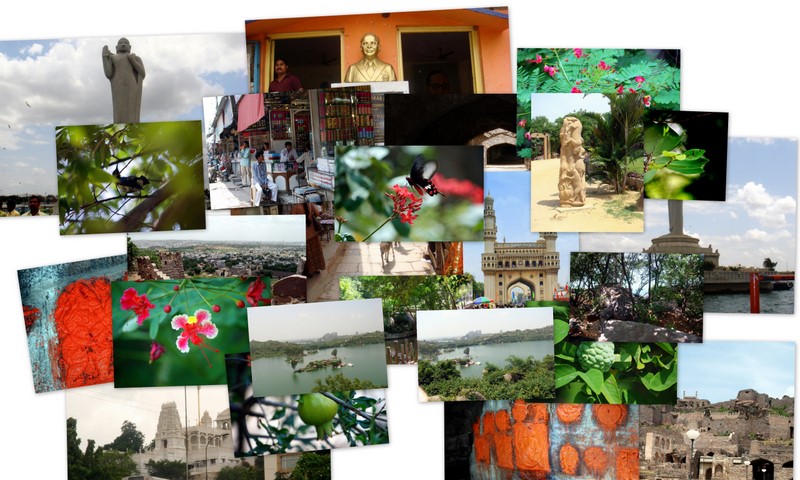
Cities are where history and contemporaneity, spaciousness and congestion, overwhelming wealth and astonishing poverty collide with each other more recklessly than anywhere else. One can live in City A for a long time and despise it and yet get entranced by City B in just a few months. That probably explains why I always remained a passive resident of Delhi, the city of my birth and my home for more than three decades, yet fell in love with Hyderabad, where I lived for less than four months. And the charm was almost instantaneous.

This was also the city where I found love.

Read the rest at Global Graffiti

Book Review: One Step Towards the Sun

Note: This review was first published in The Asia Writes Project.

In recent publishing history, the universe of Indian Writing in English (IWE) has been continually expanding, with a deluge of new titles spilling off the market shelves. While that is sweet news for the authors of these books, their counterparts writing in India’s various regional languages often don’t receive similar attention. The obvious reason for this is that regional languages have limited readerships, mostly restricted to readers from the respective regions. One way to get around this is to make these writings available in English. According to Valerie Henitiuk, “…The past couple of decades have seen a rapid rise in the distinct phenomenon of Indian Literature in English Translation (ILET).” One Step Towards the Sun is an important new addition to this phenomenon.

Edited by Henitiuk along with Supriya Kar, both of them academicians in the field of literary translation, the book is a collection of twenty-five short stories written by women from the eastern Indian state of Orissa. The very fact that women writers from this state could make their voices heard only as recently as the 1970s makes this anthology critically significant. What makes it interesting and a great read is the amazing diversity on offer–in terms of the periods of writing covered, themes, and writing styles.

Traversing through the milieus these stories present, one discovers that the women writing these stories are every bit as sensitive to issues concerning their own gender as they are about the wider humanity. As is to be expected, women’s issues form the core of many of the stories–exposing the many levels of exploitation the woman is subjected to–sexual, domestic, social, and psychological. In Basanta Kumari Pattnaik’s “In Bondage”, the nameless protagonist is brought to a big city by her brother and sister-in-law so they can use her as an unpaid maidservant. In “The Worn-Out Bird”, Aratibala Prusty narrates the tragedy of a mother who is imprisoned for killing her daughter’s rapist. However, her act of revenge goes in vain, as upon her release she learns of her daughter’s suicide, after suffering even more sexual violence.

The reader need not lose all hope though. For sharing the pages with such grim tales are characters that refuse to bow down to social prejudices, despite undergoing extreme torment. One such woman is Pata Dei, the protagonist bearing the story title by Binapani Mohanty. As she returns to her father’s village home with a child, slanderous accusations are hurled her way and the villagers question who the child’s father is. Defiant and fearless, Pata Dei narrates to the villagers the trauma of the night when a group of her own village men had raped her. Turning to her infant son, she says, “Why should you cry, dear? Don’t be afraid of these people. None of them is man enough to stand up and admit to being your father. But your mother is always there for you…”

Besides highlighting different kinds of trials faced by women, the anthology presents a gamut of themes, from Partition riots, old age, poverty, marital issues, to the impact of natural calamity on humans. Deprivation and hunger present themselves as stark contrasts to the riches of Orissa–splendid art and architecture. In Gayatri Basu Mallik’s “Ruins”, the narrator, while on a trip to Konark, the sun temple that is Orissa’s architectural pride, is bemused to experience “the ruins of real flesh and blood” as he encounters an old woman whose entire life had been a series of misfortunes. Banaja Devi echoes a similar idea in her story, “A Classic”. Here, the narrator comes across what appears to be a sculpture in a railway station, but, on closer inspection is revealed to be a beggar family–emaciated and driven to the edge by hunger.

One story that deftly tackles two themes–hunger and marital infidelity is “A Mother From Kalahandi” by Gayatri Sharaf. A seemingly blissful marriage starts falling apart for the heroine, Amrita, as she accidentally discovers her husband Swapnesh’s secrets. On probing, Amrita learns that Swapnesh has bought a young girl from the famine-struck district of Kalahandi for a paltry amount, only to bring her to the city for his sexual gratification. A social worker herself, Amrita decides to become a foster mother to the child born of her husband’s extra-marital relationship. At the same time, she convinces the biological mother to return to her village and liberate herself from the clutches of Swapnesh’s exploitation.

One Step Towards the Sun also impresses because of its stylistic variety. From elements of fantasy to disjointed soliloquy, plot twists and lyricism, the stories arrest the reader as much with the unfolding story as with the words that unveil it.

It is to Henitiuk and Kar’s credit that they have produced a book of writing translated from a regional Indian language without tedious footnotes or a painstaking glossary. The translations have standardized almost all of the original text, including some of the very localized expressions. Although the end result makes for easy readability, it can be a bit of a disappointment for someone seeking to derive a taste of local flavours offered by phrases and idioms unique to the region. One wonders if certain regional expressions couldn’t have been incorporated into the translated narratives without hindering the readability. However, this is a small omission in an otherwise excellently produced anthology. Even as IWE basks in the warm light of international awards, this book has taken but a solid step towards the sun as far as furthering ILET is concerned.

ONE STEP TOWARDS THE SUN:
Short Stories by Women from Orissa
Edited by Valerie Henitiuk and Supriya Kar
Publisher: Rupantar
Price: Rs. 295.00
ISBN 978-81-906729-1-7

ORDER AT: http://swb.co.in/store/book/one-step-towards-sun

When Jasmines Smouldered (Of the Egyptian Uprising)

A jasmine bloomed.
The fragrance blew across
and became a flame
dancing through the mist.
Not to sear the land,
only to wake it up.

Rivers flowed into deserts
and deserts met oil wells,
a new storm was
blowing.

Love oozed out,
red on earth
chanting Allah-o-Akbar,
a feeble fist
rising skyward.

Allah responded
not to the
muezzin’s call
but to the
rhapsodical jasmines,
aflame across the
rivers,
deserts,
oil wells.