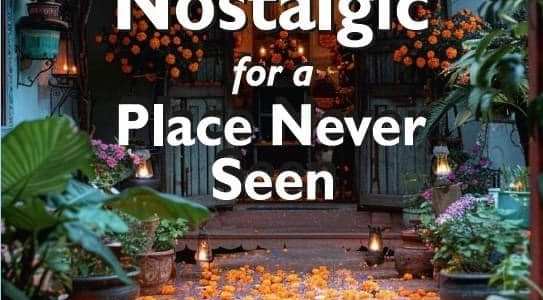
Review of ‘Nostalgic for A Place Never Seen’ in East India Story

Gargi Kalita reviewed my debut poetry collection, NOSTALGIC FOR A PLACE NEVER SEEN in East India Story. Read the review:

Bhaswati Ghosh’s Nostalgic for a Place Never Seen is a debut poetry collection that maps the evocative terrain of belonging. It explores how home is a terrain of the mind, a pulse of longing bridging the intimate and the global. A review by Gargi Kalita.

Nostalgia is never merely a return to the past—it is a tender reimagining, a delicate reconstruction of moments and emotions that memory alone can no longer fully contain. Home, in this sense, is not merely a geographical fixity but a terrain of the mind, a pulse of longing that beats through time, language, and loss. It is within this evocative terrain that Bhaswati Ghosh situated her debut  poetry collection Nostalgic for a Place Never Seen ,a volume that reads like a cartography of belonging drawn from within the self and across shifting geographies. Ghosh, a bilingual writer and translator based in Canada,with roots in New Delhi, belongs to the  lineage of Indian diasporic poets whose work bridges the intimate with the historical, the local with the global.

Some places are etched not in geography, but in remembrance—borne across generations like heirlooms wrapped in stories, scents, and silence. Bhaswati Ghosh’s Nostalgic for a Place Never Seen traces an emotional landscape, where her grandmother’s lost Barisal finds a home in verse.This poetry collection, imbued with reflections on migration, memory, and identity, is organized into eight thematically rich sections— “Dwellings: Temporary and Permanent”, “Places, Faces, Traces”, “Scents, Tastes, Textures”, “Seasons of the Heart”, “Water, Earth, Air, Fire”, “The Humming Octave”, “The Wordsmiths”, and “Movements in and Out of Time”. Across 72 poems of the collection, Ghosh explores personal and historical landscapes of belonging shaped by displacement, capturing the tension between the fleeting and the lasting, and inviting readers to find home in language and memory.

At the heart of Nostalgic for a Place Never Seen is a poignant reflection on memory, identity, displacement, cultural inheritance, and longing that extends beyond personal history. Bhaswati Ghosh’s poetry weaves internal and external landscapes, capturing the emotional geography of diasporic consciousness—a yearning not just for a place, but for the sense of rootedness it once held.

The title poem, “Nostalgic for a Place Never Seen,” which lends its name to the collection, forms the emotional nucleus of the book. Drawing on Ghosh’s inherited memory of her grandmother’s forced migration from Barisal in East Bengal (now Bangladesh)  to post-Partition Delhi, it reflects the vivid presence of places never personally visited but deeply felt through intergenerational storytelling. This aligns with Marianne Hirsch’s concept of “postmemory”—the transmission of trauma and displacement across generations. Ghosh captures this poignantly in both “Nostalgic for a Place Never Seen” and “Native Dialect.”

In a video about Sugandha, I see a mother

combing her daughter’s hair. Before I know it,

the daughter turns into my grandma

and breaks into a song.

‘Why don’t you come anymore?’ she asks.

— Nostalgic for a Place Never Seen

When her little sister visited

and Grandma broke into their

Barisailya patois, I heard songs

of home in the words. Of boat

races and river markets. Of a

home I’d dreamt of in past

lives amid simulated

nostalgia.

— Native Dialect

In the opening section, Dwellings: Temporary and Permanent, poems like “Sleeping at My Mother’s House” and “Displaced Persons’ Colony” do not merely reconstruct domestic spaces; they evoke the invisible sediment of emotion—love, loss, security, fragility, displacement —that inhabits these spaces. These dwellings become mnemonic devices, where physical architecture merges with psychological and ancestral landscapes.

Likewise, in Places, Faces, Traces, the poet functions as a flaneuse of memory, fluidly moving through places like Lajpat Nagar, Buenos Aires, and Mukteshwar—each becoming a site of introspection and remembrance.These locations act less as physical sites and more as emotional landscapes, forming a metaphorical map. Ghosh suggests that memory is borderless, bound more to emotion than to nation, language, or place. The poems wrestle with the impermanence of space and the persistent search for anchorage amidst flux.

Perhaps the most evocative section of the book is Scents, Tastes, Textures, which serves as a visceral archive of cultural identity. In poems like “Cooking Hilsa” and “Cumin,” food becomes a tactile memory, carrying heritage on the tongue and in the body. These sensorial evocations act as gateways to lost homes and forgotten rituals, echoing Roland Barthes’s idea of the “grain” in language—where meaning is felt rather than just stated. For Ghosh, food is not merely sustenance; it is survival, nostalgia, and resistance. As she writes in “Cumin”:

Taste is the original rebel. It resists being caged in

 closed jars or steaming woks.

In the later sections—Seasons of the Heart and Movements In and Out of Time—Ghosh turns inward, tracing the subtle shifts of self and emotion. Poems like “Learning, Unlearning” and “Debts to Pay” reflect on growth and changing roles, offering a sense of becoming rather than just loss or nostalgia. Ghosh shows that belonging is fluid, woven through memory and choice, and this quiet evolution is captured in “Learning, Unlearning”, where she writes:

She learns to pause more on the

page. I unlearn the stiffness of knowing it all.

A central thread in the collection is Ghosh’s nuanced exploration of “home”—Is home a physical dwelling, a landscape of memory, a sound, a scent or even a fleeting feeling? Ghosh’s poems move through Delhi, ancestral villages, and diasporic spaces, revealing home as both grounding and elusive. Echoing Edward Said’s “imagined geographies,”as  she shows that places are shaped more by memory and feeling than by maps. The collection also explores identity and belonging from a female perspective, as Ghosh reclaims her grandmother’s story—giving voice and agency to women often sidelined in Partition narratives.

Stylistically, Ghosh’s poetry is defined by a quiet musicality that emerges not from ornamentation but from emotional authenticity. Yet, within this understated lyricism lies a deft command of literary craft—her metaphors, imagery, and structure deepen each poem’s emotional resonance. In “Fading Colour,” letters losing their hue become haunting emblems of histories dimmed by time and silence. In “Pickling Language,” the simple act of preserving becomes a vessel for memory and identity, where ancestral syntax ferments quietly in jars.

Ghosh’s lyrical minimalism resists excess, favouring the resonance of ordinary moments—stillness, observation, memory—each imbued with metaphorical richness. Subtle threads of Bengali and Hindustani lend her lines a textured intimacy, anchoring the diasporic experience in language. Eschewing nostalgia, she crafts verses of precision and clarity, conjuring cities like Delhi, Mexico City, and Buenos Aires not through maps, but through mood, rhythm, and metaphor. The result is poetry both introspective and worldly—rooted in the particular, yet open to the universal.

In an age where identity is continually redefined by movement and loss, Nostalgic for a Place Never Seen reminds us of the power of poetry to anchor us—to a language, a scent, a home, even if that home exists only in memory. Traversing continents and generations through everyday rituals and stories, Ghosh explores cultural heritage, displacement, and   belonging, evoking empathy and prompting reflection on our own ties to memory and place.

There are certain spaces the soul longs for—not merely to dwell in, but to truly belong. Amid the scattered rhythms of postmodernity, this yearning becomes a search for rootedness not in geography, but in presence—a place deeply felt, where one is the place, and the place is the self. And that is what Bhaswati Ghosh’s Nostalgic for a Place Never Seen ultimately embodies—making it a vital literary contribution to Indian English poetry, diasporic literature, and memory studies.

Book Details:

Interview in The Artisanal Writer

Sabyasachi Nag, Poetry Editor for The Artisanal Writer, a Canadian journal and literary arts collective exploring, inquiring and celebrating the craft and practice of writing, interviewed me. We discussed by debut poetry collection, NOSTALGIC FOR A PLACE NEVER SEEN (Copper Coin Publishing) and other aspects of my poetic journey.

Sabyasachi Nag (SN): Congratulations on your first poetry title? How did you arrive at the collection, did you conceive of it first and went about constructing the poems or did the poems coalesce at some point into the collection? How did you settle on the title? Could you tell us a bit more about the voice of the narrator? Is it intended as a singular narrator or many: one consistent voice or polyphony?

Bhaswati Ghosh (BG): The poems in Nostalgic for a Place Never Seen came about in a spontaneously serendipitous way. Until a few years ago, I was primarily a prose writer — dabbling mostly in creative non-fiction and the occasional short story. In August 2020, my debut novel, Victory Colony, 1950 was published.

In the spring of 2021, a friend who hosts a poetry-writing collective every April for the National Poetry Writing Month, invited me to join. This was at the peak of the COVID-19 pandemic — we were housebound — and true to the cliches associated with poetry and solitude, the moment lent itself well to self-reflection. I enjoyed writing poetry in a collective — we read and shared feedback on each other’s works. This not only provided me with creative stimulus, it also brought camaraderie and connection at a time when we were dealing with isolation, anxiety and tragedy on an epic scale.

This exercise of writing a poem daily for a month for three years gave me enough poems to think of a collection while also allowing me to hone my craft and learn from fellow poets. Eventually I could see certain patterns and themes in the poems. The book’s title derives from one of the poems in the collection bearing the same title.

I would hesitate to pin a singular voice to the poems in this collection. More than a narrator expressing them, I feel poems breathe with their own life force and the poet is more like a vehicle bringing them to the surface.

SN: Although the book is sectioned in seven parts: dwellings; faces; scents, tastes and textures; seasons; elements; music; words and movements – there is a thematic circularity as it starts with displacement and ends in displacement. Is that intentional? The title alludes to a place never seen – so obviously this is a book about places – but is that place a reconstruction or recollection – is it a real place or a place from mythology?

BG: It’s less intentional than it appears to be. Many of the poems in the collection were written using prompts from various sources. When bringing them together, it seemed like a good idea to segment the poems thematically to help readers move through the collection with ease. Think of these as signs along a hiking trail in a forest. As one reader noted in her review of the book, “Thankfully the book is divided into sections, giving context and guidance as the poet shares the universe of memories and impressions that her senses have gathered and her mind synthesized.”

Many of the poems in the book do deal with the idea of location — both temporal and figurative. This made the idea of being nostalgic for a place that’s not merely physical but encompasses more — histories, memories, dreams, longings — pertinent.

SN: The book is wonderfully peppered with non-English words (mainly Bengali, your mother tongue). Is it about getting the voice right? Could you talk a bit about your process guiding your syntactic choices in this collection? Are you guided by meaning, and is there a point where you stop translating words from the mother tongue? Or do you arrive at a poem with a certain sound construct that you then look for the language and settle on words that evoke that sound?

BG: When writing poetry, one works within certain frameworks — in terms of form and structure but also atmosphere and aesthetics. In doing so, I occasionally leaned on words from Bengali or Hindustani to evoke a particular sense of the local. I see these insertions as both geographical signposts and emotive sparks that flow into a poem. They carried a spirit all of their own and had to be left there.

It’s difficult to put a finger on what triggers such word choices — it could be the intonation or musical texture peculiar to a word or phrase, but it could also be a very specific and indelible memory associated with a word, its pre-history and the sensory response it generates — not only within the poet but also among those who might be familiar with that expression. As a reader, being part of a world that’s more interconnected than ever, these interventions make poetry even more exciting and attractive to me.

In his essay Bringing Foreign Language to the Poem, Eric Steinger writes, “As poets, I believe we should take advantage of our available resources. Doing so can make poems interesting, nuanced, authentic, and contribute to the poem’s/poet’s voice.” This resonates with how some of the music-themed poems in Nostalgic for…evolved, using terms from traditional North Indian classical music systems.

SN: Several poems revolve around central characters – the grandmother (there are almost 20 references), mother (approximately 25 references) and father (10 references)…how much of this collection is autobiographical?

BG: I think that of all genres, poetry is probably the most autobiographical, as if by default. Even when a poem itself is not derived from one’s life arc, it’s a distillation of the poet’s inquiry into the subject at hand. That said, a fair bit of Nostalgic for…is indeed autobiographical — it’s an exploration of places, relationships, displacement — the last of these is perhaps the most pronounced of all the themes in the collection, heightened even more by my experience as an immigrant in Canada, my home since for almost a decade and a half now. As I made this long-distance journey to North America from India following my marriage, I began to sense, for the first time, the loss my grandmother might have felt when she’d been uprooted from her home in East Bengal (now Bangladesh) at the time of India’s independence in 1947 when the country was divided into India and Pakistan. Her stories of displacement and the trauma that accompanies it were no longer abstract tales for me; they became real as I too began experiencing the twinges of separation from home (New Delhi in my case), my family and loved ones.

SN: The narrator alternates between participant, witness and celebrant – is this collection a spoken record and oral testimony a conversation with history or a response to a “place never seen” and hence a void?

BG: It’s all of these descriptors you refer to — I couldn’t have said it better. The poems were written at different points in time and in disparate geographical settings, which might explain the switch between the voices. Quite a few of them came to me during my travels to Latin America, a region that fascinates me endlessly. My visits to places such as Mexico City (Mexico), Havana (Cuba), Cartagena (Colombia) and Buenos Aires (Argentina) have uncannily filled me with a sense of homecoming, owing perhaps to, the tropical climate, general chaos, and a profusion of colour, music and bustle of these places.

Then there are poems (Native Dialect, Nostalgic for a Place Never Seen, Milking Green Blessings) that relate to my grandmother’s loss of her homeland to the tragic event of India’s Partition I mentioned earlier.

The poems on music are deeply personal reflections of my responses to particular ragas (a melodic framework for composition, consisting of a specific set of notes and associated with certain emotions, times of day, or seasons).

There are poems on sensory delights such as food or scents, textures and sounds. In all of these explorations, the underlying quest is that of finding home as an antidote to the various types of voids I might be experiencing or holding within.

SN: How do you think the work responds to the questions it raises in the context of the timeand place the work is situated in?

BG: A lot of the poems in the collection relate to physical spaces — dwellings, markets, villages, cities, hills — straddling between continents, atmospheres, cultures and time periods. They raise questions like whether dislocating from one place and relocating to another can really be permanent, except maybe in material terms. The collection contemplates on city life with all its paradoxical oddities and inexplicable pulls. It wrestles with the manner in which the demands of the here and now contend with the salve and cushion of memory. It unlatches the many dimensions of love and takes in with curiosity its lessons for the soul. It observes movement and seeks to inhabit the in-betweenness of journeys.

As an example, I wrote the poem, Sunset on the Malecón, after returning from a visit to Havana, Cuba in 2017. This was a city that held a lot of fascination for me, given the history of the Cuban Revolution, the tiny island’s resistance to US imperialism, its association with the former Soviet Union, the lionized personas of Fidel Castro and Che Guevara. My stay in Havana in a post Soviet world, however, left me with more questions than answers. I found it a city in a time warp — unable to discard the past and yet desperate to step out of it in some ways.

Cars, once shiny, wrecks now, tire the streets.
On balconies, old men mask sighs with
cigarette smoke and loud confabs.
The morning that arrived many suns
ago ducked out like friends whose
empires collapsed overnight.


(From Sunset on the Malecón)

SN: Did you have an intended audience for the book?

BG: I didn’t have any audience in mind when writing the poems — that process is deeply personal for me. When I compiled the poems for preparing the manuscript, my hope was that the collection would find readers who can join the journeys — external and internal — the poems voyage along. There’s great satisfaction in hearing from reader friends about how a poem from the book took them back to their grandparents or reminded them of the various addresses they’ve lived at. So to answer the question, instead of aiming to reach particular audiences, I tried to put my faith in the book finding its own reader tribe.

SN: In pushing your work beyond your first title what were you most conscious of? What were/are you trying to achieve with this book in terms of your literary career?

BG: As I mentioned in a previous answer, this book happened in the most unexpected of ways — I had no expectations from it beyond that the poems within would touch those who read them. Writing can be a contradictory practice — at once allowing one to engage with and yet also disconnect from the busy, sad and often horrific world we find ourselves in. I’m ambivalent about the word “career” as a definition for any work, but literary work in particular. Like the travels through the places in Nostalgic for a Place Never Seen, writing, for me, is a road trip — staying open and curious through the drive and pausing at pit stops to rest and reflect.

SN: What was the most satisfying aspect about writing this book (other than perhaps thesatisfaction of finishing it)?

BG: The best part about writing the poems for this collection was the freedom to write them without knowing they could end up between the covers of a book. Participating in National Poetry Writing Month in April for the past four years has meant an entire month of writing poetry every day — and while that seemed daunting in the beginning, I was surprised to see how quickly that nervousness transmuted into joy and creative learning.

Writing with other poets was a bigger treat as it exposed me to a diversity of voices and styles while allowing me to find my own. Another element that made writing poetry immensely satisfying was the thrill of the unknown. A poem often begins with a kernel and not as a fully fleshed-out edifice. It  can be quite an adventure to see how it emerges bit by bit and the point at which it’s deemed complete. This mystical element makes poetry very dear to me — both the reading and writing of it.

SN: How would you like this book to be taught – as a historical document, socio-political document or as a document about a certain kind of taste in writing or particular aesthetic, genre, literary style or something else?

BG: I see Nostalgic for a Place Never Seen as a synthesis of all those elements — it has family stories that bounce off the history of the Indian sub-continent, the politics of forced migration intersecting with urban anxieties, and an immigrant’s uneasy existence in parallel universes.

In the collection, I’ve also attempted to cross linguistic barriers with the hope that the poems are fluid enough for readers to enjoy them while partaking of certain flavours that might be unfamiliar at first. What’s exciting about having a book out in the world is the many meanings it then reveals. If this collection is ever used for teaching, I’d like it to make all those meanings available and perhaps be in conversation with each other.

How I became Nostalgic for a Place (I’d) Never Seen (My debut poetry collection)

I wrote a book of poems.

It’s been a while since I’ve posted anything here, and it’s taken me a while to write this post. The sharp chill of winter. Work-life imbalance. Laziness. Procrastination. You get the drift.

Nostalgic for a Place Never Seen, my debut poetry collection, came out in November last year from Copper Coin Publishing.

I’ve been writing poetry on a regular basis for only the last four years, so having this collection fills me with both wonder and gratitude. Wonder because of the serendipitous manner in which stray poems flocked together to build a nest. Gratitude for how that nest found its tree — the publisher.

Nostalgic for a Place Never Seen

Nostalgic for a Place Never Seen traverses multiple geographies — temporal and metaphysical. Divided into eight sections: Dwellings — Temporary and Permanent; Places, Faces, Traces; Scents, Tastes, Textures; Seasons of the Heart; Water, Earth, Air, Fire; The Humming Octave; The Wordsmiths; and Movements in and out of Time — the poems in this collection ponder on themes such as migration and displacement, finding home, food, textiles, music, love and nature.

Read a selection of the poems in Scroll.

And in Usawa.

Read a review in The Tribune.

Here it is on Goodreads.

I hope you’ll give this book a read. If you’re in India, you’ll find the book in store (and online) at Midland Books, Full Circle, and Bahrisons.

If you wanted to buy it online, you could do so from:

Copper Coin Publishing (India and international)

Amazon.com

Amazon.in (India)

Flipkart (India)

From the book’s back cover:


Thank you so much. I can’t wait to hear your thoughts about the poems.