Interview in The Artisanal Writer

Sabyasachi Nag, Poetry Editor for The Artisanal Writer, a Canadian journal and literary arts collective exploring, inquiring and celebrating the craft and practice of writing, interviewed me. We discussed by debut poetry collection, NOSTALGIC FOR A PLACE NEVER SEEN (Copper Coin Publishing) and other aspects of my poetic journey.

Sabyasachi Nag (SN): Congratulations on your first poetry title? How did you arrive at the collection, did you conceive of it first and went about constructing the poems or did the poems coalesce at some point into the collection? How did you settle on the title? Could you tell us a bit more about the voice of the narrator? Is it intended as a singular narrator or many: one consistent voice or polyphony?

Bhaswati Ghosh (BG): The poems in Nostalgic for a Place Never Seen came about in a spontaneously serendipitous way. Until a few years ago, I was primarily a prose writer — dabbling mostly in creative non-fiction and the occasional short story. In August 2020, my debut novel, Victory Colony, 1950 was published.

In the spring of 2021, a friend who hosts a poetry-writing collective every April for the National Poetry Writing Month, invited me to join. This was at the peak of the COVID-19 pandemic — we were housebound — and true to the cliches associated with poetry and solitude, the moment lent itself well to self-reflection. I enjoyed writing poetry in a collective — we read and shared feedback on each other’s works. This not only provided me with creative stimulus, it also brought camaraderie and connection at a time when we were dealing with isolation, anxiety and tragedy on an epic scale.

This exercise of writing a poem daily for a month for three years gave me enough poems to think of a collection while also allowing me to hone my craft and learn from fellow poets. Eventually I could see certain patterns and themes in the poems. The book’s title derives from one of the poems in the collection bearing the same title.

I would hesitate to pin a singular voice to the poems in this collection. More than a narrator expressing them, I feel poems breathe with their own life force and the poet is more like a vehicle bringing them to the surface.

SN: Although the book is sectioned in seven parts: dwellings; faces; scents, tastes and textures; seasons; elements; music; words and movements – there is a thematic circularity as it starts with displacement and ends in displacement. Is that intentional? The title alludes to a place never seen – so obviously this is a book about places – but is that place a reconstruction or recollection – is it a real place or a place from mythology?

BG: It’s less intentional than it appears to be. Many of the poems in the collection were written using prompts from various sources. When bringing them together, it seemed like a good idea to segment the poems thematically to help readers move through the collection with ease. Think of these as signs along a hiking trail in a forest. As one reader noted in her review of the book, “Thankfully the book is divided into sections, giving context and guidance as the poet shares the universe of memories and impressions that her senses have gathered and her mind synthesized.”

Many of the poems in the book do deal with the idea of location — both temporal and figurative. This made the idea of being nostalgic for a place that’s not merely physical but encompasses more — histories, memories, dreams, longings — pertinent.

SN: The book is wonderfully peppered with non-English words (mainly Bengali, your mother tongue). Is it about getting the voice right? Could you talk a bit about your process guiding your syntactic choices in this collection? Are you guided by meaning, and is there a point where you stop translating words from the mother tongue? Or do you arrive at a poem with a certain sound construct that you then look for the language and settle on words that evoke that sound?

BG: When writing poetry, one works within certain frameworks — in terms of form and structure but also atmosphere and aesthetics. In doing so, I occasionally leaned on words from Bengali or Hindustani to evoke a particular sense of the local. I see these insertions as both geographical signposts and emotive sparks that flow into a poem. They carried a spirit all of their own and had to be left there.

It’s difficult to put a finger on what triggers such word choices — it could be the intonation or musical texture peculiar to a word or phrase, but it could also be a very specific and indelible memory associated with a word, its pre-history and the sensory response it generates — not only within the poet but also among those who might be familiar with that expression. As a reader, being part of a world that’s more interconnected than ever, these interventions make poetry even more exciting and attractive to me.

In his essay Bringing Foreign Language to the Poem, Eric Steinger writes, “As poets, I believe we should take advantage of our available resources. Doing so can make poems interesting, nuanced, authentic, and contribute to the poem’s/poet’s voice.” This resonates with how some of the music-themed poems in Nostalgic for…evolved, using terms from traditional North Indian classical music systems.

SN: Several poems revolve around central characters – the grandmother (there are almost 20 references), mother (approximately 25 references) and father (10 references)…how much of this collection is autobiographical?

BG: I think that of all genres, poetry is probably the most autobiographical, as if by default. Even when a poem itself is not derived from one’s life arc, it’s a distillation of the poet’s inquiry into the subject at hand. That said, a fair bit of Nostalgic for…is indeed autobiographical — it’s an exploration of places, relationships, displacement — the last of these is perhaps the most pronounced of all the themes in the collection, heightened even more by my experience as an immigrant in Canada, my home since for almost a decade and a half now. As I made this long-distance journey to North America from India following my marriage, I began to sense, for the first time, the loss my grandmother might have felt when she’d been uprooted from her home in East Bengal (now Bangladesh) at the time of India’s independence in 1947 when the country was divided into India and Pakistan. Her stories of displacement and the trauma that accompanies it were no longer abstract tales for me; they became real as I too began experiencing the twinges of separation from home (New Delhi in my case), my family and loved ones.

SN: The narrator alternates between participant, witness and celebrant – is this collection a spoken record and oral testimony a conversation with history or a response to a “place never seen” and hence a void?

BG: It’s all of these descriptors you refer to — I couldn’t have said it better. The poems were written at different points in time and in disparate geographical settings, which might explain the switch between the voices. Quite a few of them came to me during my travels to Latin America, a region that fascinates me endlessly. My visits to places such as Mexico City (Mexico), Havana (Cuba), Cartagena (Colombia) and Buenos Aires (Argentina) have uncannily filled me with a sense of homecoming, owing perhaps to, the tropical climate, general chaos, and a profusion of colour, music and bustle of these places.

Then there are poems (Native Dialect, Nostalgic for a Place Never Seen, Milking Green Blessings) that relate to my grandmother’s loss of her homeland to the tragic event of India’s Partition I mentioned earlier.

The poems on music are deeply personal reflections of my responses to particular ragas (a melodic framework for composition, consisting of a specific set of notes and associated with certain emotions, times of day, or seasons).

There are poems on sensory delights such as food or scents, textures and sounds. In all of these explorations, the underlying quest is that of finding home as an antidote to the various types of voids I might be experiencing or holding within.

SN: How do you think the work responds to the questions it raises in the context of the timeand place the work is situated in?

BG: A lot of the poems in the collection relate to physical spaces — dwellings, markets, villages, cities, hills — straddling between continents, atmospheres, cultures and time periods. They raise questions like whether dislocating from one place and relocating to another can really be permanent, except maybe in material terms. The collection contemplates on city life with all its paradoxical oddities and inexplicable pulls. It wrestles with the manner in which the demands of the here and now contend with the salve and cushion of memory. It unlatches the many dimensions of love and takes in with curiosity its lessons for the soul. It observes movement and seeks to inhabit the in-betweenness of journeys.

As an example, I wrote the poem, Sunset on the Malecón, after returning from a visit to Havana, Cuba in 2017. This was a city that held a lot of fascination for me, given the history of the Cuban Revolution, the tiny island’s resistance to US imperialism, its association with the former Soviet Union, the lionized personas of Fidel Castro and Che Guevara. My stay in Havana in a post Soviet world, however, left me with more questions than answers. I found it a city in a time warp — unable to discard the past and yet desperate to step out of it in some ways.

Cars, once shiny, wrecks now, tire the streets.
On balconies, old men mask sighs with
cigarette smoke and loud confabs.
The morning that arrived many suns
ago ducked out like friends whose
empires collapsed overnight.


(From Sunset on the Malecón)

SN: Did you have an intended audience for the book?

BG: I didn’t have any audience in mind when writing the poems — that process is deeply personal for me. When I compiled the poems for preparing the manuscript, my hope was that the collection would find readers who can join the journeys — external and internal — the poems voyage along. There’s great satisfaction in hearing from reader friends about how a poem from the book took them back to their grandparents or reminded them of the various addresses they’ve lived at. So to answer the question, instead of aiming to reach particular audiences, I tried to put my faith in the book finding its own reader tribe.

SN: In pushing your work beyond your first title what were you most conscious of? What were/are you trying to achieve with this book in terms of your literary career?

BG: As I mentioned in a previous answer, this book happened in the most unexpected of ways — I had no expectations from it beyond that the poems within would touch those who read them. Writing can be a contradictory practice — at once allowing one to engage with and yet also disconnect from the busy, sad and often horrific world we find ourselves in. I’m ambivalent about the word “career” as a definition for any work, but literary work in particular. Like the travels through the places in Nostalgic for a Place Never Seen, writing, for me, is a road trip — staying open and curious through the drive and pausing at pit stops to rest and reflect.

SN: What was the most satisfying aspect about writing this book (other than perhaps thesatisfaction of finishing it)?

BG: The best part about writing the poems for this collection was the freedom to write them without knowing they could end up between the covers of a book. Participating in National Poetry Writing Month in April for the past four years has meant an entire month of writing poetry every day — and while that seemed daunting in the beginning, I was surprised to see how quickly that nervousness transmuted into joy and creative learning.

Writing with other poets was a bigger treat as it exposed me to a diversity of voices and styles while allowing me to find my own. Another element that made writing poetry immensely satisfying was the thrill of the unknown. A poem often begins with a kernel and not as a fully fleshed-out edifice. It  can be quite an adventure to see how it emerges bit by bit and the point at which it’s deemed complete. This mystical element makes poetry very dear to me — both the reading and writing of it.

SN: How would you like this book to be taught – as a historical document, socio-political document or as a document about a certain kind of taste in writing or particular aesthetic, genre, literary style or something else?

BG: I see Nostalgic for a Place Never Seen as a synthesis of all those elements — it has family stories that bounce off the history of the Indian sub-continent, the politics of forced migration intersecting with urban anxieties, and an immigrant’s uneasy existence in parallel universes.

In the collection, I’ve also attempted to cross linguistic barriers with the hope that the poems are fluid enough for readers to enjoy them while partaking of certain flavours that might be unfamiliar at first. What’s exciting about having a book out in the world is the many meanings it then reveals. If this collection is ever used for teaching, I’d like it to make all those meanings available and perhaps be in conversation with each other.

How I became Nostalgic for a Place (I’d) Never Seen (My debut poetry collection)

I wrote a book of poems.

It’s been a while since I’ve posted anything here, and it’s taken me a while to write this post. The sharp chill of winter. Work-life imbalance. Laziness. Procrastination. You get the drift.

Nostalgic for a Place Never Seen, my debut poetry collection, came out in November last year from Copper Coin Publishing.

I’ve been writing poetry on a regular basis for only the last four years, so having this collection fills me with both wonder and gratitude. Wonder because of the serendipitous manner in which stray poems flocked together to build a nest. Gratitude for how that nest found its tree — the publisher.

Nostalgic for a Place Never Seen

Nostalgic for a Place Never Seen traverses multiple geographies — temporal and metaphysical. Divided into eight sections: Dwellings — Temporary and Permanent; Places, Faces, Traces; Scents, Tastes, Textures; Seasons of the Heart; Water, Earth, Air, Fire; The Humming Octave; The Wordsmiths; and Movements in and out of Time — the poems in this collection ponder on themes such as migration and displacement, finding home, food, textiles, music, love and nature.

Read a selection of the poems in Scroll.

And in Usawa.

Read a review in The Tribune.

Here it is on Goodreads.

I hope you’ll give this book a read. If you’re in India, you’ll find the book in store (and online) at Midland Books, Full Circle, and Bahrisons.

If you wanted to buy it online, you could do so from:

Copper Coin Publishing (India and international)

Amazon.com

Amazon.in (India)

Flipkart (India)

From the book’s back cover:


Thank you so much. I can’t wait to hear your thoughts about the poems.


Currency of Songs

October 2018

First published in Usawa Literary Review

It’s October, but still uncomfortably muggy in Delhi. We’re crammed in a small car, five of us, including the driver, and frantically looking for a school in Civil Lines, one of the oldest areas in India’s capital city. The search gets long-winded as we have no GPS and directions from passersby keep leading us into lonely alleys. The school we’re looking for is the venue of a Durga Puja, the autumnal festival I’ve returned home for, from Canada, where I’ve been living for a decade now. By the time we finally find the school, it is way past lunch time, and my seven-year-old niece, who is with us, is hangry, a neologism I’ve heard friends in Canada use to describe someone whose anger is induced by hunger.

We take a customary look at the idol of Durga, then dash for the food court area the Kashmiri Gate – as this venue is called – Durga Puja is famous for. A, my niece, is led to the spot where steaming mutton biryani made with succulent, spiced goat meat, is being served on shiny aluminium foil plates. There are kebabs on offer as well, but the little girl isn’t interested in any of those items. She surveys the stalls and settles on samosas as a fresh batch of these deep-fried triangles arrives before her. I reach for my purse, but A stops me. She has her own money bag with some real money her parents gave her as festival allowance. For a plate of samosa that costs 20 rupees, A pulls out not two, but five ten-rupee bills – the entire amount she’s carrying – from her purse. She places all the five notes – 50 rupees on the table for the cashier. Everyone around her breaks into laughter. At seven, A knows her counting, but clearly, she doesn’t have enough experience in dealing with currency notes to know their value. The cashier kindly picks up two of the bills and asks her to keep the rest. After finishing her samosas, a less hangry A decides to cool off with an ice cream. She gives the vendor 20 rupees and he gives her a 5-rupee coin back after deducting the price of the chocolate cone she grabs.

Later as I try to guide A through counting currency, she tells me she’s got it all. “Look, you give someone money, they give you money back,” she insists, her knowledge fresh from the transaction with the ice cream seller. The child’s innocence humours and stuns me at the same time. To her, currency notes are the same as any other — only less interesting — thing you share with people to get something (including more of it) back. It’s of no greater value than the pencils or hair clips she exchanges with a friend. I refrain from giving her financial management lessons. This is her teaching moment, and for a change, I am the student. ***

April 1999

It has been nearly three weeks since I’ve stopped going to work. A supervisor has been putting me on difficult shifts for weeks in a row. At first it seems innocuous, but when the pattern keeps repeating itself alongside favours being granted to other colleagues for no discernible reason, I stop going to work. I don’t have it in me to confront people and have internalized the idea of resigning as I spend time doing mostly nothing at home. I say mostly because almost every morning, I walk down our street, a fat book in hand, to the house of Mastermoshai, as I call Sudhir Chanda, the elderly gentleman who teaches me the songs of Rabindranath Tagore.

Mastermoshai is a professional Rabindrasangeet teacher. Professional only in the notional sense, considering his indifference, bordering on abhorrence, to money in exchange for his lessons. Through close to half a century that would see New Delhi, the city of Mastermoshai’s work and teaching, transform from a quasi-socialist to a neoliberal economy, plush with high-paying private sector jobs, redoubled spending power for the middle class and steady inflation, the teacher’s tuition fee – a laughable 30 rupees – remains unchanged. Even that amount he hardly cares for. One is free to drop into his class, named Robigeetika, and learn without paying a single rupee.

During one of his occasional visits to our house he learns about my absence from work and asks me to make better use of my time – by going to his house for music lessons. No money is mentioned. All he asks for is that I call him once before leaving the house to make sure he doesn’t have any other appointment that day. Mastermoshai specifies no time either – any time before noon is good for him. I lap up the offer. I need something that can fill up my heart like soil does a freshly-dug grave. Music seems like a safe and sanative layer at the time.

Read the rest in Usawa Literary Review
Borshamongol with Robigeetika and Mastermoshai; Bhaswati in green sari in the front; Mastermoshai right behind her, facing a microphone.

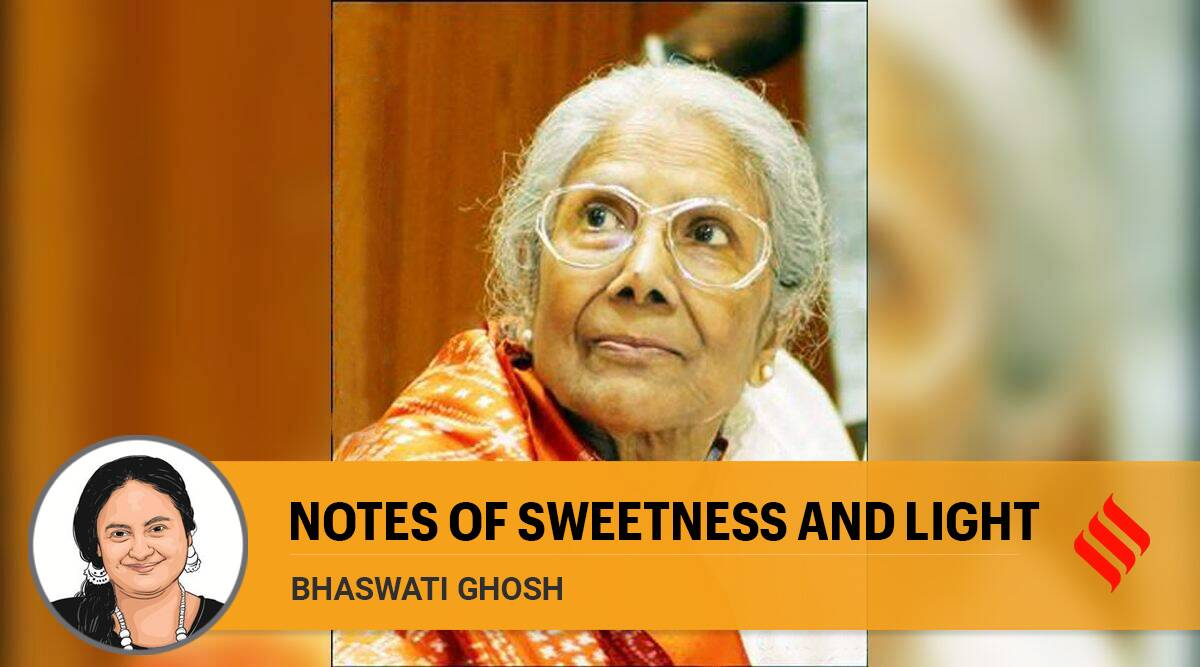
Sandhya Mukherjee’s notes of sweetness and light

My tribute to singer, Sandhya Mukherjee, published in Indian Express.

Sandhya Mukherjee came to my listening universe inconspicuously. Growing up as a probashi Bengali in Delhi in the pre-digital age, I didn’t have Mukherjee as part of my early listening experience in the way Lata Mangeshkar or Geeta Dutt had been. I was two years away from hitting my teens when Mukherjee’s voice — unmistakable for its lilt and lalitya, Sanskrit/Bengali for sweetness or charm — entered my world as we moved to Chittaranjan Park in south Delhi. No Durga Puja went by without listening to songs by two legendary Mukherjees — Sandhya and Hemanta — being blared on loudspeakers. The pandals of the late 1980s were venues for the screening of black-and-white Bengali films on giant projectors. This was also when I found Sandhya Mukherjee’s voice merging with the screen persona of Suchitra Sen, even as Hemanta Mukherjee’s did with Uttam Kumar’s who often played her romantic interest. As I spent the past few days listening to the breathtakingly wide range of songs Mukherjee sang in her long and illustrious career, I found that the ability to adapt — to artistic idiosyncrasies, situational peculiarities and the basic demands of a piece of composition — was what made her such a versatile and gifted artist.

Read the rest in Indian Express

Letters from a foreign shore — Rabindranath Tagore’s letters to his niece

First published in Cafe Dissensus

39

Shilaidaha

Thursday, January 9, 1892

[January 14]

For the last couple of days, the weather here has been vacillating between winter and spring. In the morning, northern winds send shivers through land and water and, in the evening, the southern breeze dances through the moonlight of the bright fortnight. It is clear that the spring is nigh. After a long time, an Indian nightingale has started singing from the garden on the other side. The human heart is somewhat excited, too. One can now hear strains of song and music from the village across, which indicates people aren’t too eager to shut their doors and windows and retreat to bed all bundled-up, while the evening is still young.

It’s a full-moon night – a giant moon stares at me from the open window to my left as if to check if I am berating it in this letter. Perhaps she thinks the earth’s residents gossip more about her blemish than her jyotsna. A lone bird calls to dispel the shore’s quietude. The river is still, no boat sails on it; the forest on the other side spreads its solemn shadow on the water. This massive moonlit sky looks a touch hazy – the way things appear when drowsy eyes try to stay awake.

Tomorrow onwards, evenings will begin getting darker again; as I cross this small river after completing my kutcherry work, I will notice a slight separation between me and my beloved away from home. Could the one who had unveiled to me her large and mysterious heart be wondering if all that self-revelation was prudent enough and thus pull back the curtain to her heart again?

Indeed, nature becomes intimate to one who lives alone abroad. I have truly felt for a few days now that I might no longer receive this swathing moonlight once the full-moon night is over; that from this foreign place, I will drift further abroad; that the familiar calm beauty that awaits me at the river bank every day after work, won’t be there for me, and that I would have to make my return journey on the boat in darkness.

But today is a full-moon night – this is the first purnima of this year’s spring, and so I record its story in writing. Perchance I might remember this still night – complete with that lone bird’s call and the gleam of the light on the boat anchored to that bank; this clear outline of the river, that coating of a quasi-dark forest and that detached, indifferent, pallid sky – after a long time…

(Jyotsna: Moonlight; Purnima: Full-moon night)

***

105

Shajadpur

July 7, 1893

This is a small village. Meandering through broken ghaats, a tin-roofed bazaar, granaries with split bamboo fencing, bamboo clumps, mango-jackfruit-palm-shimul-banana-akondo-bherenda-yam trees huddled in a bush, huge boats with raised masts anchored on the river banks, paddy submerged in water, and half-soaked jute fields, I reached Shajadpur last evening. This is going to be my abode for a while now. After spending days in the boat, it’s lovely to step into a house in Shajadpur. It’s wonderful to discover the freedom of being able to move around and stretch one’s limb at will and the impact it has on one’s mental health.

This morning, the sun is beaming from time to time, a wind is blowing swiftly, tamarisk and lychee trees are sashaying and rustling in a sway, a variety of birds are calling out in as many different ways to enliven the forest’s morning assembly. Sitting in this large, companion-less bright and open second-floor room, I am delighted to see a row of boats on the canal and, across it, a village flanked by trees on both sides. On this side, moderate activity guides the movements of a nearby locality. The workflow of a village isn’t rushed, and yet, neither is it inert or lifeless. Work and rest seem to walk hand in hand here.

Ferry boats sail on, passengers walk along the canal with umbrellas in their hands, women dip rice-filled wicker baskets in the water to wash the grain, farmers carrying bundles of jute on their heads head towards the haat, two men rest a log on the ground and crack it with axes for firewood, a carpenter upturns a fishing boat to repair it with a chisel, the village mongrel wanders around aimlessly, a few cows lazily sit on the ground and ward off flies by shaking their ears and tails before ingesting their lunch of the monsoon grass. When crows annoy them excessively by sitting on their backs, they turn their heads just a few times to register their protest.

The sounds of this place – the monotony of cracking wood, the cheer of unclothed children in play, the plaintive high-pitched song of a cowboy, the sloshing of oars, the shrill drone of the oil-grinding block – don’t create any dissonance when they combine with bird calls and rustling  of leaves. In fact, all of it is like a peaceful dream sequence of a bigger sonata, a bit in the manner of Chopin, albeit attuned in an expansive yet controlled composition.

My mind brims with sunlight and all these sounds; I better conclude this letter and soak in it for a while.

(Ghaat: River bank; Haat: Village market)

Image courtesy: theculturetrip.com

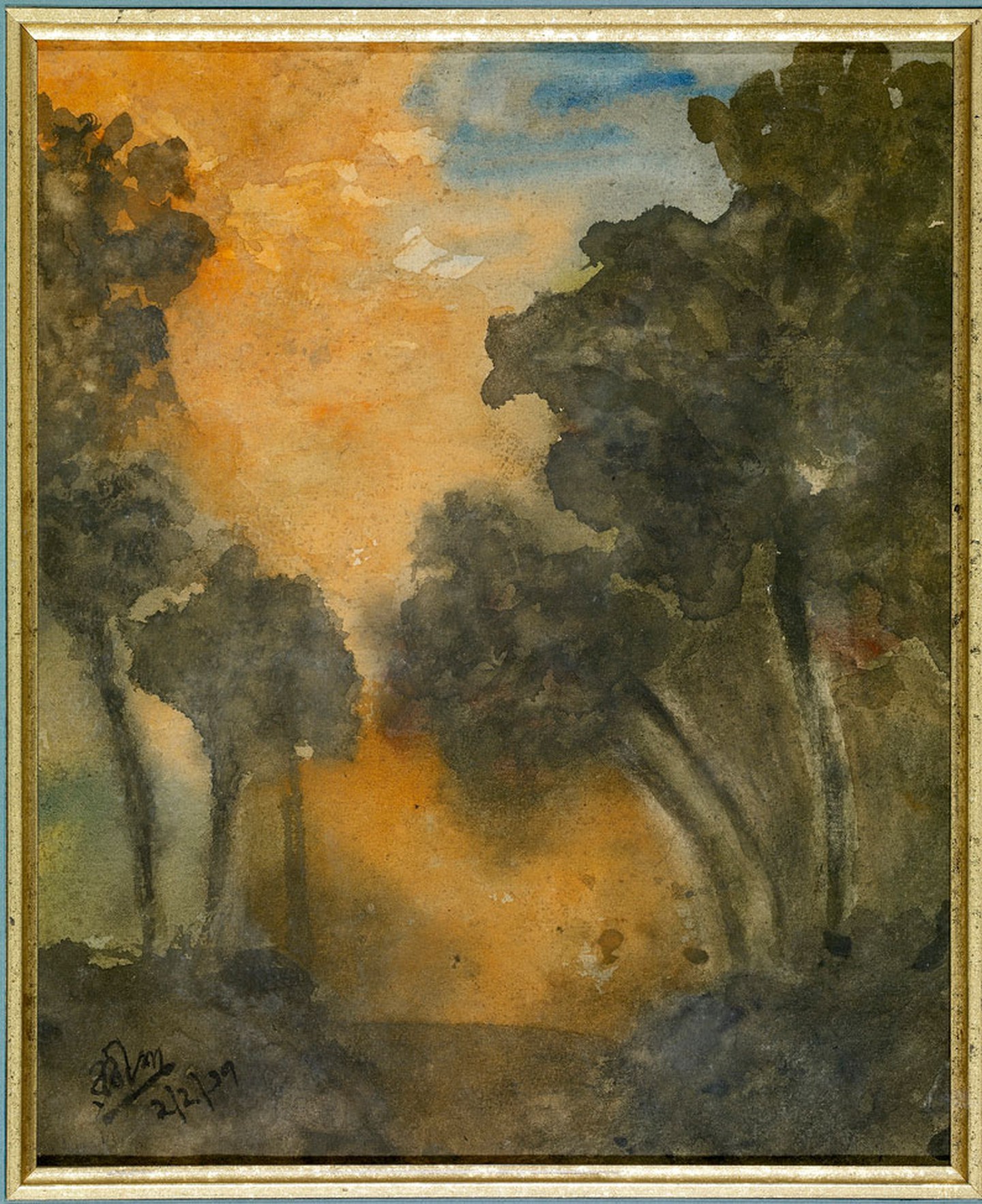
Notes of Eternity: Rabindranath Tagore

                                                                                                                          Calcutta |May 2, 1895

A nahabat recital can be heard playing somewhere today. A morning nahabat makes the heart quiver strangely. I haven’t been able to discern the significance of the unspeakable state that envelopes one’s mind when listening to music. And yet, every time the mind attempts to dissect that state. I have noticed that whenever beautiful music plays, the moment its intoxication hits the soul, this world of life and death, this land of arrivals and departures, this world of work, of light and darkness recedes into a distance — as if across a vast Padma River — from where everything appears as if it were only a picture.

road nature trees branches

To us, our everyday world doesn’t always appear to be the most well balanced. A tiny fraction of our life might seem disproportionately huge, our hunger and thirst, daily squabbles, rest and labour, petty annoyances besmirch the present moment. Music, with its beautiful intrinsic equilibrium, can, within moments make the world stand in a perspective where the small, transient imbalances disappear. With music, a whole, vast and eternal balance transforms the entire world into a mere image, and man’s life and death, laughter and tears, past and future land in the present to play in one’s ears as the meditative rhythm of poetry. With that, the intensity of our personal tendencies decrease, we become puny and immerse ourselves without strain into the immensity of music.

Small and artificial social ties are useful to function in the society, yet music and other evolved art forms instantly show us their insignificance, making every art somewhat antisocial. This is why listening to a good poem or song quickens our hearts, tearing asunder social formalities and igniting in the mind a struggle that seeks the freedom of eternal beauty. Anything beautiful stirs in us a conflict between the fleeting and the permanent, causing us a certain inexplicable pain.

Poona | May 6, 1895

Nahabat: A temple music tower. Musicians sit on the upper story and play during festivals and sometimes at the time of daily worship. (Source)

Translated by Bhaswati Ghosh

Photo by Pixabay on Pexels.com

Ahir Bhairav and 2 more poems

First published in Saaranga

1.

AHIR BHAIRAV

Morningness bathes you. Grandfather’s
Arms rise skywards. The newspaper-man
hurls elastic-clasped, rolled-up
headlines into the porch. Mother
lights the stove to wake up milk.

Ahir Bhairav takes you to a place
so empty, it’s full. The absolute centre
of nothingness. The beginning of
all beginnings. A lighthole.

In a slowly-igniting corner of your mind,
your guru’s saintly beard unspools.
You can hear him talking about the sadhu
who devoted his life to the service of Bhairav,
the primordial sound. Your guru’s smile is
a cryptic message now.

Vilayat and Imrat lead you with strings.
Unscratched morning flows into
a cowshed. The uniraga sadhu still
befuddles, but with Ahir Bhairav, you
partake in a fraction of his madness, his
self-absorbed samadhi in the lighthole.

The school girl dreams. One day she’ll tune
her voice to the throat of the songbird
whose call mocks the cage of age.

***

2.

FISH OUT OF WATER

Water was the first traitor she came
To know. It didn’t drown her.
Seasoned traitors seldom do that.
She was the river’s sibling-child, knew
its mood swings, joaar and bhata
like she did her night terrors, throat-clasping.
Easy to forget once the grip loosened.

When father spread his net over
its body, the river heaved through
the mesh, packing fish into its giant
mouth. She should have known then
What it is to be thrown onto dry
Ground. Gasp. Wriggle. Writhe. Succumb.
Forget that water ever nestled your breath.

The river’s betrayal came not in abandoning her.
It did when it became a concrete mesh,
And she, a fish in the city’s sewage tank.

Photo by Nataliya Vaitkevich on Pexels.com

***

3.

UNTITLED

A long-dead poet brings home truths to the work desk.
Mid-day ennui seeks lunch break and a walk in the park.
Between flesh and flight, the girl chooses to ride the breeze
Like kebab smoke trailing the gallies of purani Delhi. Careless, footloose.
Another dead poet dreams of a new day on earth, a more womanly day.
Old wounds find new ways of festering. Congealed blood rejects washing.
Rain harnesses in megapixels tears that no longer wet hearts.

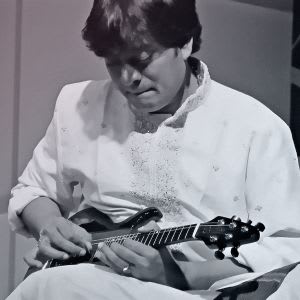
LISTENING TO U. SRINIVAS

Mandolin’s secrets have no use for cover.
They burst open into splintered reveries
And flood your waking dreams.

Mandolin lures moody southern
Winds; blows them lustily in your
Courtyard. The breeze ruffles
Your hair, your sourness.

At temples, Mandolin gathers the
Holy fire of the morning sun to bathe
Your face.

When Mandolin plays, you turn
Into a snake and slither without a hiss
To a corner where the string
Charmer leads you.

Mandolin indoctrinates without
A mantra. Magicians rarely
Need one. You become a bird and
fly away with Mandolin.

More on U. Srinivas here.

U. Srinivas songs, U. Srinivas song MP3 download