
How I became Nostalgic for a Place (I’d) Never Seen (My debut poetry collection)

I wrote a book of poems.

It’s been a while since I’ve posted anything here, and it’s taken me a while to write this post. The sharp chill of winter. Work-life imbalance. Laziness. Procrastination. You get the drift.

Nostalgic for a Place Never Seen, my debut poetry collection, came out in November last year from Copper Coin Publishing.

I’ve been writing poetry on a regular basis for only the last four years, so having this collection fills me with both wonder and gratitude. Wonder because of the serendipitous manner in which stray poems flocked together to build a nest. Gratitude for how that nest found its tree — the publisher.

Nostalgic for a Place Never Seen

Nostalgic for a Place Never Seen traverses multiple geographies — temporal and metaphysical. Divided into eight sections: Dwellings — Temporary and Permanent; Places, Faces, Traces; Scents, Tastes, Textures; Seasons of the Heart; Water, Earth, Air, Fire; The Humming Octave; The Wordsmiths; and Movements in and out of Time — the poems in this collection ponder on themes such as migration and displacement, finding home, food, textiles, music, love and nature.

Read a selection of the poems in Scroll.

And in Usawa.

Read a review in The Tribune.

Here it is on Goodreads.

I hope you’ll give this book a read. If you’re in India, you’ll find the book in store (and online) at Midland Books, Full Circle, and Bahrisons.

If you wanted to buy it online, you could do so from:

Copper Coin Publishing (India and international)

Amazon.com

Amazon.in (India)

Flipkart (India)

From the book’s back cover:


Thank you so much. I can’t wait to hear your thoughts about the poems.
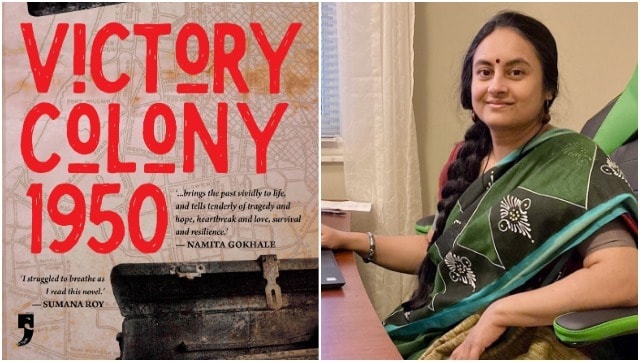
 

Excerpt: Victory Colony, 1950

An excerpt from my debut novel, Victory Colony, 1950, in The Dispatch

Manas had little chance to interact with Amala over the past two days as the women were still holed up inside the school. The morning after the clashes ended, Manas and his friends took a tour of the freshly-seized squatter colony. Manas could see the enormousness of the task that lay ahead for the space to become truly habitable. There was no clean water supply or electricity. Nor did the residents have any sewage or waste collection system in place.

As they walked through the area, Subir thought aloud the need for setting up a few hand pumps at the very least. Manas nodded, saying they needed a new fundraising drive to get the basics in place in Bijoy Nagar.

‘We’ll also need more volunteers, Manas-da,’ Manik said.

Manas agreed as he thought of the added effort needed to manage the camp and work with the squatting refugees.

They landed close to Amala’s shack. The landlord’s goons had razed the incomplete fencing Amala had earlier put up. Manas saw Amala resurrecting the fence with a fresh batch of hogla leaves. She seemed engrossed in what she was doing. Manas noticed her lips moving with the hint of a sweet smile.

As the boys came closer, Manas said softly so as not to break Amala’s reverie, ‘Ei je, how goes?’

He thought he had caught a fragment of a song in her voice before it faded away as she looked at him and smiled. A tiny hurricane swept through Manas’s heart.

Read the rest in The Dispatch