It’s been a while since I’ve posted anything here, and it’s taken me a while to write this post. The sharp chill of winter. Work-life imbalance. Laziness. Procrastination. You get the drift.
Nostalgic for a Place Never Seen, my debut poetry collection, came out in November last year from Copper Coin Publishing.
I’ve been writing poetry on a regular basis for only the last four years, so having this collection fills me with both wonder and gratitude. Wonder because of the serendipitous manner in which stray poems flocked together to build a nest. Gratitude for how that nest found its tree — the publisher.
Nostalgic for a Place Never Seen
Nostalgic for a Place Never Seen traverses multiple geographies — temporal and metaphysical. Divided into eight sections: Dwellings — Temporary and Permanent; Places, Faces, Traces; Scents, Tastes, Textures; Seasons of the Heart; Water, Earth, Air, Fire; The Humming Octave; The Wordsmiths; and Movements in and out of Time — the poems in this collection ponder on themes such as migration and displacement, finding home, food, textiles, music, love and nature.
It was the middle of the month of Bhadra. With the onset of autumn, the dark nimbus of the monsoon had left the sky. Clouds came in brighter tones as did sunshine. After the previous year’s drought and poor crop, this year’s rainfall had been abundant. The paddy on the fields had a dark green hue and looked thick and healthy. A serene mood prevailed all around. Families of householders were busy with Durga puja preparations that began with the most laborious and important of them all — plastering the walls with mud. This was to be followed by painting alpona designs at the threshold using white and red chalk, roasting rice into puffed and popped rice, and preparing sweets like naadu and mudki. There was no end to the chores related to puja.
“That woman has ten hands, along with those of her children and retinue; how could we two-handed ones match her strength?” Ginni, the matron of the Chatterjee family thought aloud.
Today their house was going to receive the first coat of mud. The artisans had arrived at the chandimandap to start working on the idol.
Red clay had been dissolved in a bucket of water. The daughters-in-law and maids were ready — with their saris tied to their waist and their gold bangles covered with rags — to witness the plastering of the idol’s frame with mud.
“Dear, can one of you go and check how long it’s going to take?” Chatterjee Ginni asked the women. “Where are all the boys?”
“They are all at the puja site,” one of the girls said.
That — the chandimandap — was exactly where the boys had gathered. Kumareesh, the elderly idol maker was busy arguing with the watchman, “Will you donate your prize money to me? Why should I do your work?”
Kalachand, the watchman said, “Hey, why are you getting worked up? Do they let you grab that soil so easily? Have you seen how they curse you and chase you away?”
“Why, couldn’t you get some on the sly during your night patrolling? Or did you skip your routine last night?”
“How can I skip my duty? I have to go for at least one round. How would I know that you’ll be here today? Forgive me, please.”
Approaching the door, Chatterjee Ginni asked, “O, Kumareesh, are you done yet? The girls are waiting with the mud batter. How long will you keep brabbling here?”
Kumareesh was a short, frail man. His limbs, narrow like the hands and legs of puppets, moved as swiftly. His walk was equally agile. Even before Chatterjee Ginni could finish speaking, he began shouting at the top of his voice, “What do I even tell you, Ma; I can’t work with this Kalachand anymore. He makes no effort, has no brains, no hands, no legs, nothing — what can I do, you tell me?”
Even as he yelled out those words, he drew closer to the matron and bowing before her said in a calmer voice, “Are you doing well, Ma? And your children? All the Babus? And the dear sisters and Bou-Mas, is everyone fine?”
Ginni-Ma smiled and said, “Yes, everyone is fine. How about your children…”
Snatching words off others’ mouths was Kumareesh’s old habit. He began ruefully, “Where do I begin Ma, measles, stomach upset, fever are all playing hopscotch. Doctors and boddis have turned me into a pauper.”
Then, in a quieter tone, he said, “I heard that Chhoto Babu is back, I’m so happy to hear that. Why don’t you bring Bou-Ma, our dear daughter-in-law now? That will fix everything. His blood is young after all, he made one mistake…everything will be all right.”
Putting a lid to the subject, Ginni-Ma said, “What’s taking you so long to get started? The girls are all waiting with the wet mud; when will they take a bath?”
Kumareesh said, “Everything is ready, we just need the soil from the prostitutes’ quarters…”
What sensory forces inhabit the landscape of childhood? What does it look, sound, feel and taste like? For Palash and Shafikul, two boys growing up in rural Bengal, that landscape looks like fields and rivers to play football and take a dip in; it sounds like the toktoki, a small metallic toy that makes a clickety-clack sound; it feels like catching caterpillars and flying kites. Dostojee, Prasun Chatterjee’s debut film, opens with a childhood scene most of us are acquainted with — throwing pebbles into the water. As the two boys try to outdo each other in covering the distance their stones can manage, no boundaries separate them. Yet, a wall appears soon enough, as quickly as the boys — each of whom calls the other by the same name — “Dostojee,” meaning friend — enter their respective houses, separated by a thatched straw wall.
As next door neighbours, the two boys have about as mainstream a friendship as two village boys could have during ordinary days. Except, the days have ceased to be ordinary. A spectre of suspicion and ill-will pervades the air around them, holding in its sway, the minds and moods of the grown-ups responsible for showing them the way. Dostojee uses the powerful trope of child’s play to convey messages that are anything but child’s play. In fact, this relationship couldn’t be developing at a more fraught time in history. The Babri Masjid, a 16th-century mosque has only recently been demolished in Ayodhya by a mob of Hindutva nationalists, who consider the mosque site to be the birthplace of Rama. This last fact is significant, because, although he’s a part of the region’s folklore, thanks to the epic of Ramayana, Rama isn’t traditionally revered as a god in Bengal. Yet as the wildfire of hurt religious sentiments reaches their village, that is set to change.
Dostojee presents a familiar story — of simmering communal tension — in a remarkably unfamiliar way. To begin with, the story takes place in a Muslim-majority village in West Bengal. This in itself is an interesting alternative to the dominant Hindu perspective one often comes across. When I asked him the reason behind this, Chatterjee told me “This comes from my own experience of traveling to areas like the film’s setting in Murshidabad for the last decade and a half, during which time I saw a continuous erosion of harmony between the Hindus and Muslims. There’s also another, more subconscious reason. My family came to West Bengal from East Pakistan in the early 1960s in dire circumstance. I tried to imagine what the relations between the two communities could be like, had we been living in a Muslim-majority scenario.”
Even as the battle lines are drawn — with the Muslims vowing to construct a new mosque, one they will call the Chhota Babri Masjid and the Hindus reciprocating by bringing Rama’s idol to the village temple — the graph of the Palash-Shafi (short for Shafikul) friendship maintains an even keel. The affairs of the grown-ups are beyond their understanding; Shafi, for instance, can’t understand why his father won’t allow him to attend a play on Ramayana, when he’d done the same without any fuss the previous year. When he still goes for the play, in stealth, the two friends walk up backstage during the play’s intermission and find the actors playing Rama, Sita and Ravana (all men), sharing a smoking break. The boys are incredulous, and when invited by the actors to enter their tent, Palash finally asks them, “Aren’t you each other’s enemies?” The response of the actors — “No, we’re friends. We only act as if we were enemies, all for the belly’s sake, you see?” — is one of the many subtle shrapnel director Chatterjee uses to make his point about organized religion and orchestrated clashes. This subtle artistry of getting the message across, where words and images have both external and internal meanings, makes Dostojee compelling yet poetic in the way great cinema is meant to be.
In the ceaseless romanticising of childhood, it is often overlooked that it is also a difficult territory. In a world governed by adults, children have to constantly look for workarounds, wiggling out ways to protect their little worlds while appearing to be abiding by the laws laid down for them. That is how childhood survives, by negotiating, but as Dostojee shows, also by subverting. And so, even as Shafi goes to see the Rama play despite being forbidden, Palash too, quietly brings an Eid treat from his friend’s house, hiding it well from his mother’s eyes, for his little sister. And on the eve of the Hindu festival of janamashtami that celebrates the birth of lord Krishna, Shafi comes over to Palash’s house to decorate the jhulan, an ornamental swing depicting various episodes from Krishna’s life. It is an activity children in Bengal take great joy in, and while Shafi’s innocent participation in an activity associated with a religion other than his own might not seem all that incongruous, what makes it noteworthy is Shafi’s sourcing of mud for the purpose — from the soil for the proposed new mosque.
One could watch Dostojee for its visuals alone — Chatterjee spoils the viewer in that department, with scene after stunning scene representing not only the beauty of rural Bengal, but of the particular joy of growing up there. In one scene, the two children are seen in a wide open field in the evening, wearing something similar to chef’s hats on their heads. Except, these are paper hats Shafi has made using scrap. They look ordinary up until the moment the hats achieve what their maker intends them to — gleaming with fireflies that stick to the adhesive Shafi has plastered the hat with. Even the word magic falls short to describe this scene — two boys laughing and dancing with a thousand fireflies crowning their heads as dusk descends — and its visual thrill. Then there are the more familiar and enduring images of rural Bengal — endless paddy fields, lush monsoons, village fairs and the bioscope as well as repetitive sights and sounds of weaving — the source of livelihood for Shafi’s family.
One of the most telling images in the film is that of Pagla, the village madman — sitting silently on a platform attached to a wall, the two halves of which have posters calling for the solidarity of Hindus and Muslims respectively. The madman isn’t a new idea, but even for an oft-used trope, this single wordless scene — depicting insanity as the only balance holding warring groups of religious fanatics in place — is as powerful as it gets in terms of visual coding.
Even as the two boys float — for “rise” is too lofty a word for the natural ease with which they bond — above the discord festering around them, there comes a point when they too must be separated. On an evening of torrential downpour when the boys dip into the river and begin “catching” fish with as much as Palash’s bare hands and the shirt Shafi has stripped himself of, Palash drowns, taking with himself Shafi’s privilege of uttering the word “Dostojee” ever again.
From this moment on, Shafi’s life wouldn’t be the same, of course, but Shafi himself won’t be the same person either. He would give up his waywardness and turn into the diligent student that Palash was, focusing on his lessons and reaching school on time. His friend’s death would make him obsessed with how fish can swim freely in water without drowning. When his home tutor illustrates for him how the fish’s body is designed to draw oxygen from water, Shafi, who had always been the more hands-on of the two friends, decides to invent a machine that would allow humans to similarly take in oxygen when in water.
Shafi would be diligent about one more thing — perhaps the most important of them all — keeping alive a project he and Palash had started together — making a butterfly from a caterpillar. Braving the awkwardness that comes with having to face Palash’s parents, he keeps returning to their house to put fresh leaves into the jar in which they put the caterpillar. The manner in which this simple act of childhood play is turned into metaphor is yet another testament to Chatterjee’s ability to turn the ordinary into the sublime. Gripped by the memory of the caterpillar, as Shafi comes running to Palash’s house late one evening, we see in the lantern’s dim flicker, how the caterpillar’s movement inside the glass jar catches the attention of Palash’s mother. Transcending itself, the tiny creature now becomes a symbol — of something that breathes and moves, and something that carries a bit of her son in its aliveness. She begins feeding it, and the day Shafi releases the fully formed butterfly, she is seen breaking down for the first time since her son’s death. The suddenness of the insect flying out of the jar hits too close to home for her.
It is perhaps in the film’s final scene — ambiguous, magic-realist, open-ended — where the stylistic panache of Chatterjee, comes full circle, albeit inconspicuously. As a reward for doing well in the final exams, Shafi’s home tutor offers to take him around the village on his bicycle. Shafi requests to be taken to the mango orchard he used to visit with Palash. Once there, he comes across the tree on which the two friends had carved the word “Dostojee”. The film could have ended here and made its point, but it doesn’t. As he looks around, Shafi hears the sharp, unmissable call of the koel, filling the air with its drawn-out koo-oo-s. Soon enough, Shafi returns the call with a koo sound and the bird responds with an even sharper call. This calling game goes on for a while, until Shafi, not the bird, becomes the primary caller. The entire exercise is about the echoing of the same sound by the bird and Shafi. Exactly like the echo he and Palash used to exchange every day when they called each other “Dostojee.” The film reminds us that is how friendship lives on — as echoes, as shadows — even when friends don’t.
Telling larger stories through the prism of childhood friendship is a delicate exercise and the execution is where the filmmaker’s facility and skill are tested. As in the case of the Chilean film, Machuca (2004), written and directed by Andrés Wood that depicts a friendship developing between two boys distanced by class during the months leading up to the coup d’état led by General Augusto Pinochet, or Julie Gavras’s French-Italian film, Blame It on Fidel (French: La Faute à Fidel; 2006), with a nine-year-old protagonist who must negotiate the world of her activist parents acting as liaisons for Chilean supporters of Salvador Allende alongside that of her Catholic school and grandparents, Dostojee too does a superbly nuanced telling of how children separated by religion are able to keep the faith while working their way through the rough road of bigotry and distrust.
[After travelling to more than twenty countries around the world and winning eight international awards DOSTOJEE has hit the to the big screen in theatres on November 11. The two leading child actors, Arif Shaikh and Asik Shaikh recently won the Best Actor award at the Malaysian Golden Globe Awards 2022.]
For the last couple of days, the weather here has been vacillating between winter and spring. In the morning, northern winds send shivers through land and water and, in the evening, the southern breeze dances through the moonlight of the bright fortnight. It is clear that the spring is nigh. After a long time, an Indian nightingale has started singing from the garden on the other side. The human heart is somewhat excited, too. One can now hear strains of song and music from the village across, which indicates people aren’t too eager to shut their doors and windows and retreat to bed all bundled-up, while the evening is still young.
It’s a full-moon night – a giant moon stares at me from the open window to my left as if to check if I am berating it in this letter. Perhaps she thinks the earth’s residents gossip more about her blemish than her jyotsna. A lone bird calls to dispel the shore’s quietude. The river is still, no boat sails on it; the forest on the other side spreads its solemn shadow on the water. This massive moonlit sky looks a touch hazy – the way things appear when drowsy eyes try to stay awake.
Tomorrow onwards, evenings will begin getting darker again; as I cross this small river after completing my kutcherry work, I will notice a slight separation between me and my beloved away from home. Could the one who had unveiled to me her large and mysterious heart be wondering if all that self-revelation was prudent enough and thus pull back the curtain to her heart again?
Indeed, nature becomes intimate to one who lives alone abroad. I have truly felt for a few days now that I might no longer receive this swathing moonlight once the full-moon night is over; that from this foreign place, I will drift further abroad; that the familiar calm beauty that awaits me at the river bank every day after work, won’t be there for me, and that I would have to make my return journey on the boat in darkness.
But today is a full-moon night – this is the first purnima of this year’s spring, and so I record its story in writing. Perchance I might remember this still night – complete with that lone bird’s call and the gleam of the light on the boat anchored to that bank; this clear outline of the river, that coating of a quasi-dark forest and that detached, indifferent, pallid sky – after a long time…
(Jyotsna: Moonlight; Purnima: Full-moon night)
***
105
Shajadpur
July 7, 1893
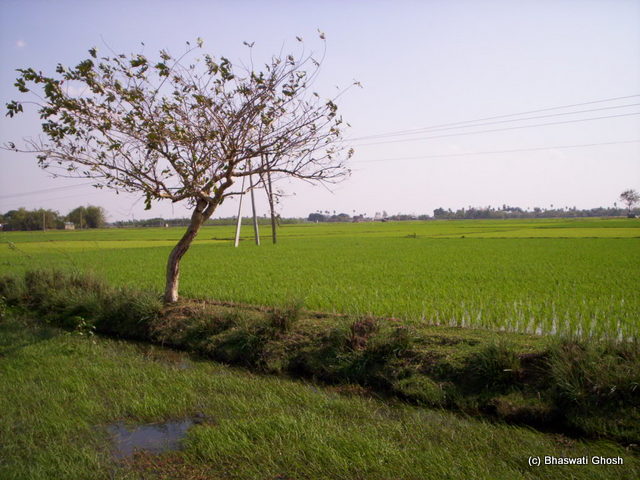
This is a small village. Meandering through broken ghaats, a tin-roofed bazaar, granaries with split bamboo fencing, bamboo clumps, mango-jackfruit-palm-shimul-banana-akondo-bherenda-yam trees huddled in a bush, huge boats with raised masts anchored on the river banks, paddy submerged in water, and half-soaked jute fields, I reached Shajadpur last evening. This is going to be my abode for a while now. After spending days in the boat, it’s lovely to step into a house in Shajadpur. It’s wonderful to discover the freedom of being able to move around and stretch one’s limb at will and the impact it has on one’s mental health.
This morning, the sun is beaming from time to time, a wind is blowing swiftly, tamarisk and lychee trees are sashaying and rustling in a sway, a variety of birds are calling out in as many different ways to enliven the forest’s morning assembly. Sitting in this large, companion-less bright and open second-floor room, I am delighted to see a row of boats on the canal and, across it, a village flanked by trees on both sides. On this side, moderate activity guides the movements of a nearby locality. The workflow of a village isn’t rushed, and yet, neither is it inert or lifeless. Work and rest seem to walk hand in hand here.
Ferry boats sail on, passengers walk along the canal with umbrellas in their hands, women dip rice-filled wicker baskets in the water to wash the grain, farmers carrying bundles of jute on their heads head towards the haat, two men rest a log on the ground and crack it with axes for firewood, a carpenter upturns a fishing boat to repair it with a chisel, the village mongrel wanders around aimlessly, a few cows lazily sit on the ground and ward off flies by shaking their ears and tails before ingesting their lunch of the monsoon grass. When crows annoy them excessively by sitting on their backs, they turn their heads just a few times to register their protest.
The sounds of this place – the monotony of cracking wood, the cheer of unclothed children in play, the plaintive high-pitched song of a cowboy, the sloshing of oars, the shrill drone of the oil-grinding block – don’t create any dissonance when they combine with bird calls and rustling of leaves. In fact, all of it is like a peaceful dream sequence of a bigger sonata, a bit in the manner of Chopin, albeit attuned in an expansive yet controlled composition.
My mind brims with sunlight and all these sounds; I better conclude this letter and soak in it for a while.
After spending a long time on the boat, it feels wonderful to have suddenly arrived at the Shazadpur house. Light and air streams in unrestrained through the large windows and doors — wherever I look, I see green branches of trees and hear bird call. The moment I step out to the southern verandah, all the veins of my brain fill with the fragrance of Kamini flowers. All of a sudden I realize a hunger lurked within me for an expansive sky — being here has fulfilled it completely.
I am the sole master of four large rooms — I sit with all the doors open. The inspiration and motivation that I receive here to write is unlike that in any other place. A living essence of the outside world enters me unhindered through the open doors — the light and the sky and the air and the sounds and the smells and the waves of green mingle with the passions of my mind and create innumerable stories. The afternoons here, in particular, have a deep spell. The sun’s heat, the silence, the quiet, calls of birds, especially the crow’s and an extended period of leisure make me pensive and eager.
I don’t know why I have a feeling that Arabian stories are made of afternoons like these brimming with golden sunshine. Those Persian and Arabian lands of Damascus, Samarkand, Bukhara…those grape clusters, rose gardens, the nightingale’s songs, Shiraz wines, desert paths, rows of camels, horse-riding wayfarers, a clear source of water amidst a thick curtain of date trees…cities with narrow royal lanes festooned with awnings, a shopkeeper wearing a turban and comfortable, loose-fitting clothes — selling melons and mewa at the end of the street…a massive royal palace by the roadside with incense smell wafting out of it, a huge mattress covered with kimkhwāb placed by the window…Amina, Zubeidi and Sufi in zari footwear, wide pajamas and colourful corsets as they inhale smoke rising off a curled hubble-bubble near their feet, at the door, a habshi dressed in flashy clothes stands guard…and in this mysterious, unfamiliar faraway land, in a wealth-filled, spectacular yet eerie royal palace, thousands of stories — possible and impossible — are being created out of the laughter and tears, hopes and anxieties of humans.
These afternoons I spend in Shazadpur are fabled afternoons. I remember writing the story “Postmaster” sitting at the table fully engrossed right at this hour. As I wrote, the light around me, the breeze and the shivering tree branches all added their language to it. There are few joys that come close to creating something close to one’s heart by being immersed in one’s surroundings. This morning I became inclined to write something on limericks and could become thoroughly involved in it, which brought me immense delight. Like the world of clouds, limericks make for a free country unbounded by rules and laws. Unfortunately, the land that rules and laws dominate is never far behind to follow one. As I wrote, a sudden insurrection of officials stormed in, blowing to dust my land of clouds.
When that ended, it was time to eat. There’s nothing more sloth-inducing than eating a full meal in the afternoon. It overwhelms one’s imagination and the spirit’s higher callings. Bengalis are unable to enjoy the deep intrinsic beauty of an afternoon because of their predilection to eat sumptuous meals at that time and follow that by closing the door to smoke on tobacco and slide into a satiating slumber. This is what makes them hale and hearty. But nowhere do quiet, desolate afternoons spread over in the sweeping, silent manner in which they do over Bengal’s uniformly limitless, plain crop fields.
Afternoons like these have haunted me since childhood. Back then, no one used to be in the outer third-storey quarters; I alone sat in the angular couch with the door wide open and a warm breeze blowing in. My entire day went by in the company of vivid imagination and unspeakable desires.
Literature, Gender, and the Trauma of Partition: The Paradox of Independence
Debali Mookerjea-Leonard
Routledge, Taylor & Francis Group, 2017
In writing my first novel, whose protagonist is a young refugee woman from East Pakistan, I employed the device of coincidence to achieve a happy ending. Doing so wasn’t a sudden rush on my part to end what had become a protracted writing project but a well thought-out conclusion. It was not to be. When they read it, two of my trusted beta readers quashed it summarily, citing it as lazy and escapist. Even though incredible incidents can happen in real life, one of them advised, in a work of fiction, coincidences are hard to pull off convincingly.
An incident Debali Mookerjea-Leonard mentions in the preface to Literature, Gender and the Trauma of Partition: The Paradox of Independence starkly bears out this paradox.
Shortly after the All India Muslim League’s call for Direct Action in Calcutta in 1946, the author’s grandfather was stranded in Howrah station as public transport had been suspended in the wake of the sectarian clashes. He eventually got a ride from a kind Muslim family who had a private car, but had to climb on the footboard as the vehicle was full. To ensure his safety, he was given a flag of the Muslim League and advised to shout “Pakistan Zindabad” when passing through Muslim neighbourhoods. He did, and reached his home safely.
The insanity that gripped the subcontinent a year later when India was partitioned has been arduously chronicled in historical archives. In the privileging of journalistic reportage and record-keeping, personal histories surrounding the traumatic event haven’t received much attention until recently. The initiatives of Urvashi Butalia, Ritu Menon, Kamla Bhasin, and Jashodhara Bagchi, among others come to mind.
Mookerjea-Leonard’s book is an important intervention in this regard, not only because of its meticulous research and compelling arguments but because it sits in that nebulous middle – a no man’s land if you will – of fact and fiction. The author examines with incisive rigour fictional works on Partition and juxtaposes them against factual information and recent recordings of oral histories. As someone not directly affected by the event, hers is a lens that is both objective and earnest.
The works discussed in Literature, Gender and the Trauma of Partition are mostly from Bengal, which the author calls the “neglected shelves” of Bengali literature, written by writers from both sides of the Radcliffe divide. As she mentions in the Preface, this book is her tribute to her city, Calcutta. It is also a conscious effort to shine a light on the sufferings of those at the eastern end of the divide, as the tragedy of Partition in Bengal has been either underrepresented or misrepresented when compared to Partition in Punjab. This could well be attributed to, as Mookerjea-Leonard is cognisant of, the predominant and recurrent theme ofdisplacement in the east as opposed to that of horrific violence in the west.





 Bhaswati Ghosh