First Sorrow by Rabindranath Tagore

The path by the shadow of the forest is now covered with grass.

On that deserted road, someone called me from behind.

“Don’t you recognise me?”

I turned back to look at him.

“I remember you, but do not recall your name.”

He said, “I am the sorrow who came to you when you were twenty-five.”

The corner of his eyes revealed a spark of ray, just like moonlight on a lake.

I stood there, surprised.

“Back then, you appeared like a dark monsoon cloud. Now, you look like a golden idol. Have you lost the tears of that day?” I asked.

He didn’t say anything, just smiled. I realized everything was contained in that smile.


The clouds of the rainy day had learned to smile like bright sunny days of the summer.

I asked him, “Have you preserved my youth of twenty-five?”

“Yes, I made it my necklace. Not even a single petal of the spring’s garland had fallen.”

I said, “See, how I have shriveled with age. But my youth is still adorning your neck, as fresh as ever.”

He slowly put that necklace around my neck and said, “Do you remember, that day you had said, you don’t need consolation, you only want sorrow?”

I shrugged a little. “Yes, I did. But it has been so long; I had forgotten about it.”

“But the one within you hadn’t forgotten. Now, you must accept me,” he said.

I held his hand and said, “How wonderful you look!”

He smiled and said, “That which was once sorrow, is now peace.”

Translated by Bhaswati Ghosh

The Chess Players

“The passion for playing chess is one of the most unaccountable in the world. It slaps the theory of natural selection in the face. It is the most absorbing of occupations. The least satisfying of desires. A nameless excrescence upon life. It annihilates a man. You have, let us say, a promising politician, a rising artist that you wish to destroy. Dagger or bomb are archaic and unreliable – but teach him, inoculate him with chess.”

H.G. Wells, Certain Personal Matters, 1898

Never having sat across a chessboard, I should think that observation of Wells is a bit of an acerbic exaggeration. However, if the stories of chess and its lovers were considered, that remark would appear anything but an overstatement. A recent review of The Immortal Game, a book chronicling the history of chess with a touch of personal attachment, took me back to a tale of Shatranj ke Khilari or The Chess Players, a compelling short story by one of the maestros of Urdu-Hindi literature, Munshi Premchand.

The story is, of course, better known for its screen version, directed by the legendary Satyajit Ray. While the film remains a personal favourite for a number of reasons (great overlaying of the parallels between the state of politics and the state of mind of the populace, appropriate casting, sincere recreation of ambience), reading the story itself was a reintroduction to the masterly craftsmanship Premchand wielded with his pen.

It’s a pity I read the story in Bengali translation. Pity because language is such a big part of Premchand’s writing, as indeed it is of the culture his writing mirrors. I have read his stories in the original language before and have been charmed as much by his skillful use of the Hindi/Urdu vocabulary as by his layered writing style and the themes his stories discuss.

The Chess Players is one such layered story. It tracks the chess exploits of two friends, Mirza Sajjad Ali and Mir Roshan Ali, both belonging to the gentry of Lucknow, a city known for its tehzeeb or culture. While Lucknowi traditions and artistic legacy has mostly been the subject of exaltation in most written works, in this story of Premchand, this same legacy becomes the author’s diatribe. That’s mainly because of the period in which the story is set. The time is British India and the setting the luxury-steeped province of Awadh, ruled by Wajid Ali Shah, a king devoted to art, artists and courtesans and equally impervious to matters of the state.


Wajid Ali Shah’s hedonistic ways seem to infect his subjects as well, and the two chess players are no exception to the pattern. Like their Nawab’s obsession with extravagant indulgences, the Mirza and the Mir are obsessed with the game of chess. Morning, noon, and night, it’s the one thing that plays on their minds and the one thing their minds play with. For a while Mirza’s house is the centre of their duels, even as his wife detests the chessboard as if it were her competitor in hogging her husband’s attention. Soon her intolerance for the game reaches the point where she throws away the chessboard even as an intense battle is on between the two players.

Premchand then shifts the scene of chess combats to Mir Roshan Ali’s house. This place has its own set of problems. On the one hand are Roshan Ali’s servants, exasperated to suddenly work round the clock for serving the two playing masters. Not only that; there’s also Mir’s wife, whose adulterous affair with her lover is halted because of the presence of her husband in the house. The lover comes up with a devious plan—posing as a messenger from the king’s court, he announces Wajid Ali Shah has ordered Roshan Ali to appear in the court so as to enlist his services in the military. Alarmed at the possibility of such a scenario, the two friends quickly shift the venue of play again to the ruins of a mosque—their final spot. They select this place because of the privacy it offers. Anything to keep their game from getting interrupted.

The story’s focus is tight; it remains concentrated on the chess players and their keen contests on the 64-square board. The only interjections come in the form of political reportage. As the momentum in the chess battlefield intensifies, so does the battle between the British and Nawab Wajid Ali Shah. The latter is a tepid affair though, and before long, the British hold the king captive. Premchand describes the event in this way:

Never before could the king of an independent country have been defeated so peacefully, without bloodshed, like this. This was not the ahimsa [nonviolence] with which the gods are pleased. This was the kind of cowardice at which even the biggest cowards shed tears. The nawab of the spacious land of Avadh was departing as a prisoner, and Lucknow was drunk in the sleep of sensual pleasure. This was the last extreme of political decay.

[Source:
“THE CHESS PLAYERS”: FROM PREMCHAND TO SATYAJIT RAY by Frances W. Pritchett]

The climax of the story highlights how a simple pastime, when turned into an obsession, can lead to fierce ego clashes. In the final scene, Mirza Sajjad Ali is seen desperately trying to win at least one round of the game, already having lost thrice in a row. The clouds of his anxious heart seem to find a resonance in the darkness of the evening reverberating with the cacophony of nocturnal creatures. His difficulty in answering the moves of Mir Roshan Ali wasn’t helping either. Soon his restlessness transformed into an incensed verbal attack on the Mir. He accused the latter of foul play and finally delivered check. When the defiant Mir refused to concede defeat, the war of words reached an extreme, where friendship gave way to an acrimonious attack on each other’s ancestors. Shortly, even this wasn’t enough to prove their pride, and a sword fight commenced between the two. Premchand remarks how when their king was captured, it hadn’t bothered either of the chess players, yet when it came to personal egos, they had all the courage in the world to fight for its prestige.

The story ends on a bloody note as the two friends are slain by the edge of each other’s swords. Premchand ends the story and his critique of the prevailing apathy to politics by observing how the two friends had not shown an iota of concern when the British were seizing their territory, yet, to protect the pawns of their artificial battlefield, they were ready to even kill each other. The irony is not lost one bit as the annihilation of the The Chess Players is complete.

Note to self: Buy a Premchand anthology in Hindi as the first New Year purchase.

, ,

Guest Blog – Lisa Jordan

Christmas is upon us. As the festivities and merry-making envelop our senses, Lisa Jordan, Christian fiction writer, reflects on her genre, and how her faith has shaped her writing. Let us join her as she brings us closer to…

A Cradle for a King

Travel over two thousand years ago with me to a little town called Bethlehem. Our imaginary journey takes us to a stable where a tired husband and his wife, heavy with child, had been denied room at the inn. An ordinary woman has given birth to an Extraordinary Child. Instead of being surrounded by family and well-wishers, she and her carpenter husband have been greeted by noisy, smelly livestock. A feeding trough cradled their newborn Child. A cradle for a King. Such lowly surroundings for the Prince of Peace. Mary’s life has changed dramatically since the day the angel proclaimed her destiny. What went through her mind as she hugged this tiny infant to her breast? She was an ordinary woman whom God used for His extraordinary Purpose.

I’m honored to be a guest on Bhaswati’s wonderful blog. She invited me to share with her readers what it means to be a Christian fiction writer. The Christmas season is a glorious time for Christians, but as a Christian writer, it is also a wonderful time of reflection for me. God’s gift of His Son is the root of Christianity. Without His birth, my faith as I know it wouldn’t exist. Because of that faith, I have chosen to write Christian fiction.

Christian fiction glorifies God and promotes Biblical principles. The characters in Christian fiction stories are Christians or they have come to accept Christ as their Savior by the book’s end. Christian fiction novels and stories have a spiritual element woven into the plot. The characters rely on God to help them through their situations. The books are wholesome with no swearing, no premarital sex, or graphic content.

Christian fiction characters endure real life situations and writers of Christian fiction novels use realistic, and sometimes, edgy themes, such as abuse, adultery, addiction, child pornography, prostitution, rape. Christian fiction genres are broken into many of the sub-genres as secular fiction, such as romantic suspense, chick-lit, romantic comedy, women’s fiction, thrillers, science fiction/fantasy.

Some of my favorite Christian authors include Susan May Warren, Colleen Coble, Deborah Raney, Kristen Billerbeck, Diann Hunt, Trish Perry, Dee Henderson, Judy Baer, Allie Pleiter, Debra Clopton. There are many more. These women write in different genres, but they share the love of Jesus and their novels reflect their faith.

I’ve known I’ve wanted to be a writer since I was sixteen years old. Through the years, I’ve penned stories that will never see the light of day. However, each of those stories has taught me valuable lessons about how to develop three dimensional characters, setting, plot, conflict, etc. Even published writers will say they never stop learning. By listening to constructive criticism and accepting advice from other knowledgeable writers, I’m striving to write a novel that will catch an editor’s attention.

Belonging to reputable writing organizations has helped me hone my craft. I’m a proud member of American Christian Fiction Writers, the premiere organization for Christian fiction, and Faith, Hope & Love, the inspirational chapter of Romance Writers of America. I’ve had the opportunity to attend two ACFW conferences. Both have been vital in helping me understand the complex craft of writing.

Writing Christian fiction is a ministry. It is my desire to combine my faith with stories of my heart to touch the hearts of women who may read my future novels. I write Christian women’s fiction novels about ordinary women who are extraordinary in God’s eyes. After all, I have years of experience of being an ordinary woman, but I believe in an extraordinary God. I invite you to visit my website.

As the holidays approach, take a break from the shopping, the baking, the parties, the gifts, and remember Jesus is the reason for the season. Merry Christmas. May God’s blessings be abundant throughout the New Year!

Morning Marvels

Every morning, I go for a walk on my terrace. The stretch of open space has proven to be the most hassle-free exercising venue for an undisciplined soul like me. I don’t need to sport special attires since technically it’s part of my house. I usually climb my way up when the morning manifests itself fully. This means I don’t start my day with the first rays of the sun, but only when the soft rays mature into a generous splash of tropical sunshine spread across at least a section of the terrace land.
My mornings on the terrace have introduced me to a whole bunch of friends and events.

The All-India Avian Congress is hard to ignore, what with the volume of its esteemed members’ throats. Crows clearly appear to dominate the proceedings, even as pigeons prefer playing the part of silent board members. They leisurely take up their positions atop building roofs or electric poles, barely putting up with their cacophonic counterparts.

At times the meetings don’t end on a peaceful note, leading to a show of strength with regard to territorial rights. Again, the agile crows take the lead, often scaring me with their ominously low flights, marked by agitated wind flapping. Are these birds known to have higher blood pressures? I suspect so; especially since a couple of them attacked me during a park walk around a year ago.

The crowing supremacy cowers into a resigned defeat, however, when kites appear on the horizon. Where the crows and pigeons vie for slices of the sky, the kite claims the entire pie with a single sweep of its magnificent flight. My walk stops momentarily as I look up, transfixed to see this breathtaking stretched-wings wonder spanning across the blue canvas.

Soon the chirpy parakeets rush in, restless to get on with business as soon as possible. The business being picking on the fresh guavas off our tree in the backyard. They do get some competition from the home mynas, who are already found soaking in the comfort of a cozy nest amid the foliage of the guava tree. Although the parakeets are almost always too swift for my reflexes with the camera, they make me smile. Not just for their alacrity, but also because folklore tells me guavas bitten off by a parakeet turn out to be the sweetest of the lot.


Then there are the canine friends who are the kings and queens of the park behind our house. Seeing them send out vociferous warning messages to any outsider dog is being witness to the act of maintaining the security of one’s sovereign regime.


My walks have also unraveled to me an ancient scientific understanding. Just as the sunlight ambles over to the spot where the homemade pickle jars are kept, I can tell it’s 11 am (did I not tell you I walk really late in the morning?). Amazing to know how accurate the earliest experts in astrophysics had been.

This morning, as I was ready to climb down the stair, the flight of two pigeons caught my glance. I couldn’t help stopping for a moment and be in awe. On more than one occasion I’ve suddenly noticed my footsteps gathering momentum automatically the second a catchy song is played on the phone radio I carry during my terrace jaunts. As the pigeons flew overhead this morning, I found their flight to be effortlessly synchronized to the song that was playing.


Pure joy.

Abiding Characters – I

Characters who live. Whose breath conjoins ours from the printed pages on which they appear. Who stay with us long after the book is closed, the story is forgotten. Abiding Characters. A new series.

Raicharan

From Khokababu’s Return by Rabindranath Tagore

First Signs: Hardly anything strikes about Raicharan at first. He enters the household of his masters as a servant boy of twelve. His job is to look after a one-year-old baby. When this baby boy, Anukul, grows up into a man, Raicharan still remains his servant. Although his rights over his master wane once the latter gets married, the space for his unreserved affection is filled in by Anukul’s little son.

What Endures: Even though he is the quintessential servant, ever devoted to his master’s family, Raicharan’s unwavering love for Anukul’s toddler, marked by rustic simplicity and endearing awe tugs at the reader’s heart again and again. There is no end to Raicharan’s marvel when the little boy learns to cross the threshold of his room even as he crawls. The servant is even more amazed when the baby utters his first words calling his ma “Ma”, his pishi “Pichi” and Raicharan, “Channa”. He had in fact declared within months of the little boy’s birth that upon growing up, he will be a judge for sure.

The decisive turn in Raicharan’s life and indeed in the short story comes when the servant accompanies his little master astride his stroller for a late-afternoon promenade. A clear day turns murky as the little child is lost to lure of the Padma River even as Raicharan is busy picking up flowers as demanded by his young boss.

When the child’s mother sends people to look for the child-servant duo the same evening, they find a hapless Raicharan’s yowl—calling out for his junior commandant—tearing through the monsoon winds. However, the judge-to-be isn’t found, his mother accuses Raicharan of stealing her son, and the old servant leaves the household, unable to bear the burden of his guilt of leaving the child alone while plucking flowers.

Soon after his return to his village home, Raicharan is blessed (or cursed as the perspective may be) with a son. Even though his wife dies during childbirth, Raicharan pays no attention to the newborn baby. As a reader, I was at once incredulous and shocked to read this part of the story. For who could think the affectionate man, who went out of his way to fulfill the tantrums of Anukul’s son, could be so dispassionate toward his own child? However, that’s exactly the cause of Raicharan’s indifference; to him the child epitomizes deception, trying to claim the love that was the birthright of his previous master.

Only when his son, named Phelna (meaning “rejected”) by his sister, starts crawling across the room’s threshold and demonstrates other signs of intelligence, does Raicharan take note of him. From this point, he begins seeing striking parallels between Phelna and Anukul’s dead son. Convinced that his son is a reincarnation of the dead child, he starts bringing up his son in grand style—buying him expensive clothes and toys and preventing him from befriending other village boys. As the boy grows up, Raicharan takes him to the city and enrolls him into a good school, while taking up a measly job himself. All this while, he raises his son like a prince. The boy takes a liking to Raicharan as well, but not quite in a son-like way. For, as Tagore writes in the story, “In his affection Raicharan was a father and in his service, a servant.”

Years later, when Phelna reaches the age of twelve, Raicharan takes him to Anukul’s home. There, to everyone’s astonishment, he admits to having stolen Anukul’s son and presents Phelna as that stolen child. This dramatic revelation, while delighting the parents of the dead child, turns Anukul hostile toward Raicharan. The most ironic point in the story comes when Anukul orders his old servant to get out of their household and young Phelna, standing proudly along side his ‘parents’, asks his ‘father’ to forgive Raicharan. The boy’s suggestion to keep sending a modest stipend to the former servant is upheld by Anukul. Only, the money comes back from Raicharan’s village address. Nobody is found to live there any longer.

I like Raicharan despite: his obsessive commitment to his master’s family, his near exasperating spirit of sacrifice, and his invitation to emptiness in his own life in order to fill the vacuum in his master’s household. I like him for the humanity he represents. Even if it remains unsung in the end.

Khokababu = Term of endearment for little boy.
Pishi = Aunt (Father’s sister).

Image:

WoodNWings

Salil Chowdhury: Awakening Strains

November 19 is Salil Chowdhury’s birth anniversary. Although this multi-layered artist passed away in 1995, his stamp of exclusivity continues to sustain his livingness. A majority of Indians know Chowdhury (popular among his admirers as Salilda) as a virtuoso music composer. So did I, for a good many years, leading into my college life. His s music was hard to ignore for any lover of vintage-era Hindi film music. The earthy notes in Do Beegha Zameen (based on a short story by Chowdhury) or the Indianised version of a Hungarian folk tune in Madhumati; the poignancy of a day wearing down in Anand’s Kahin dur jab din dhal jaye or the strains of Middle Eastern music in Kabuliwallah—music, which didn’t slot Salil Chowdhury into any musician’s club, but established him in a league of his own. His versatility, the ability to make music that was internationally-influenced yet India-rooted, and his knack for getting the very best out of his singers easily made him stand out among his peers.
One day, during my college years, Salil Chowdhury stunned me again. This time, with a side of his that had remained unknown to me all this while—as a poet-composer of songs of protest and mass awakening.

Bicharpoti tomar bichar korbe jara
Aaj jegechhe shei jonota…

The people who will judge you
Have woken up, Your Honour.
Your guns and hangings, your prison tortures
Will be crushed by their weight.

Salil wrote this song in 1945, two years before India’s independence. It was a diatribe against the farce that was often carried out in the name of judicial hearing of Indian freedom fighters. The 1940s was also the decade when Salil Chowdhury joined the Indian Peoples Theatre Association or IPTA, an organisation of artistes and writers, born to address the conscientious role of the artistic community. As part of IPTA, Salil wrote many songs, beseeching his fellow countrymen to take power into their hands and rebel against exploitation by those in power. He wrote in simple Bengali, using words village folk spoke and voicing issues that concerned them.

O aayre, o aayere
Bhai bondhu, chal jaire…

Come, o’ brother,
Let’s cut the paddy and
Stock the harvest in our granaries.

Thus went his anthem for poor peasants who were perennially robbed off the rewards of their toil by shrewd, profiteering landlords. The poet-composer didn’t stop at his creation, though. He took these songs to villages, and soon these became people’s songs in the truest sense.

It’s easy to see what inspired Chowdhury to feel for the disadvantaged members of his community. As a young boy, he grew up in the tea gardens of Assam, where his father was a doctor. Chowdhury senior would routinely have the poorly paid coolies of the tea gardens to organise and stage plays against British exploitation. He also took part in many anti-British rallies, quite an audacious feat when the British were still ruling India.

Although in the mid 1950s this brilliant song-writer-musician matured into an exceptional self-taught composer with the onset of his professional career in film music, he never lost touch with the man within who dreamt of a classless society and envisioned an India that wasn’t touched by religious differences. He wrote his last mass song in the early 1990s, shortly after the demolition of the Babri Mosque by Hindu fundamentalist forces.

O aalor potho jatri, E je ratri
Ekhane themo na
E balur chore ashar
Toroni tomar jeno bendho na

O’ traveller of light
Don’t stop in this dark of night
Don’t anchor your boat of hope
On this slippery shore.

For more information and recordings of Salil Chowdhury’s brilliant compositions, visit The World of Salil Chowdhury.

Images:

The World of Salil Chowdhury
People’s Democracy

Good Reads…


Dotara, the instrument Bauls play while singing

…I stumbled upon online over the past few days.

Writing Palestine at Words Without Borders, my window to contemporary world literature (‘wish I would visit the site more often). The WWB feature showcases the writings of nine Palestinian writers, reflecting the many hues of the conflict-ridden desertscape. Some great writing, brought to us through sensitive translation. My favourite is The Shoes by Nassar Ibrahim:

Time passes slowly, hot and dusty: Barriers, guns, soldiers, identity card checks, long waits, curses and humiliations. Everything mixes with everything else; the advance and the retreat both have the same measure of suffering. In the back, the barriers and the humiliations; ahead, the same thing. So, forward he went. Isn’t arrival, isn’t the surmounting of suffering, the defiance of being broken down a simple, clear parity? An entire nation finds byroads, steps over logic and reason to maintain for itself the logic which says, Persistence first, or death.

Bhupinder Singh’s most inspired tribute to India’s firebrand socialist poet, Kaifi Azmi. The quality of the post is made better by Bhupinder’s wonderful translation of Kaifi’s poetry. A great read.

To look for Kaifi, is to keep on searching the for new, better, more egalitarian worlds. And heavens that are more just. To remove this search from his poetry would be to take away its soul.


William Dalrymple’s feature article on Bauls or Bengali minstrels. The essay is engagingly heartfelt, yet at the same time marked by a traveller’s objective recounting and a historian’s passion for research. Besides being a treat in itself, the article brought back great reminiscences. The mention of Bhaskar Bhattacharya, a former colleague, and of his association with the Bauls of West Bengal, revived some wonderful memories. My brother happened to be a part of Bhaskar’s team working on a film on the lives of these minstrels, and some of them even came to our house during their Delhi visits. I don’t know how I missed this superb article for so long.

Throughout their 500-year history, the Bauls have refused to conform to the social or religious conventions of conservative and caste-conscious Bengali society…The goal is to discover the “Man of the Heart” – Moner Manush – the ideal that lives within every man…

Happy weekend reading to all. 🙂

, , , ,

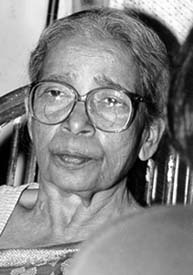
Writing as Resistance: The indomitable Art of Mahasweta Devi

This post was written as a guest entry for a reader’s words, the blog of the perceptive and literary-inclined Bhupinder Singh.

Writers are often cited as perceptive observers of the prevailing human condition. Some of the greatest writers have used the power of their written word to bring across the struggles and sufferings of the exploited before a wider audience. There exists a small section of writers, however, which feels compelled to act as more than mere spectators and reporters of the human condition. They throw themselves into the fight, as it were, of deprived people.

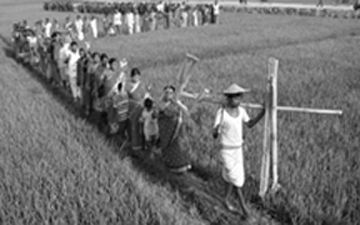
This trailblazer of a writer is arguably the finest example of activist writers in India. For more than a quarter of a century now, she has been actively working with tribals in certain Indian states. She fights for their basic rights, helps them unite and become self-reliant, and writes about their life, often reduced to a sub-human level by the rich and powerful. A prolific writer, most of her recent work draws from her association with these marginalized communities.

The Person:

Mahasweta was born in undivided India in 1926, about two decades before India’s independence. The daughter of Manish Ghatak, a poet and novelist, and Dharitri Devi, a writer and social worker, Mahasweta probably had literary activism in her genes. It was community service that emerged on the scene before writing, though. As a college student, Mahasweta joined her friends for providing relief to the victims of the infamous man-made Bengal famine (1942-44). They would distribute food, check through dead bodies lying in street to reach out to those still alive, feed them and take them to relief centres. This direct, raw brush with suffering became the seed of Mahasweta’s empathizing disposition.

Marriage came early, at the age of 20, when she tied the knot with Bijon Bhattacharya, a renowned Bengali playwright. Her husband was also a member of the Communist Party of India (CPI), and at the time the couple was establishing its marital life, communists often became the targets of persecution. As a result, it became tough for Bhattacharya to support his family, extended with the birth of their son, Nabarun, two years after their marriage. Mahasweta did several odd jobs to keep the hearth burning—selling dye powder, supplying monkeys for research to the U.S., teaching at a school, private tuitions—before she finally got a government job at the Post and Telegraph department. But this job was not to last for too long either. Someone dropped a few books of Marx, Lenin, and Engels in her office drawer, and Mahasweta was terminated on the charge of being a communist.

The Writer:

This is when she took to the pen—mainly to supplement family income. She started with light fiction for literary magazines. Her first book-length work appeared in 1956. Jhansir Rani or The Queen of Jhansi was a fictional account of the life of Lakshmi Bai, an Indian woman ruler who valiantly led her forces to fight the British, before being killed by them at age 22. Even as a first-time author, Mahasweta showed the impractical sincerity that distinguishes true writers of historical fiction. She borrowed money from family and friends to travel to the Bundelkhand region in north India, where Lakshmi Bai ruled, and walked her way through remote villages and deserts, collecting oral history, folklores, and ballads. Interestingly, this same seriousness of approach in collecting data for her stories would be seen years later, during the activist phase of her life.

The debut book brought Mahasweta recognition as a writer, and thus started her ascent in the world of Bengali literature. She authored several books, adding the pennies toward sustaining her family, while at the same time mirroring the prevailing social atmosphere. This promising writer went through a period of personal turmoil, during which time her marriage broke apart, and she suffered from acute depression. Bouncing back soon, she completed her master’s degree in English and served as a lecturer of English literature for two decades. This was also the period when she came up with her seminal novel, Hajar Churashir Ma (The Mother of 1084), which deals with the Naxalite movement in West Bengal that saw many young lives ending before their prime. The book captures the sad realities of the movement through the eyes of the mother of one such young boy. In her attempt to understand the violent movement, this mother comes face to face with her sense of estrangement from the double standard-ridden bourgeois society to which she belongs. Poignant, yet shorn of overt sentimental elements, the novel made a big impact on readers across India and was recently taken to the silver screen by director Govind Nihlani.

The Activist:

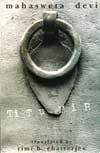
Over the next few years, Mahasweta’s pen took a decisive turn. She started integrating history into her storytelling. This wasn’t the conventionally disseminated history though; this was forgotten history, a part of the past that had been conveniently kept under the wraps. She wielded the power of narrative to document as well as spread stories of tribal resistances against the British and other social exploitations in books such as Aranyer Adhikar (Right to the Forest), and Chotti Munda O Tar Teer (Chotti Munda and his Arrow), among others. Here was a writer who truly wrote what she knew. Her vocation wasn’t divorced from her writing. She is amongst the foremost activists working for a better life for India’s tribals. Not content to stay cosy within her writing room, she ventured deep into the forests to live and work with tribal people.

She founded India’s first bonded-labour organization in 1980, bringing together thousands of bonded labourers to give them an organised platform for raising their voice against forced labour. A year before this, she turned Bortika, a literary periodical edited by her, into an open forum in which tribal people, peasants, factory workers, and rickshaw pullers wrote about their day-to-day experiences and problems.

This effort of hers is groundbreaking, since it records the issues of the underprivileged in their own words, unadulterated and unadorned. She went on to create a tribal welfare society for the Kheria and Shabar tribes, which are among the poorest in India. In 1986, this untiring champion of the voiceless founded the Adim Jaati Aikya Parishad or Ancient Tribes Union, a forum of 38 West Bengal tribal groups.

Nine years ago, at 71, Mahasweta received the Ramon Magsaysay Award for “her compassionate crusade through art and activism to claim for tribal peoples a just and honorable place in India’s national life.” While accepting the award, she said, “I will have a sense of fulfillment if more and more young writers took to unbeaten tracks. My India still lives behind a curtain of darkness. A curtain that separates the mainstream society from the poor and the deprived. But then why my India alone? Cannot one say the same for so many countries and societies today? As the century comes to an end, it is important that we all make an attempt to tear the curtain of darkness, see the reality that lies beyond and see our own true faces in the process.”

Images:
Delirium
The Hindu
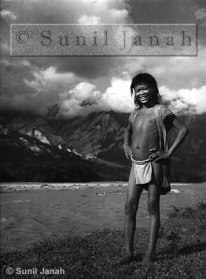
Sunil Janah’s Site


, , ,

Guest Blog – Cesar Puch

Cesar Puch dons numerous hats and does so with élan. Horror writer, programmer, webmaster, art director, and very recently, editor. Shadow Regions, an anthology of twilight zone-ish horror tales, edited by Puch, is now available. In this post, Cesar takes us on…

A Stroll Down the Dark Path of Horror Writing

A short while ago my good friend Bhaswati mentioned she wanted to invite a few of her acquaintances to write some guest posts in her blog and that she wanted me to do one of those. I told her I was definitely interested and I asked her if there were any “guidelines” before I went ahead with my post. “Actually, there is something,” she said then, and mentioned her interest in a theme that’s very close to me, a theme that brought some questions to her mind.

I write horror. As many of you might know, our Sury’s (Bhaswati’s) writing goes in a totally different direction, yet she always wonders… We’re the best of friends, even when she is in India and I’m in Peru, we share a lot together and one thing she commented once was how someone she considers to be “so nice” (her judgement, lol) could come up with stuff that can be pretty dark.

I don’t know if I’m nice or not, and I do believe everyone has a shade of darkness within, huge or tiny that varies. It is what makes us humans after all. I do like to think of myself as “a good person”, I stick to myself, I try to be respectful to others, and I try to play devil’s advocate whenever there’s a discussion just to try to grab all the dimensions in a problem… But yes, darkness is familiar to me. So why choose that? Why write horror? How can an apparently happy, nice, good person by society’s standards come up with stuff that makes us cringe? Does it take a toll? Let’s try to answer these questions.

Many years ago horror novelist Stephen King wrote a book called “The Dark Half”. In it, Thad Beaumont, a literary writer makes money and fans on the side by writing gore with the byline of George Stark. Stark is not only a name on a page, but has been even given a “past” as a violent ex-con now living in a self-imposed exile. When Thad makes the decision of “killing off Stark,” the fictitious Stark materializes and comes “back from the death” to claim vengeance on the editor, the publisher, and ultimately on Thad—the people responsible for his death. In doing so, Stark appears as murderous as the characters in his gory novels.

Are all horror writers like George Stark? OK, forget the murders (or not … :-s) but are all horror writers dark people who dwell on violence and blood, who have a twisted view of the world, who surround themselves with the goriest props and who have a shrine at home for Friday the 13ths Jason Voorhies? The answer is… ok, maybe some, in greater or lesser degree. But for the most part, we are talking about family people, very respectful, very friendly. I’ve had the chance to meet a few horror authors who turn out to be really nice people to deal with. I recently started reading a novel called The Rising, a very gory, very acclaimed book about zombies by author Brian Keene. The first thing I read was the dedication: “For David, Daddy loves you more than infinity”. Not quite the axe-wielding lunatic, huh?

Personally I’m not a big fan of gore (for those who don’t know gore implies stuff like running blood, spilling bowels, decapitations, and other gruesome stuff, the more gruesome the better, at least for fans). I am a true fan of The Twilight Zone and stories that, as I said in the introduction to my anthology Shadow Regions, scare you in the mind, not in the gut. I like the psychological aspect of horror, the supernatural part of it. However, during my experience as a writer, I inevitably dealt with pretty hard stuff: rape, violence, child abuse, pedophilia, death of loved ones, teenage sex and drug use, murder, etc. You see, before writing about sadistic killings, I prefer writing about (sadly) very real stuff. Is that hard to do? Yes, sometimes it is. But when you write horror you just do it.

I’m sure writing tough subjects are a part of every genre in fiction. Does it keep us away from going back to the keyboard? Not really. Why? Hard to tell. One thing is clear though. Our writing, at least mine, is in no way a celebration of these terrible things, but they are inevitable for the plot moving forward.

And what about the not so real but oh so terrible other stuff? The supernatural bit? Why that? I can’t answer for other authors and their choice of the amount of gore and supernatural elements they put in their work. For me, the supernatural has a charm of its own. It pokes at my sense of wonder. It takes me away from a world where things are bound to happen into another where even more things are bound to happen, in ways I never thought possible.

I used to be a scaredy-cat when I was little. I don’t know when that changed, when I took a step inside that darkness. But I believe I didn’t go in without a few lifelines. I do like to think I keep a solid line traced between what’s fiction and what’s real, even if one mirrors the other. I do like to think that the horror I write is not a direct reflection of me, but a sort of catharsis. Once I talked to a friend of mine—who happens to be a psychologist—about eros and thanatos (good and evil), how we all have some of both within ourselves. She said, in my case I was sort of recycling thanatos and turning it into eros, creation.

So why do I write these hard things? Here’s a simple-minded answer: I’d rather see them on page than in the real world.

I write creepy stuff, I generate scares for people who want to be scared, excited, chilled for a bit before returning to their everyday lives. Readers come in all shades and colors. Some want that jolt, be it just a little shock or a massive discharge. And for those readers there will always be the authors who provide those jolts. Those people are not the potential serial killers some would think. They just approach fiction in a different way.