A series on my experiences as a new immigrant in Canada.
B, my husband, and I go to buy our first car since landing in Canada. The finance guy is a young man with Javaid as his second name. His first name sounds like an Americanized version of his original name.
J: So sir, where are you from?
B: We’re from India.
J: Oh great, where in India?
B: She is from Delhi, I am from Chandigarh, Punjab.
J: Oh that’s wonderful. Actually I’m also from Punjab. I was born in Lahore…our family came to Pakistan from the Indian side of Punjab.
“I see,” I say with a slight smile.
J: Yes, they moved to Toba, you know Toba Tek Singh?
Manto’s invisible presence is suddenly felt in the cramped cubicle.
“B’s father is also from Lahore,” I say.
“He was born there, too,” B adds.
J: Oh, good, good. See sir, it’s always good to come here and find Pakistanis, Indians…your own community.
Yes, in the land of immigrants, it helps to be one community if you are from India or Pakistan.
Sometimes, it also helps seal car deals.
PS: Listen to a superb telling/reading of Toba Tek Singh by Zia Muhiuddin.
A series on my experiences as a new immigrant in Canada.
For the little more than two months we’ve been walking around, past, next to it, this modest-looking West Indian restaurant in our neighbourhood in Mississauga has been teasing us. We would see other immigrants, most of them presumably from the Caribbean, going in. We didn’t follow suit.
“We will have a treat here once one of us has a job,” my husband kept assuring, and the flickering orange ember peeking out from the restaurant’s counter became a silent sentinel of our pledge.
Yesterday evening, on our way back from our customary evening walk, we stepped inside Jerkies. The place wasn’t a cramped hole in the wall–there were five or six tables, enough to seat around 25 people. A crime serial on the lone TV mounted to the wall had two engrossed viewers–a black mother and her young daughter, seated on one of the tables. Right across them was the counter, behind which stood a sanguine black man. When we looked at the menu behind him, written on a blackboard with chalk, there was only one item we were sure of ordering–jerk chicken, and no marks for guessing that. We wondered what the other item should be; I suggested to my husband in Hindi that he ask our sanguine friend. No sooner than he had sought the man’s recommendation, emerged the words, “goat curry.” The confidence on his face and in his baritone sealed his suggestion as our second choice.
As we sat down at a table, waiting for our meal to arrive, Dear Husband (DH) and I whispered to each other about the conviction in Sanguine Friend’s voice while advising us to go for goat curry. “It’s one immigrant’s innate understanding of another,” DH said, referring to a West Indian’s confidence in suggesting mutton curry to an Indian.
A little later, the red-haired lady who had been so absorbed in watching the crime serial brought us a plate full of rice and beans, salad and jerk chicken. “Who’s having this?” She asked. When I told her it’s me, she put the plate before me and handed me a napkin wrapping the fork and knife. I had barely dug in and given top marks to the very well done jerk chicken when DH’s plate of goat curry with rice-beans and salad came. A few bites and we knew Sanguine Friend’s recommendation totally hit the spot. Tender to the point of falling off the bones, the curry had been spiced in a manner that it could have been cooked by an Indian. Along with our respective dishes, the lady also brought us fried plantains, complimentary. Nice!
What looked like too much food when it arrived on the table had been diminished to bare bones within half an hour; such was the fury and enthusiasm of the two eaters.I guess one of them did find a job after two months.
“How was the food?” Sanguine Friend asked when we went to pay the bill. “We’ll be back,” DH said with a smile.
This personal essay first appeared in Global Graffiti magazine’s “Cities” issue.
“…She would always remember Paris as the most beautiful city in the world, not because of what it was or was not in reality, but because it was linked to the memory of her happiest years.”
—Gabriel García Márquez, Love in the Time of Cholera.
Cities are where history and contemporaneity, spaciousness and congestion, overwhelming wealth and astonishing poverty collide with each other more recklessly than anywhere else. One can live in City A for a long time and despise it and yet get entranced by City B in just a few months. That probably explains why I always remained a passive resident of Delhi, the city of my birth and my home for more than three decades, yet fell in love with Hyderabad, where I lived for less than four months. And the charm was almost instantaneous.
In recent publishing history, the universe of Indian Writing in English (IWE) has been continually expanding, with a deluge of new titles spilling off the market shelves. While that is sweet news for the authors of these books, their counterparts writing in India’s various regional languages often don’t receive similar attention. The obvious reason for this is that regional languages have limited readerships, mostly restricted to readers from the respective regions. One way to get around this is to make these writings available in English. According to Valerie Henitiuk, “…The past couple of decades have seen a rapid rise in the distinct phenomenon of Indian Literature in English Translation (ILET).” One Step Towards the Sun is an important new addition to this phenomenon.
Edited by Henitiuk along with Supriya Kar, both of them academicians in the field of literary translation, the book is a collection of twenty-five short stories written by women from the eastern Indian state of Orissa. The very fact that women writers from this state could make their voices heard only as recently as the 1970s makes this anthology critically significant. What makes it interesting and a great read is the amazing diversity on offer–in terms of the periods of writing covered, themes, and writing styles.
Traversing through the milieus these stories present, one discovers that the women writing these stories are every bit as sensitive to issues concerning their own gender as they are about the wider humanity. As is to be expected, women’s issues form the core of many of the stories–exposing the many levels of exploitation the woman is subjected to–sexual, domestic, social, and psychological. In Basanta Kumari Pattnaik’s “In Bondage”, the nameless protagonist is brought to a big city by her brother and sister-in-law so they can use her as an unpaid maidservant. In “The Worn-Out Bird”, Aratibala Prusty narrates the tragedy of a mother who is imprisoned for killing her daughter’s rapist. However, her act of revenge goes in vain, as upon her release she learns of her daughter’s suicide, after suffering even more sexual violence.
The reader need not lose all hope though. For sharing the pages with such grim tales are characters that refuse to bow down to social prejudices, despite undergoing extreme torment. One such woman is Pata Dei, the protagonist bearing the story title by Binapani Mohanty. As she returns to her father’s village home with a child, slanderous accusations are hurled her way and the villagers question who the child’s father is. Defiant and fearless, Pata Dei narrates to the villagers the trauma of the night when a group of her own village men had raped her. Turning to her infant son, she says, “Why should you cry, dear? Don’t be afraid of these people. None of them is man enough to stand up and admit to being your father. But your mother is always there for you…”
Besides highlighting different kinds of trials faced by women, the anthology presents a gamut of themes, from Partition riots, old age, poverty, marital issues, to the impact of natural calamity on humans. Deprivation and hunger present themselves as stark contrasts to the riches of Orissa–splendid art and architecture. In Gayatri Basu Mallik’s “Ruins”, the narrator, while on a trip to Konark, the sun temple that is Orissa’s architectural pride, is bemused to experience “the ruins of real flesh and blood” as he encounters an old woman whose entire life had been a series of misfortunes. Banaja Devi echoes a similar idea in her story, “A Classic”. Here, the narrator comes across what appears to be a sculpture in a railway station, but, on closer inspection is revealed to be a beggar family–emaciated and driven to the edge by hunger.
One story that deftly tackles two themes–hunger and marital infidelity is “A Mother From Kalahandi” by Gayatri Sharaf. A seemingly blissful marriage starts falling apart for the heroine, Amrita, as she accidentally discovers her husband Swapnesh’s secrets. On probing, Amrita learns that Swapnesh has bought a young girl from the famine-struck district of Kalahandi for a paltry amount, only to bring her to the city for his sexual gratification. A social worker herself, Amrita decides to become a foster mother to the child born of her husband’s extra-marital relationship. At the same time, she convinces the biological mother to return to her village and liberate herself from the clutches of Swapnesh’s exploitation.
One Step Towards the Sun also impresses because of its stylistic variety. From elements of fantasy to disjointed soliloquy, plot twists and lyricism, the stories arrest the reader as much with the unfolding story as with the words that unveil it.
It is to Henitiuk and Kar’s credit that they have produced a book of writing translated from a regional Indian language without tedious footnotes or a painstaking glossary. The translations have standardized almost all of the original text, including some of the very localized expressions. Although the end result makes for easy readability, it can be a bit of a disappointment for someone seeking to derive a taste of local flavours offered by phrases and idioms unique to the region. One wonders if certain regional expressions couldn’t have been incorporated into the translated narratives without hindering the readability. However, this is a small omission in an otherwise excellently produced anthology. Even as IWE basks in the warm light of international awards, this book has taken but a solid step towards the sun as far as furthering ILET is concerned.
ONE STEP TOWARDS THE SUN:
Short Stories by Women from Orissa
Edited by Valerie Henitiuk and Supriya Kar
Publisher: Rupantar
Price: Rs. 295.00
ISBN 978-81-906729-1-7
Armed with sticks as his only tools, curiosity as his propeller and experiment as his navigator, a man discovers an exciting truth–that the earth may not be what it appears to be–flat. Quizzed by the appearance of a shadow in one geographical location, while none at a farther distance, this man of many parts conducted a simple experiment with sticks and not only realized the roundness of the earth, but even calculated its circumference with amazing accuracy.
I got introduced to Eratosthenes and his fascinating discovery through a book called Cosmos, authored by Carl Sagan. I was in high school then. As I read about this pivotal discovery in the realm of astrophysics, I felt drawn to the site of Eratosthenes’s experiment–Alexandria. But there was more to arouse my wonder. Cosmos informed me that both Eratosthenes and the city of his work held a magnificent amount of wealth within them. The man in question wasn’t just a scientist/astronomer as has been revealed; he was also a historian, geographer, philosopher, poet, theatre critic and mathematician.
Alexandria, “the greatest metropolis of the age,” boasted of the most eclectic milieu possible. Living with each other were “Macedonian and later Roman soldiers, Egyptian priests, Greek aristocrats, Phoenician sailors, Jewish merchants, visitors from India and sub-Saharan Africa – everyone, except the vast slave population…” Though bothered by the last bit–the exclusion of slaves–I would still love to visit such a city. Even more because of what comes next…
…the city’s library and its associated museum. Cosmos says, “The Alexandrian Library is where we humans first collected, seriously and systematically, the knowledge of the world.” However, the book also records with despair that, “Of that legendary library, the most that survives today is a dank and forgotten cellar of the Serapeum, the library annex, once a temple and later reconsecrated to knowledge. A few moldering shelves may be its only physical remains.”
Not the pyramids, not the mummys, it was Egypt’s second-largest city, its extraordinarily rich past, and one man’s curiosity-driven discovery that made me long to visit that country.
Jan-Feb 2011 A.D.
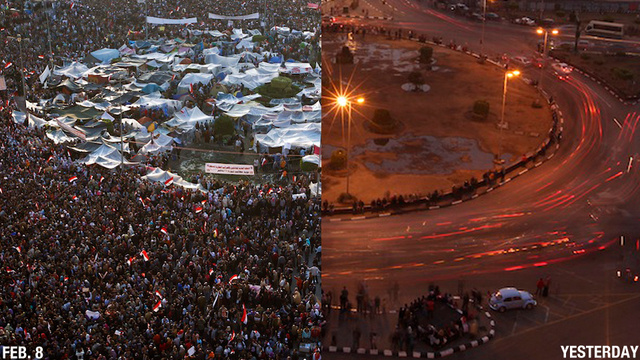
Armed with no more than hands, feet and an intense will to live free, people all over Egypt come to an astonishing discovery–that they can reclaim their lives, their dignity and their country–if only they don’t relent. Millions–toddlers; young men and old women; wealthy and destitute; religious and non-believers–smashed through their caged lives to descend on the streets of Cairo, Suez. And Alexandria.
Bolstered by neighbouring Tunisia, where a people’s revolt had just ousted an oppressive dictator, Egypt’s people took to their own streets with the same intent–to overthrow the tyrannical autocrat who had reigned for three decades–longer than all the years some of the protesting youth had spent on earth. Sparked by a common interest to see the dictator gone, the protesters forgot the differences they apparently had–of religion, sex or social position. Within hours a frenzy of revolt seized the people and spilled forth, stunning the world.
The more I saw these fearless men, women and children on television news and on the internet, the more I felt pulled to their struggle, which defied not only adversity, but even logic. For the regime they were seeking to remove pulled every dirty trick out of its closet to repress, even silence the resistance. Tear gas, water canons, rubber bullets. And then actual bullets, armed thugs, Molotov cocktails, unlawful detentions, beatings, threats, torture deaths…
The protesters did not budge.
Not for a day or two, or a week. They did not budge for nearly two-thirds of a month. Eighteen days, to be precise. Not even when the wider world turned skeptical, not when their own people pointed to the plunging economy and the threatened tourism business. Indeed, it seemed to me that they were chanting to each other this part of The Great Dictator’s speech:
“Soldiers! Don’t give yourselves to brutes – men who despise you and enslave you – who regiment your lives – tell you what to do – what to think and what to feel! Who drill you – diet you – treat you like cattle, use you as cannon fodder. Don’t give yourselves to these unnatural men – machine men with machine minds and machine hearts! You are not machines! You are not cattle! You are men! You have the love of humanity in your hearts. You don’t hate, only the unloved hate – the unloved and the unnatural!”
Everyday, ordinary Egyptians refused to be treated as cannon fodder, notwithstanding the precious, full-of-promise lives that bled and were buried. For eighteen days, humanity smiled and blossomed across that country–doctors set up roadside clinics, people shared food on the cold, hard asphalt that became their liberation square–and not just in Cairo’s Tahrir. For the first time in years, maybe in their entire lives, they sang. Of freedom.
I wished I could sing along. Right there, with them.
Not the mummys, Pharaohs, pyramids; Egypt’s people’s passion-driven heartwarming, blood-surging uprising and its remarkable present make me long to visit that country.
Last night, I decided to close the book I had been reading for months now, with a determination as unyielding as the pace with which I advanced with this book. Gabriel García Márquez “Love in the Time of Cholera” is a chronicle of love–wherein, possibly the most powerful of human emotions is in a constant tussle against a range of obstacles.
Narrating a tale that is set for a considerable part around ships, the book starts by taking the reader on an interesting voyage–with the introduction of the key characters, their strange life stories and stranger personal quirks. It is the story of the romance between two people, as dissimilar to each other as can be. A promising story of young love, unbridled passion and an almost illogical fable of romance, marked by long letters and little more.
Fermina Daza, the female protagonist, continues this amorous association despite her father’s ruthless opposition to the same. And just as the passionate affair reaches an exciting bend, the author brings in a clever twist in the story. All of a sudden, without any provocation or apparent logic, Fermina spurns the advances of her lover, Florentino Ariza. The stage is set for an interesting drama to unfold, and I was ready for the voyage.
Except that I had boarded a ship that seemed to be without a compass. This isn’t because the author bypassed the convention of a linear narrative; it’s more than that. My problem with the novel’s middle was that it seemed direction-less and loaded with extraneous information. For page after page, equaling nearly half a century in terms of the story’s timeline, the reader is subjected to the endless affairs Florentino Ariza has with about as many different women. Yet, he doesn’t really love them, but only “uses” them to bide his time, until he can return to the love of his life. In this time, Fermina Daza has married a wealthy doctor and is a leading lady of the elite society. We learn about the ebbs and flows of her married life, complete with certain insights on what marriage entails, which seemed to me, to be the author’s own suppositions on the institution of marriage. Basically, the story doesn’t move in this phase. One learns a lot about human quirks and their implications in varied dimensions of life–marriage, family, society, professional career, but there is so little action that bears any significance to the main plot that one wonders the purpose of it all. I struggled to remain motivated to read the book through end; the enervated narrative fell short of providing enough encouragement. This could have been the author’s way of reinforcing the long, almost hopeless wait that Florentino Ariza endures to reclaim his love.
I am glad my persistence paid off as the story neared its end. In the twilight of their lives, the two lovers whose paths had crossed in youth only to diverge, meet again. They are brought together by the strange dynamics of fate, as Fermina’s husband dies of a most bizarre accident. Here on, the ship that had seemed aimless for so long, suddenly cruises with a frenetic speed, along with our lovers–old in their bodies, but not in their passion. As they defy social conventions, physical constraints and even the doubts of their own minds, we celebrate their journey through the river–breezy, uncertain, excitable–not too different than their romance itself.
Cholera has been used as a motif in various places throughout the story, and in the end it becomes a device to checkmate possible hazards that come in the way of love. I tend to think cholera is also symptomatic of the fact that love is a kind of sickness. The kind in which the disease is its own cure.
The lovely and humorous Gargi hononoured me with the Honest Scrap Award sometime back. As the recipient, I must tell you all ten things about myself.Disclaimer:
The author shall not be deemed responsible for any boredom this post may cause.
1) The first prize I ever won was for a recitation competition. I was in class (grade) I and bagged a consolation prize for reciting a poem by Swami Vivekananda.
2) In class VI when I had to give up one of the two extracurricular activities of dance and music, I let go of dance. Music has stayed with me, ever since.
3) It was in class VI only that any recognition of my writing came about. The perpetrator of this act was an essay I wrote about a trip to Appu Ghar, an amusement park in Delhi. Our English teacher, with whom I am still in touch, wrote “Good” at the end of it.
4) As a Bengali, I am crazy about fish–possibly in any and all forms. Unlike many Bengalis, I am not so crazy about sweets. There, I said it.
5) I wrote my first short story at age 14. It was in Bangla and was lucky enough to meet the approval of my immensely talented (and accomplished) author Grandma.
6) A place I return to (and must keep returning to) again and again is Santiniketan. I wasn’t born or raised there, but it’s a heart’s connection I haven’t been able to explain or eliminate.
7) The first trip I ever made outside my hometown was to the historic city of Agra. Fatehpur Sikri enchanted me even more than the world wonder, Taj Mahal.
8) My technologically challenged brain causes me eternal frustration…Sigh.
9) My first foreign trip happened in 2009, courtesy a translation Fellowship I won for my translation of a remarkable book on legendary sculptor-painter, Ramkinkar Baij. I was in the lovely city of Norwich, UK, for two months.
10) I met my husband through this very blog. He is even there on my blogroll. 🙂
With the breeze of a sudden night Comes the news of your arrival. As I dive into the sea of slumber You wake up, Fusing the conscious with the unconscious.
The night goes silent, draping a blanket of darkness. You radiate In your own light, intrinsic glory– A star.
At dawn, I wake up, My feet touch the ground There too, I see you— In soft, full smile. Footloose, the night’s star and the earth’s dust Embrace, sway each other.
I bow down, pick you up, To give meaning to my worship.
Note: Every autumn, as Durga Puja, the biggest festival of Bengalis, approaches, a certain delicate flower blooms quietly in the night, spreading its soft fragrance all over. Since my childhood, this tropical bloom has awed me with its magical essence. In Bengali, we call the flower Shiuli or Shefali.
Disclaimer: I am not a poet and don’t claim this is poetry. It’s just a spontaneous expression, triggered by memory.
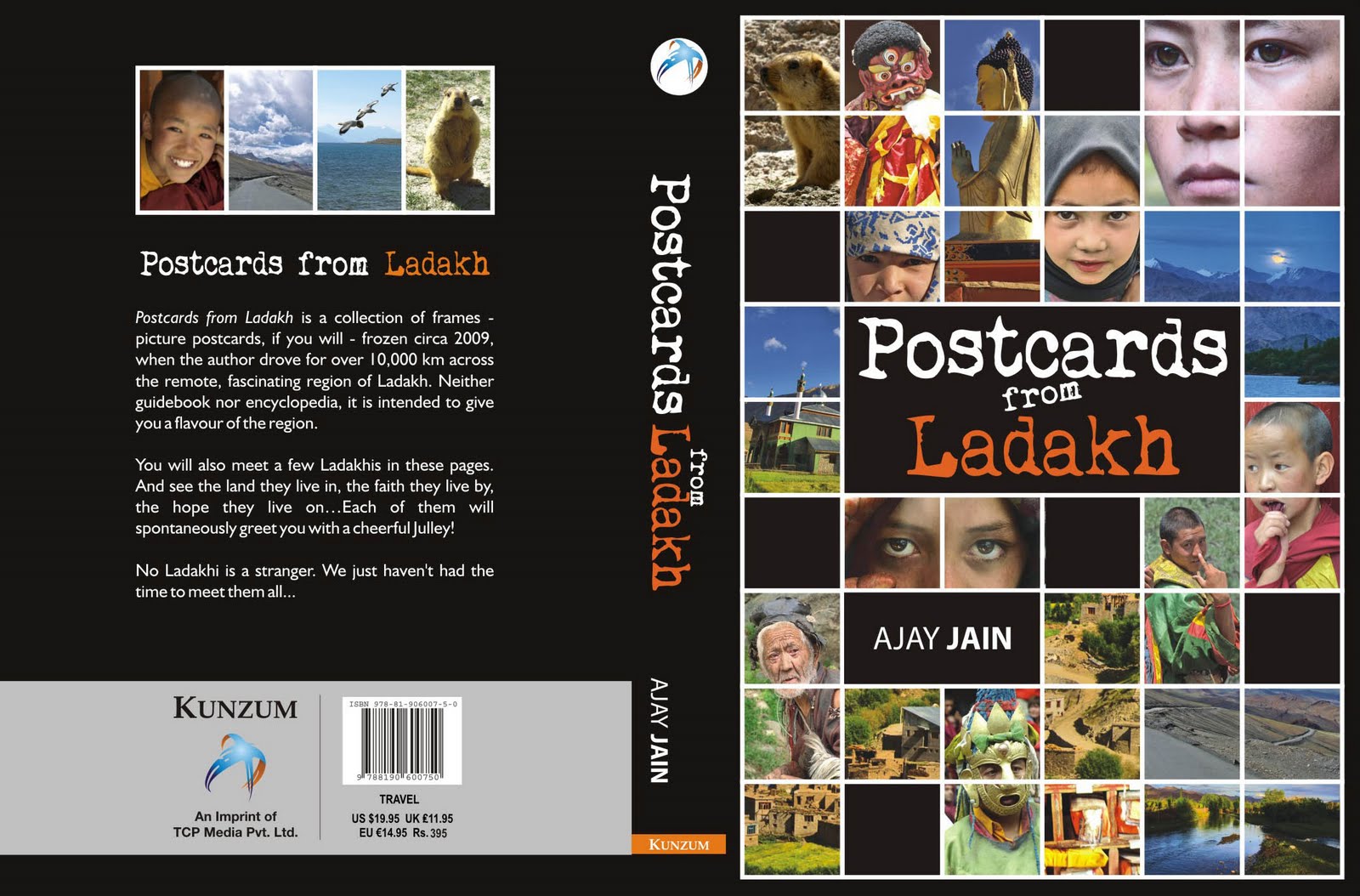
By: Ajay Jain Kunzum Non-fic (Travel) Price: INR 395, US $19.95, UK £11.95 Available at: Ajay Jain’s Blog
Among the souvenirs I collect during my travels, picture postcards are recurring visitors. Besides being light in weight–both in terms of mass and price, these cards open mini windows to new worlds. Easy to carry, easy to share, easy to keep or frame–picture postcards have almost everything going for them. Well, almost. My one pet peeve with these cards has been the limited information one usually gets about the picture in question–mostly just a line or two and at the most, about a paragraph. Ajay Jain’s new book, Postcards from Ladakh, redresses this issue with commendable facility.
With this book, Jain takes us inside the astonishingly beautiful yet often difficult terrain of Ladakh–among the remotest and most sparsely populated regions of India. Every page you turn is a new postcard–the picture on the left and Jain’s notes on the right. As he notes in one of the opening chapters titled Ladakh, Circa 2009, “Start reading from any page,” for you won’t miss anything if you didn’t follow the exact order of the postcards.
The pictures grab the reader’s attention right away, and once I had seen/read a few cards, I started imagining my own reading of the images before my eyes floated over to Jain’s text. Since this world was as alien to me as that of tribes living in the Congo basin, my imagination couldn’t stretch too far. That’s where this book succeeded in style. It presented me with just enough information on each accompanying picture without overwhelming me with a flood of it or depriving me by sharing too little. Jain writes the notes in affable first and second person voices, generously interspersing them with wit, practical advice and most of all, his passion for the place.
A big chunk of the postcards reflect Ladakh’s Buddhist tradition, its intricacies, distinguishing features and sovereign influence on the local populace. Others highlight the region’s flora, fauna, economy, history, and geology. The last few chapters are extremely useful for anyone planning a trip to Ladakh. In these, Jain provides an experienced traveller’s tips on how to pack, how to move about and how to keep the environment clean. There’s also an engaging interview with Ladakh’s spiritual supremo, the Twelfth Gyalwang Drukpa. I found this a nice touch to this collection of postcards.
I leave you now with an invitation to read this book and with some of my favourite postcards:
This image, depicting an old apricot collector, arrested my attention for quite a while. Do you also find the wrinkles on his face speaking of an unknown, unknowable pain?
Rock art dating to the 6th century AD. On a single rock in the entire region. Intrigued to know more? Visit Ladakh to find out. Or just read Postcards from Ladakh.
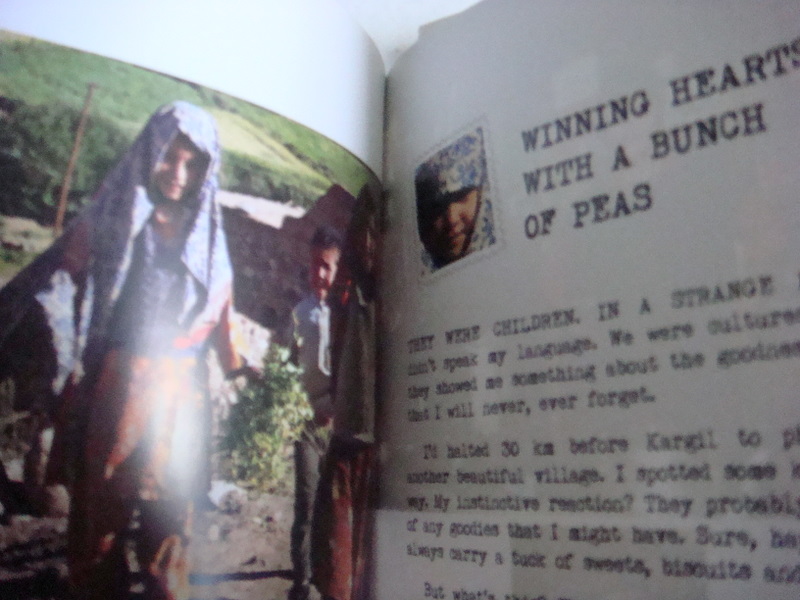
Stories like the one this postcard tells warmed my heart the most. It shows a bunch of happy little children who shared their bounty of sweet peas with the author, expecting nothing in return. Although he did reward them with chocolates, I suspect, he was the bigger winner.
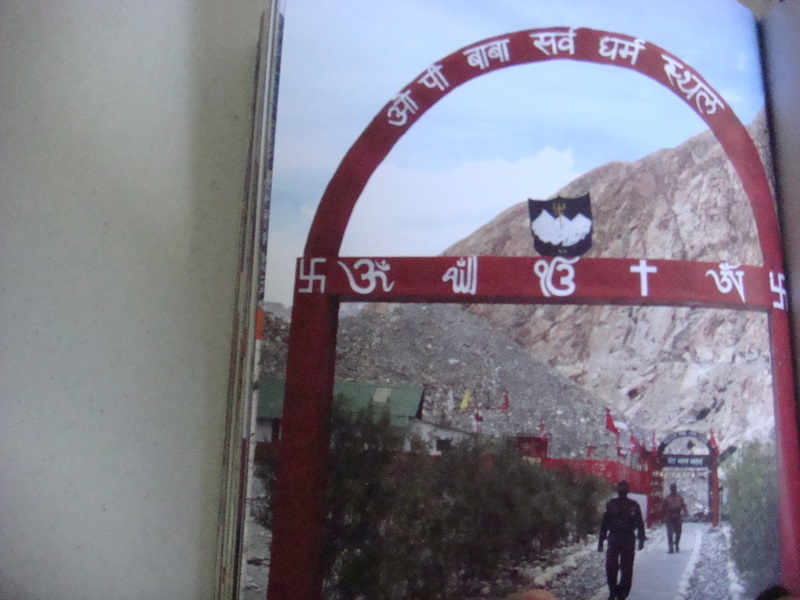
This all-religion shrine, situated in the harsh Siachen glacier is believed to bless its devotees, mostly military soldiers, with special “visions.”
And lastly, this multi-image postcard about Himalayan marmots is just too good to be denied a mention. The author was lucky himself and shares his most entertaining encounter with these “adorable creatures,” who are often a little shy of human presence.
The only additional feature I wished the book included is a glossary of terms. Some of the Ladakhi Buddhist references can get confusing, even with repeated reading. All the same, whether you are in a hurry or at leisure, Postcards from Ladakh is a perfect reading companion. It’s also a smart travel guide without posing as one.

 “B’s father is also from Lahore,” I say.

 Last night, I decided to close the book I had been reading for months now, with a determination as unyielding as the pace with which I advanced with this book. Gabriel García Márquez “Love in the Time of Cholera” is a chronicle of love–wherein, possibly the most powerful of human emotions is in a constant tussle against a range of obstacles.