
Outstanding Nonfiction – II

City of Djinns
By: William Dalrymple

It’s funny how some books come your way in the most casual of manners and leave a lasting impression. This was definitely the case for me with City of Djinns. My brother borrowed it from a friend, and when I saw the book was about Delhi, the city where I was born and grew up, I picked it up out of sheer curiosity. I hardly knew such a goldmine lay before me.

William Dalrymple, a Scotsman, lived in Delhi for four years, beginning in 1989. This stay became the seed for this travel-history-memoir, marked with sincere research and sparkling wit. The city’s many wrappings of history, its layered personality through the ages, its complex division of contrasting images, all catch the author’s inquisitive eye as he goes about exploring layer after layer with the passion of an archaeologist and brings the same vitality back for the reader. From the ancient times of the great Indian epic Mahabharata, to the reign of the Mughal dynasty, from scrutinizing the architecture of the British in the city while they were ruling India (the part designed by the British is what came to be known as New Delhi, thus dividing it from Old Delhi) to talking to the descendants of the Mughal empire and interacting with mystic sufis–Dalrymple’s is a journey that switches between aeons time and again, resulting in a vast, multi-hued canvas of the Indian capital’s history.

As I hinted earlier, the book held a personal interest for me. I will admit I was a little skeptical when I started reading it though. This is the sort of skepticism that comes from the typical Western style of interpreting India. A lot of judgment overshadowing observation creeps into the narrative of foreigners recounting their experiences in India. Yes, this is a poor, third-world country, yes, a lot of images (poverty, squalor, congestion) here are not exactly what the Western eyes are attuned to witness. But that’s not all this land is about. Trust me, I was born here.
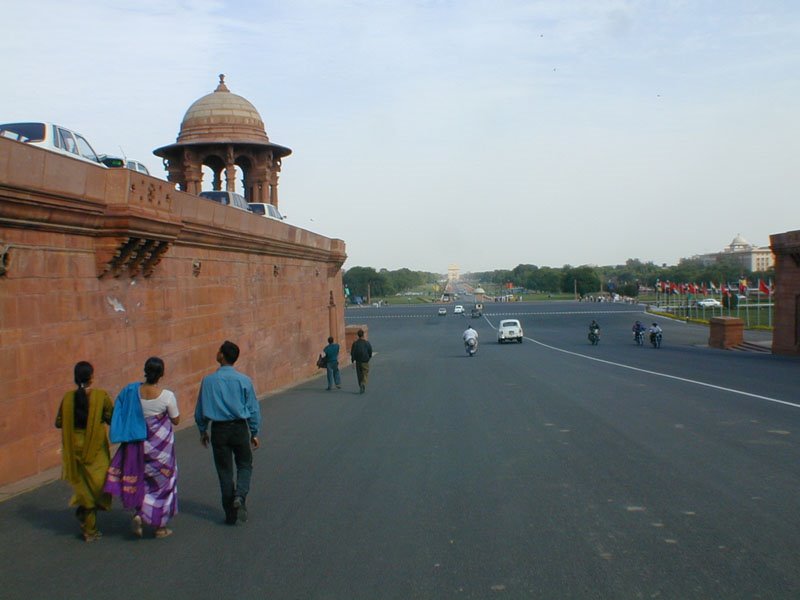

City of Djinns, however, comes as a refreshing read in this respect. While the author does throw in a lot of humour by way of telling us about his practical landlady, Mrs. Puri and his taxi-driver-with-attitude, Balwinder Singh, he draws what can best be called a heartfelt, affectionate picture of the city that was his home for four years (the book covers one year of his stay in Delhi). A workable grasp of Hindi in his armour, he does a fantastic job of interviewing different sections of people–from the Sikhs who were at the receiving end of a religious riot in 1984, to descendants of Anglo-Indians who carry on living a ‘misfit’ existence (not fully accepted by the Indian society and excluded by the British back home), to eunuchs whose sad lives make the reader cringe.

As I read through the book, I was enamoured by its compelling power to grasp me as a reader. Given the amount of history and information it packs within its covers, it doesn’t become dry or info-dump-like at any point. In fact, the more I read, the more I wanted to read. It was as if I was discovering the city I had lived in for so many years for the first time!

Indeed, City of Djinns was an eye-opener that left me feeling embarrassed. I hardly knew my city. Reading the book made me realize how many obvious clues of history, scattered all over the city, had I let pass my notice. The book made me love my city more, made me care more for the fascinating stories its monuments held within their walls. It taught me to be more observant of the nuggets of the past that beckoned to me at turns and corners through the length and breadth of this vast and ancient-modern city.

When a book does that to you, rest assured it has achieved its purpose. With remarkable authority even.

Note: This is the second of my posts on some top-quality non-fiction books I have read. It is a follow up to my post Not Fiction? Not a Bore.

Outstanding Nonfiction – I

In an Antique Land

By: Amitav Ghosh

I came across this book during my undergraduate days. My mother, then working in the post-graduate library of the University of Delhi, got the book issued on her staff card. I had heard some nice things about the author and asked her to get one of his books for me to read. In an Antique Land was her random pick. There couldn’t have been a better choice in so far as creating a first impression about the writer was concerned.

The book’s subtitle is: History in the guise of a traveller’s tale, and it is just that. What starts off as an unassuming yet highly entertaining travelogue told in first person by Ghosh, who finds himself in Egypt as an anthropology research scholar, gradually winds its way through the alleyways of history going back to 7oo years. How so? Well, we are introduced to the story of Bomma, an Indian slave, who had travelled to the Middle East, and lived along the coast of Nile, all those centuries ago. From this point, the book shifts between the two narratives–that of Ghosh, the research scholar-traveller, who records his observations on modern Egyptian life with fascinating detail and curiosity; and of the history of Bomma, the slave. Then at some point, the two narratives find a common ground, and for the reader, it becomes as gripping as a well-plotted detective story. As Ghosh pieces together history, travel and the cultural conflict in the Egyptian society (the tug between conservative values and modern-day desires), he crosses boundaries of genre and emerges a trailblazer of a writer.

The manner in which Ghosh juxtaposes history with travel narrative in this book is outstanding. To keep readers engaged on two different story tracks without confusing them requires finesse of the highest order, and Ghosh displays that in a most effortless way. The book, while being non-fiction, has some fictional elements and is only richer on that account. What’s more, in the atmosphere the author creates for the reader, history, present-day facts, and fiction, all blur and merge together a lot of times in the book, making it intriguing.

Like I said, this was the first of Amitav Ghosh books I read, and I was simply blown over. I would easily rate him amongst the finest of modern-day English writers. I am yet to read his fiction, but even as I write, I am spending my reading time getting engrossed in a section of his book The Imam and the Indian, reprinted in a Granta Book of Travel edition. Once again, I am not disappointed.

Amitav Ghosh belongs to a rare breed of writers. The main characteristic of these writers is, once you read one of their books and get charmed, you expect them to repeat the act in other works. The good news is, they always deliver.

Note: This is the first of my posts on some top-quality non-fiction books I have read. It is a follow up to my post Not Fiction? Not a Bore.

Not Fiction? Not a Bore ;)

Some years back when I joined an online writing community, the first for me, I noticed something interesting on the forums. Of the wide range of critique groups, based on different genres and parameters, there was one that elicited the least response. This was the nonfiction genre. The community had a good number of members, yet only a handful of takers for nonfiction. I wondered why. And found out the primary reason behind this lack of interest was the notion that non-fic is “plain boring.” Now, those are not my words (hence the quote marks).

I was of course part of the handful of people who did form a non-fic critique group. And let me tell you loud and clear, reading the group’s works was anything but boring. Quite the opposite. The pieces were interesting and made for a good deal of learning. From Christmas legends to war veteran’s stories, from a fun-column on political correctness to a member’s series of Encounters (that was the title of the series) with nature and animals, and from Native American traditions to humor columns, our group postings were what would be any reader’s delight. The subject matters were mostly informative, the writing style inviting, affectionate, perky or intimate, as need be. Rarely, if ever, was it didactic so as to turn off the general reader.

My own limited reading repertoire includes some fine works of nonfiction, and I have been left satisfied and enriched as I turned the last page of each one of them. I will use this space for discussing some of these brilliant (yes, they do deserve that qualification) works and their masterly authors.

My point? Nonfiction need not be drab, eye-straining tomes filled with dry information. Just like good fiction, well-written non-fic brings places, people, cultures, and events to life. And what’s more, it tells true stories. About real people.