Of faces and portraits: Ramkinkar Baij

I recently had the opportunity to read from “My Days with Ramkinkar Baij” on the occasion of the launch of “Could you Please, Please Stop Singing?”, Sabyasachi Nag’s book of poetry at the Art Gallery of Mississauga.

In this excerpt, Baij talks about the essence of portraits and the fodder faces can provide to an artist. He also discusses his own treatment of Tagore for sculpting a bust of the poet.

Here’s a video recording of the reading.

Call for submissions: The Everyday and Other Tagore

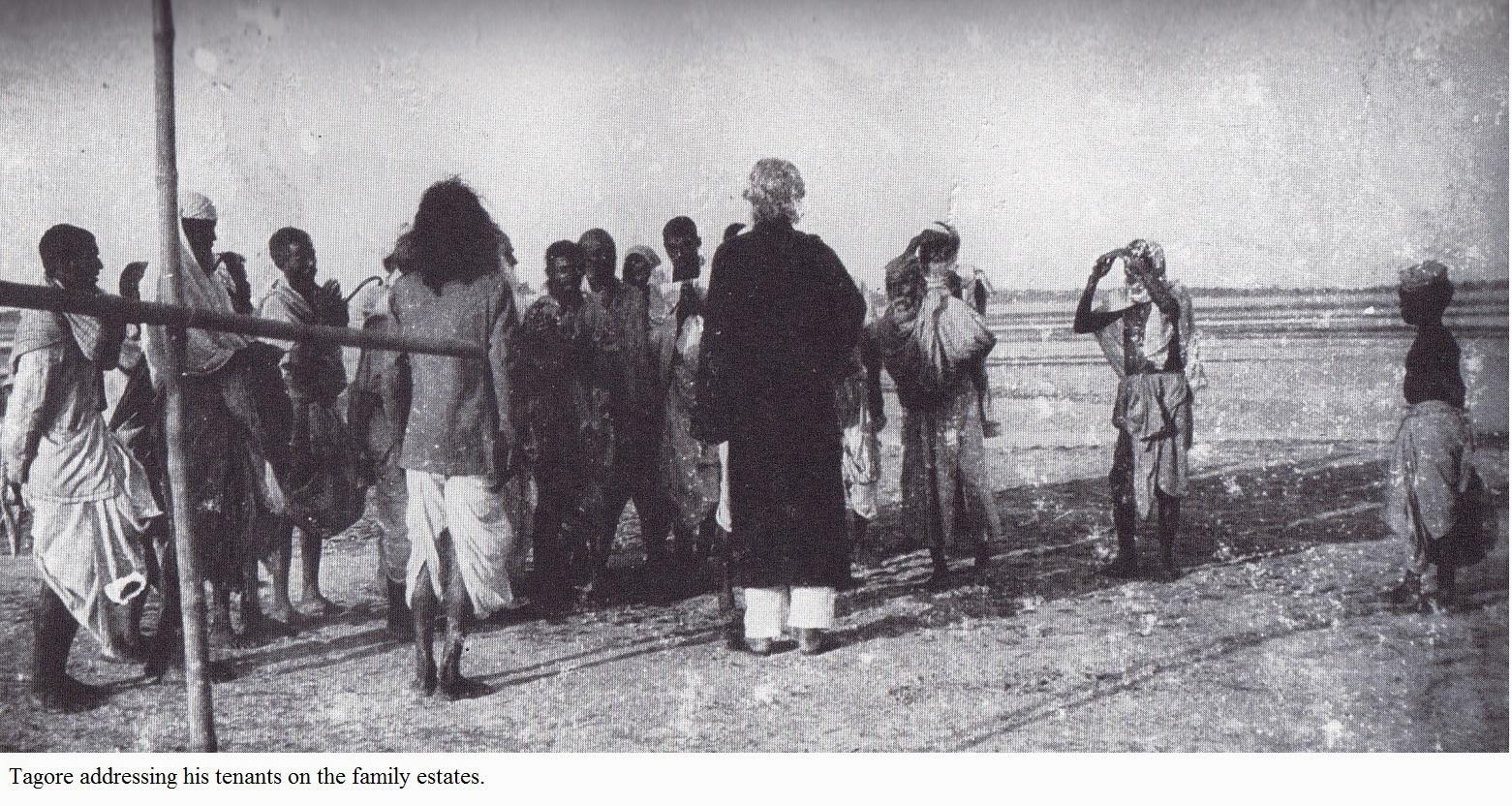
Tagore addressing his tenantsCAFE DISSENSUS

UPDATE: The issue is now available here.

Issue 19:  October 2015: The Everyday and Other Tagore [Last date for submission: 30 September, 2015; Date of publication: October, 2015]

Send submissions to: bhashwati@gmail.com

There is the Rabindranath Tagore we all know – the winner of the Nobel Prize in literature, the founder of Visva-Bharati University, the grand literary canon of India, and the towering figure without whom Bengal just can’t do.

And there’s the other Rabindranath Tagore, the one who forms the leitmotif of the activities of a social worker working with children from marginal communities in Delhi. Tagore shows up in their handcrafted embroideries, in the food they make, in their art and craft projects, in the plays they enact, and in the worldview they imbibe, unbeknownst to themselves.

Tagore comes alive in the song an unknown Baul fakir sings in a village in Bangladesh, “Jawkhon porbe na mor payer chinho ei baate,” (When my footprints are no longer seen on this path). The words haunt the listener with the singer-poet’s elegiac visions of a time after he is gone. It’s penned and composed by Tagore, yes, but the fakir makes it his own, with his distinctly carefree, unchained rendition.

In a very urban school in Delhi, a principal strives to give her students a taste of Tagore’s inclusive education paradigm. She doesn’t have the space to provide the open-air classrooms of Visva-Bharati, but she opens the doors of art, literature, music, dance, and drama to her pupils, so they can breathe free beyond the confines of a book’s pages.

In one of his most powerful poems (Patraput, 15), Tagore declares himself an outcast, one who has renounced the bondage of religion and ritual. He likens himself to Bauls and their search for the man of the heart, a quest to find divinity in humanity, not in external or imagined symbols.

This is the other, everyday Tagore – internalized in universes that don’t often feature in scholarly discourses.

This issue of Café Dissensus invites fiction, nonfiction, poetry, or multimedia works on the theme of The Everyday and Other Tagore.

Along with written pieces, we are also open to audio-visual content. If you would like to do a short interview (5-15 minutes), please feel free to send that to us. If you send us the rush copy, we can edit. However, it would be better if you do the editing and send to us.

Your submissions should not exceed 1500 words. If a particular piece deserves more space, we are willing to go beyond the word limit. Please email them to bhashwati@gmail.com. Also, provide a brief 2-3 line bio at the end of your piece. Submissions will be accepted until 30 September, 2015.

Photo courtesy: http://permacultureambassadors.blogspot.ca/

Immigrant’s postcard (mini) – Four days in Québec City — Part 2

Read other Immigrant’s Postcards here.

Day 3: Wet-weather friends

DSC05593It’s a rainy day.

Since morning, we haven’t accomplished much, other than eating brunch, visiting the observatory, and walking to the bank to draw cash. After a mostly sleepless night, my zombie feet refuse to dance in the rain anymore without a burst of caffeine.

We keep dragging ourselves through the soaked streets of this still-much-foreign city, desperately looking for a café. It’s nearly three in the afternoon on Canada Day, and many cafes and bistros have downed their shutters.

Discouraged, we keep plodding towards our hotel when a 24/7 and “Ouvert” sign flashes before me. We walk in – it looks like a big sports bar – hockey plays on multiple TV screens as I take a seat and put down my drenched umbrella. My husband walks over to the counter to place our order of coffee and baklava.

“Bonjour,” the cashier, a young Francophone, greets him. “Where are you from?” He asks my visibly tourist husband.

“We’re from Ontario,” B says. The answer is less than satisfactory.

“No, I mean where are you from originally?”

“Oh. India.”

“Namaste,” says the cashier, offering a knowing smile and not a handshake but a full-blown namaskar.

He has more to offer.

“Naam kyea haie?” He asks B.

“Bhupinder. Aapka naam kya hai?”

“Francois.”

On a soggy afternoon, three people fleetingly enter a spot of friendship over steaming coffee and the sticky sweetness of baklava in a mostly empty sports bar.

DSC05913-001Day 4: Lead kindly light

We’ve just been to the unabashedly gorgeous Montmorency waterfalls. Soaking wet in the fall’s mists, as we sit back in the dry comfort of the car, my husband tells me of a religious shrine that’s among the region’s attractions.

And so we alight in front of the impressive Basilica of Sainte-Anne-de-Beaupré , moments later. After clicking the customary outside photos, we walk in. The church’s magnificence — in scale, splendour and decoration — enthralls me. I gesture to my husband to take our seats in a pew.

The sanctum is abuzz with activities and devotees keep streaming in. B uses the time to click photos of the stained glass windows, sculpted walls and spectacular ceiling. An elderly man is seen walking towards the pews, talking to people. He soon comes to us and asks B,

“Bonjour, Francais?”

“English,” B says.

“Oh. French – not yet?” The gentleman says, the possibility in that question perceptible in his hopeful affection and playful smile. “They are going to have a Mass in five minutes. No cameras during that time, please. You can take all the photos you want after that. Welcome to Sainte-Anne-de-Beaupré.”

When the service begins a few minutes later, we see the same man attired in full priestly robes – he is the Father of the church.

And so we sit through an hour-long Mass without understanding a word of it (all French), yet enveloped in organ music and stirring singing, soft light, burning candles and incense smoke, prayer chants and the Father’s impassioned address from the pulpit.

Is it because we want to take photos afterwards (we don’t end up taking that many)? Maybe. But I believe it’s more because of a priest’s gentle voice and kindly smile.

What we experience can’t be photographed anyway.
Read Part 1

Immigrant’s postcard (mini) – Four days in Québec City — Part 1

Read other Immigrant’s Postcards here.

Day 1:  The Sisters

DSC05665After a 10-12 km walking tour of the fortified city and along the river, we sit down on a bench at the foot of the majestic Château Frontenac hotel to catch our breath.A stream of people—mostly tourists, some office goers, a few elderly folks—pass us by.

A group of three Chinese women (sisters? friends?)—probably in their fifties—arrives. We can’t decipher their animated conversation. But two of them take their cameras out to photograph the third lady, who is only too happy to pose.

She stands next to a bench facing us, holding an arm up. “Hold on, I’m not done yet,” she seems to say to her friends while swiftly moving up the hill behind the bench. There, she takes her position, raising an arm and a leg even as she prods the other two women to click fast.

Passersby pause in their walk to take in this unique scene; some explode into laughter.

And although there is no sea in sight, all I’m reminded of is the comradeship of the widowed sisters-in-law in Tapan Sinha’s “Nirjan Saikate.”

Day 2: Pocket change 11707794_10153519566065087_1302432540971826171_o

Back from a lush and soothing ferry ride across the St. Lawrence River, we buy crepes from a mother-daughter stand at a local artisan fair. We walk into a park to consume the supper.

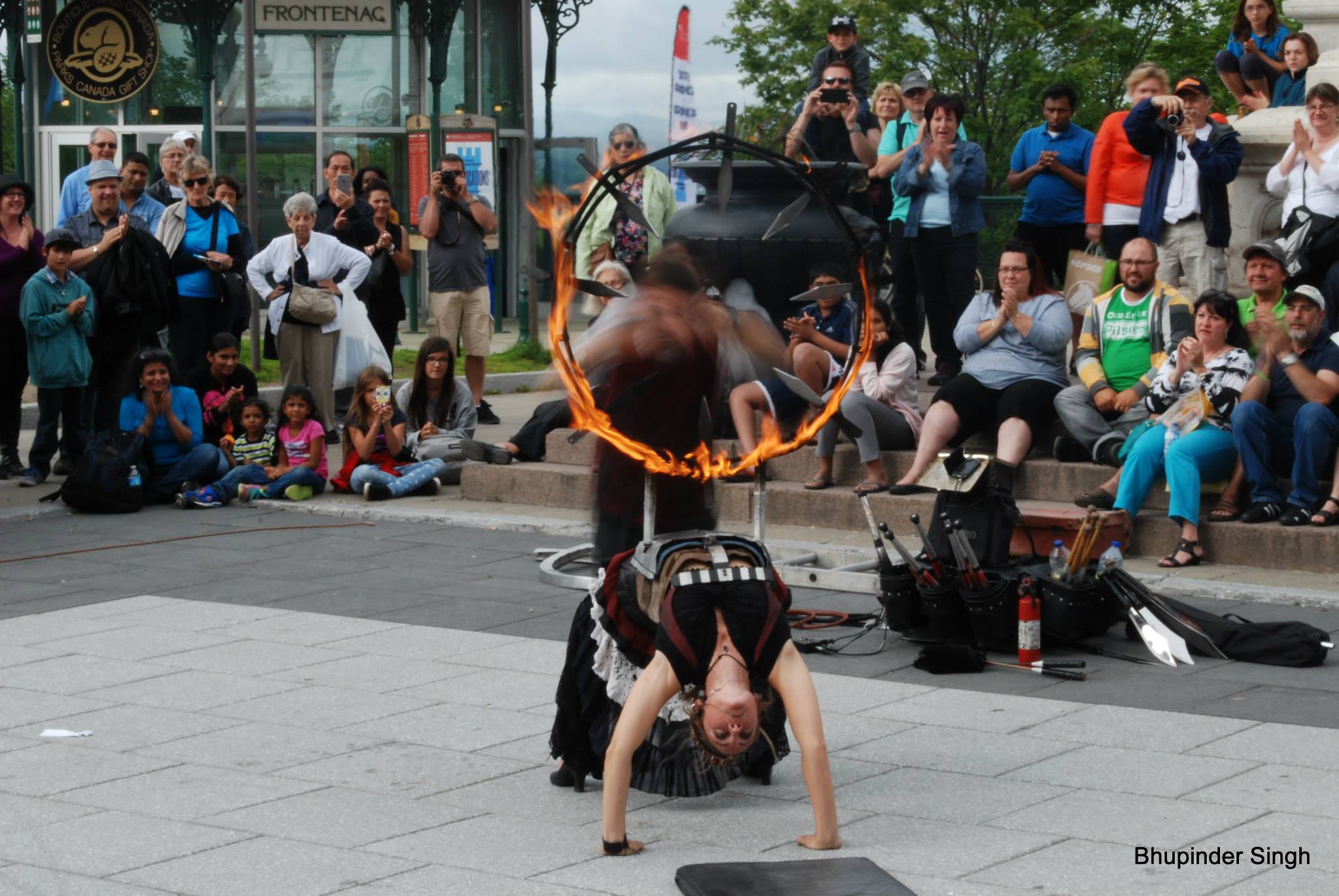
A couple of young musicians emerge to set up their arrangements even as snatches of a conversation between two members of the audience floats over to my ears. The man is telling his female partner/friend about the man-woman busker team we saw perform at the Château Frontenac square yesterday.

As with every street performance, the daring duo had requested the gaping, near-voyeuristic audience to make donations at the end of the show.

Our man in the park today talks about his chat with the male busker. “I asked him how much money do people actually put in your hat after the show?

“He told me most people put pocket change – the quarters, nickels and loonies. Very few – maybe one or two people – actually put five or ten dollar bills.

“And so that’s what you give after watching a 45-minute show in which the performers risk their lives. And right after that, you spend $200 on dinner.”

I can validate what he is saying. Yesterday, when I sheepishly carried two five-dollar bills to put in the buskers’ hat, I noticed those were the only non-coin currency items in the hat.

Suddenly, I don’t feel so bad about eating crepes clumsily in the park instead of dining at a fancy restaurant.

Read Part 2

Immigrants postcards (mini) ~ I

1

The driving instructor, a middle-aged man of calm demeanour gets frustrated when his Indian student waits for his instructions before making even the simplest of moves. “It’s not your fault,” he tells her. “I see this with girls and women from India, Pakistan, South Asia…all the time. You see, over there you’re taught to listen to the man!”

The instructor is from Afghanistan.

2

A young colleague — the only person in the entire office with whom I can converse in my mother tongue — talks about his home, not far from Dhaka. We talk about the rise of fundamentalist forces in our home countries and of the asphalt-melting heat there. He saves the best news for the last. “I have a newborn niece,” he says with a soft smile. “Abbu-Amma don’t call me as often now. She’s the first girl in our family, you see.” Nieces are fun, I tell him from experience.

He plans to visit his family in the fall. I don’t need to ask him why.

3

I discovered the magic of Alphonsos only in Canada. Back in North India where I grew up, the trio of Dusherri-Langda-Chausa ruled the mango scene.

There or here, I haven’t learned the dainty way to eat mangoes. It has to be skin-licking, pit-sucking, juice-flowing messiness. Stains and all.

Read the regular Immigrant’s Postcards here.

Immigrant’s Postcard: White is White (even when it isn’t)

Read other Immigrant’s Postcards here.

My husband has a visit scheduled for his vision test. The optometry is close to his workplace. A couple of days before his appointment, the doctor leaves him a voicemail to confirm the time, date and location. The message is an elaborate one; short of reciting the exact map, the doctor makes sure his patient has all the necessary information to show up for the test. At the appointed time, my husband finds the doctor to be an octogenarian, as he had imagined him to be by the tone of his voice and his laboured speech in the voicemail.

The oculist smiles widely on seeing my husband. “So you are a Sikh.” My husband acknowledges with a soft smile as the doctor goes on to tell him of his English lineage. On hearing B’s date of birth, he says, “Oh, so you were six months old when I moved to Canada.” “Have you been to Goa?” He asks my husband. “Yes.” The affirmative response encourages the elderly specialist to share the story of his friendship with a man from Goa. “He had a Portuguese heritage. For some reason, he was dark skinned even when everyone else in his immediate family had a light, Caucasian skin tone.” In between applying eye drops and asking my husband to stick his eyes into machines the ophthalmologist has to use but doesn’t seem to have much faith in, he regales him with how his Goan friend, a fellow ophthalmologist, travelled around the world in a ship. “I can’t tell you all his stories, but I can tell you one today.” This is the story goes on to narrate.

DSC_2190-001

The Goan oculist once visited South Africa to attend a conference on ophthalmology. Those were the apartheid years. After the conference, the group of ophthalmologists he was travelling with went to dine at a restaurant. Everyone but the oculist from Goa was allowed inside the “Whites only” restaurant. The man accepted the decision and made as if to leave the spot. He had barely stepped out of the restaurant’s precincts when a woman, a member of the restaurant staff, came running to him. “Sir, please wait a minute,” she said. The man turned around, half surprised. “Sir, please come in,” the lady huffed. “We have been able to confirm that you are white.” The dark-skinned Goan man of Portuguese descent walked in to join his colleagues, as sanguine as he was moments ago when he was denied entry into the restaurant.

Immigrant’s Postcard: The Game

Read other Immigrant’s Postcards here.

She is petite, her skin a burnished coffee tone. Ever smiling, this beautiful Ethiopian woman is a janitor and my friend. We chat about her weeknight chores and weekend plans. She tells me about her gang of girlfriends, the one that’s stuck together for 14 years, the one that meets every month for a potluck or a fun outing.

“No husbands or kids,” she tells me. The rules of the game are uncompromisingly clear. The women, all hardworking immigrants from Ethiopia, earn this–their day of leisure–and they wouldn’t let encumbrances of domesticity ruin it.

I point to her braided hair and request her to teach me how to do it. Not a problem she says, flashing her toothy smile.

The next time we run into each other, I find her extra animated .

“Did you see Survivor? On TV last night?” she asks me.

I nod in the negative. We don’t have cable, so I don’t get to watch that show.

“You know, there is an Indian girl in it. You’re from India, right?”

“Yes,” I nod.

“Oh my god–she is so good. She has a good strategy, she is smart…she knows how to get there. We are all wishing for her to win.”

I have no idea of the show she is talking about.

But I know she is right.

Survivor — that’s a game Indian girls of all ages play. A lot. With or without strategies. At home, on streets, in buses. And inside cars and university campuses.

Aranyalipi — Notes from refugee quarters, by Amiya Sen

[This is an extract from “Aranyalipi,” Amiya Sen’s nonfiction book-length account of refugees from East Pakistan who had been rehabilitated in Dandakaranya, a region that includes parts of Chhattisgarh, Orissa and Andhra Pradesh. The Dandakaranya Development Authority was created by the union government in 1958 to assist refugees from Pakistan. This excerpt appears in Muse India’s Literature of Refugees issue.]

Translated by Bhaswati Ghosh

Dear Su,

…I had no idea about DaAmiya Senndakaranya. After crossing a hundred and forty-five miles of hilly terrain between Mana camp and Raipur we reached Kondagaon–high above the plains. Yet, even at that point, I didn’t realize we were at the forest’s gate. This was the entrance to the heart of the Dandakaranya project. I had imagined the real Dandak forest lay deeper inside. This was a dense settlement of thousands of people–little Bengal, just like little Andaman.
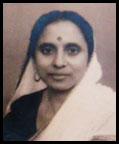
Jogani astounded me. This was the first planned village as part of the project, about six or seven miles from Kondagaon. In July 1959, the village of Jogani was established with 88 families and a total population of 392.

Although we are now urban dwellers on a mass basis, the image of a village is well etched in our hearts. It is rare to find an individual who hasn’t seen a village or lived in one for at least some time. But what a village this was! A few drab-looking tin houses sat in an area cleared off the forest floor. No other human settlement was visible through the gaps of the scattered shaal trees lining the nearby area.

A few broken houses dotted the landscape. Many of those rehabilitated here with government aid had already left the village. Jogani’s land is sterile; it doesn’t cultivate any edible crop. I was told that only two or three families had been lucky enough to receive arable land. The rest of the land was left unclaimed at the time of my visit. Those who left the village didn’t do so without giving a fight to the infertile soil. Along with their menfolk, women too had taken up crowbars to rid the soil of shaal saplings and weeds. For days on end, many of them ate grass seeds to curb hunger. At last, helpless and defeated, they drifted off this settlement.

There is soil-testing laboratory in Jagdalpur, Madhya Pradesh. Apparently, all peasant refugees are allotted land only after the soil is tested in that lab. But Jogani tells a different story–it doesn’t seem like the soil of this village was ever tested. This could be the first step of an experiment with agriculture-reliant refugees.

Those who have stayed back in the village depend on jobs or labour. Take Jaladhar Sarkar, for instance. He came to India in 1954, from Bishwambhapur village in Srihatta district. After living in a camp for four years, he has been rehabilitated in Jogani with twenty-one bighas of land. He and his two sons support a family of six or seven by working as peons and construction workers. The land they received lies fallow and unused.

In 1960, a loom had been opened in Jogani. It still exists but has lost its sheen. Work goes on at an irregular pace. Whenever the products made there accumulate, there is a pause in the work of daily wagers.

Currently, the only employment generator around Jogani is Borgaon Industrial Centre, about four or five miles from the village. Men and women from Jogani walk every day to work there. Among them, the daily wagers are the most disadvantaged. The work, low-paying as it is, doesn’t come with the guarantee of being available all through the year.

It was a Monday. The village, if one could call this desert-like place that, looked totally deserted. Besides shaaland mahua trees, there was no sign of green anywhere. Not even a pumpkin or bottle gourd patch that one saw in Mana’s camps. Mana has water, it has canals and ponds. Here, tube wells exist. Had paddy or any other crop grown on the land, the villagers would have pumped out water to cultivate some vegetables. But where is the time for that now! Every morning they must run to Borgaon in search of work. If only that could fill their bellies! But then, it’s possible that that the soil here is indeed barren.

I met a few people–none of them evinced any joy on having received land and a house for free. Actually, they got the money for their houses as a loan, which they needed to pay off once they were settled. But what settlement and what pay-off? With no place to go, they continue to stay here, in spite of all hardship. But they are not un-enterprising. They toil hard to make sure their children receive education. They would take up any work that comes their way. But the opportunities are so limited.

The very first step of the Dandakaranya settlement left me disappointed. In comparison, I was pleased to see Bijapur as part of my present trip. This was situated in Bastar too, but as a transit camp, not a village. As of March 15, 1965, 67 families stayed there.

There were only two tube wells in the entire camp. But a spot of green welcomed one to every hut. Bottle gourd and pumpkin vines climbed up the roofs of huts. Mounds of mahua flowers were spread out to dry in front of several houses. These would be boiled to make jaggery. This settlement was forest-dependant too. But the dense cluster of huts and the camp’s consistent population had imbued it with a lively atmosphere. The camp dwellers effused optimism. They dreamed of ascending to a better life — of farmland, house, agricultural loan, and the victory roll of produce brushing against plough.

Life is at work, everywhere. Saplings pierce cracked walls to sprout. Flowers bloom on mountain tops. I have even seen fish germinating in the city’s makeshift drains.

I enter a hut and find a young mother carrying her infant on her lap. It’s her first born. The young father, though excited, is also a bit distressed. Nights in Bastar are still quite chilly. The child doesn’t have any warm clothing. In many homes, I saw just kanthas and pillows for bedding. No one has quilts or blankets. Almost all these people arrived in India following the 1964 riots in Pakistan.

In an instant, that cabinet stuffed with blankets in Mana flashed before my eyes.

I ask the refugees, “Didn’t you get any blankets?”

“No, didimoni,” say the men and women in unison. “We only got woks, enamel plates, a bucket and a few such things. These were given to us in Sealdah station. We didn’t get anything after coming here.”

“You all came here through Mana, right?”

“Yes, didimoni.”

The path to enter Dandakaranya is through Mana—the headquarters of all transit camps and work centres of the project.

According to government statistics, refugees over the age of eight are provided sixteen rupees or clothing worth that amount. The record doesn’t mention how many times this happens; possibly only once. The record also notes the distribution of blankets.

“Woollen blankets may be supplied at the rate of one blanket per adult, subject to a maximum of three per family.” [Estimates Committee, (B.C. No. 412) 1964-65]

The blankets were meant for last year’s riot victims. These refugees belong to the same category. Why didn’t they get the blankets then?

The dole money the refugees receive isn’t enough to cover even two square meals a day, let alone allow for clothes. But leave aside government funds and statistics; the stash I saw in Mana came mostly from donations meant for refugees. If those blankets don’t come to these unfortunate people, have they been filled in almirahs just for the purpose of being displayed to VIPs?

In Mana, expecting mothers received yet another benefit. When a baby was born, the mother and her child got a set of new clothes. The women of Jogani aren’t as fortunate.

A gentleman accompanying me said, “Don’t believe everything they say. These people here are no less sly; they might have sold off the blankets.”

I know it is easier being the devil than the lord. But looking at their faces, it appeared improbable that so many male and female devils had landed here from East Bengal.

For argument’s sake, even if one accepted the gentleman’s proposition, the question remains as to why these people sold off the blankets. One can discount those who have left the camp. But those who have stayed back know very well how indispensable blankets are during winters here. They are also aware that it is impossible for them to find any alternative sources of combating the cold weather. If knowing this, they still sold off the blankets, it follows they must have done so out of extreme penury.

The British robbed India to add riches to its empire. And we have robbed our own poor of food and shelter–in the name of freedom.