Review of ‘Nostalgic for A Place Never Seen’ in East India Story

Gargi Kalita reviewed my debut poetry collection, NOSTALGIC FOR A PLACE NEVER SEEN in East India Story. Read the review:

Bhaswati Ghosh’s Nostalgic for a Place Never Seen is a debut poetry collection that maps the evocative terrain of belonging. It explores how home is a terrain of the mind, a pulse of longing bridging the intimate and the global. A review by Gargi Kalita.

Nostalgia is never merely a return to the past—it is a tender reimagining, a delicate reconstruction of moments and emotions that memory alone can no longer fully contain. Home, in this sense, is not merely a geographical fixity but a terrain of the mind, a pulse of longing that beats through time, language, and loss. It is within this evocative terrain that Bhaswati Ghosh situated her debut  poetry collection Nostalgic for a Place Never Seen ,a volume that reads like a cartography of belonging drawn from within the self and across shifting geographies. Ghosh, a bilingual writer and translator based in Canada,with roots in New Delhi, belongs to the  lineage of Indian diasporic poets whose work bridges the intimate with the historical, the local with the global.

Some places are etched not in geography, but in remembrance—borne across generations like heirlooms wrapped in stories, scents, and silence. Bhaswati Ghosh’s Nostalgic for a Place Never Seen traces an emotional landscape, where her grandmother’s lost Barisal finds a home in verse.This poetry collection, imbued with reflections on migration, memory, and identity, is organized into eight thematically rich sections— “Dwellings: Temporary and Permanent”, “Places, Faces, Traces”, “Scents, Tastes, Textures”, “Seasons of the Heart”, “Water, Earth, Air, Fire”, “The Humming Octave”, “The Wordsmiths”, and “Movements in and Out of Time”. Across 72 poems of the collection, Ghosh explores personal and historical landscapes of belonging shaped by displacement, capturing the tension between the fleeting and the lasting, and inviting readers to find home in language and memory.

At the heart of Nostalgic for a Place Never Seen is a poignant reflection on memory, identity, displacement, cultural inheritance, and longing that extends beyond personal history. Bhaswati Ghosh’s poetry weaves internal and external landscapes, capturing the emotional geography of diasporic consciousness—a yearning not just for a place, but for the sense of rootedness it once held.

The title poem, “Nostalgic for a Place Never Seen,” which lends its name to the collection, forms the emotional nucleus of the book. Drawing on Ghosh’s inherited memory of her grandmother’s forced migration from Barisal in East Bengal (now Bangladesh)  to post-Partition Delhi, it reflects the vivid presence of places never personally visited but deeply felt through intergenerational storytelling. This aligns with Marianne Hirsch’s concept of “postmemory”—the transmission of trauma and displacement across generations. Ghosh captures this poignantly in both “Nostalgic for a Place Never Seen” and “Native Dialect.”

In a video about Sugandha, I see a mother

combing her daughter’s hair. Before I know it,

the daughter turns into my grandma

and breaks into a song.

‘Why don’t you come anymore?’ she asks.

— Nostalgic for a Place Never Seen

When her little sister visited

and Grandma broke into their

Barisailya patois, I heard songs

of home in the words. Of boat

races and river markets. Of a

home I’d dreamt of in past

lives amid simulated

nostalgia.

— Native Dialect

In the opening section, Dwellings: Temporary and Permanent, poems like “Sleeping at My Mother’s House” and “Displaced Persons’ Colony” do not merely reconstruct domestic spaces; they evoke the invisible sediment of emotion—love, loss, security, fragility, displacement —that inhabits these spaces. These dwellings become mnemonic devices, where physical architecture merges with psychological and ancestral landscapes.

Likewise, in Places, Faces, Traces, the poet functions as a flaneuse of memory, fluidly moving through places like Lajpat Nagar, Buenos Aires, and Mukteshwar—each becoming a site of introspection and remembrance.These locations act less as physical sites and more as emotional landscapes, forming a metaphorical map. Ghosh suggests that memory is borderless, bound more to emotion than to nation, language, or place. The poems wrestle with the impermanence of space and the persistent search for anchorage amidst flux.

Perhaps the most evocative section of the book is Scents, Tastes, Textures, which serves as a visceral archive of cultural identity. In poems like “Cooking Hilsa” and “Cumin,” food becomes a tactile memory, carrying heritage on the tongue and in the body. These sensorial evocations act as gateways to lost homes and forgotten rituals, echoing Roland Barthes’s idea of the “grain” in language—where meaning is felt rather than just stated. For Ghosh, food is not merely sustenance; it is survival, nostalgia, and resistance. As she writes in “Cumin”:

Taste is the original rebel. It resists being caged in

 closed jars or steaming woks.

In the later sections—Seasons of the Heart and Movements In and Out of Time—Ghosh turns inward, tracing the subtle shifts of self and emotion. Poems like “Learning, Unlearning” and “Debts to Pay” reflect on growth and changing roles, offering a sense of becoming rather than just loss or nostalgia. Ghosh shows that belonging is fluid, woven through memory and choice, and this quiet evolution is captured in “Learning, Unlearning”, where she writes:

She learns to pause more on the

page. I unlearn the stiffness of knowing it all.

A central thread in the collection is Ghosh’s nuanced exploration of “home”—Is home a physical dwelling, a landscape of memory, a sound, a scent or even a fleeting feeling? Ghosh’s poems move through Delhi, ancestral villages, and diasporic spaces, revealing home as both grounding and elusive. Echoing Edward Said’s “imagined geographies,”as  she shows that places are shaped more by memory and feeling than by maps. The collection also explores identity and belonging from a female perspective, as Ghosh reclaims her grandmother’s story—giving voice and agency to women often sidelined in Partition narratives.

Stylistically, Ghosh’s poetry is defined by a quiet musicality that emerges not from ornamentation but from emotional authenticity. Yet, within this understated lyricism lies a deft command of literary craft—her metaphors, imagery, and structure deepen each poem’s emotional resonance. In “Fading Colour,” letters losing their hue become haunting emblems of histories dimmed by time and silence. In “Pickling Language,” the simple act of preserving becomes a vessel for memory and identity, where ancestral syntax ferments quietly in jars.

Ghosh’s lyrical minimalism resists excess, favouring the resonance of ordinary moments—stillness, observation, memory—each imbued with metaphorical richness. Subtle threads of Bengali and Hindustani lend her lines a textured intimacy, anchoring the diasporic experience in language. Eschewing nostalgia, she crafts verses of precision and clarity, conjuring cities like Delhi, Mexico City, and Buenos Aires not through maps, but through mood, rhythm, and metaphor. The result is poetry both introspective and worldly—rooted in the particular, yet open to the universal.

In an age where identity is continually redefined by movement and loss, Nostalgic for a Place Never Seen reminds us of the power of poetry to anchor us—to a language, a scent, a home, even if that home exists only in memory. Traversing continents and generations through everyday rituals and stories, Ghosh explores cultural heritage, displacement, and   belonging, evoking empathy and prompting reflection on our own ties to memory and place.

There are certain spaces the soul longs for—not merely to dwell in, but to truly belong. Amid the scattered rhythms of postmodernity, this yearning becomes a search for rootedness not in geography, but in presence—a place deeply felt, where one is the place, and the place is the self. And that is what Bhaswati Ghosh’s Nostalgic for a Place Never Seen ultimately embodies—making it a vital literary contribution to Indian English poetry, diasporic literature, and memory studies.

Book Details:

Interview in The Artisanal Writer

Sabyasachi Nag, Poetry Editor for The Artisanal Writer, a Canadian journal and literary arts collective exploring, inquiring and celebrating the craft and practice of writing, interviewed me. We discussed by debut poetry collection, NOSTALGIC FOR A PLACE NEVER SEEN (Copper Coin Publishing) and other aspects of my poetic journey.

Sabyasachi Nag (SN): Congratulations on your first poetry title? How did you arrive at the collection, did you conceive of it first and went about constructing the poems or did the poems coalesce at some point into the collection? How did you settle on the title? Could you tell us a bit more about the voice of the narrator? Is it intended as a singular narrator or many: one consistent voice or polyphony?

Bhaswati Ghosh (BG): The poems in Nostalgic for a Place Never Seen came about in a spontaneously serendipitous way. Until a few years ago, I was primarily a prose writer — dabbling mostly in creative non-fiction and the occasional short story. In August 2020, my debut novel, Victory Colony, 1950 was published.

In the spring of 2021, a friend who hosts a poetry-writing collective every April for the National Poetry Writing Month, invited me to join. This was at the peak of the COVID-19 pandemic — we were housebound — and true to the cliches associated with poetry and solitude, the moment lent itself well to self-reflection. I enjoyed writing poetry in a collective — we read and shared feedback on each other’s works. This not only provided me with creative stimulus, it also brought camaraderie and connection at a time when we were dealing with isolation, anxiety and tragedy on an epic scale.

This exercise of writing a poem daily for a month for three years gave me enough poems to think of a collection while also allowing me to hone my craft and learn from fellow poets. Eventually I could see certain patterns and themes in the poems. The book’s title derives from one of the poems in the collection bearing the same title.

I would hesitate to pin a singular voice to the poems in this collection. More than a narrator expressing them, I feel poems breathe with their own life force and the poet is more like a vehicle bringing them to the surface.

SN: Although the book is sectioned in seven parts: dwellings; faces; scents, tastes and textures; seasons; elements; music; words and movements – there is a thematic circularity as it starts with displacement and ends in displacement. Is that intentional? The title alludes to a place never seen – so obviously this is a book about places – but is that place a reconstruction or recollection – is it a real place or a place from mythology?

BG: It’s less intentional than it appears to be. Many of the poems in the collection were written using prompts from various sources. When bringing them together, it seemed like a good idea to segment the poems thematically to help readers move through the collection with ease. Think of these as signs along a hiking trail in a forest. As one reader noted in her review of the book, “Thankfully the book is divided into sections, giving context and guidance as the poet shares the universe of memories and impressions that her senses have gathered and her mind synthesized.”

Many of the poems in the book do deal with the idea of location — both temporal and figurative. This made the idea of being nostalgic for a place that’s not merely physical but encompasses more — histories, memories, dreams, longings — pertinent.

SN: The book is wonderfully peppered with non-English words (mainly Bengali, your mother tongue). Is it about getting the voice right? Could you talk a bit about your process guiding your syntactic choices in this collection? Are you guided by meaning, and is there a point where you stop translating words from the mother tongue? Or do you arrive at a poem with a certain sound construct that you then look for the language and settle on words that evoke that sound?

BG: When writing poetry, one works within certain frameworks — in terms of form and structure but also atmosphere and aesthetics. In doing so, I occasionally leaned on words from Bengali or Hindustani to evoke a particular sense of the local. I see these insertions as both geographical signposts and emotive sparks that flow into a poem. They carried a spirit all of their own and had to be left there.

It’s difficult to put a finger on what triggers such word choices — it could be the intonation or musical texture peculiar to a word or phrase, but it could also be a very specific and indelible memory associated with a word, its pre-history and the sensory response it generates — not only within the poet but also among those who might be familiar with that expression. As a reader, being part of a world that’s more interconnected than ever, these interventions make poetry even more exciting and attractive to me.

In his essay Bringing Foreign Language to the Poem, Eric Steinger writes, “As poets, I believe we should take advantage of our available resources. Doing so can make poems interesting, nuanced, authentic, and contribute to the poem’s/poet’s voice.” This resonates with how some of the music-themed poems in Nostalgic for…evolved, using terms from traditional North Indian classical music systems.

SN: Several poems revolve around central characters – the grandmother (there are almost 20 references), mother (approximately 25 references) and father (10 references)…how much of this collection is autobiographical?

BG: I think that of all genres, poetry is probably the most autobiographical, as if by default. Even when a poem itself is not derived from one’s life arc, it’s a distillation of the poet’s inquiry into the subject at hand. That said, a fair bit of Nostalgic for…is indeed autobiographical — it’s an exploration of places, relationships, displacement — the last of these is perhaps the most pronounced of all the themes in the collection, heightened even more by my experience as an immigrant in Canada, my home since for almost a decade and a half now. As I made this long-distance journey to North America from India following my marriage, I began to sense, for the first time, the loss my grandmother might have felt when she’d been uprooted from her home in East Bengal (now Bangladesh) at the time of India’s independence in 1947 when the country was divided into India and Pakistan. Her stories of displacement and the trauma that accompanies it were no longer abstract tales for me; they became real as I too began experiencing the twinges of separation from home (New Delhi in my case), my family and loved ones.

SN: The narrator alternates between participant, witness and celebrant – is this collection a spoken record and oral testimony a conversation with history or a response to a “place never seen” and hence a void?

BG: It’s all of these descriptors you refer to — I couldn’t have said it better. The poems were written at different points in time and in disparate geographical settings, which might explain the switch between the voices. Quite a few of them came to me during my travels to Latin America, a region that fascinates me endlessly. My visits to places such as Mexico City (Mexico), Havana (Cuba), Cartagena (Colombia) and Buenos Aires (Argentina) have uncannily filled me with a sense of homecoming, owing perhaps to, the tropical climate, general chaos, and a profusion of colour, music and bustle of these places.

Then there are poems (Native Dialect, Nostalgic for a Place Never Seen, Milking Green Blessings) that relate to my grandmother’s loss of her homeland to the tragic event of India’s Partition I mentioned earlier.

The poems on music are deeply personal reflections of my responses to particular ragas (a melodic framework for composition, consisting of a specific set of notes and associated with certain emotions, times of day, or seasons).

There are poems on sensory delights such as food or scents, textures and sounds. In all of these explorations, the underlying quest is that of finding home as an antidote to the various types of voids I might be experiencing or holding within.

SN: How do you think the work responds to the questions it raises in the context of the timeand place the work is situated in?

BG: A lot of the poems in the collection relate to physical spaces — dwellings, markets, villages, cities, hills — straddling between continents, atmospheres, cultures and time periods. They raise questions like whether dislocating from one place and relocating to another can really be permanent, except maybe in material terms. The collection contemplates on city life with all its paradoxical oddities and inexplicable pulls. It wrestles with the manner in which the demands of the here and now contend with the salve and cushion of memory. It unlatches the many dimensions of love and takes in with curiosity its lessons for the soul. It observes movement and seeks to inhabit the in-betweenness of journeys.

As an example, I wrote the poem, Sunset on the Malecón, after returning from a visit to Havana, Cuba in 2017. This was a city that held a lot of fascination for me, given the history of the Cuban Revolution, the tiny island’s resistance to US imperialism, its association with the former Soviet Union, the lionized personas of Fidel Castro and Che Guevara. My stay in Havana in a post Soviet world, however, left me with more questions than answers. I found it a city in a time warp — unable to discard the past and yet desperate to step out of it in some ways.

Cars, once shiny, wrecks now, tire the streets.
On balconies, old men mask sighs with
cigarette smoke and loud confabs.
The morning that arrived many suns
ago ducked out like friends whose
empires collapsed overnight.


(From Sunset on the Malecón)

SN: Did you have an intended audience for the book?

BG: I didn’t have any audience in mind when writing the poems — that process is deeply personal for me. When I compiled the poems for preparing the manuscript, my hope was that the collection would find readers who can join the journeys — external and internal — the poems voyage along. There’s great satisfaction in hearing from reader friends about how a poem from the book took them back to their grandparents or reminded them of the various addresses they’ve lived at. So to answer the question, instead of aiming to reach particular audiences, I tried to put my faith in the book finding its own reader tribe.

SN: In pushing your work beyond your first title what were you most conscious of? What were/are you trying to achieve with this book in terms of your literary career?

BG: As I mentioned in a previous answer, this book happened in the most unexpected of ways — I had no expectations from it beyond that the poems within would touch those who read them. Writing can be a contradictory practice — at once allowing one to engage with and yet also disconnect from the busy, sad and often horrific world we find ourselves in. I’m ambivalent about the word “career” as a definition for any work, but literary work in particular. Like the travels through the places in Nostalgic for a Place Never Seen, writing, for me, is a road trip — staying open and curious through the drive and pausing at pit stops to rest and reflect.

SN: What was the most satisfying aspect about writing this book (other than perhaps thesatisfaction of finishing it)?

BG: The best part about writing the poems for this collection was the freedom to write them without knowing they could end up between the covers of a book. Participating in National Poetry Writing Month in April for the past four years has meant an entire month of writing poetry every day — and while that seemed daunting in the beginning, I was surprised to see how quickly that nervousness transmuted into joy and creative learning.

Writing with other poets was a bigger treat as it exposed me to a diversity of voices and styles while allowing me to find my own. Another element that made writing poetry immensely satisfying was the thrill of the unknown. A poem often begins with a kernel and not as a fully fleshed-out edifice. It  can be quite an adventure to see how it emerges bit by bit and the point at which it’s deemed complete. This mystical element makes poetry very dear to me — both the reading and writing of it.

SN: How would you like this book to be taught – as a historical document, socio-political document or as a document about a certain kind of taste in writing or particular aesthetic, genre, literary style or something else?

BG: I see Nostalgic for a Place Never Seen as a synthesis of all those elements — it has family stories that bounce off the history of the Indian sub-continent, the politics of forced migration intersecting with urban anxieties, and an immigrant’s uneasy existence in parallel universes.

In the collection, I’ve also attempted to cross linguistic barriers with the hope that the poems are fluid enough for readers to enjoy them while partaking of certain flavours that might be unfamiliar at first. What’s exciting about having a book out in the world is the many meanings it then reveals. If this collection is ever used for teaching, I’d like it to make all those meanings available and perhaps be in conversation with each other.

Currency of Songs

October 2018

First published in Usawa Literary Review

It’s October, but still uncomfortably muggy in Delhi. We’re crammed in a small car, five of us, including the driver, and frantically looking for a school in Civil Lines, one of the oldest areas in India’s capital city. The search gets long-winded as we have no GPS and directions from passersby keep leading us into lonely alleys. The school we’re looking for is the venue of a Durga Puja, the autumnal festival I’ve returned home for, from Canada, where I’ve been living for a decade now. By the time we finally find the school, it is way past lunch time, and my seven-year-old niece, who is with us, is hangry, a neologism I’ve heard friends in Canada use to describe someone whose anger is induced by hunger.

We take a customary look at the idol of Durga, then dash for the food court area the Kashmiri Gate – as this venue is called – Durga Puja is famous for. A, my niece, is led to the spot where steaming mutton biryani made with succulent, spiced goat meat, is being served on shiny aluminium foil plates. There are kebabs on offer as well, but the little girl isn’t interested in any of those items. She surveys the stalls and settles on samosas as a fresh batch of these deep-fried triangles arrives before her. I reach for my purse, but A stops me. She has her own money bag with some real money her parents gave her as festival allowance. For a plate of samosa that costs 20 rupees, A pulls out not two, but five ten-rupee bills – the entire amount she’s carrying – from her purse. She places all the five notes – 50 rupees on the table for the cashier. Everyone around her breaks into laughter. At seven, A knows her counting, but clearly, she doesn’t have enough experience in dealing with currency notes to know their value. The cashier kindly picks up two of the bills and asks her to keep the rest. After finishing her samosas, a less hangry A decides to cool off with an ice cream. She gives the vendor 20 rupees and he gives her a 5-rupee coin back after deducting the price of the chocolate cone she grabs.

Later as I try to guide A through counting currency, she tells me she’s got it all. “Look, you give someone money, they give you money back,” she insists, her knowledge fresh from the transaction with the ice cream seller. The child’s innocence humours and stuns me at the same time. To her, currency notes are the same as any other — only less interesting — thing you share with people to get something (including more of it) back. It’s of no greater value than the pencils or hair clips she exchanges with a friend. I refrain from giving her financial management lessons. This is her teaching moment, and for a change, I am the student. ***

April 1999

It has been nearly three weeks since I’ve stopped going to work. A supervisor has been putting me on difficult shifts for weeks in a row. At first it seems innocuous, but when the pattern keeps repeating itself alongside favours being granted to other colleagues for no discernible reason, I stop going to work. I don’t have it in me to confront people and have internalized the idea of resigning as I spend time doing mostly nothing at home. I say mostly because almost every morning, I walk down our street, a fat book in hand, to the house of Mastermoshai, as I call Sudhir Chanda, the elderly gentleman who teaches me the songs of Rabindranath Tagore.

Mastermoshai is a professional Rabindrasangeet teacher. Professional only in the notional sense, considering his indifference, bordering on abhorrence, to money in exchange for his lessons. Through close to half a century that would see New Delhi, the city of Mastermoshai’s work and teaching, transform from a quasi-socialist to a neoliberal economy, plush with high-paying private sector jobs, redoubled spending power for the middle class and steady inflation, the teacher’s tuition fee – a laughable 30 rupees – remains unchanged. Even that amount he hardly cares for. One is free to drop into his class, named Robigeetika, and learn without paying a single rupee.

During one of his occasional visits to our house he learns about my absence from work and asks me to make better use of my time – by going to his house for music lessons. No money is mentioned. All he asks for is that I call him once before leaving the house to make sure he doesn’t have any other appointment that day. Mastermoshai specifies no time either – any time before noon is good for him. I lap up the offer. I need something that can fill up my heart like soil does a freshly-dug grave. Music seems like a safe and sanative layer at the time.

Read the rest in Usawa Literary Review
Borshamongol with Robigeetika and Mastermoshai; Bhaswati in green sari in the front; Mastermoshai right behind her, facing a microphone.

All the Octave’s Notes

First published in ABRÁCE LIVE!

A royal courtesan scorned by her lover
A warrior princess who makes her life over
Brothers cursed to turn into beasts
A farmer’s wife who cooks up a feast
The first songs I heard throbbed with dreams and rivers
That’s what music is, a lifelong lover.

A bottle of fortified milk with its sipper inside my mouth, I would lie on the bed or the sofa as the story of Buddhu and Bhutum, two royal newborns cursed to the lives of a monkey and an owl, entered my toddler ears. Long before I knew what music meant, my ears were getting trained to catch a variety of notes. Saving money from their modest salaries, my mother and her younger brother would buy LP records to play for us on a turntable in my grandparents’ house where I was growing up. They were bringing home a variety of musical influences — Rabindrasangeet — songs written and composed by Rabindranath Tagore, the Bengali Nobel laureate, shyamasangeet — written and sung in the praise of Goddess Kali, Atulprasadi — devotional and love songs written and composed by Atul Prasad Sen, a Bengali composer, lyricist and singer who was also a lawyer, social worker, educationist and writer. Of everything that was played, though, what I and my brother, nearly three years older than me, loved were dramatized musicals (also known as dance dramas) by Tagore and musical folktales of the kind narrating Buddhu and Bhutum’s story in Bengali. The heightened effect of drama, rendered through songs and musical dialogues was the perfect blend of music and storytelling that had our attention, hungry for the goofy.

At the Monday/Thursday class
eight of us circle our guru,
his cotton wool beard just about
eclipsing that concessional smile.
Bageshree holds the room
and our octaves together.

(From my poem, Bageshree)

While singing and listening to music remained a constant in both home and school, it was only in middle school that I came to identify the octave’s notes. My mother enrolled me into private classes in Hindustani classical vocal music, one of the two branches of Indian classical music (the other being Carnatic). She saved money again, this time to buy a harmonium to help me practice my lessons at home. In school, we got to learn a fair share of Hindi patriotic songs and Rabindrasangeet.

And then there was the radio at home. In between preparing for school work and practicing my classical music lessons, the radio — our primary source of listening to music — had replaced the turntable by this time. To me, the radio was a magic box. You turned on a knob and it brought you Hindi film music from the golden era of the 1950s and 60s, you moved the knob to your right and it played English pop songs and Western classical music. Somewhere in the middle, if you persisted, you could catch BBC World News, albeit with the hissing impatience of a faltering signal. Twice a week at dinner time, my mother religiously tuned into two Western music shows — Forces Request on Mondays and A Date with You on Thursdays. While the former featured songs requested by members of the Indian armed forces, the latter was a request show for regular listeners. This was my first window into The Beatles, The Carpenters, ABBA, The Beach Boys, Glen Campbell and many other singers and bands. That they coexisted in my musical universe with luminaries of Hindi film music like Sahir Ludhiyanvi, Sachin Dev Burman, Shailendra, Salil Chowdhury and many others as well as Rabindrasangeet in the melodic voices of Kanika Bandopadhyay, Suchitra Mitra and Debabrata Biswas was simply as natural as the multilingual world I inhabited that required me to switch form Bengali to Hindi to English based on the environment I found myself in.

In grade eight, my musical world became even richer as our first cassette tape player entered the house. It was a small machine, custom made for us by an acquaintance. In the machine’s early days, our cassette collection totaled to two tapes. Yet, the musical wealth these two cassette tapes brought was truly infinite. You’ll see why.

The first tape was a predictable choice — a Rabindrasangeet album my mother bought. The other one, procured by my brother, would alter my musical universe forever. It was a jugalbandi (duet) of sitarist, Ravi Shankar and sarod player, Ali Akbar Khan, accompanied on the tabla by Alla Rakha , legendary musicians all three of them. It was a concert, Ravi and Ali, guru brothers — a relationship tag disciples trained by the same guru would go by — recorded at the Philharmonic Hall in New York City in October 1972, a month after the death of their guru, Allauddin Khan, who happened to be Ali Akbar’s father and Ravi Shankar’s father-in-law. At the beginning of the tribute concert, Ravi Shankar introduced him as one of “the greatest musicians.” I find it curious that the year and the month of that particular concert coincided with my brother’s birth.

The virtuoso musicians played three rāgas (“a melodic framework for improvisation in Indian classical music akin to a melodic mode. The rāga is a unique and central feature of the classical Indian music tradition, and has no direct translation to concepts in classical European music. Each rāga is an array of melodic structures with musical motifs, considered in the Indian tradition to have the ability to “colour the mind” and affect the emotions of the audience.”), opening with Hem Bihag, created by the departed guru, Allauddin Khan himself, followed by Manj Khamaj and Sindhi Bhairavi.

Listening to Ravi Shankar and Ali Akbar Khan strum the strings of two different instruments in such meditative and yet unintrusive harmony took me to a place I’d never been before, and one I didn’t want to leave. To say that they were complementing each other would be woefully inadequate. It was as if they were playing each other’s instruments, not the one they themselves held. I hadn’t had the opportunity to listen to a true jugalbandi before this, and I remain grateful to this day that my initiation to this collaborative form happened with such a stellar performance. The moment I heard the first notes of the sitar and sarod in alaap (the non-rhythmic melody structure revealing the rāga), at once pensive and uplifting, I knew this was the love of a lifetime. Once they moved on to Manj Khamaj, this time their notes finding the company of Alla Rakha’s beats on the tabla, I felt being enveloped in Delhi’s December sunshine, an experience I’ve forever cherished, with a balmy tropical winter sun bringing a kind of warmth which instead of whip-lashing you, cloaked you in a warm embrace.

A soothing sadness, the colour
of mellow afternoons, glides in.
Tears soak stationary hours
and passing cataclysms.

Negotiating years and terrains
Manj Khamaj keeps breathing.
A footsure confidant. In its
folds, wars lose their way.

(From my poem, Manj Khamaj)

To this day, listening to this Manj Khamaj jugalbandi teleports me to such a comforting, snug tropical winter afternoon. As I listen to it for a millionth time, the music embeds itself into my immediate surroundings with such intimacy that I can’t tell where one instrument takes off and the other follows, as if the sitar and sarod were two brothers themselves, with the tabla as their loving guardian that held them together and became playful with them in turns. Through all my musical discoveries and learning, this album has remained a sublime true north that never fails to bring me back home, metaphorically and otherwise. It’s a discovery I made because of my brother, and that memory, entwined with the divine effect of the music itself, makes this widely-acclaimed concert intimately personal for me.

Ever since that brush with music at the deepest level, at the level of the spirit, I’ve found my musical world continue to expand, to include Sufi music, Latin American jazz, African folk music, the work of innovative composers like Gustavo Santaolalla and Ludovico Einaudi. In this world the inner and the outer become one for me and boundaries lose all meaning.

Music had held me by the hand when the world seemed to slip away from under my feet; it has calmed my nerves when medicine or sleep couldn’t; it has brought me joy in the middle of enervating ennui and it has often taken me back to that crispy sunshine of my childhood winters in Delhi.

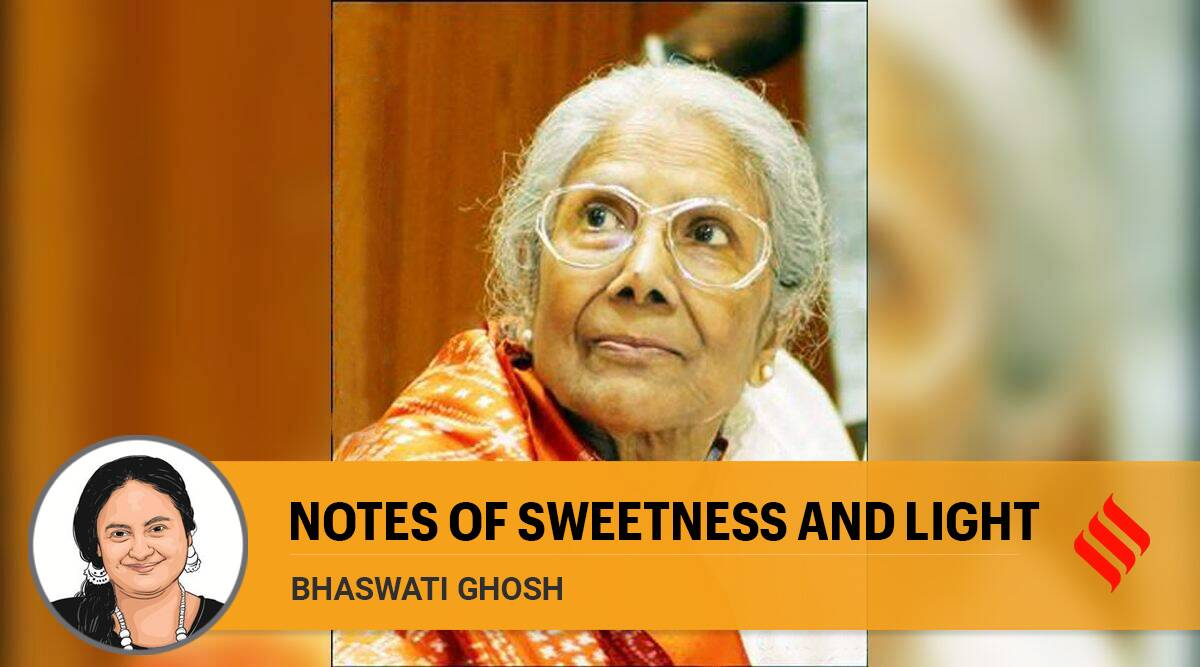
Sandhya Mukherjee’s notes of sweetness and light

My tribute to singer, Sandhya Mukherjee, published in Indian Express.

Sandhya Mukherjee came to my listening universe inconspicuously. Growing up as a probashi Bengali in Delhi in the pre-digital age, I didn’t have Mukherjee as part of my early listening experience in the way Lata Mangeshkar or Geeta Dutt had been. I was two years away from hitting my teens when Mukherjee’s voice — unmistakable for its lilt and lalitya, Sanskrit/Bengali for sweetness or charm — entered my world as we moved to Chittaranjan Park in south Delhi. No Durga Puja went by without listening to songs by two legendary Mukherjees — Sandhya and Hemanta — being blared on loudspeakers. The pandals of the late 1980s were venues for the screening of black-and-white Bengali films on giant projectors. This was also when I found Sandhya Mukherjee’s voice merging with the screen persona of Suchitra Sen, even as Hemanta Mukherjee’s did with Uttam Kumar’s who often played her romantic interest. As I spent the past few days listening to the breathtakingly wide range of songs Mukherjee sang in her long and illustrious career, I found that the ability to adapt — to artistic idiosyncrasies, situational peculiarities and the basic demands of a piece of composition — was what made her such a versatile and gifted artist.

Read the rest in Indian Express

Home is Grandma’s Butterfly Breath in a Guava Tree

First published in Plato’s Caves online

Home is a kidnapper who has finally made you submit to its territory, mapped and unmapped.

Home is your first partner in crime who, by introducing you to its hidden corners, gives a toddler you a taste of what manipulating adults with pranks feels like.

Home is the no-nonsense courtroom, where, you, still a toddler, take the gods to task by bashing up their idols at the altar for denying your grandma her own house.

Home is the compassionate table fan that breezes through the room on a hot summer day as Rafi and Geeta Dutt croon aankhon-hi-aankho-mein on the radio and two children – your brother and you – sprawl on the cool cement floor of a government quarter to hurry through your summer holiday homework.

Home is the indulgent playground overlooking that same government quarter where children make friends over hopscotch and their mothers, knitting buddies, on charpaais.

Home is the confused late-entry hero that is finally grandma’s own house. Its dust and half walls hold you in a perplexed daze. Your brother, yet to reach his teens, brings you back to reality as he returns with a pot of rice he’s managed to cook in the half-baked kitchen of this unfinished structure.

Home is the jealous new paara, neighbourhood, who estranges you from old friends and the loving playground with its consolatory offer of a cricket-colonized back street and stock loneliness.

Home is the keen, encouraging listener of your early-morning and late-evening riyaaz that mother helps add melody to with the harmonium she buys you off months of savings.

Home is the generous open terrace that grows in personality as you do in age – as your study-time ally in your yet-to-be-teen, mellow winter afternoons; as the host of a star-draped night sky beckoning you to let go in your ambivalent early 20s; as your gym and fitness partner later, when you do learn to let go.

Home is the comforting pal your grandfather brings you back to from the bus stop every evening after school. It’s where grandma waits with hot food and a listening ear for all your school stories, helping you bridge the interval until mother returns from work.

Home is the trusted ally you make your way back to, having survived an attack by gunmen in a public space, to hug your grandma, sick with worry. In the days to follow, home makes you an accelerated learner of what political revenge means even as your eyes adjust to the sight of blood on the streets you call paara.

Home is the saboteur who smashes that trust and hurtles you into the dark, suffocating dungeon of an empty house after making you witness the deaths of your grandparents for two years in a row.

Home is the traitor who makes you grow up while you’re still an adolescent without allowing you the time or the technique for the messy transition.

Home is the embarrassing hole in the bedsheet you cover with a folded quilt that you desperately hope wouldn’t shift when your university friends come over to your house to plan a trip.

Home is the sterile mate you’ve lost all love for but continue to live with, your days drained of élan vital, your nights a concert hall for sleep-snuffing nightmares.

Home, after years, no, a whole decade, is finally the conciliatory collaborator who invites you to work from home – with your mother, now retired from work, filling up all the hollows your grandparents’ departure had cleaved into its spaces.

Home is the humble plot of land your grandma bought, even if it’s no longer the house she built. Her breath moves through the guava tree she planted, still rooted to the faithful backyard soil and alights on your skin as a butterfly every time you fly back.

Home is a detective plot that can only unravel in back stories. Each flicker of memory is evidence of the scraps that went into constructing this labyrinth. Every solution is wisdom distilled only in hindsight.

Photo by Andreea Ch on Pexels.com

‘Jago Hua Savera’: Recalling a Cinematic Manifesto for the Dawn of Hope

First published in The Wire

Night falls on a river. The village around it thickens with darkness. Not the river. On its breast, distant lights flicker like inextinguishable fireflies. The glow comes from the boats of the fishermen sailing on its waves. A majhi (boatman) sings a drawn-out tune and the river’s water folds into its haunting essence with every splash of the oar.

This is how the 1959 Pakistani film, Jago Hua Savera (The Day Shall Dawn) unfolds as does Padma Nadir Majhi (The Boatman of Padma), the novel it’s adapted from. An enthralling flute amplifies the aural impact of Jago Hua Savera’s opening scene even more, holding the viewer in a delicate trance. A synthesis of the work of stalwarts like Faiz Ahmed Faiz who wrote the songs, dialogues and story; music director, Timir Baran and Academy Award winning cinematographer, Walter Lassally – this first scene establishes the tenor of the film’s sensitive and neo-realist aesthetic.

That the night isn’t pitch-black isn’t insignificant. Like the Padma itself, it is mysterious and pregnant with possibility. Of light. Of dawn. It has to be that way. For the Padma is as unforgiving to the fisherfolk edging its banks as it is giving.

When Manik Bandopadhyay wrote Padma Nadir Majhi, his sparkling novel chronicling the lives of East Bengal’s fishermen, India was under British rule and the Second World War was still three years away. When director A.J. Kardar adapted it for the screen, Partition had split India, and Faiz’s reworked story reflected the region’s altered geopolitics. Filmed on location at Saitnol on the banks of the Meghna River in what was then East Pakistan, the film’s story marks a significant, and arguably necessary, departure from the novel.

The biggest change is also the most awkward one – the fisherman’s tongue. Instead of the regional Bangla dialect of the book, the characters in Jago speak in colloquial Hindustani. It’s not an A for B transposition, though. For me, a Bengali married to a Sikh, the ingenious workaround Faiz and Kardar employed to get around the language hurdle struck a personal resonance. Despite speaking fairly respectable Hindi all my unmarried life in Delhi, my hometown, with my husband, I started speaking in a deliberately incorrect tongue, upturning verb conjugations – a pattern absent in Bengali.

The fishing villagers of Jago speak a similar broken Hindustani, their vocabulary sparse and uncluttered. When the viewer is least expecting it, fragments of Bengali float into her ears – a kid begging his father to spare “duto poisa,” another telling his uncle, “Miyan boddi anchhe,” (the miyan has brought a traditional doctor), and then a full exchange in Bangla between two sisters, Tripti Mitra playing the younger of them.

An idiom for celluloid

One would be mistaken, however, in attempting to locate the film’s vocabulary in a particular vernacular. From the first scene to the concluding one, the elements that dominate both the stylistic and utilitarian purposes of Jago are wordless – the music, the ambient sounds, the silence. In the opening scenes, the viewer gets a sense of a sound peculiar to Padma’s boatmen as Bandopadhyay describes it:

“From the heart of the river afar, a call is heard, a faint sound of human voice…This is a language known only to the boatmen of East Bengal. There are no words in this language, only undulating vocalization. Across unbounded horizons spreading over the river, this sound travels long distances, becoming fainter in volume, but unchanged in its ripples.” [From Padma Nadir Majhi, translated by the author.]

The depth and breadth of Timir Baran’s prowess as a composer are on full showcase here, not just in the three songs that a boatman sings, all carrying the resilient poise of Faiz’s poetry, but also in the music director’s unusual choice of the classical veena – to overlay everyday village scenes with a sedate composure.

Then there are atmospheric sounds – the Padma’s waves, of course, but also the chatter of kids playing on its banks, the cawing of crows, the buzz of a bustling fish market and, later in the film, the big city’s honking automobiles, hawking porters and tinkling bicycles – that lend the narrative a compelling immediacy.

Lassally’s mature camerawork makes it even easier for the director to stick to verbal minimalism in the film. From the first frame, the camera moves with eloquence to capture both nature and man. While the Padma’s expanse and excitability are made almost palpable for the viewer, the close-ups of the characters’ faces strike one as archives of an ancient sadness.

In Jago, the majority of the villagers are Muslims as opposed to the Hindus in the novel. The characters and the plot are a lot less complex, too, making this nearly an original story, written for a new audience.

Most noticeable among the revised characters is that of Bandopadhyay’s Hossain Miya, an enigmatic man of wealth who could be caring or ruthless, depending on the situation. In Jago, he becomes the unidimensional Lal Miyan, a moneylender like any other, stripped of complexities.

The other big character swap is that of the protagonist’s sister-in-law’s. The novel’s Kapila is Mala in the film, played with sensual charm by Tripti Mitra. As in the book, she retains her flirtatious ways, but instead of enticing Miya, her brother-in-law, is seen to attract the attention of Kasim, Miya’s brotherly friend. Bangladeshi acting legend, Khan Ataur Rahman not only plays the role of Kasim with self-assurance, but also sings the film’s songs with tender facility. Particularly enduring is his rendition of “Beet chali hai raat/ab chhoro gham ki baat,” (The night is about to end, my friend/Let go of your songs of sorrow), a spirited nazm by Faiz that Baran has set – to an electrifying effect – to a traditional bhatiyali tune.

Of deprivation and the dawn of hope

There is less gossip and innuendo in the film, too, the extent of it being Lal Miya pointing fingers at Kasim and Mala’s open show of affection for each other. Yet, despite all these deviations, the film remains faithful to Bandopadhyay’s work in a fundamental way – in its politics.

At the core of Padma Nadir Majhi is the social discrimination, ostracism and extreme poverty the fishermen suffer. Their destitution is naked, for they have little to cover it with. But it’s still not without dignity. Miya pulls a fragile cover over his newborn son and helps his invalid wife lie down beside him with the gentlest touch. When his daughter’s leg is fractured, Kasim lifts her in his arms and takes her for treatment to the city hospital – a long and arduous journey he undertakes without a blink. Ganju, obsessed with buying a new boat off Lal Miyan, saves every penny for it despite seeing tuberculosis sniffing the life out of him.

Despite its affirmative title, Jago Hua Savera is rooted in reality. Ganju will acquire his boat but not live long enough to enjoy it. Miya will not be able to buy it, not even after collecting all his life’s savings, including the money his wife has been saving for their daughter’s wedding, the pennies in his son’s piggy bank and Kasim’s offered savings. Wistfully, and in his torn vest, he’ll keep his gaze on the treasured boat as it floats on Padma’s bosom.

And still the fisherfolk will wrest their dawn from the night – the Padma will hold them in her sway again, Miya will approve of Kasim’s relationship with Mala, and Kasim and Miya will return to the fishing boat. And the glow of its lantern.

This is a dawn that’s as unremarkable as the fishermen’s’ lives. It is still a savera, nonetheless.

Jago Hua Savera is a landmark film, not only because of its international cast and crew or the way it draws inspiration from the best of world cinema. But because it reinvents a classic in its own, cinematic, idiom.

[The Day Shall Dawn (1959) was selected as the Pakistani entry for the Best Foreign Language Film at the 32nd Academy Awards, but was not accepted as a nominee. It was also entered into the first Moscow International Film Festival where it won a Golden Medal. Days before the film was to premier, the new government of Pakistan (under Ayub Khan) asked the film’s producer, Nauman Taseer not to release the film. The writer, Faiz Ahmad Faiz, was later imprisoned by the government for his communist beliefs. Anjum Taseer, son of the producer, had the film fully restored in 2010.]

Notes of Eternity: Rabindranath Tagore

                                                                                                                          Calcutta |May 2, 1895

A nahabat recital can be heard playing somewhere today. A morning nahabat makes the heart quiver strangely. I haven’t been able to discern the significance of the unspeakable state that envelopes one’s mind when listening to music. And yet, every time the mind attempts to dissect that state. I have noticed that whenever beautiful music plays, the moment its intoxication hits the soul, this world of life and death, this land of arrivals and departures, this world of work, of light and darkness recedes into a distance — as if across a vast Padma River — from where everything appears as if it were only a picture.

road nature trees branches

To us, our everyday world doesn’t always appear to be the most well balanced. A tiny fraction of our life might seem disproportionately huge, our hunger and thirst, daily squabbles, rest and labour, petty annoyances besmirch the present moment. Music, with its beautiful intrinsic equilibrium, can, within moments make the world stand in a perspective where the small, transient imbalances disappear. With music, a whole, vast and eternal balance transforms the entire world into a mere image, and man’s life and death, laughter and tears, past and future land in the present to play in one’s ears as the meditative rhythm of poetry. With that, the intensity of our personal tendencies decrease, we become puny and immerse ourselves without strain into the immensity of music.

Small and artificial social ties are useful to function in the society, yet music and other evolved art forms instantly show us their insignificance, making every art somewhat antisocial. This is why listening to a good poem or song quickens our hearts, tearing asunder social formalities and igniting in the mind a struggle that seeks the freedom of eternal beauty. Anything beautiful stirs in us a conflict between the fleeting and the permanent, causing us a certain inexplicable pain.

Poona | May 6, 1895

Nahabat: A temple music tower. Musicians sit on the upper story and play during festivals and sometimes at the time of daily worship. (Source)

Translated by Bhaswati Ghosh

Photo by Pixabay on Pexels.com