Could You Please, Please Stop Singing? Book Review

Could You Please, Please Stop Singing?
Sabyasachi Nag
Mosaic Press
Available at: http://www.mosaic-press.com/product/could-you-please-please-stop-singing/

Review by: Bhaswati Ghosh

First published at http://www.citrusmag.com/#!bookwarm/ddvnt

It’s a sobering morning as I write this. My Facebook feed is flushed with faces wearing the French flag, quotes denouncing horrific events that shook the world, and raging debates on selective outrage. The world is reacting to the violence that has Beirut and Paris mourning hundreds of people — denizens and tourists — who lost their lives in serial bomb blasts.

Tired and benumbed, I turn to a different window on my computer screen — to read Sabyasachi Nag’s poems from his latest collection, Could You Please, Please Stop Singing?

When words — even prayers — do little to palliate the mind, “Mamuda’s Fries,” Nag’s first poem in the collection, brings me warmth with its textual imagery. It’s a simple poem on the face of it — about a father returning home with fries for his family at the end of a draining work day. The batter singes like the rest/of his walk. Yet, as he closes it off, Nag manages to frame in the poem an everyday family portrait that transports you to a comforting spot.

When the fries come,/they let them sit a while, radiant/on the puffed rice, then the stories/roll, greased, like the wheels/of a worn ritual.

What it is that we really mourn when mass attacks happen? The loss of life and innocence, for sure, but do we not also feel aggrieved for all the possibilities of “worn rituals” that are thwarted by the untimely ceasing of the rolling of stories Nag talks about? In trying to grapple with brutalities, somewhere we probably also feel the loss of the mundane sinews that bind the core of our daily lives – the smile that brings us home, the bric-a-bracs that feed our memory as comfort food does our palate.

https://i0.wp.com/www.mosaic-press.com/newwp/wp-content/uploads/2015/11/Could-You-Please-Stop-Singing-Cover-final.jpg

This soft pulse of relationships throbs throughout Nag’s poetry. The book is dedicated to his father, and it isn’t difficult to see why. The bond between a father and his son echo in many a poem. In “Sweat”, a father’s homecoming is celebrated by his son with games even as his departure is etched in sensory notifications – duffle bags, polished shoes, but also “Chewed betel from his breath.” And, of course, there’s his sweat.

The air will be naked soon./For one more day, his sweat/will linger in the wardrobe /and the laundry room.

In “Wheels”, a prose poem that reads like a journal signposting a father’s life cycle through five decades, from a hardworking man whose square shoulders evenly stretched under the weight of fish and produce he routinely brought home to compensate for long absences … to someone pulled down by gravity, stooped over the curved, steel handle bars of the red rollator, leaving nothing to chance, as always, trying his hardest to make the wheels turn, turn… Here, Nag at once encapsulates the mechanics of middle class life with a child’s exhilaration of having

him (the father) back from the trains and morbid news as well as the works of physiological aging, which, despite all denial or resistance, pulls one into its inevitability.

The wheel of bonding between the poet and his father keeps turning as Nag chronicles the growing up of his own son. The same wisp of endearment marks these poems, as also perhaps, the same yearnings and the gaps that separate them. Nine and he keeps his laces flailing./Is that an attitude thing? Nag asks in “Absent”, then answers, He thinks them– laces, have needs/to write on puddles, tangle with weeds/drag the dirt, sometimes swallow/pollen, ragweed, dander – be out of sorts. The father’s wonder and happiness on his son entering his teen years is poised by steady genealogical conviction. he leapt like a lemming almost into his own/

and all that hair on his legs and underarms/cannot convince me yet,/he will grow up to be much taller than me.

Like relationships, a number of motivations inform and bear upon Nag’s thematic range and expression. Food is a prominent trigger, and while reading some of the poems in this collection, I couldn’t help but admire the poet’s facility with cooking and the secrets the kitchen can reveal about life in general. How else could he know this about the “Fine Art of Chapattis”? Roll them to the shape of moon,/Mars, continents, faces of gods,/feelings, fear... and Serve hot and buttered, just when hunger/is in the same room as lust. In “Reasoning”, which sounds curiously similar to “seasoning,” Nag blurs the line between gods and devils, even to the extent of provoking one to examine whether there’s a line that distinguishes the two entities at all. Asafoetida is at once god’s flavour/and devil’s shit – attractive to moths/wolves, believers//There must be a reason –//why dharma and pot mix without particle blenders/temples polish stairwells with milk/and silver is smoked in myrrh.

Coming from Calcutta, where the urban poor share the cityscape with the richest of the rich, Nag writes about the subaltern often in Could You Please, Please Stop Singing? Even as he contextualizes the lives of the underdog, he remains sensitive not to smudge the dignity that is mostly denied to them. A poem I haven’t been able to shake out of me is “A City House Help Returns Home”. Self-explanatory as the title is, the poem reminds one of the many young house helps in India and the blank, tear-wiped look one sees on their faces. Nag doesn’t stop with mere observation, though. He seems to penetrate that vacuous look as he talks about a young boy returning home on a break from his city job. Between servings of gruel and green/chili, salt and a splash of mustard oil –/he’s scared someone will ask:/what brings ya back? Having posed the little boy’s dilemma — sad as it is — Nag answers it with words that strike like a whiplash: His little brother who/ works in the pickle farm,/his cousin who climbs coconut trees,/his friends who smoke the berry hives –/they know.

Could You Please, Please Stop Singing? is a very urban collection. The stress, grime and anxieties of city life are palpable, even viscerally felt in a number of poems. In “Through Uneven Slats — a Riot” Nag says, Rush for news, rush for bread,/rush around clots, rush past mangled hair,/rush through smoke, and smoke. “The New Enemy” speaks about the contempt for the urban poor in a language so raw, it hurts you with its force. Nag plays on Robert Pinksy’s line “A country is the things it wants to see” when he says A country is the things it wants you to not see./So a finger snaps crying out for a sledge hammer/itching to drive a nail into her bulbous head, smash her chiseled rib cage,/Whac–a–mole her deep into the shit hole/so she doesn’t slime back out again –

The spectre of violence – riots, terror attacks, even break-ins – punctuates the collection with uneasy periodicity, compelling one to acknowledge the political thrust that drives the poet. He draws this thrust from diverse sources – Badal Sarkar’s play “Ebong Indrajit,” the Indian mythology, world literature and more. The violence he talks about isn’t just external. In the poem that bears the book’s title, which, in turn is inspired by a line in Ernest Hemingway’s short story, “Hills Like White Elephants”, Nag denudes the violence that often rages inside the human mind. The poem, reflecting on the impact of the singing of a busker woman in a train has on the narrator, verbalizes the voices that speak within us – in turmoil and clamouring disquiet. In a train you are alone with a young busker./She sings of loveless nights, an endless moon–washed/river on the other side of the planet./ On hunches, supine/she touches her scummy finger nails to your knees,/shocks you with static.

Nag ends the poem with words that reverberate like the plunk of a train rolling on a track. Why does the train abruptly stop?/Why is the revolutionary walking out the door? The honesty of Nag’s poem lies in his not offering an answer. In its vulnerability.

And although it might sound sweeping, those very attributes – honesty and vulnerability – define the collection as a whole and make Nag’s a voice worth returning to.

Everyday shadows — Book review

61AAigRVfILEveryday and Some Other Days
Pooja Garg Singh
Authors Press
Available:
India: http://www.amazon.in/dp/8172739605
Worldwide: http://www.amazon.com/gp/product/8172739605

A couple of weeks ago, my husband and I were out and about to take in the last of fall’s sunshine and carmine-toned leaves. We posed with and photographed coloured trees, nestled our feet in dry leaves, tired those feet out by walking miles in the autumn sunshine, and then relaxed them at a cafe that offered lazy views of the weekend downtown besides coffee and Bailey’s cheesecake. Two weeks hence, tree branches wear nothing or dead leaves, snow has replaced leaves on the ground and coffee will be no more than a homemade indulgence. That’s simply how the character of everydayness changes–across seasons and terrains, external and internal. In Everyday and Some Other Days, Pooja Garg Singh mediates the fluid space between every day and red-letter–or some other–days with unruffled ease. This is how she does it:

The year buzzards came to the fields,
She was out tilling a book in her hands

….

Next morning, when the dawn came
She was out in the charred fields

Sowing poems and reaping them — [ The Song of Everyday and Some Other Days]

Moments, slippery as foam escaping a kitchen sink, are arrested by Singh with a marked sincerity of tone and fluidity of expression. The mundane is her best, most trusted ally–in poem after poem, Singh demonstrates how the mundane of yesterday is never quite the same as that of today; how different sameness can feel in another hour, zone or mood.

For what seemed like ages, we held hands on the telephone
You fed me crumbs from morning mist, watercress at lunch
Poetry you read on the underground [London – New York]

And this–distances and their interplay with human relationships–keeps returning to the songs of love and longing Singh pens. This appreciation is visible in “Approaching Winter,” in which a trace of the unknown and fearful joins the love and longing. “Yesterday, Tomorrow” blurs the spaces between time–Nothing stirred behind the trees/But I thought I heard your shadow fall/It was this evening/Or so I think/But it could have been yesterday/Or tomorrow or ten years later/Or before. Curiously, the loss of physical nearness evokes a new kind of bonding, one that spreads itself over and also absorbs the larger universe.

If rains were our promise
I hear this distant gray rumble above
and a sticky mustiness overcomes my limbs
Does it mean you are coming home? [Homecoming in My Mind]

Singh is able to bring about this sense of memory-induced proximity even through the most everyday of images. In “Umbrella,” the protagonist looks frantically for a lost umbrella so she could pick her child up from the bus stop on a rainy day. Unable to find it, she runs out …soaking/-and terribly late. She chides herself for losing precious time/looking for that umbrella your father took with him/when he moved away with his things last week.

Singh’s canvas–personal on the surface–is at once universal in a way that offers an experience of the poet’s sensibilities that could possibly get refracted on the reader’s life lens in some other way. “Alzeihmer’s Fugue”, written from the perspectives of a father whose memory has betrayed him and his child, ends with these heart wrenching lines–I take more pictures now and I write more often/Hoping my son will find a way to me when he feels like an orphan.

Reading through the poems in Everyday and Some Other Days, I felt a tinge of wistfulness–a sense that in all of life’s ordinary stories, there’s something that still remains to be found. Yet, this yearning is not a despondent one, but the journey of a questing, curious spirit. I finished reading the book–cover to cover–at one go. But this isn’t a book that’s likely to sit on my bookshelf. It’s one that will hop into the car on my way to work, keep me company in the kitchen as I go through my chores and let me get through a dreary winter evening. It’s a book that fills me with a sweet yen–of seeing another book by the same poet.

Of Martyrs, Marigolds and Mayhem (Book Review)

Of Martyrs and Marigolds

Aquila Ismail

Create Space

Available at: http://www.amazon.com/Martyrs-And-Marigolds-Aquila-Ismail/dp/1463694822

Sixty-five years ago, India was freed of two centuries of British rule. The freedom, however, came with massive human tragedy. The country was divided into what is present-day India and Pakistan, on the basis of religion. The Partition of India resulted in some of the heaviest bloodshed witnessed in the history of the subcontinent. More than 12 million people were displaced as a result of the division. Sadly, the bloodletting that started at the time of Partition did not die down with the passage of time. In the years and decades to follow, the monster of communal tension assumed numerous sinister faces across the subcontinent and continues to rear its head to this day.

One manifestation of this simmering tension was the 1971 war between India and Pakistan, triggered by the Liberation War–a conflict between the Pakistani army and East Pakistanis. The actual war lasted only 13 days, making it one of the shortest wars in history. But the events leading up to it had started long before, culminating in the formation of a new country called Bangladesh. These events and their consequences–tragic and irreversible–are at the core of Aquila Ismail’s debut novel, “Of Martyrs and Marigolds.”

The novel narrates the story of a young girl, Suri, and her family–Urdu-speaking Muslims who had moved to East Pakistan from India at the time of Partition. It is estimated that between 2,000,000 and 3,000,000 civilians were killed in Bangladesh, and as many as 400,000 women were raped by the Pakistani armed forces. The conflict led a further eight to ten million people from the erstwhile East Pakistan seek refuge in neighbouring India.

The story of Bangladesh is mired in geographical, ethnic and linguistic complexities. In the division of India and Pakistan, the latter got parts of Punjab and Bengal, separated from each other by more than a thousand miles. Language emerged as a major bone of contention, with the majority East Pakistani population demanding Bengali to be made an official language. The language resistance that saw students becoming martyrs forms the backdrop of “Of Martyrs and Marigolds” as the story of Suri’s love affair with Rumi, a Bengali Muslim boy, unfolds.

The narrative, through rich detailing, reveals the liberal outlook of Suri’s father, a civil servant in the Pakistani administration. All through, Suri’s family remains supportive of the legitimate democratic movements in East Pakistan and critical of the high-handed and arbitrary ways of the West Pakistan leadership, which eventually unleashes military action upon its own people in East Pakistan. Numerous novels and short stories have brought to light the horrors of the atrocities committed by the Pak army on Bengalis.

In March of 1971, the tables turned with the same army conceding defeat to the Indian army. Along with freedom to Bengalis in the form of the new country of Bangladesh, this also brought reprisals against non-Bengalis, many of whom were believed to have colluded with the Pakistani military. However, as is the sad fallout in any conflict involving two communities, a lot of innocent civilians bore the brunt of the backlash too. Suri’s family represents one of many such Urdu-speaking units that got caught in the crossfire and were rendered helpless and homeless overnight.

“Of Martyrs and Marigold” impresses with its flourish of imagery–the verdant landscape of East Bengal, its folk songs, and cuisines happily share the pages with the Western influences–English literature, baseball, the Beatles to name a few–in Suri’s life. Remarkable too is the sensitivity with which a delicate subject that continues to generate strong reactions among people within the Indian subcontinent and outside it has been handled. The author’s sincere narrative stays away from vitriol or any suggestion of hate mongering, relying instead on a helpless victim’s heartfelt questioning of her fate.

The descriptions of reprisals against Urdu-speaking East Pakistanis are vivid to almost a disturbing effect. As in most conflicts, women are the worst sufferers, as they face both ends of the sword–the wrath inflicted upon those being targeted and a further sexual violence in the form of rape and physical torture. Ismail depicts instances of such violence with chilling workmanship. A few chapters towards the end present these horrors with excruciating details that continue to haunt the reader long after the book has been put down.

Some of the dialogues in the novel sound stilted and the pace of action slows down in the middle. The multiplicity of characters sometimes makes it difficult for the reader to follow the storyline, but this gets easily overlooked by the overall force of the story. “Of Martyrs and Marigolds” definitely instills hope in the reader for more such moving tales from Aquila Ismail’s pen.

Book Review: One Step Towards the Sun

Note: This review was first published in The Asia Writes Project.

In recent publishing history, the universe of Indian Writing in English (IWE) has been continually expanding, with a deluge of new titles spilling off the market shelves. While that is sweet news for the authors of these books, their counterparts writing in India’s various regional languages often don’t receive similar attention. The obvious reason for this is that regional languages have limited readerships, mostly restricted to readers from the respective regions. One way to get around this is to make these writings available in English. According to Valerie Henitiuk, “…The past couple of decades have seen a rapid rise in the distinct phenomenon of Indian Literature in English Translation (ILET).” One Step Towards the Sun is an important new addition to this phenomenon.

Edited by Henitiuk along with Supriya Kar, both of them academicians in the field of literary translation, the book is a collection of twenty-five short stories written by women from the eastern Indian state of Orissa. The very fact that women writers from this state could make their voices heard only as recently as the 1970s makes this anthology critically significant. What makes it interesting and a great read is the amazing diversity on offer–in terms of the periods of writing covered, themes, and writing styles.

Traversing through the milieus these stories present, one discovers that the women writing these stories are every bit as sensitive to issues concerning their own gender as they are about the wider humanity. As is to be expected, women’s issues form the core of many of the stories–exposing the many levels of exploitation the woman is subjected to–sexual, domestic, social, and psychological. In Basanta Kumari Pattnaik’s “In Bondage”, the nameless protagonist is brought to a big city by her brother and sister-in-law so they can use her as an unpaid maidservant. In “The Worn-Out Bird”, Aratibala Prusty narrates the tragedy of a mother who is imprisoned for killing her daughter’s rapist. However, her act of revenge goes in vain, as upon her release she learns of her daughter’s suicide, after suffering even more sexual violence.

The reader need not lose all hope though. For sharing the pages with such grim tales are characters that refuse to bow down to social prejudices, despite undergoing extreme torment. One such woman is Pata Dei, the protagonist bearing the story title by Binapani Mohanty. As she returns to her father’s village home with a child, slanderous accusations are hurled her way and the villagers question who the child’s father is. Defiant and fearless, Pata Dei narrates to the villagers the trauma of the night when a group of her own village men had raped her. Turning to her infant son, she says, “Why should you cry, dear? Don’t be afraid of these people. None of them is man enough to stand up and admit to being your father. But your mother is always there for you…”

Besides highlighting different kinds of trials faced by women, the anthology presents a gamut of themes, from Partition riots, old age, poverty, marital issues, to the impact of natural calamity on humans. Deprivation and hunger present themselves as stark contrasts to the riches of Orissa–splendid art and architecture. In Gayatri Basu Mallik’s “Ruins”, the narrator, while on a trip to Konark, the sun temple that is Orissa’s architectural pride, is bemused to experience “the ruins of real flesh and blood” as he encounters an old woman whose entire life had been a series of misfortunes. Banaja Devi echoes a similar idea in her story, “A Classic”. Here, the narrator comes across what appears to be a sculpture in a railway station, but, on closer inspection is revealed to be a beggar family–emaciated and driven to the edge by hunger.

One story that deftly tackles two themes–hunger and marital infidelity is “A Mother From Kalahandi” by Gayatri Sharaf. A seemingly blissful marriage starts falling apart for the heroine, Amrita, as she accidentally discovers her husband Swapnesh’s secrets. On probing, Amrita learns that Swapnesh has bought a young girl from the famine-struck district of Kalahandi for a paltry amount, only to bring her to the city for his sexual gratification. A social worker herself, Amrita decides to become a foster mother to the child born of her husband’s extra-marital relationship. At the same time, she convinces the biological mother to return to her village and liberate herself from the clutches of Swapnesh’s exploitation.

One Step Towards the Sun also impresses because of its stylistic variety. From elements of fantasy to disjointed soliloquy, plot twists and lyricism, the stories arrest the reader as much with the unfolding story as with the words that unveil it.

It is to Henitiuk and Kar’s credit that they have produced a book of writing translated from a regional Indian language without tedious footnotes or a painstaking glossary. The translations have standardized almost all of the original text, including some of the very localized expressions. Although the end result makes for easy readability, it can be a bit of a disappointment for someone seeking to derive a taste of local flavours offered by phrases and idioms unique to the region. One wonders if certain regional expressions couldn’t have been incorporated into the translated narratives without hindering the readability. However, this is a small omission in an otherwise excellently produced anthology. Even as IWE basks in the warm light of international awards, this book has taken but a solid step towards the sun as far as furthering ILET is concerned.

ONE STEP TOWARDS THE SUN:
Short Stories by Women from Orissa
Edited by Valerie Henitiuk and Supriya Kar
Publisher: Rupantar
Price: Rs. 295.00
ISBN 978-81-906729-1-7

ORDER AT: http://swb.co.in/store/book/one-step-towards-sun

Of the Sickness of Love

Last night, I decided to close the book I had been reading for months now, with a determination as unyielding as the pace with which I advanced with this book. Gabriel García Márquez “Love in the Time of Cholera” is a chronicle of love–wherein, possibly the most powerful of human emotions is in a constant tussle against a range of obstacles.
Narrating a tale that is set for a considerable part around ships, the book starts by taking the reader on an interesting voyage–with the introduction of the key characters, their strange life stories and stranger personal quirks. It is the story of the romance between two people, as dissimilar to each other as can be.  A promising story of young love, unbridled passion and an almost illogical fable of romance, marked by long letters and little more.
Fermina Daza, the female protagonist, continues this amorous association despite her father’s ruthless opposition to the same. And just as the passionate affair reaches an exciting bend, the author brings in a clever twist in the story. All of a sudden, without any provocation or apparent logic, Fermina spurns the advances of her lover, Florentino Ariza. The stage is set for an interesting drama to unfold, and I was ready for the voyage.

Except that I had boarded a ship that seemed to be without a compass. This isn’t because the author bypassed the convention of a linear narrative; it’s more than that. My problem with the novel’s middle was that it seemed direction-less and loaded with extraneous information. For page after page, equaling nearly half a century in terms of the story’s timeline, the reader is subjected to the endless affairs Florentino Ariza has with about as many different women. Yet, he doesn’t really love them, but only “uses” them to bide his time, until he can return to the love of his life. In this time, Fermina Daza has  married a wealthy doctor and is a leading lady of the elite society. We learn about the ebbs and flows of her married life, complete with certain insights on what marriage entails, which seemed to me, to be the author’s own suppositions on the institution of marriage. Basically, the story doesn’t move in this phase. One learns a lot about human quirks and their implications in varied dimensions of life–marriage, family, society, professional career, but there is so little action that bears any significance to the main plot that one wonders the purpose of it all. I struggled to remain motivated to read the book through end; the  enervated narrative  fell short of providing enough encouragement. This could have been the author’s way of reinforcing the long, almost hopeless wait that Florentino Ariza endures to reclaim his love.

I am glad my persistence paid off as the story neared its end. In the twilight of their lives, the two lovers whose paths had crossed in youth only to diverge, meet again. They are brought together by the strange dynamics of fate, as Fermina’s husband dies of a most bizarre accident. Here on, the ship that had seemed aimless for so long, suddenly cruises with a frenetic speed, along with our lovers–old in their bodies, but not in their passion. As they defy social conventions, physical constraints and even the doubts of their own minds, we celebrate their journey through the river–breezy, uncertain, excitable–not too different than their romance itself.

Cholera has been used as a motif in various places throughout the story, and in the end it becomes a device to checkmate possible hazards that come in the way of love. I tend to think cholera is also symptomatic of the fact that love is a kind of sickness. The kind in which the disease is its own cure.

Framed Notes from Beyond

Postcards from Ladakh

By: Ajay Jain
Kunzum
Non-fic (Travel)
Price: INR 395, US $19.95, UK £11.95
Available at: Ajay Jain’s Blog

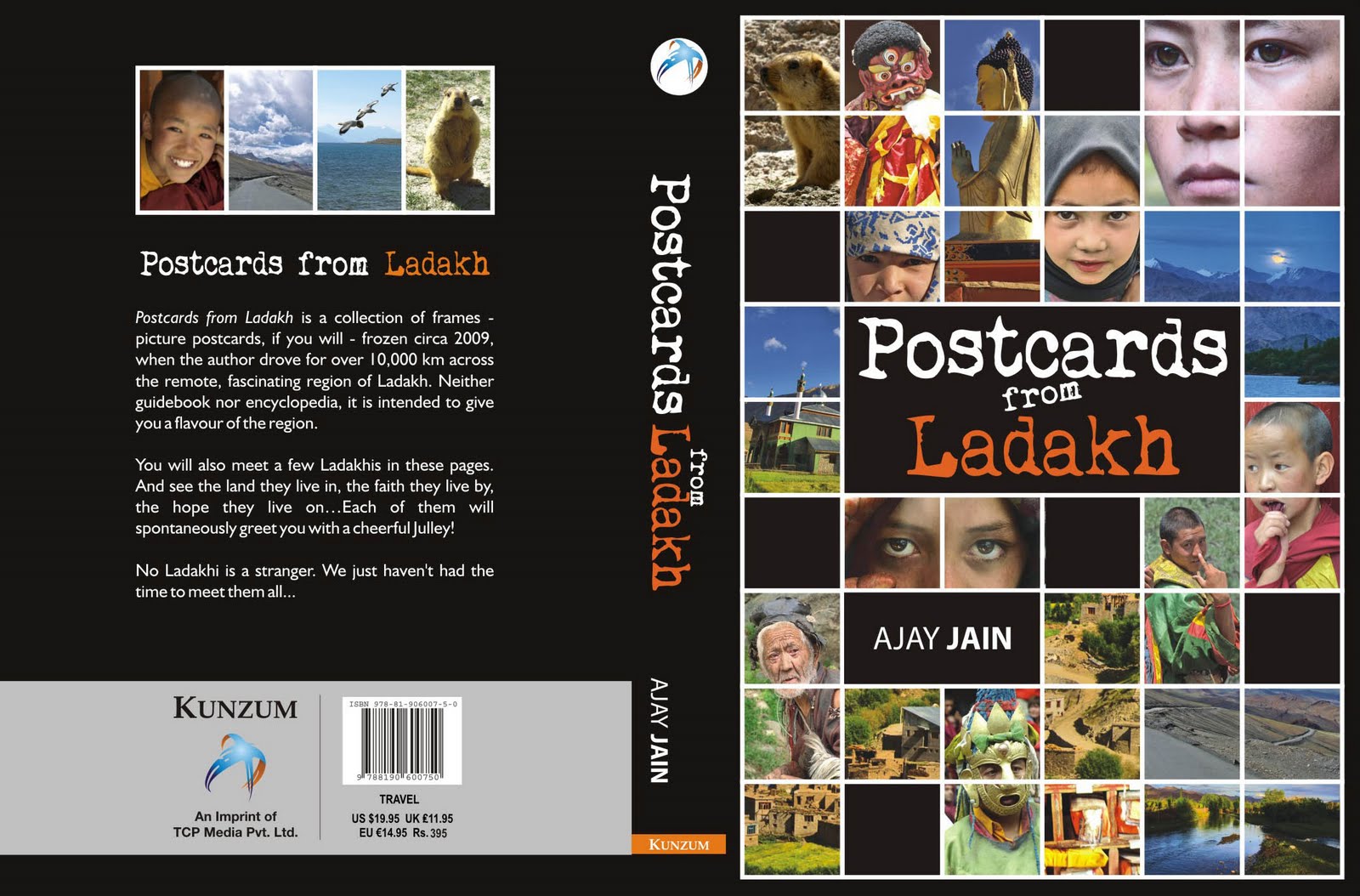
Among the souvenirs I collect during my travels, picture postcards are recurring visitors. Besides being light in weight–both in terms of mass and price, these cards open mini windows to new worlds. Easy to carry, easy to share, easy to keep or frame–picture postcards have almost everything going for them. Well, almost. My one pet peeve with these cards has been the limited information one usually gets about the picture in question–mostly just a line or two and at the most, about a paragraph. Ajay Jain’s new book, Postcards from Ladakh, redresses this issue with commendable facility.

With this book, Jain takes us inside the astonishingly beautiful yet often difficult terrain of Ladakh–among the remotest and most sparsely populated regions of India. Every page you turn is a new postcard–the picture on the left and Jain’s notes on the right. As he notes in one of the opening chapters titled Ladakh, Circa 2009, “Start reading from any page,” for you won’t miss anything if you didn’t follow the exact order of the postcards.

The pictures grab the reader’s attention right away, and once I had seen/read a few cards, I started imagining my own reading of the images before my eyes floated over to Jain’s text. Since this world was as alien to me as that of tribes living in the Congo basin, my imagination couldn’t stretch too far. That’s where this book succeeded in style. It presented me with just enough information on each accompanying picture without overwhelming me with a flood of it or depriving me by sharing too little. Jain writes the notes in affable first and second person voices, generously interspersing them with wit, practical advice and most of all, his passion for the place.

A big chunk of the postcards reflect Ladakh’s Buddhist tradition, its intricacies, distinguishing features and sovereign influence on the local populace. Others highlight the region’s flora, fauna, economy, history, and geology. The last few chapters are extremely useful for anyone planning a trip to Ladakh. In these, Jain provides an experienced traveller’s tips on how to pack, how to move about and how to keep the environment clean. There’s also an engaging interview with Ladakh’s spiritual supremo, the Twelfth Gyalwang Drukpa. I found this a nice touch to this collection of postcards.

I leave you now with an invitation to read this book and with some of my favourite postcards:

This image, depicting an old apricot collector, arrested my attention for quite a while. Do you also find the wrinkles on his face speaking of an unknown, unknowable pain?

Rock art dating to the 6th century AD. On a single rock in the entire region. Intrigued to know more? Visit Ladakh to find out. Or just read Postcards from Ladakh.


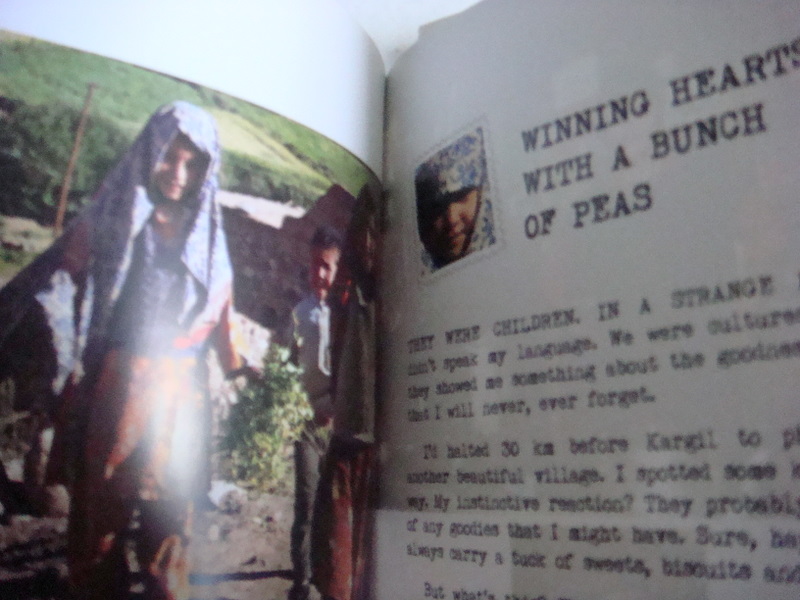
Stories like the one this postcard tells warmed my heart the most. It shows a bunch of happy little children who shared their bounty of sweet peas with the author, expecting nothing in return. Although he did reward them with chocolates, I suspect, he was the bigger winner.


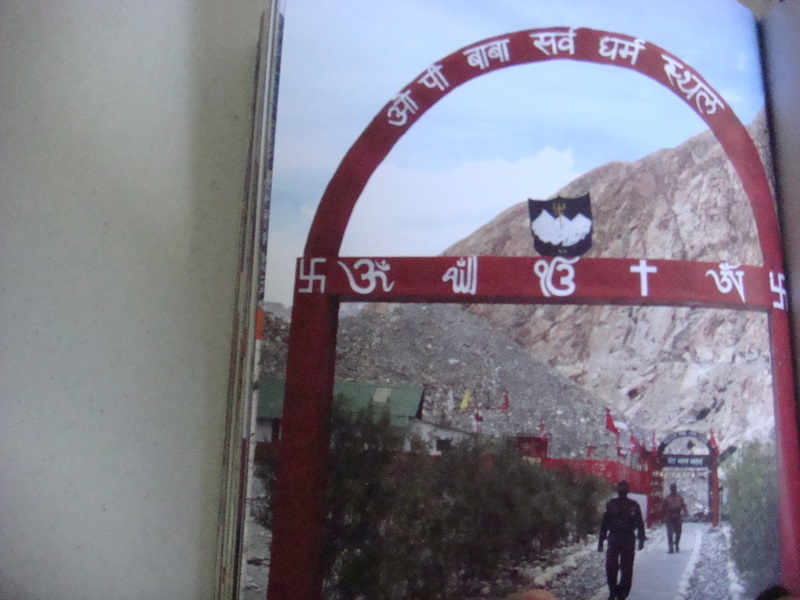
This all-religion shrine, situated in the harsh Siachen glacier is believed to bless its devotees, mostly military soldiers, with special “visions.”


And lastly, this multi-image postcard about Himalayan marmots is just too good to be denied a mention. The author was lucky himself and shares his most entertaining encounter with these “adorable creatures,” who are often a little shy of human presence.


The only additional feature I wished the book included is a glossary of terms. Some of the Ladakhi Buddhist references can get confusing, even with repeated reading. All the same, whether you are in a hurry or at leisure, Postcards from Ladakh is a perfect reading companion. It’s also a smart travel guide without posing as one.

Peep Peep Don’t Sleep: Book Review

Peep Peep Don’t Sleep
By: Ajay Jain
Kunzum
Non-fic (Travel)
Price: INR 350, US $19.95, UK £11.95

Available at: Ajay Jain’s Blog

We thought travel was about visiting places, soaking in new territories, and relishing the journey. Who could have known Road Signs could be part of the travel entertainment package as well? Yes, Road Signs, those inevitable pointers that we take no more seriously than empty coke cans strewn across the terrains we travel through.

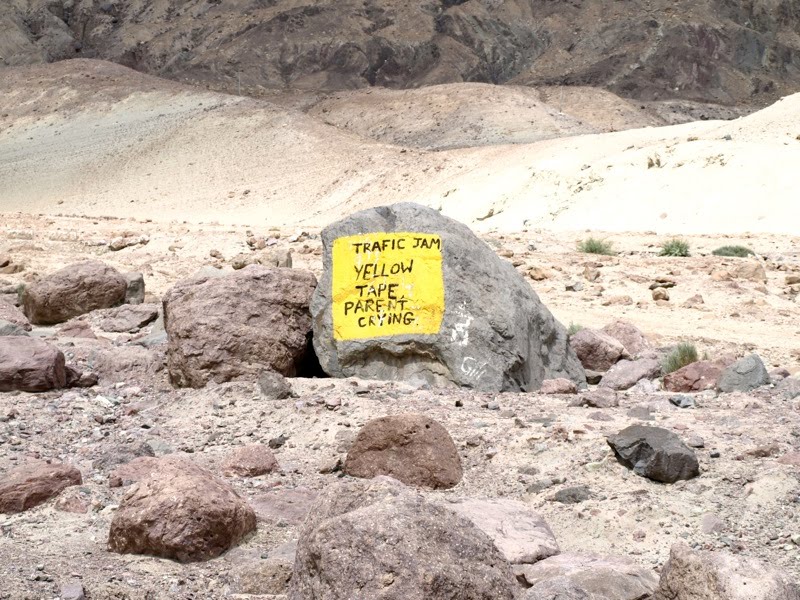
Welcome then, to the world of Border Roads Organisation (BRO), the Indian agency responsible for construction and maintenance of all roads in areas along India’s borders with Pakistan, China, Nepal, and Bhutan. For, BRO, with its BROtherly (even fatherly at times) attitude, can turn the toughest of driving trips along India’s edges into the funniest. Many a traveler journeying through these often rugged stretches must have enjoyed a smirk or four reading BRO’s imaginative Road Signs. Author-journalist Ajay Jain has, however, done a favour to those of us who are yet to grab the fun for ourselves. With his book, Peep Peep, Don’t Sleep.

Jain drove more than 10,000 kilometers, all by himself, through Indian highways for more than a year to photograph some of the most hilarious, and at times, indecipherable Road Signs and advertisements. He didn’t stop there, though, but went on to add witty captions to these images, along with some chuckle-provoking commentary.

Ready for some sampling?

“I am curvaceous, be slow.” Relax, this is no porn movie dialogue; it’s just a hilly road in Ladakh, nudging you, the driver, to go easy with the wheels. And if you still don’t get the message, you are again poked to just “Feel the curves (do) not test them.”

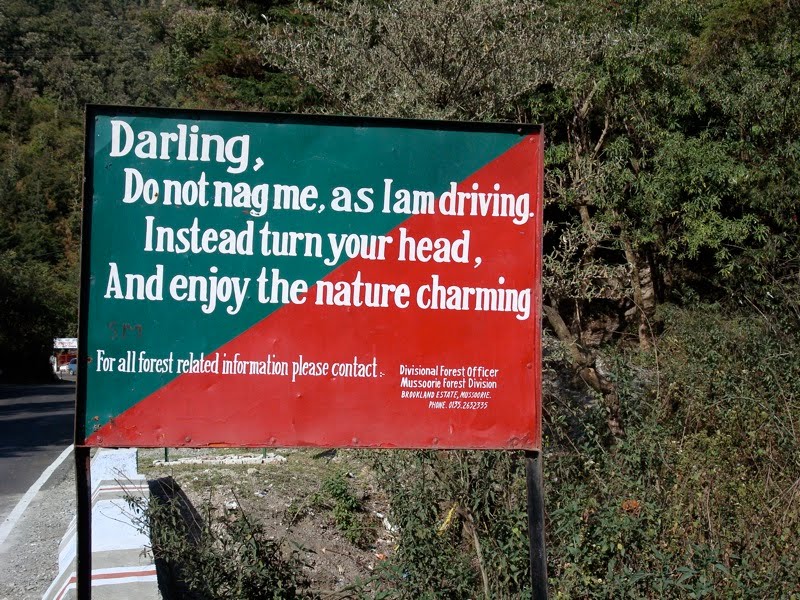
The extent to which BRO can go to encourage drivers to play it safe is amazing. On a road from Dehradun to Mussoorie, a sign speaks thus for a distressed husband:


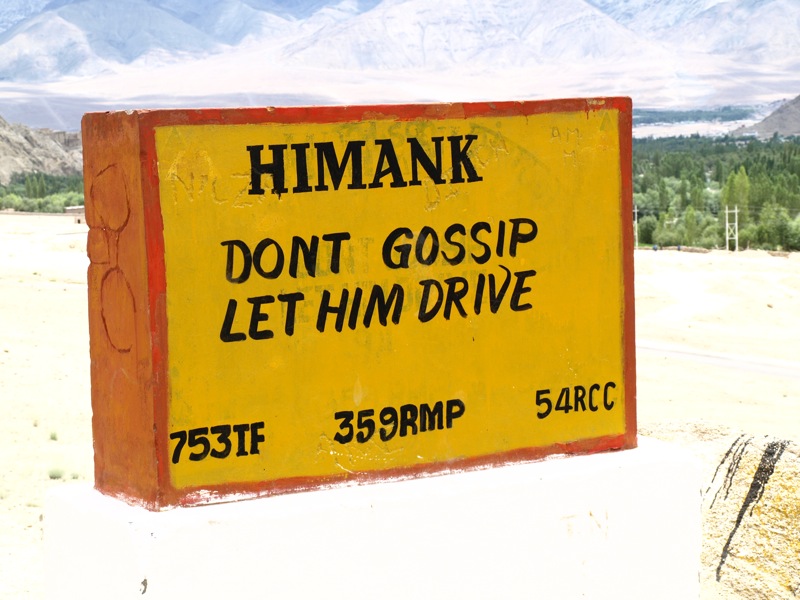
But BRO can’t place such a sign in just one place. And so they warn female partners again at another spot to not gossip as their male companions control the steering.

Jain’s caption to that image can’t stop wondering though, “…Do only ladies gossip?” My question too.

Then there are the cryptic signs. Ones that instead of making you more cautious with your feet on the accelerator will likely leave you scratching your head. Like the following sign. If you can decipher it, kindly do the author and me a favour by letting us know what it means.


And while you are at it, please crack this one too:


By now, you can make out how earnest BRO is in its aim to keep a check on travelers, especially drivers. If one still fails to heed its message, though, one must be prepared to face embarrassment at some point. With a message that says, “Cution. Short cuts may cut shorts.” With such a warning, one can never take any chances, can one? And if the driver still doesn’t listen to the BRO, well, he or she might have to contend with the deadliest of outcomes:


Ajay Jain didn’t just compile funny, inane, and quirky Road Signs in these 200-odd pages. He also went on to put together some of the most bizarre advertisements found across India. A lot of these he found in Dharamsala, the sanctuary of the Dalai Lama and a large number of his followers. His commentary on this section of the book says it all, “Welcome to the Dharamsala School of Quick Learning… You can find enlightenment and knowledge being sold—fast food style—all over Dharamsala…”


Did you know shopping discounts led to tension? So if you are in Dharamsala, spare yourself needless anxiety by shopping at:


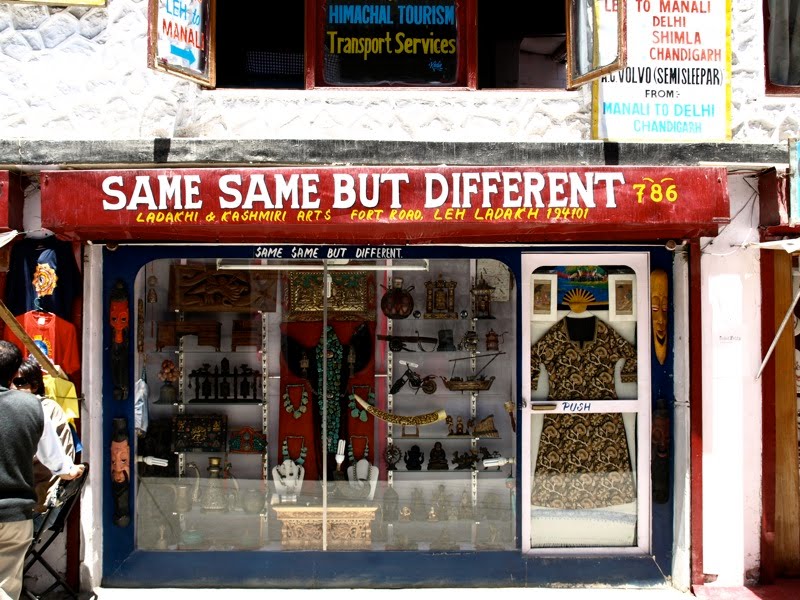
In case you thought all shops selling similar stuff are the same, think again. Or rather, know for yourself by visiting this store in Ladakh:


In the short space of a review, it’s hardly possible to capture the amount of fun “Peep Peep Don’t Sleep” (one of the Road Signs in the book, by the way) packs. As I laughed, smirked and found myself bewildered through Peep Peep’s pages, I also realized this excellently produced book is a keeper. Not only is it a testament to what can happen when the English language is twisted albeit inadvertently, it’s also a manifesto of the BRO’s sincere, if a bit over-the-top aim of cautioning the (sometimes) sleepy, reckless, or drunken driver.

All photos © Ajay Jain

Cross posted at: A Reader’s Words

River Valley to Silicon Valley: Book Review

RIVER VALLEY TO SILICON VALLEY: Story of three generations of an Indian family
By Abhay K.
Bookwell
Available at: bookwell@vsnl.net.in

Dreamers abound this world. In lands spread over all the habitable continents, people dream of living lives bigger than their circumstances allow them. Some dreams are material in nature, some more romantic and soul-filling. I reckon the world is a better place for the dreamers it holds. For, in most cases, dreams, those intangible pieces of impossible ideas, are what lead to the most awesome of deeds. In River Valley to Silicon Valley, Abhay K proves that.

As the book’s subtitle says, it’s the “story of three generations of an Indian family.” Although focused on Abhay’s family, it also tells the story of India’s changing social-scape. Beginning with the tale of the writer’s grandfather and his rural farm life in newly-independent India, the book moves on to recounting his father’s extraordinary determination to receive education and ameliorate village conditions. The book finally brings readers face to face with Abhay and his elder brother as they step out of the village to script their twin destinies in India’s capital—Abhay as an Indian Foreign Service diplomat and his brother as an executive in a multinational corporation.

On the face of it, River Valley to Silicon Valley is just a portrayal of a middle class Indian family’s passage from agriculture to modern vocations, and from breaking barriers within the village to touching stars outside its boundaries. The book, however, is a lot more than that. It’s a testimony of what unflinching self-belief and stubborn focus can lead to—living one’s dream, no matter how far-fetched it may appear in the beginning. As it narrates the story of Abhay and his family in a simple, unpretentious voice, the book stealthily plants the seeds of dreaming big in the reader. Not a bad bargain, that.

The book may not score highly in the show-vs-tell or grammar department. But it is a book with a soul. For this reader, River Valley to Silicon Valley is any day a better pick than soulless books with perfect grammar.

Thanks for writing this honest, inspiring gem, Abhay.

Coming Up: An interview with Abhay K. Stay tuned!

In Conversation with Ramkinkar: Book Review

Yes, I have already blogged about this book. But it’s worthy of two mentions, if not more. Shilpi Ramkinkar Alapchari or In Conversation with Artist Ramkinkar ranks as one of the best books I have read in the last five years. The author, Somendranath Bandopadhyay sure knows how to bring conversations alive on the printed page. For, not one among the series of dialogues this book features reads like a well-structured interview or stiff intellectual discourse. The tone of the book, in itself conversational and informal, makes the animated interaction between the two principal voices even more life-like.

The book’s most overpowering element is the close, personal, and honest view of Ramkinkar, the man. Here is a barber’s son, coming from a financially humble background, pulled by the charm of idol-making in his village, who reaches the zenith of India’s art horizon. This ascension is only a fraction of Ramkinkar, though. What makes it so remarkable is his complete obliviousness to the fame and recognition he achieves. The book presents layer after layer of this lovable artist completely shorn of materialistic or pride-geared ambitions, rooted to the soil for all his life, not overwhelmed while receiving honor, and unfazed in the face of the most shattering despair. I saw a simple man, who never considered himself any special when the whole world revered him as a genius. A man who felt the closest to the people of the earth—the santhal tribal folks—whom he loved and respected from the core of his being for their simplicity, hard working nature and joyful living. I saw an artist so innocent and unadorned that he cared naught for the ways of the civilized world. The same ways he sometimes found so uncomfortable to deal with he calls the people displaying those as “the ones that sound so out-of-tune. “ I also saw a man pulsating with the rhythm of life, radiating warmth, and uninhibited when laughing out loud. Although a book doesn’t carry sound, the power of this one’s words helped me imagine Ramkinkar’s thunderous laughter.

Another day’s story. At the counter of Vishwabharati’s central office. (Kinkarda has) come to the cash section to withdraw his salary. While handing out the pay, the counter colleague politely informs Kinkarda that this would be his last salary packet. Kinkarda is stunned. He says, “Why, why is that?” “You retired a month ago. So…” Hearing that Kinkarda falls off the sky, “What are you saying, what will I eat then? So you won’t give me pay next month?” “No, sir,” the counter official informs awkwardly.

Kinkarda dashes off to the Vice Chancellor’s house. Kalidas Bhattacharya, the VC, was having lunch. Hearing Kinkarda’s voice he rushes out with food-stained hands. After hearing the story he says, “You heard it correctly at the office. The university has to work according to its rules, you see; that’s the problem. But there are provisions for those who retire. You, too, have those. You will receive a pension every month. Besides that there’s provident fund, gratuity…”

Kinkarda is elated. “Ah! I thought the same. There must be some arrangement. See, good thing I came to you. That’s what I was wondering, there has to be a way.”

This man is strange. His anxiety and its release are both worth watching. His mind is detached from all things material. The fists are loose. In those loose fists he’s only held art all his life.

As endearing as it is to see the sculptor’s personality, it’s still not a full view. Without knowing Ramkinkar the artist, the full depth of his inner self isn’t fathomable. Again, the author brings this part of Ramkinkar Baij in all its glory. The conversations mostly hover around the artist’s works and the author’s keen understanding of them. We get deep into the mind and heart of a creator, learning how each of his works came into being—both mentally and organically. Someone who has no artistic acumen, the discussions on Ramkinkar’s finest creations fascinated me with every nuance leading to their origin. To learn that the figure of Sujata, the woman who had served milk rice pudding to Buddha, had actually been inspired by a lanky student at Shantiniketan was not a let down, but a revelation. Especially when one learned the associated story of how the famous Nandalal Bose, Ramkinkar’s mastermoshai at Shantiniketan, advised putting a bowl on top of the woman’s head, transforming her into Sujata.

“Study isn’t done only with open eyes, but with the eyes closed as well. You see beauty with your eyes and with your heart. Only when the two meet is the seeing complete….Your eye’s vision comes near the heart’s, and the heart’s vision moves toward the eye’s. Somewhere in the middle they meet…But this meeting isn’t free from conflict, my dear, it has a lot of friction. And what remains after all the clash isn’t two any longer—the two then merge into One.”

In Conversation…mentions how even Tagore acknowledged Ramkinkar’s genius. One day, the poet summoned the young artist to his room. When the latter answered the call, frightened and nervous, Tagore said to him, “So, will you be able to fill this entire campus with your works?” Probably the greatest prize Ramkinkar received (and he did receive some prestigious awards).

While reading the book I lamented not being born early enough to see this humane, child-like, genius of a sculptor. But I am glad Somendranath Bandopadhyay preserved his essence so lovingly for me to cherish.

Note: All quoted text written by Somendranath Bandopadhyay, translated by Bhaswati Ghosh.

Living Conversations

Capturing the life, sensibilities, and works of a person—that’s what biographies and autobiographies are made of. But could there be another way to bring to life the essence of an individual? If the book I am reading these days is anything to go by, the answer is yes, emphatically at that.

Shilpi Ramkinkar Alapchari
or In Conversation with Ramkinkar by Somendranath Bandopadhyay (review promised later) is an amazing read. An intriguing glimpse into the mind and heart of one of India’s most revered sculptor-artists, the book is neither a biography nor a series of interviews; yet perhaps it is more than either. The curious thing is that the book cannot be strictly classified into any type. Like Ramkinkar Baij’s life and art, it transcends stale definitions. As I read through this informal set of dialogues the author and the artist shared over the course of a year, I wonder what is it that keeps me—someone who has no background in visual arts—so hooked to the book? I have nailed some of the reasons:

1) Interesting subject: For me, this is the strongest aspect of the book. The author chose to record his interactions with a person who has such an original voice that is sure to pull a reader. Ramkinkar’s free-spirit, touching diffidence, ability to remain untouched by both praise and censure of the highest order, and his child-like innocence and absentmindedness—all these make him so “approachable” for the reader. The author does an admirable job of bringing Ramkinkar as he was, mainly because he keeps the sculptor’s voice intact.

“To tell you the truth, I have found everything from life—no less than twelve annas, could be more. All these things that surround me, the fields, village people, the everyday life of Santhals—all this. Just see all the drama that goes on through the year. Keep your eyes and ears open—and see—fill your two eyes to the brim—soak in all you want to. How much can an artist take during his lifetime anyway?”

2) Distinct voices: Another facet that makes this ongoing conversation so engaging for the reader is the difference in the author’s and the artist’s voices. Bandopadhyay has done a superb job of distinguishing the two voices—his own marked by cultivated sophistication, Ramkinkar’s by unrestrained expression. This only fits the nature of the book—telling us two different people are talking to each other about a shared interest.

This morning, I am a bit late in coming to him. I enter; a little ashamed. He is looking for something. Every now and then, his hands reach under the pillow. Hearing the sound at the door, he looks up. A lost look.

“Where did it go? I’d kept it here only. Saw it in the morning too. Just a while ago.”

“What is it? Have you lost something?”

“A two-rupee note, my dear—red note, small. Trouble is, there’s no bidi. The container is empty. I think there were some bidis in it. Vanished.”

“Shall I look?”

“Do, please.”

No, Kinkarda’s said red note is nowhere to be found. I search everywhere. At last, a torn-cover notebook comes out—from under the bed sheet. If anywhere, the note has to be inside it. In between the folds of small chits. One says “two matchboxes,” another “Charminar—1 packet.” The dates are very old. Suddenly, I notice a folded red something. Yes, it’s money. Not a two-rupee note, though, but a cheque. After the first figure, multiple zeros stand in a row. But the date? Like in those chits, it elapsed long ago.

“You found it?” Kinkarda eyes it, too. His animated eyes gleam with the joy of discovery.”

“Not a note; this is a cheque.”

“Oh, I thought we found it.” Kinkarda becomes frustrated again.

A fat-amount cheque lies in neglect under the covers. The man is restless over a small red note.

The bidi arrives, though. The co-operative store is right in front of his house.

With a gladdened heart, he rotates a bidi in his fingers before putting it into his mouth. Shaky fingers light a matchstick. He releases the smoke in a long, satisfied swirl.

“What’s that book in your hands?”

“Jacob Epstein.”

“Wah, wah! It has plates, I hope?”

“Of course.”

He looks at ‘Rima’ intently. Then, ‘The Day and the Night’. For a long time. The bidi smoke keeps ebbing out, until it disappears. He dumps the unconsumed dying bidi in the container and holds the book up with both hands.

“Do you see what he has done?”

Loving respect lights Kinkarda’s face. His eyes run over the sculptures so familiar to him, as if he is shedding affection on them with his joyful glance.

3. Author’s passion for the main theme: I believe that’s the basis of this conversation. The author, in spite of serving as a professor of Bengali literature in Shantiniketan, happens to be a passionate art enthusiast and has written an important book on Tagore’s art. His conversation with a great sculptor becomes so lively only because he himself is a lover of the subject and has studied it deeply. The author shows a fine appreciation for Ramkinkar’s works and doesn’t shy away from sharing his unease over a few finer points of some of the sculptor’s greatest works.

“I really like that work (The Storm) of yours. I like it because of its stunning vitality. The pulse of life in the two girls’ figures is of course there, but what really astounds me is the soft smile in that hard rock…

But I have a doubt, Kinkarda. Been having it for a long time now. I have thought of talking to you about it. Couldn’t muster the courage. Now that I have the chance, may I?

That boy’s figure. It feels as if it has been forcibly added. I have seen it carefully a lot of times. Tried to understand the work. Somehow, the boy’s figure isn’t in sync with the rhythm of the women’s figures. Even though I like the figure, I like his stance.”

Kinkarda keeps quiet. For a long time. He must be thinking of something with closed eyes, or revolving around his creation in his mind’s eye.


“There’s vitality in the boy’s figure, too. But I can’t totally dismiss your observation, my dear. No, no, you are right. Right you are…

Listen then.

The folds behind the girls’ saris’ ends—do you know how much those weigh? They are loaded with iron and concrete. It’s very difficult to keep them floating. You are seeing the end is flying; you see it with light ease. And me? I had sunk under the pressure of those folds. How do I keep those ends flying? A sculptor has to think about these practical things. I was harried with those sari ends. Ha, ha, ha. In the end, I added that boy. It’s a support. I even gave him my flute. To stand there, touching the sari ends.”

4. Description of setting: The author’s literary bent comes into full view when he recounts the atmosphere in each chapter. Not just the surroundings, but the atmosphere of Ramkinkar’s face, his typical mannerisms, his loud laughter—all recreate the different hues of moods the author had experience as he chatted with the genius sculptor.

20, Andrews Palli. Kinkarda lives in this house now.

He sits in the front room by the small slice of verandah. Sitting, sleeping—all in this room. The door is ajar. It stays like that all the while. Looking at the near dark, silent room it’s hard to believe Kinkarda is here at the moment. Can he ever be compared to this deafening silence?

The very mention of this name brings up so many images in the mind.

Kalabhavan premises. Kinkarda sits under a tree during some free moments off his teaching. A bunch of curious students from different countries huddle him. A thunderous guffaw booms out of this engrossed assembly and stuns passersby.

Kinkarda stands on an elevated platform. He wears a saffron lungi, a tal-leaf toka on his head, his lips sealed. The tireless hammer and chisel in his hands break the afternoon stillness. A newly-born sculpture faces him with a hard concrete body. There’s no measure of time.

Is it any wonder that the more I read this book, the more I feel I know Ramkinkar, the free man, the marvelous sculptor, intimately?

Note: All quoted text written by Somendranath Bandopadhyay, translated by Bhaswati Ghosh.

Images:

The Speculist
http://www.pbase.com/cassanco/image/48243916