After a week of rain, hail and non-seasonal arctic chills, a balmy sunshine and a breeze carrying whispers of spring indulge us in the Southern Ontario suburb where I live with my husband. With a book in my hand, I step out into the backyard and find it to be the venue of an unrehearsed celebration of this climatic turnaround. All our immediate neighbours are out – the daughters of our next-door neighbours yell hellos to their school friends in the backyard across theirs; our other next-door gardener neighbour is busy tending to her perennials; my husband readies the soil for his impending vegetable garden.
Human hums and giggles enter me along with the constant chirp of the backyard birds. As I open my book Chhinnapatrabali – Rabindranath Tagore’s collection of letters, written for the most part to his niece, Indira Devi Chaudhurani, I don’t miss the rare synchronicity this moment brings, especially in our current physically distanced world. The cover of my reading material is beginning to tear up, evidence of the book’s confidant-like association with me through the decade of my life outside India.
Tagore wrote a lot of these letters from his family estate in East Bengal, which he’d been tasked to manage in his youth. While opening a window to his literary talent and creative process, the letters also serve as a manifesto of living in and celebrating solitude and its many gifts. A shift away from the human-centric way of life is one of these gifts. In letter after letter, Tagore speaks of how, whenever he lands in the rural environment of his estate from the industrially-rushed Calcutta, he senses centrifugalism of the humankind. “There’s less of man and more of earth here,” he notes in a letter and adds, “when in the village, I cease to see man as an independent entity,” likening mankind’s journey to that of rivers coursing their way through forests and cities.
Chhinnapatrabalialso endears itself to me because of the way it reveals the everyday Rabindranath, shorn of his career accolades and their accompanying weight. With gentle humour and uncensored vulnerability, the letter writer brings out his deepest loves and anxieties, his humanism shining through them like the sun gleaming in our rain-sodden backyard.
In reading the letters nestled in this volume, I learn, recurrently, the need to take a pause from the staged antics of a mechanized life. For, as Tagore shows, true viewing – whether of blackbirds and squirrels in my backyard, or the rivers and trees, boatmen’s songs and women’s banter, cows chasing flies away with their tails, a silent full moon night in a Bengal village – calls for rest and repose. Not only of the outer eye that sees. But of the inner eye that makes, out of one, a seer.
When shallow, water extracts
its wages in laughter peals. Children
Slosh in the lake filling buckets, spilling
More than they draw, like their giggles
splattering over the beach.
Mothers keep watch from the shore with sips
of wine, not aged yet. Grandfathers slide back
to afternoons when sibling platoons
scattered their own ruckus on the sand. Backwards
Is the aging mind’s favourite sandpit.
At the deep end, water gets more exacting.
It asks for payment in palpitations, dense
heaving. It’s voluminous crests mock
blood rush, adventure, even love.
There’s no digging at the deep end, only
swimming and sinking. You age as the water
does — angry, quickening, fateful.
Between the shallow and the deep ends,
Water makes you float. Gravity is a
slippery trickster. Not a bedrock.
Spring has lost its
Spring and doesn’t
spring anymore. It waits
a long time to
alight from behind a steely
Curtain. Politely, in slow
Overtures, with well-rehearsed
daffodil smiles.
Once spring was rambunctious,
impolite. It burst open
Like a ripe wood apple
In summer, pregnant with
Forbidden pleasures.
Spring lured us into sucking
a pit off its berryness.
Abandoning textbooks.
Diving into a sea of
yellow, the colour
of sudden love. Faces were
canvasses for
freestyle paint-throwing.
Spring waited for no one.
It raced straight into summer.
Spring. Sprint. Vanish.
The ripening berries its
only remnant. As tart and
impolite as spring.
As irresistible.
A nahabat recital can be heard playing somewhere today. A morning nahabat makes the heart quiver strangely. I haven’t been able to discern the significance of the unspeakable state that envelopes one’s mind when listening to music. And yet, every time the mind attempts to dissect that state. I have noticed that whenever beautiful music plays, the moment its intoxication hits the soul, this world of life and death, this land of arrivals and departures, this world of work, of light and darkness recedes into a distance — as if across a vast Padma River — from where everything appears as if it were only a picture.
To us, our everyday world doesn’t always appear to be the most well balanced. A tiny fraction of our life might seem disproportionately huge, our hunger and thirst, daily squabbles, rest and labour, petty annoyances besmirch the present moment. Music, with its beautiful intrinsic equilibrium, can, within moments make the world stand in a perspective where the small, transient imbalances disappear. With music, a whole, vast and eternal balance transforms the entire world into a mere image, and man’s life and death, laughter and tears, past and future land in the present to play in one’s ears as the meditative rhythm of poetry. With that, the intensity of our personal tendencies decrease, we become puny and immerse ourselves without strain into the immensity of music.
Small and artificial social ties are useful to function in the society, yet music and other evolved art forms instantly show us their insignificance, making every art somewhat antisocial. This is why listening to a good poem or song quickens our hearts, tearing asunder social formalities and igniting in the mind a struggle that seeks the freedom of eternal beauty. Anything beautiful stirs in us a conflict between the fleeting and the permanent, causing us a certain inexplicable pain.
Poona | May 6, 1895
Nahabat:A temple music tower. Musicians sit on the upper story and play during festivals and sometimes at the time of daily worship. (Source)
After spending a long time on the boat, it feels wonderful to have suddenly arrived at the Shazadpur house. Light and air streams in unrestrained through the large windows and doors — wherever I look, I see green branches of trees and hear bird call. The moment I step out to the southern verandah, all the veins of my brain fill with the fragrance of Kamini flowers. All of a sudden I realize a hunger lurked within me for an expansive sky — being here has fulfilled it completely.
I am the sole master of four large rooms — I sit with all the doors open. The inspiration and motivation that I receive here to write is unlike that in any other place. A living essence of the outside world enters me unhindered through the open doors — the light and the sky and the air and the sounds and the smells and the waves of green mingle with the passions of my mind and create innumerable stories. The afternoons here, in particular, have a deep spell. The sun’s heat, the silence, the quiet, calls of birds, especially the crow’s and an extended period of leisure make me pensive and eager.
I don’t know why I have a feeling that Arabian stories are made of afternoons like these brimming with golden sunshine. Those Persian and Arabian lands of Damascus, Samarkand, Bukhara…those grape clusters, rose gardens, the nightingale’s songs, Shiraz wines, desert paths, rows of camels, horse-riding wayfarers, a clear source of water amidst a thick curtain of date trees…cities with narrow royal lanes festooned with awnings, a shopkeeper wearing a turban and comfortable, loose-fitting clothes — selling melons and mewa at the end of the street…a massive royal palace by the roadside with incense smell wafting out of it, a huge mattress covered with kimkhwāb placed by the window…Amina, Zubeidi and Sufi in zari footwear, wide pajamas and colourful corsets as they inhale smoke rising off a curled hubble-bubble near their feet, at the door, a habshi dressed in flashy clothes stands guard…and in this mysterious, unfamiliar faraway land, in a wealth-filled, spectacular yet eerie royal palace, thousands of stories — possible and impossible — are being created out of the laughter and tears, hopes and anxieties of humans.
These afternoons I spend in Shazadpur are fabled afternoons. I remember writing the story “Postmaster” sitting at the table fully engrossed right at this hour. As I wrote, the light around me, the breeze and the shivering tree branches all added their language to it. There are few joys that come close to creating something close to one’s heart by being immersed in one’s surroundings. This morning I became inclined to write something on limericks and could become thoroughly involved in it, which brought me immense delight. Like the world of clouds, limericks make for a free country unbounded by rules and laws. Unfortunately, the land that rules and laws dominate is never far behind to follow one. As I wrote, a sudden insurrection of officials stormed in, blowing to dust my land of clouds.
When that ended, it was time to eat. There’s nothing more sloth-inducing than eating a full meal in the afternoon. It overwhelms one’s imagination and the spirit’s higher callings. Bengalis are unable to enjoy the deep intrinsic beauty of an afternoon because of their predilection to eat sumptuous meals at that time and follow that by closing the door to smoke on tobacco and slide into a satiating slumber. This is what makes them hale and hearty. But nowhere do quiet, desolate afternoons spread over in the sweeping, silent manner in which they do over Bengal’s uniformly limitless, plain crop fields.
Afternoons like these have haunted me since childhood. Back then, no one used to be in the outer third-storey quarters; I alone sat in the angular couch with the door wide open and a warm breeze blowing in. My entire day went by in the company of vivid imagination and unspeakable desires.
The more you spend time on your own on a river or in an open space in a village, the clearer it becomes that nothing could be grander or more beautiful than to simply do your daily work with ease. From the grass in the field to the star in the sky, all elements are doing only that. Because nothing is making a desperate attempt to cross its limits, there’s such immense peace and beauty in nature; and yet, whatever each thing does isn’t all that valueless — the grass has to use all its energy to remain grass; it must engage the very end of its root to the ground to soak in the nectar. The earth is so resplendently lush only because the grass doesn’t try to overstep its boundary or ignore its routine work with the ambition of becoming a banyan tree.
In reality, it is through fulfilling daily small tasks and duties, not through grandiose initiatives or overstatements that the human society maintains its grace and harmony. Whether it is art or valour — nothing is complete in itself. On the other hand, even a small act of duty contains contentment and wholeness. To sit and continuously gripe, contemplate, consider every situation to be unworthy of oneself — all the while letting time and small and big obligations slip one by — nothing could be worse than that.
When one resolves to and believes in one’s ability to carry out all tasks up to one’s capacity with truth, strength and a full heart amid all pleasure and pain, one’s entire life is filled with happiness and all petty sorrows disappear.
A series on my experiences as an immigrant in Canada.
I try to imagine my mother’s face when I tell her over the phone that I’m coming home. When I tell her I’m coming home for Durga Puja. I try to imagine her face during every subsequent transatlantic conversation we have. I grapple to picture the contours of her face as we talk — has it grown a wee bit more cherubic ever since I told her I’m coming home? I ask her what she’s doing whenever I call her. She says she’s drinking her morning tea and I try to discern a smile in her voice, to distinguish it from the “tea drinking” reports she gave me every day until she learned about my visit. When she tells me she has asked for help to spruce things up around the house before I get there, I try to decipher the braille of her expression as she made that appeal. I trace impressions of jaws widening, eyes brimming up with sleepless excitement. We could Skype, we both have the tools, but we mostly talk over the phone. She knows how to see me through my voice, and the oceanic gulf that has kept us apart for the nine years since I got married enables me to see her the same way — through her quivers and monotones, her heaving sighs and squeals. Sometimes our phone calls trade in gossips and passionate debates. She cracks jokes on others. And on the government of the day. When this happens, I’m relieved in the knowledge that the weight of wrinkles haven’t yet buried that impish grin on her face. I see that, too. In the waves of her trills.
Morningness bathes you. Grandfather’s Arms rise skywards. The newspaper-man hurls elastic-clasped, rolled-up headlines into the porch. Mother lights the stove to wake up milk.
Ahir Bhairav takes you to a place so empty, it’s full. The absolute centre of nothingness. The beginning of all beginnings. A lighthole.
In a slowly-igniting corner of your mind, your guru’s saintly beard unspools. You can hear him talking about the sadhu who devoted his life to the service of Bhairav, the primordial sound. Your guru’s smile is a cryptic message now.
Vilayat and Imrat lead you with strings. Unscratched morning flows into a cowshed. The uniraga sadhu still befuddles, but with Ahir Bhairav, you partake in a fraction of his madness, his self-absorbed samadhi in the lighthole.
The school girl dreams. One day she’ll tune her voice to the throat of the songbird whose call mocks the cage of age.
***
2.
FISH OUT OF WATER
Water was the first traitor she came To know. It didn’t drown her. Seasoned traitors seldom do that. She was the river’s sibling-child, knew its mood swings, joaar and bhata like she did her night terrors, throat-clasping. Easy to forget once the grip loosened.
When father spread his net over its body, the river heaved through the mesh, packing fish into its giant mouth. She should have known then What it is to be thrown onto dry Ground. Gasp. Wriggle. Writhe. Succumb. Forget that water ever nestled your breath.
The river’s betrayal came not in abandoning her. It did when it became a concrete mesh, And she, a fish in the city’s sewage tank.
A long-dead poet brings home truths to the work desk. Mid-day ennui seeks lunch break and a walk in the park. Between flesh and flight, the girl chooses to ride the breeze Like kebab smoke trailing the gallies of purani Delhi. Careless, footloose. Another dead poet dreams of a new day on earth, a more womanly day. Old wounds find new ways of festering. Congealed blood rejects washing. Rain harnesses in megapixels tears that no longer wet hearts.
Inside the bus, secrets waited. (Illustration: Suvajit Dey)
Riding a bus had become foreign to me. As foreign as waking up to noiseless mornings that could put nights to shame with their stark absence of light. Since migrating to Canada seven years ago, I had let myself happily slide into the snug comfort of a personal car to get around.
One winter morning, that ceased to be the case.
In the middle of December 2017, I found myself waiting for a public bus on a steel-grey dawn with mountains of stiff white snow all around me. A change in the work life of my husband, with whom I used to share a car to get to the workplace, had just shaken up my daily commute. This meant a not-so-minor adjustment, coming as it did during the country’s unforgiving, bordering on dangerous, winter. The bus stop nearest to our house was a good 8-minute walk, not the best idea in a period visited by frequent and violent snow squalls. The next best alternative was to leave early in the morning, an hour and a half before my usual schedule, so that my husband could give me a lift to the bus stop — the first of the two I needed to wait at — before proceeding to his place of work in a different city.
Standing there in the pitch dark of a sunless morning, an arctic chill cutting through my skin like a hundred hypodermic needles, I wondered if I’d be able to bear the regimen for too long.
My interest in the ethics of public transit, especially as it related to reducing carbon footprint, wouldn’t merely be put to test but seriously challenged as I became a daily bus passenger amid temperatures plummeting to -20C and below. At each of the two bus stops, I would have to wait anywhere between two-nine minutes. Then, after a half-hour bus trip, I would have to walk for another six minutes to reach my office from the bus stop closest to it. Enough time for a skin-numbing life lesson on the power of a single minute.
The Insider’s View
Inside the bus, secrets waited. There was warmth and ease, and not only because of the controlled temperature settings. The first time the bus turned a right-hand corner instead of moving straight on the road that led to my workplace, I sighed in frustration. This easily meant a longer commute than I was used to. Within moments, we were deep inside the sprawling campus of a university. A new world — of gothic buildings nestled in woods, winding roads and sidewalks and a river bisecting the eastern part of the campus — kept extending before my eyes like a poetic dream. Even the heaps of snow that blanketed most of the landscape couldn’t mask the beauty and magnificence of it.
Over the course of the long winter I would look forward to this — the most twisted — part of my commute the most. Tall trees across the campus, rendered nameless by their wintry bareness, framed the building structures with their filigreed branches. Looking at them I forgot clock-controlled time. For an instant, I would imagine what the place would look like in spring or summer. Yet, I was in no hurry for that visual to manifest. What lay before me sufficed, spectacularly.
Immigrants are notorious creatures of existential comparison. Riding the public transit inevitably brought back for me memories of commuting to college in Delhi by DTC (Delhi Transport Corporation) buses, necessary yet dreaded. The three years of my undergraduate programme required me to board a crowded bus from Kalkaji to Netaji Nagar, always late and often tilted with the weight of the humans it carried. My experiences as a female passenger in those three years made me vow never to ride a DTC bus once I had a job. I kept this promise to myself. From day one of earning a salary, I switched to Delhi’s ubiquitous paid personal transport — the autorickshaw. This was and felt like, a luxury, considering my paltry income. It also increased my respect for my mother, who had to rely on DTC buses for the entirety of her working life, travelling from south Delhi to North Campus. In Delhi’s hyper materialist environment, anything that cost you more indicated your ascension on the status-symbol ladder. If you could afford an auto, you would never look back at a DTC bus again.
Two decades later, as I ride the public transit at the other end of the world, the democracy of the act intrigues me. Beyond the obvious inclusiveness of wheelchair and infant stroller access, the bus here is what the suit-and-tie executive rides alongside the homeless bum with his overflowing cart of broken belongings. Its egalitarianism has liberated me from any stigma I might have been carrying for the public bus in my subconscious.
A Public Inn
Some of the closest friendships my mother enjoyed were forged in the public bus. As an introvert, I listened with envy to her stories of the in-bus sisterhood of working women. They shared everything, from in-law problems to kids’ issues, health worries and edible treats. Not having inherited her propensity for bonding with strangers, I have found books to be my most trusted bus buddies. Reading a book inside a moving bus is exhilarating. From Delhi to eastern India to rural China, the geographies I have traversed through the pages of the books I read seemed to take on a more active, pulsating life with the bus’s jerks and swerves. As I read, the distractions around me — the university students’ banter, the bus driver’s announcements, the view outside the window — taught me how the world of a daily passenger is both solitary and communal. The silent alliances formed are no less real than verbal ones. There’s reassurance in the mere act of travelling together, even if you don’t exchange a single word.
The daily bus route to my office, curiously numbered 13, didn’t merely help me survive the Canadian winter on an unyielding snow belt; it took me to a spot — aesthetic and emotional — where I ended up writing a poem on this journey. As I would discover, the public bus has its own community of poets and artists. Poetry on Buses is an initiative that encourages daily commuters in King County in Washington, the US, to write poems on their experiences on the bus and other modes of public transit. Their poems are then displayed on the local transit systems. In 2016, the project invited poems on the theme, “Your Body is Water.” The obvious comparison between water and public transport reminded me of own poem in which I imagine the streets on which the bus runs as a meandering river. In London, Ontario, where I live, a woman artist drew a series of sketches depicting life in the bus. She went on to post her illustrations at bus shelters around the city as a gesture of her appreciation for this mode of transport and its role in engendering a spirit of community.
The public bus is no longer foreign to me. It’s a mobile inn where I rest and recharge myself before the world appropriates my limbs and spirit.
“She was playing with little girls in the neighbourhood alley.”
This is how Saadat Hassan Manto opens his story Das Rupay (Ten Rupees). “She” is the story’s young protagonist, yet, as Manto implies by introducing her with the generic third-person pronoun instead of her name, she could be any girl. Nearly eight decades after he wrote that story, she – the fictitious Sarita – seems to be gathering a disconcertingly increasing number of real-life sisters in India. As one comes across news reports of little girls being sexually violated – each more harrowing than the other – across the country, Das Rupay serves as an unnerving reminder of everything that’s at stake for and taken away from a young girl when she is raped.
Pushed into the flesh trade by her mother, 15-year-old Sarita is more a little girl than a teenager. Like most little girls, she’s free from worries. She enjoys, like I did in my teens, playing with girls a lot younger than her. And from the slivers of her personal life that have filtered through the horrific news surrounding an eight-year-old girl’s rape and murder in Kathua, we know she enjoyed playing with her horses. More recently, in the case of an 11-year-old girl who was raped by a dozen-and-half men over seven months in Chennai, her mother blithely assumed her daughter was playing with her friends when, in fact, she was being sexually abused.
Back in my teenage years, not all neighbours appreciated my propensity to play with girls younger than me. Some found such “childishness” annoying. As Tagore, too, illustrates in his short story, Samapti, this expectation for a girl to relinquish her girlhood no sooner than she hits puberty is anything but atypical in the Indian context.
In Das Rupay, Sarita’s playing in the nukkad irks her widowed mother for a different reason. Her daughter is an easy source of income and she hates to keep Kishori, the local pimp – and the fat-pocketed customers he brings – waiting. As a cover for her complicity in trafficking her own child, the mother makes tall claims like, “I’m thinking of enrolling her to the municipality school that just opened,” which her neighbours know to be a sham. Sadly, for today’s flesh-and-bone Saritas, the school building isn’t always a safe place. School teachers, older students and even a principal in Patna can turn into sexual predators, as recent news reports suggest.
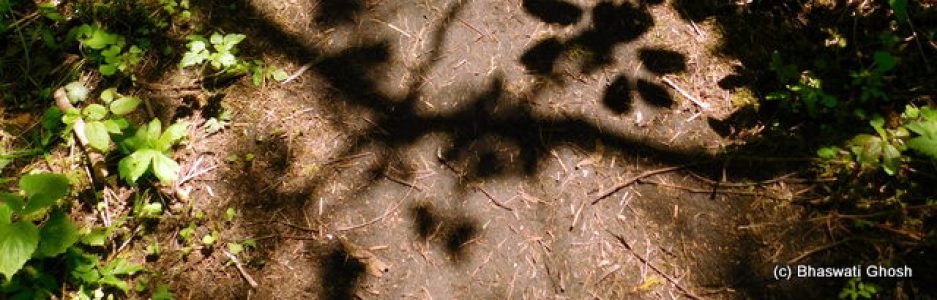
 After a week of rain, hail and non-seasonal arctic chills, a balmy sunshine and a breeze carrying whispers of spring indulge us in the Southern Ontario suburb where I live with my husband. With a book in my hand, I step out into the backyard and find it to be the venue of an unrehearsed celebration of this climatic turnaround. All our immediate neighbours are out – the daughters of our next-door neighbours yell hellos to their school friends in the backyard across theirs; our other next-door gardener neighbour is busy tending to her perennials; my husband readies the soil for his impending vegetable garden.
 Tagore wrote a lot of these letters from his family estate in East Bengal, which he’d been tasked to manage in his youth. While opening a window to his literary talent and creative process, the letters also serve as a manifesto of living in and celebrating solitude and its many gifts. A shift away from the human-centric way of life is one of these gifts. In letter after letter, Tagore speaks of how, whenever he lands in the rural environment of his estate from the industrially-rushed Calcutta, he senses centrifugalism of the humankind. “There’s less of man and more of earth here,” he notes in a letter and adds, “when in the village, I cease to see man as an independent entity,” likening mankind’s journey to that of rivers coursing their way through forests and cities.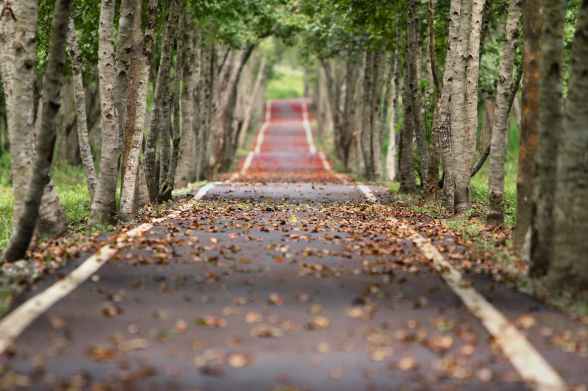

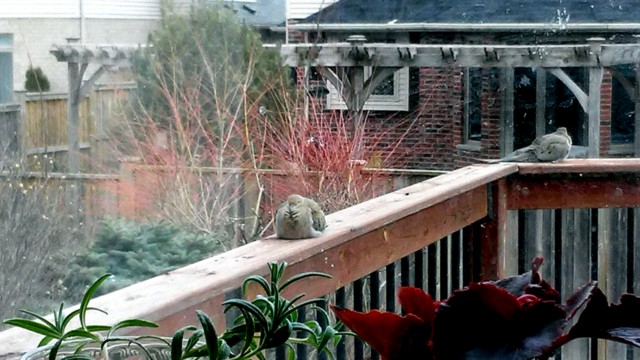
 y to imagine my mother’s face when I tell her over the phone that I’m coming home. When I tell her I’m coming home for Durga Puja. I try to imagine her face during every subsequent transatlantic conversation we have. I grapple to picture the contours of her face as we talk — has it grown a wee bit more cherubic ever since I told her I’m coming home? I ask her what she’s doing whenever I call her. She says she’s drinking her morning tea and I try to discern a smile in her voice, to distinguish it from the “tea drinking” reports she gave me every day until she learned about my visit. When she tells me she has asked for help to spruce things up around the house before I get there, I try to decipher the braille of her expression as she made that appeal. I trace impressions of jaws widening, eyes brimming up with sleepless excitement. We could Skype, we both have the tools, but we mostly talk over the phone. She knows how to see me through my voice, and the oceanic gulf that has kept us apart for the nine years since I got married enables me to see her the same way — through her quivers and monotones, her heaving sighs and squeals. Sometimes our phone calls trade in gossips and passionate debates. She cracks jokes on others. And on the government of the day. When this happens, I’m relieved in the knowledge that the weight of wrinkles haven’t yet buried that impish grin on her face. I see that, too. In the waves of her trills.

 Bhaswati Ghosh