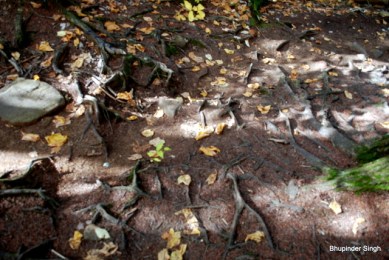
Retracing Dandakaranya

059-DSC_1860
First published in Indigo Lit
For Titti

I search for your footmarks
In the arid, rocky terrain. The
Agility of your feet eludes mine.

The jungle notes you left behind
Shriek with trauma. Of green groves
Uprooted from rivers, thrown amid
Stones and cacti. Yet I sleep restfully. The
Shrapnel that ripped apart your
Nights doesn’t touch me.

Half a century later, the cracking
Earth has smothered the laughter
Of the Adivasi girls you met. The
Mountain still burns the same. With their
Heaves. And the lava of their rage as mining
Corporations show them their two-penny index.

The desert retains some of
Your tears– corroded, insoluble.
Those refugee girls you taught? They
Must be doing well by now. So I tell myself.

But look, how like them, like you,
I’m still looking for home. The
Albatross refuses to take flight.

Dead Man Talking — Hassan Blasim’s short stories

The Corpse Exhibition and Other Stories of Iraq
Hassan Blasim
Penguin
Translated from the Arabic by Jonathan Wright


What is left when a place dies a thousand violent deaths?

A million stories sprout over the graveyard. Each narrator is a Scheherazade (of One Thousand and One Nights), except none of them is compelled to tell a tale for fear of being killed. Some of them have already crossed over to the other shore and even the 18114111-_uy475_ss475_ones living know death to be staring them in the face. Yet the emotive force — mind-bending and magnetic — of the voices echoing through Hassan Blasim’s short stories forces the listener/reader to be pulled into their universes — macabre and enigmatic as they are.

I felt the sharp stab of Blasim’s storytelling knife in The Corpse Exhibition — the very first story in the collection. Written in the backdrop of the Iraq War, the story puts a chilling spin on the practice of displaying executed bodies in public. The narrator, evidently the boss of an organization curating the corpse exhibitions speaks in a clinical tone to a prospective new hire. The emphasis on the aesthetics of displays — one of the top pieces the boss cites is that of the corpses of a breastfeeding mother and her child both naked placed under a dead palm tree with not a trace of wound — layers the story with a degree of perversion that’s so disturbing it is riveting.

Read the rest of the review here.

Behenji

First published in Stonecoast Review

When I first heard
It, the word didn’t
Sound endearing or like
An appellation. Behenji
Was a crude joke reserved for
Those girls who
Wore salwar-kameezes,

Tied their hair into
Well-oiled, tight ponytails
And spoke no English.
Behenjis stood on the other side.
Always on the other side,
Huddled among their own,
Away from us

Convent and
Public-school types. Did
Behenjis cringe the
Same way at those
Dirty looks as did my school friend
While uttering “Mohalla” when
She shared her home
Address with me?

Behenji was
The weird look my
Friend got when he
Asked for Mayawati’s
Biography at a bookstore.
“Inhe Behenji chahiye,”
The store boy sniggered
To his co-worker.

At a diaspora party,
I’m the salwar-kameez
Sporting odd one
Among a bevy of
Desis in short dresses.
I see how easy
It is to become a
Behenji.
 

[Behenji, literally meaning sister, has come to be used as a pejorative term for traditionally-attired, less urban-looking young women across educational institutions in India.]

The Starling’s Song

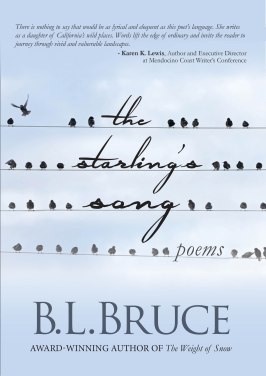
ss_frontcover1The Starling’s Song

B.L. Bruce

Black Swift Press

Available on: Amazon.com

Review by Bhaswati Ghosh

For those of us who live it every day, urban life can be unforgiving in its demands. Yet, there are release buttons that can help us slow down and turn towards the natural world and its rhythms. This movement isn’t as much a result of curiosity as it is of a desperate seeking — whether to find the missing pieces of the jigsaw of modern living or to simply let go of the puzzle altogether. The Starling’s Song, a recent poetry collection,  constructs a fine floating bridge to negotiate that distance — between nature’s tranquility and human restiveness. B.L. Bruce makes us walk on that now-steady, now-wobbly bridge with Feel, her very first of the three dozen or so poems in this chapbook.

Were you here I’d point out/the coyote’s tracks through the sand,/the distance between where/each paw fell,/tell you he was running. I’d reveal the place/where, beneath the dune grass, the gull’s/body lay torn open and hollowed, say/to you, This, this is how I feel.

Bruce’s piercing vision captures and reflects images from the non-human, organic realm with a rare crystal sheen. But this eye isn’t limited to being a camera; by juxtaposing nuances from the world of plants and animals, the poet is able to find clues to anxieties peculiar to the human condition.

I’ve not yet discovered my gift/of bearing, not yet realized/a power to propagate, to nurture.//I cannot understand myself,/but know the fawn abandoned/when the doe is hit on the highway,/the keening of quail, the scream/of the cottontail’s young/as they are taken by the red fox. (Mothering)

This undercurrent of disquiet is what takes The Starling’s Song to a different level, beyond the genre of mere nature poetry. While Bruce’s brushstrokes of imagery are luscious enough to hold the reader in a spell,  it is her layering of emotions and memories, especially uncomfortable ones, to those images that makes them quaver with loneliness and heartache in strangely soothing ways. In Waiting, she says,

Mist moves/to the edge of the forest,/catches the last, dusted light, keeps/joining the woodsmoke./ I am waiting/for you, for the sound of you/on the road, on the doorstep.

In her poems in this collection, clearly written from the vantage point of delicious proximity to nature, Bruce doesn’t stop at exploring the self and its relationship to others through an intimate association with the world outside concrete walls and human organization. Nature isn’t always a peaceable therapy to help reconstitute memories and make sense of them; it can be equally pain-inducing and cruel, based on what the mind reads of it in a given moment. Bruce’s Picker is chillingly reminiscent of Seamus Heany’s Blackberry Picking in its desolation and disturbed unraveling of the seemingly innocuous and even joyful act of berry picking, as

I am bending low/over row after neat row/of red, ripe strawberries.

Turns to…

…I remember/the mushroom picker’s daughter./She watched a man get sucked/into the maw of a machine that/sorted and weighed the day’s pick.//From a window above,/she looked on as the machine/spat out the man’s blood…

Now, overripe berries/ooze in the August sun./I weigh them, put them/in baskets, and drive home/where I’ll wash them,/boil them, add sugar,/and make jam.

None of the poems in The Starling’s Song is too long and brevity certainly seems one of Bruce’s key strengths. The shorter the poem, the more punch it packs. Blood and Seed are two such examples that are able to carry enormous weights on their slender shoulders. Ripe with muscular strength, these poems eschew the need for strong-boned superstructures.

I eat a pomegranate/and think of you,/delicately, patiently/separating peel/from seed. With my tongue, suck/the tart juices/from the kernel,/spit out what’s left. (Seed)

What strikes the most about the poems in The Starling’s Song is the rawness of the word imagery. There isn’t a lot of coating going on, nor is there any attempt to ensnare the reader with mysterious metaphors or complex philosophizing. Instead, there’s a refreshing starkness — of both scenes and the longings and aches they echo within the human mind.

And yet, even the pain — with all its stabbings– has the ability to redeem a certain kind of peace, as Bruce discovers and relays in Chorus, the penultimate poem in the collection.

Even now the arresting silence/in your absence has a music to it.

Dispatch: Love in Hyderabad

First published in Global Graffiti magazine

Bhaswati Ghosh

“…She would always remember Paris as the most beautiful city in the world, not because of what it was or was not in reality, but because it was linked to the memory of her happiest years.”

Gabriel García Márquez, Love in the Time of Cholera.

Cities are where history and contemporaneity, spaciousness and congestion, overwhelming wealth and astonishing poverty collide with each other more recklessly than anywhere else. One can live in City A for a long time and despise it and yet get entranced by City B in just a few months. That probably explains why I always remained a passive resident of Delhi, the city of my birth and my home for more than three decades, yet fell in love with Hyderabad, where I lived for less than four months. And the charm was almost instantaneous.

This was also the city where I found love.

Hyderabad welcomed me as a nervous, just-married bride, whose groom happened to work there. The extent of my idea of this southern city until then was summed up in tourist book images—Golconda Fort and Charminar, a rich Muslim ethos and possibly an equally rich cuisine. I knew too that the city was the latest hot-spot on India’s map. But as I would soon realize, this was but a fraction of the fortune that Hyderabad encompassed within its precincts.

The more-than-four-hundred-year-old city didn’t waste any time in bewitching me, in making sure that our bond, even if short-lived, wouldn’t, at least in my memory, be short-term. The charm began with an expanse of calm, placid water that soothed my psyche, left near-parched by Delhi’s unforgivingly dry landscape. The first sight-seeing trip I took with my husband, even as I was still opening up to him, was a launch cruise on Hussain Sagar Lake. The 16th-century blue-green lake’s historic trajectory took it from once being a source of irrigation for the city to the venue that now held the largest monolithic statue in India—Buddha, sculpted out of a single piece of white granite stone. Even though his back was to us, I suspect the Wise One smiled as we stepped onto the launch boat and proceeded toward him. Could he “see” how the mists of scepticism in my heart dissolved—with each unruffled wave we crossed—and were then replaced with the clarity that love brings?

Another stop on this trip was  Birla Mandir, a Hindu temple in the vicinity. As we crossed the road, the temple announced to us its presence from atop Naubath Pahad, a hillock. Boasting an architectural blend of Rajasthani, South Indian and Orissa styles, the temple’s large premises are divided into territories dedicated to different gods of the Hindu pantheon. As we peregrinated from one deity’s court to another, I saw quotations from several holy texts, including those of Hindus, Buddhists, Christians and Sikhs—though Islamic verses and symbols were conspicuously absent. More captivating views were in store. As we landed on the marble-laid main courtyard of the temple, the twin cities of Hyderabad and Secunderabad smiled back at us.

For B, my husband, the best part of this trip was yet to come. No sooner had we stepped out of Birla Mandir than a small bust, situated by the side of the temple, drew him. It was the sculpted bust of Dr. B. R. Ambedkar, India’s champion for the rights of Dalits—people whom the caste-dominated Hindu society has shunned, humiliated and oppressed for centuries. Ambedkar also played a pivotal role in drafting India’s constitution and instituting in it equal rights for all citizens—irrespective of their caste or religion. B has been greatly influenced by Dr. Ambedkar’s scholarship and upholds his rejection of the Hindu caste system.

The temple, with all its stunning architecture and deities born of human imagination, soon receded from our consciousness. It was ironical yet appropriate for Ambedkar’s image to be placed close to a canon of the Hindu religion—a temple housing many of its popular figures. While Dr. Ambedkar’s egalitarian vision is yet to become a reality for the Dalits of India, it was heartening to know that Hyderabad’s Birla Temple is open to people of all religious faiths and social strata, including Dalits. Just as B found meaning in this visit, I was taken by the numerous street-side stalls selling vermilion, coconut, bangles, sacred red threads and an assortment of curios promising to please the temple gods. I am not too religious, but a profusion of colours and smells never fails to draw me in.

Birla Mandir was the last of our divine excursions. After this trip, I focused on setting myself up in a new house and exploring my new surroundings.

* * * * *

When I first stepped into my husband’s “flat” at “At Home Apartments” in the Kondapur neighbourhood of Hyderabad, it appeared to me to be a spruced-up version of a bachelor pad. There were just two rooms: a large bedroom and a smaller room that doubled as the sitting room and kitchen. Two single-seater sofas and a table completed the furniture in this room. For cooking, we had been provided with a microwave oven and a few utensils.

The spacious bedroom more than made up for any inadequacy of the sitting room-kitchen. The best part of this room was a large window right behind our bed. The view beyond this window—tracts of cultivated fields stretching into a limitless horizon, a few buffaloes grazing the land, the tent of a farmer who worked on his field, a small Hindu temple—magnetically allured me. Our flat was on the fifth floor, the top-most in the building, and because of its strategic proximity to the green expanse, it offered a rare panoramic view of open space—increasingly a rarity in Indian cities. Living on the top floor came with another reward—we were closest to the terrace above, where we would spend hours—lured, awed by and photographing winged wonders.

I would soon learn that one didn’t have to run to the terrace to enjoy bird-watching in Hyderabad. They were everywhere and in amazing diversity. Every morning, upon waking, we just had to look out of our window, and there they were—bee-eaters, parakeets, sparrows, doves, kingfishers, the ubiquitous crows and other unknown tribes. Seeing them hopping from one tree branch to another, collecting meals, chirping or just flying around for the sake of it, ensured that we never had anything other than good mornings.

During my years growing up in Delhi, the visibility of smaller birds like sparrows had gradually dwindled. In Delhi’s frightfully shrinking avian habitat, the survival of small members became increasingly threatened. So when I saw birds of different breeds and sizes happily grazing the Hyderabad skies together, my heart was aflutter.

What added to the joy was the existence of a small swamp a few meters away from our apartment. I strongly suspect this marshy patch brought me closer to B, as it revealed the wide-eyed-wondering bird-lover in him. We would routinely stop at this spot to watch egrets and herons, red-wattled lapwings and little cormorants making good use of the prized cool patch in the midst of newly-constructed skyscrapers that surrounded the marsh. Excited by our daily finds of new birds, we soon headed to a place that would make our wonder graduate to speechless amazement—the Hyderabad Zoo, definitely among the best in India and rivalling the likes of Australia’s Taronga Zoo.

The thrill of these discoveries notwithstanding, at home we still didn’t have a proper kitchen. And food still remained a primary necessity. Since the microwave wasn’t useful for much beyond making instant noodles, we had to scout for food sources outside. For our very first dinner as newlyweds, B took me to Hot Rottis, a small eatery perched on top of a shop in the nearby marketplace. The place offered a mix of south Indian and north Indian (mostly the latter) homemade food and no bells and whistles. For 45 rupees (less than a US dollar), you could have rice, lentils, two types of vegetables, yogurt, pickles, salad, a dessert, and, of course, the name of the shop—hot rottis—freshly made Indian whole-wheat flat breads. This joint catered well to serve the dietary needs of young people from North India, mostly IT professionals who were a long way away from home—geographically as well as in terms of food culture.

Hyderabad turned out to be a food heaven, not unlike the eastern Indian city of Kolkata. Like the latter, what makes Hyderabad a food lover’s delight is not just the mind-boggling heterogeneity of foods available, but the high affordability quotient—one could enjoy well-cooked, hearty meals with no substantial loss to one’s pocket. So while Hot Rottis and its rival Drumsticks sustained our daily dinner needs, a veritable culinary carousel would see the two of us hopping from one restaurant to another throughout the city.

For us, the best flavours were the ones that were exclusive to Hyderabad, no less associative than imposing structures such as Golconda Fort or Charminar. Two of these were desserts: the first double ka meethha—a pudding of bread, milk nuts and saffron. We found it on the menu of most restaurants, some that weren’t even serving food from any part of India. The other very Hyderabadi dessert, khubaani ka meethha, made B its life-patron with the very first tasting. Dried apricots concentrated into thick, syrupy sweetness, give the dessert the ambrosia of halwa and the lightness of fruit. A perfect dessert to share after all those meal mountains we had internalized, rather literally.

However, the greatest edible reward from Hyderabad was haleem—the signature dish that sweeps over the city’s collective tongue during the fasting month of the Muslim festival of Ramadan. Haleem is one of the many items served during iftaar—the breaking of the daily fast during Ramadan. The dish, however, tastes every bit as good even if one doesn’t fast before digging into it.

We discovered haleem on our way back from Golconda—the fort of many forts that makes one marvel at its grandeur: the stories of devotion, literally carved on its walls. Ram Das, a certain Hindu official at the court of the Muslim king Tana Shah, was imprisoned in Golconda Fort for misusing funds to build a Rama temple. Even in his despair, Ram Das’ devotion didn’t diminish. His carvings of Hindu deities Rama, Lakshman and Hanuman still remain on the walls of his prison.

Having traversed the fort’s enormous breadth and after climbing up and down its steep terrain on an appreciably warm day, it was relaxing to sit inside a taxi for the ride back home. Mid-way through our journey, B asked the driver if he knew where good haleem was served. “Sure, saab, I will take you there,” said the driver. Soon, we were in front of Pista House, arguably, the best haleem makers in the city. The two boxes of pounded wheat and mutton, stewed into a smooth paste, smothered with ghee and topped with fine ginger juliennes easily rank among the best things I’ve ever eaten. Haleem was also just what the doctor would have ordered after a long day of trekking through a fascinating yet inexorable fort.

In spite of the breathtaking sights, natural bounty and the scrumptious food, Hyderabad had its own contradictions. It seemed a place where the new nudged in to make its way beside the old.

The city appeared safe enough for young, single women to move around. At the same time, most women dressed conservatively. And while there was a steady inflow of IT-employed youth from other, more cosmopolitan cities, Hyderabad’s own youth remained reticent to profess love in the open. What else could explain the recurring clandestine rendezvous across the city? Cupid seemed to be on overdrive here, what with young couples snuggling up to each other the moment they found a moment. Or a suitable crevice.

We first spotted them in the lush, verdant botanical gardens, rich in flora of a flourishing variety, inviting birds of various stripes and songs. As well as hearts floating on air, above bodies swaying on the grass. The ingenuity and dedication of these wild young hearts was commendable. Inside bushes, behind a big tree, tucked away in alcoves, they bloomed as resplendently as the dahlias and daisies in the garden.

We also saw them at Durgam Cheruvu or the Secret Lake, a lake-forest spread over sixty-three acres. The lake remains deceptively true to its name. None of it is visible from the outside, and one has to walk a fair distance to enter the lake area. Inside, it’s a magical world, complete with pristine waters, hills and rocky formations, and recently installed art in the form of sculptures and rock art.

Just a few minutes before, B and I had been on a very urban road, and then, suddenly, we shared this space with the most enchanting butterflies; humming birds donning stunning yellow, electric blue hues, bulbuls; red-breasted lemon hibiscus; a blushing purple-pink gulmohar variety and other spell-inducing flowers; and even fruits like the pomegranate and the custard apple. As we wound our way through the rocks, we spotted many a dark, damp spots, sheltering insects, moss, the odd creeper. And the snuggled duos.

Climbing up, all the way to the top, we discovered the most stunning view of the green-gray lake. We also found hiking trails that scared me and thrilled B. Just when he had finally convinced me to climb down one, we saw a couple sitting right next to its base, behind the curtain of tree branches. We quietly retreated.

In Hyderabad, love abounded. As the Buddha’s compassion, as the co-existence of a structure of Brahminical Hinduism and its greatest critic, as the pigeons coo-cooing inside the magnificent ramparts of Charminar and the burqa-clad women buying flowers and bangles outside it, as the haleem slathered with ghee, as the apricots transformed into sugary sin, and as love birds, peeking, sometimes glaring, from crevices, hills, open markets. How could I have remained love-less here? In less than four months, I had been smitten. By B. And by Hyderabad.

Text and photos ©Bhaswati Ghosh
 

Of faces and portraits: Ramkinkar Baij

I recently had the opportunity to read from “My Days with Ramkinkar Baij” on the occasion of the launch of “Could you Please, Please Stop Singing?”, Sabyasachi Nag’s book of poetry at the Art Gallery of Mississauga.

In this excerpt, Baij talks about the essence of portraits and the fodder faces can provide to an artist. He also discusses his own treatment of Tagore for sculpting a bust of the poet.

Here’s a video recording of the reading.

Could You Please, Please Stop Singing? Book Review

Could You Please, Please Stop Singing?
Sabyasachi Nag
Mosaic Press
Available at: http://www.mosaic-press.com/product/could-you-please-please-stop-singing/

Review by: Bhaswati Ghosh

First published at http://www.citrusmag.com/#!bookwarm/ddvnt

It’s a sobering morning as I write this. My Facebook feed is flushed with faces wearing the French flag, quotes denouncing horrific events that shook the world, and raging debates on selective outrage. The world is reacting to the violence that has Beirut and Paris mourning hundreds of people — denizens and tourists — who lost their lives in serial bomb blasts.

Tired and benumbed, I turn to a different window on my computer screen — to read Sabyasachi Nag’s poems from his latest collection, Could You Please, Please Stop Singing?

When words — even prayers — do little to palliate the mind, “Mamuda’s Fries,” Nag’s first poem in the collection, brings me warmth with its textual imagery. It’s a simple poem on the face of it — about a father returning home with fries for his family at the end of a draining work day. The batter singes like the rest/of his walk. Yet, as he closes it off, Nag manages to frame in the poem an everyday family portrait that transports you to a comforting spot.

When the fries come,/they let them sit a while, radiant/on the puffed rice, then the stories/roll, greased, like the wheels/of a worn ritual.

What it is that we really mourn when mass attacks happen? The loss of life and innocence, for sure, but do we not also feel aggrieved for all the possibilities of “worn rituals” that are thwarted by the untimely ceasing of the rolling of stories Nag talks about? In trying to grapple with brutalities, somewhere we probably also feel the loss of the mundane sinews that bind the core of our daily lives – the smile that brings us home, the bric-a-bracs that feed our memory as comfort food does our palate.

https://i0.wp.com/www.mosaic-press.com/newwp/wp-content/uploads/2015/11/Could-You-Please-Stop-Singing-Cover-final.jpg

This soft pulse of relationships throbs throughout Nag’s poetry. The book is dedicated to his father, and it isn’t difficult to see why. The bond between a father and his son echo in many a poem. In “Sweat”, a father’s homecoming is celebrated by his son with games even as his departure is etched in sensory notifications – duffle bags, polished shoes, but also “Chewed betel from his breath.” And, of course, there’s his sweat.

The air will be naked soon./For one more day, his sweat/will linger in the wardrobe /and the laundry room.

In “Wheels”, a prose poem that reads like a journal signposting a father’s life cycle through five decades, from a hardworking man whose square shoulders evenly stretched under the weight of fish and produce he routinely brought home to compensate for long absences … to someone pulled down by gravity, stooped over the curved, steel handle bars of the red rollator, leaving nothing to chance, as always, trying his hardest to make the wheels turn, turn… Here, Nag at once encapsulates the mechanics of middle class life with a child’s exhilaration of having

him (the father) back from the trains and morbid news as well as the works of physiological aging, which, despite all denial or resistance, pulls one into its inevitability.

The wheel of bonding between the poet and his father keeps turning as Nag chronicles the growing up of his own son. The same wisp of endearment marks these poems, as also perhaps, the same yearnings and the gaps that separate them. Nine and he keeps his laces flailing./Is that an attitude thing? Nag asks in “Absent”, then answers, He thinks them– laces, have needs/to write on puddles, tangle with weeds/drag the dirt, sometimes swallow/pollen, ragweed, dander – be out of sorts. The father’s wonder and happiness on his son entering his teen years is poised by steady genealogical conviction. he leapt like a lemming almost into his own/

and all that hair on his legs and underarms/cannot convince me yet,/he will grow up to be much taller than me.

Like relationships, a number of motivations inform and bear upon Nag’s thematic range and expression. Food is a prominent trigger, and while reading some of the poems in this collection, I couldn’t help but admire the poet’s facility with cooking and the secrets the kitchen can reveal about life in general. How else could he know this about the “Fine Art of Chapattis”? Roll them to the shape of moon,/Mars, continents, faces of gods,/feelings, fear... and Serve hot and buttered, just when hunger/is in the same room as lust. In “Reasoning”, which sounds curiously similar to “seasoning,” Nag blurs the line between gods and devils, even to the extent of provoking one to examine whether there’s a line that distinguishes the two entities at all. Asafoetida is at once god’s flavour/and devil’s shit – attractive to moths/wolves, believers//There must be a reason –//why dharma and pot mix without particle blenders/temples polish stairwells with milk/and silver is smoked in myrrh.

Coming from Calcutta, where the urban poor share the cityscape with the richest of the rich, Nag writes about the subaltern often in Could You Please, Please Stop Singing? Even as he contextualizes the lives of the underdog, he remains sensitive not to smudge the dignity that is mostly denied to them. A poem I haven’t been able to shake out of me is “A City House Help Returns Home”. Self-explanatory as the title is, the poem reminds one of the many young house helps in India and the blank, tear-wiped look one sees on their faces. Nag doesn’t stop with mere observation, though. He seems to penetrate that vacuous look as he talks about a young boy returning home on a break from his city job. Between servings of gruel and green/chili, salt and a splash of mustard oil –/he’s scared someone will ask:/what brings ya back? Having posed the little boy’s dilemma — sad as it is — Nag answers it with words that strike like a whiplash: His little brother who/ works in the pickle farm,/his cousin who climbs coconut trees,/his friends who smoke the berry hives –/they know.

Could You Please, Please Stop Singing? is a very urban collection. The stress, grime and anxieties of city life are palpable, even viscerally felt in a number of poems. In “Through Uneven Slats — a Riot” Nag says, Rush for news, rush for bread,/rush around clots, rush past mangled hair,/rush through smoke, and smoke. “The New Enemy” speaks about the contempt for the urban poor in a language so raw, it hurts you with its force. Nag plays on Robert Pinksy’s line “A country is the things it wants to see” when he says A country is the things it wants you to not see./So a finger snaps crying out for a sledge hammer/itching to drive a nail into her bulbous head, smash her chiseled rib cage,/Whac–a–mole her deep into the shit hole/so she doesn’t slime back out again –

The spectre of violence – riots, terror attacks, even break-ins – punctuates the collection with uneasy periodicity, compelling one to acknowledge the political thrust that drives the poet. He draws this thrust from diverse sources – Badal Sarkar’s play “Ebong Indrajit,” the Indian mythology, world literature and more. The violence he talks about isn’t just external. In the poem that bears the book’s title, which, in turn is inspired by a line in Ernest Hemingway’s short story, “Hills Like White Elephants”, Nag denudes the violence that often rages inside the human mind. The poem, reflecting on the impact of the singing of a busker woman in a train has on the narrator, verbalizes the voices that speak within us – in turmoil and clamouring disquiet. In a train you are alone with a young busker./She sings of loveless nights, an endless moon–washed/river on the other side of the planet./ On hunches, supine/she touches her scummy finger nails to your knees,/shocks you with static.

Nag ends the poem with words that reverberate like the plunk of a train rolling on a track. Why does the train abruptly stop?/Why is the revolutionary walking out the door? The honesty of Nag’s poem lies in his not offering an answer. In its vulnerability.

And although it might sound sweeping, those very attributes – honesty and vulnerability – define the collection as a whole and make Nag’s a voice worth returning to.

Call for submissions: The Everyday and Other Tagore

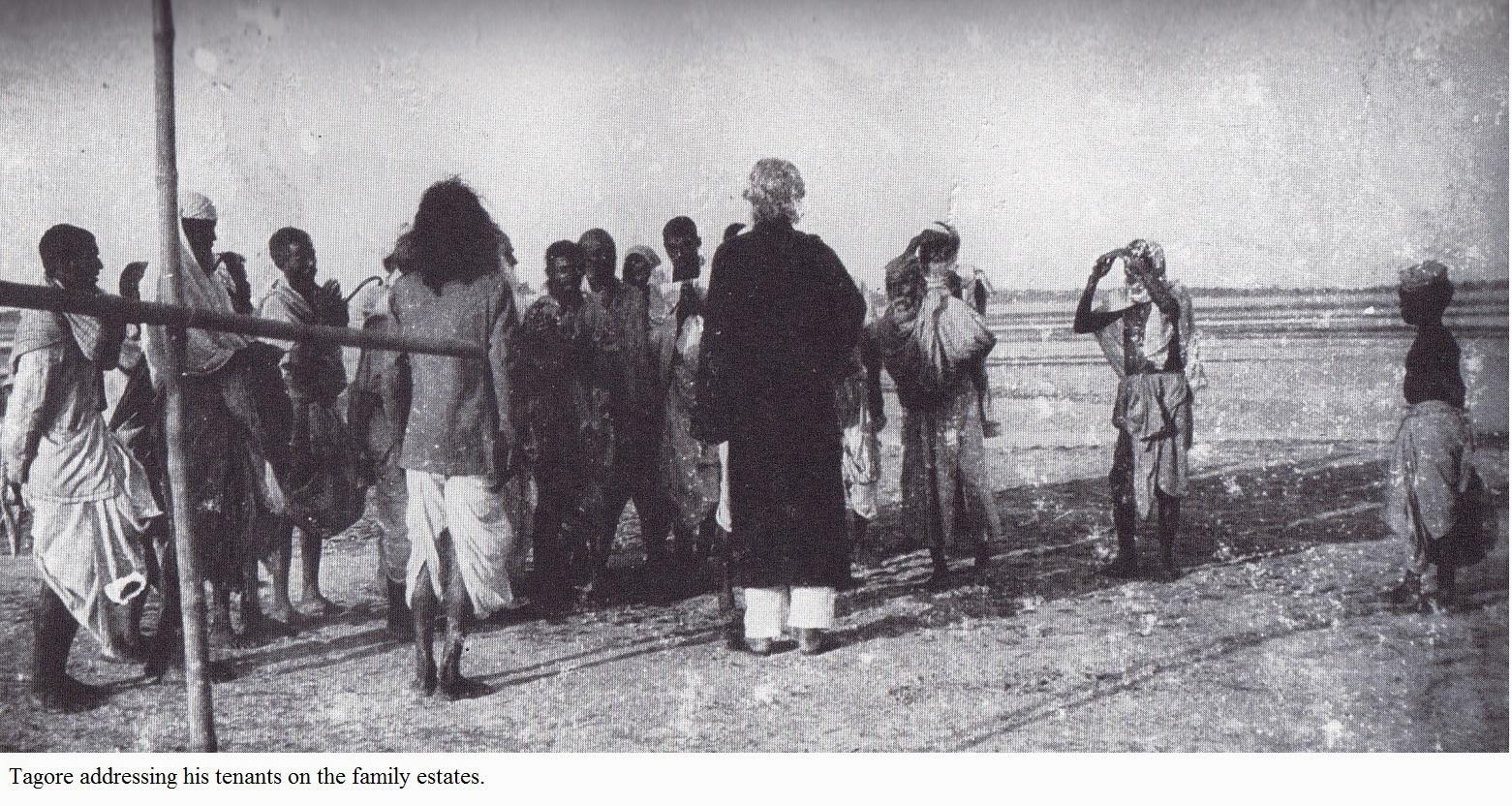
Tagore addressing his tenantsCAFE DISSENSUS

UPDATE: The issue is now available here.

Issue 19:  October 2015: The Everyday and Other Tagore [Last date for submission: 30 September, 2015; Date of publication: October, 2015]

Send submissions to: bhashwati@gmail.com

There is the Rabindranath Tagore we all know – the winner of the Nobel Prize in literature, the founder of Visva-Bharati University, the grand literary canon of India, and the towering figure without whom Bengal just can’t do.

And there’s the other Rabindranath Tagore, the one who forms the leitmotif of the activities of a social worker working with children from marginal communities in Delhi. Tagore shows up in their handcrafted embroideries, in the food they make, in their art and craft projects, in the plays they enact, and in the worldview they imbibe, unbeknownst to themselves.

Tagore comes alive in the song an unknown Baul fakir sings in a village in Bangladesh, “Jawkhon porbe na mor payer chinho ei baate,” (When my footprints are no longer seen on this path). The words haunt the listener with the singer-poet’s elegiac visions of a time after he is gone. It’s penned and composed by Tagore, yes, but the fakir makes it his own, with his distinctly carefree, unchained rendition.

In a very urban school in Delhi, a principal strives to give her students a taste of Tagore’s inclusive education paradigm. She doesn’t have the space to provide the open-air classrooms of Visva-Bharati, but she opens the doors of art, literature, music, dance, and drama to her pupils, so they can breathe free beyond the confines of a book’s pages.

In one of his most powerful poems (Patraput, 15), Tagore declares himself an outcast, one who has renounced the bondage of religion and ritual. He likens himself to Bauls and their search for the man of the heart, a quest to find divinity in humanity, not in external or imagined symbols.

This is the other, everyday Tagore – internalized in universes that don’t often feature in scholarly discourses.

This issue of Café Dissensus invites fiction, nonfiction, poetry, or multimedia works on the theme of The Everyday and Other Tagore.

Along with written pieces, we are also open to audio-visual content. If you would like to do a short interview (5-15 minutes), please feel free to send that to us. If you send us the rush copy, we can edit. However, it would be better if you do the editing and send to us.

Your submissions should not exceed 1500 words. If a particular piece deserves more space, we are willing to go beyond the word limit. Please email them to bhashwati@gmail.com. Also, provide a brief 2-3 line bio at the end of your piece. Submissions will be accepted until 30 September, 2015.

Photo courtesy: http://permacultureambassadors.blogspot.ca/

Immigrant’s postcard (mini) – Four days in Québec City — Part 2

Read other Immigrant’s Postcards here.

Day 3: Wet-weather friends

DSC05593It’s a rainy day.

Since morning, we haven’t accomplished much, other than eating brunch, visiting the observatory, and walking to the bank to draw cash. After a mostly sleepless night, my zombie feet refuse to dance in the rain anymore without a burst of caffeine.

We keep dragging ourselves through the soaked streets of this still-much-foreign city, desperately looking for a café. It’s nearly three in the afternoon on Canada Day, and many cafes and bistros have downed their shutters.

Discouraged, we keep plodding towards our hotel when a 24/7 and “Ouvert” sign flashes before me. We walk in – it looks like a big sports bar – hockey plays on multiple TV screens as I take a seat and put down my drenched umbrella. My husband walks over to the counter to place our order of coffee and baklava.

“Bonjour,” the cashier, a young Francophone, greets him. “Where are you from?” He asks my visibly tourist husband.

“We’re from Ontario,” B says. The answer is less than satisfactory.

“No, I mean where are you from originally?”

“Oh. India.”

“Namaste,” says the cashier, offering a knowing smile and not a handshake but a full-blown namaskar.

He has more to offer.

“Naam kyea haie?” He asks B.

“Bhupinder. Aapka naam kya hai?”

“Francois.”

On a soggy afternoon, three people fleetingly enter a spot of friendship over steaming coffee and the sticky sweetness of baklava in a mostly empty sports bar.

DSC05913-001Day 4: Lead kindly light

We’ve just been to the unabashedly gorgeous Montmorency waterfalls. Soaking wet in the fall’s mists, as we sit back in the dry comfort of the car, my husband tells me of a religious shrine that’s among the region’s attractions.

And so we alight in front of the impressive Basilica of Sainte-Anne-de-Beaupré , moments later. After clicking the customary outside photos, we walk in. The church’s magnificence — in scale, splendour and decoration — enthralls me. I gesture to my husband to take our seats in a pew.

The sanctum is abuzz with activities and devotees keep streaming in. B uses the time to click photos of the stained glass windows, sculpted walls and spectacular ceiling. An elderly man is seen walking towards the pews, talking to people. He soon comes to us and asks B,

“Bonjour, Francais?”

“English,” B says.

“Oh. French – not yet?” The gentleman says, the possibility in that question perceptible in his hopeful affection and playful smile. “They are going to have a Mass in five minutes. No cameras during that time, please. You can take all the photos you want after that. Welcome to Sainte-Anne-de-Beaupré.”

When the service begins a few minutes later, we see the same man attired in full priestly robes – he is the Father of the church.

And so we sit through an hour-long Mass without understanding a word of it (all French), yet enveloped in organ music and stirring singing, soft light, burning candles and incense smoke, prayer chants and the Father’s impassioned address from the pulpit.

Is it because we want to take photos afterwards (we don’t end up taking that many)? Maybe. But I believe it’s more because of a priest’s gentle voice and kindly smile.

What we experience can’t be photographed anyway.
Read Part 1

Immigrant’s postcard (mini) – Four days in Québec City — Part 1

Read other Immigrant’s Postcards here.

Day 1:  The Sisters

DSC05665After a 10-12 km walking tour of the fortified city and along the river, we sit down on a bench at the foot of the majestic Château Frontenac hotel to catch our breath.A stream of people—mostly tourists, some office goers, a few elderly folks—pass us by.

A group of three Chinese women (sisters? friends?)—probably in their fifties—arrives. We can’t decipher their animated conversation. But two of them take their cameras out to photograph the third lady, who is only too happy to pose.

She stands next to a bench facing us, holding an arm up. “Hold on, I’m not done yet,” she seems to say to her friends while swiftly moving up the hill behind the bench. There, she takes her position, raising an arm and a leg even as she prods the other two women to click fast.

Passersby pause in their walk to take in this unique scene; some explode into laughter.

And although there is no sea in sight, all I’m reminded of is the comradeship of the widowed sisters-in-law in Tapan Sinha’s “Nirjan Saikate.”

Day 2: Pocket change 11707794_10153519566065087_1302432540971826171_o

Back from a lush and soothing ferry ride across the St. Lawrence River, we buy crepes from a mother-daughter stand at a local artisan fair. We walk into a park to consume the supper.

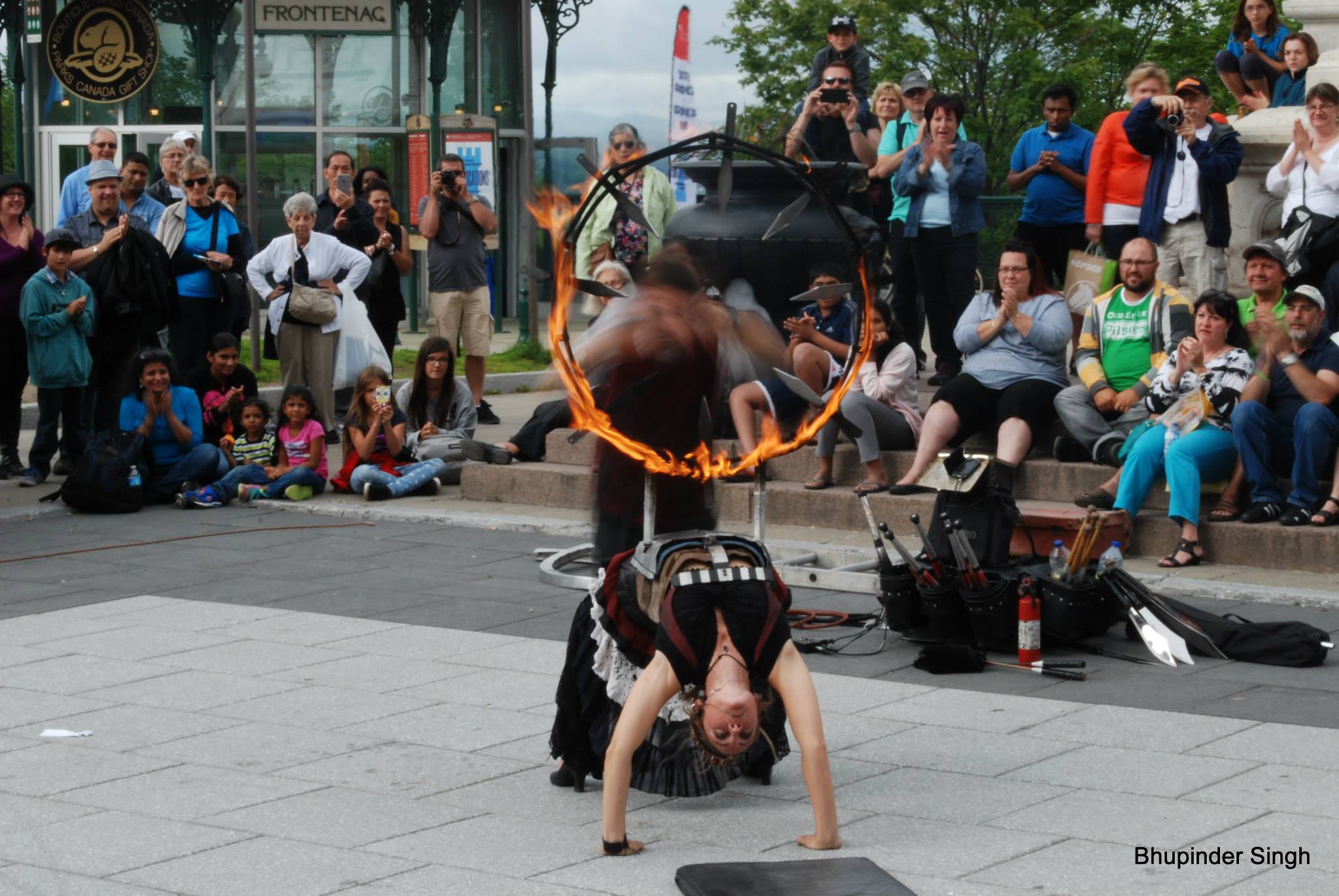
A couple of young musicians emerge to set up their arrangements even as snatches of a conversation between two members of the audience floats over to my ears. The man is telling his female partner/friend about the man-woman busker team we saw perform at the Château Frontenac square yesterday.

As with every street performance, the daring duo had requested the gaping, near-voyeuristic audience to make donations at the end of the show.

Our man in the park today talks about his chat with the male busker. “I asked him how much money do people actually put in your hat after the show?

“He told me most people put pocket change – the quarters, nickels and loonies. Very few – maybe one or two people – actually put five or ten dollar bills.

“And so that’s what you give after watching a 45-minute show in which the performers risk their lives. And right after that, you spend $200 on dinner.”

I can validate what he is saying. Yesterday, when I sheepishly carried two five-dollar bills to put in the buskers’ hat, I noticed those were the only non-coin currency items in the hat.

Suddenly, I don’t feel so bad about eating crepes clumsily in the park instead of dining at a fancy restaurant.

Read Part 2