My Literary Wanderings ~ arriving at life’s crossroads, with both pain and joy!

A new column about literary journeys I will be curating in Saaranga. This inaugural post starts with my own story.
At seven — an age when writing only means filling the school homework notebook with the dreary repetition of my handwriting — the joy of reading arrives at my door. It’s a hot morning of my summer vacations in New Delhi, and like on most such mornings, I’m preoccupied with some or the other holiday homework — tasks designed to keep children in line and make them more tolerable to their family members for two long and sultry months. A postman knocks on our gate holding that rare item — a parcel — that lights up our faces with barely- concealed smiles. As my grandmother emerges from the kitchen and opens the package with her turmeric-stained fingers, out come the precious contents — a book of Bengali chhawra or rhyming verses and illustrated Ramayana and Mahabharata for children in Bengali — books she had ordered for me through relatives in Calcutta. The fun of words rolling into limericks and nonsense verse as you uttered them, of reading stories you didn’t have to write an exam for, of letting your mind fill with imagination what the words in the books left out — these must have been the initiation for me on the road to being a literary pilgrim.  

*

The year I move on to middle school, I decide to switch schools. I’m glad I do, because in grade six, I find the teacher who would influence me the most in my life. Abha Das, a petite woman who wears crisp cotton saris and glasses on her small but penetrating eyes, doesn’t merely give lectures on the stories in our English textbook. She makes each one of the stories, which she takes days to finish, a riveting experience — at once an education in the craft of storytelling and reading with empathy and understanding. As she gives a lecture on E. R. Braithwaite’s To Sir with Love, she asks us to look back and think of the times we felt belittled because of our identity. By doing this — throwing us headlong at our vulnerabilities — she dissolves the distance between the narrator and us. Relating to the characters we read about in fiction in such a visceral way would help make me be a better reader even before I show any promise of being a writer. One morning, I would find the teacher waiting at the end of our morning assembly line. She’s there to thank me for a birthday card I’d left on her desk in the staffroom with a poem titled To Ma’am with Love. Her teaching would turn my joy of reading into a deeper love for words. I would now notice their intonation, their music, and recognize their inherent power to breed both love and violence. 

*

Even as Abha Ma’am enthralls us in school, at home, too, another petite woman — Amiya Sen, my grandma — remains a force I can’t ignore. She’s a grandmother like every other, doting and endlessly patient, yet she’s more. I see her go to work at an office when no other friend’s grandmother does. She stitches the best frock dresses for me every Durga Pua and knits me sweaters with the most exquisite patterns every winter. She reads — books, newspapers, magazines, my school textbooks, packets made from old newspapers — like there’s no tomorrow. And she writes. She writes after returning from work, she writes in between cooking meals, she writes after running errands, she writes late into the night after everyone has fallen asleep, she writes the first thing in the morning before anyone wakes up. She has no writing desk to fulfill this fetish; I only see her writing on the floor where she sprawls on her stomach to lie on a straw mat, her arms resting on a pillow. She would be my first example of what a full-time writer truly means — not someone who has no job and earns their living through writing, but someone who steals and grabs every millisecond of available time to write while carrying out the seven thousand and nine other responsibilities that eat into her writing time. At thirteen, I write my first short story in Bangla and show it to her with nervousness. With a warm hug of approval, she encourages me to write more. Two years later, before I’m able to grasp the full scope of her writing artistry, she leaves the world. And she leaves me clueless about fighting loneliness, about living with the scary beast of loneliness. 

*

Three decades go by. I am far removed from the house I grew up in, the one that my writer grandmother built with her life’s savings and dreams. I now live with my husband in Canada where it’s cold for more than half a year. In the thirty years since my grandmother passed away and I passed out of school where Abha Ma’am taught me, I’ve carried more than luggage. I have lugged Grandma’s stories — literally and figuratively. I have with me a bunch of short stories she wrote longhand, to type out and prepare for possible publication. But I also have the stories she told me as I grew up — stories of her childhood back in undivided India, of her life as a young bride, of her coming to Delhi and learning the English alphabet from her children, of the heartbreaking and unrelenting tragedies she’d had to endure in her life, of the unceasing pain of being displaced from her desh, the native soil of East Bengal that she’d been estranged from with India’s division in 1947. Somewhere along the way, all of these make a story grow inside me, and I end up writing a novel. When Victory Colony, 1950, my first book of fiction is published, I feel happy, relieved and sad at once. Like every new author, I’m elated to finally see my story out there in the world. Yet somewhere inside, it hurts me to realize that the one person I would have liked to read it isn’t there. 

A year after the book is published, I have a dream featuring my grandmother. She is lively and as engaged with current events as she always had been, and I feel anxious anticipating her reaction to my novel. When I wake up, a bittersweet sensation tugs at my throat. I feel relief and yet I also feel an ache. 

Perhaps that is what our literary wanderings are about — arriving at life’s crossroads, with both pain and joy staring at us. It is my pleasure to welcome you all to Saaranga’s new column on these journeys with authors — I hope you’ll indulge us and enjoy taking in the songs, dramas and scenes that forge our writerly paths. 
Guest post by Rekha Karmakar

This post, written by Rekha Karmakar who blogs at Tabulous Mom, is a tribute to Amiya Sen, my grandmother, whom the blogger knew as a neighbour in Delhi more than five decades ago.

Story of a woman born about a century ago

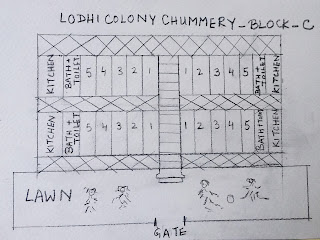
A rough sketch of the layout of a chummery in Lodhi Colony (New Delhi) in the 1950s, from my distant memory, where Amiya Sengupta’s and our family lived

This story is not about any female revolutionist, during the British period, who took up arms to fight for the country’s independence. It is about an ordinary humdrum housewife like our mothers and aunts who toiled in the kitchen and looked after their families.


I knew this lady since I was five years old though I lost track of her in course of time. One may wonder why I am writing about her after so many years.

To be very honest, my memories were rekindled by a story written by her worthy granddaughter Bhaswati Ghosh, who currently lives in Canada and is herself a writer. Her story about her grandmother Amiya Sengupta in ‘Memoir Excerpts: Excerpt from Till the River Runs Dry’ published in SETUMAG.IN brought back my memories about her.

Like many of my FB friends, I had not met Bhaswati, who, I suppose, is also an alumni of my school in Delhi. Once she wrote on FB about her maternal grandmother Amiya Sengupta, who would write stories in her copybook, some of which were also published.

‘Amiya Sengupta’ ? I pondered for a while as it rang a bell in my mind. I thought it might be the ‘mashima’ of our ‘chummery’ in Lodhi Colony in New Delhi. I messaged Bhaswati enquiring about her grandmother and was immediately confirmed by her that I was on the right track.

Why did it take me so much time to figure out who Amiya Sengupta was? Later it occurred to me it might have been because those days women were not usually known by their names. They were either ‘boro bou’/’mejo bou’/’choto bou’ (daughters-in-law as per hierarchy) or ‘so and so’s mother’ after their children were born. Amiya Sengupta was ‘mashima’/auntie to us and ‘Gita’s ma’ to others. Her eldest daughter Gita happens to be the mother of Bhaswati.

A few years after independence (in the 1950s), a group of young and daring Bengalis came to Delhi, with their families, to build a new India. My father, Amiya Sengupta’s husband Sudhir Chandra Sengupta and a few others were among them.

Away from home, these men were put up in ‘chummries’ along with their families. ‘Chummeries’ were two storeyed buildings used as a ‘mess’ for bachelor British soldiers during the British raj. Central govt employees of different states of India were temporarily put up in those buildings after independence.

There used to be a staircase in the middle of the building. On each side of it, there were five rooms in a row. These had a bed room and a small drawing room sort of space in front. Each batch of five rooms had three common bathrooms and three common toilets, which were kept quite clean.

Next to it, was the kitchen which was divided into five parts though none had a door. Food was cooked on ‘balti unans’ (coal fire ovens made in a bucket) or mud ‘unans’ built on the floor.

Quite often, I would sit next to my mom and listen to the ladies talking while they were cooking. It usually veered around recipes and always ended with talking about their ‘daish’/native land in East Pakistan as the memories were still very fresh. Amiya Sengupta, whom I shall, henceforth, refer to as ‘mashima’, always took the lead.

Amiya Sen

‘Mashima’ and ‘meshomosai’ stayed on the same floor, as we did, with their two children – a daughter and a son. They were a little older than my parents, who regarded them as their friend, philosopher and guide.

‘Meshomosai’ was very good in mathematics. Whenever I got stuck, I would go to him. Usually the first few sums of an exercise were solved in the class but the last few ones, which were difficult, would invariably be given as home task. Hence, I would have to go to him very often. ‘Meshomosai’ was very glad to help but on one condition. The condition was that I would have to pick up his grey hair for getting the sums solved. (His hair had become grey untimely). I, too, readily agreed. Now I realize I must have made him almost bald considering the number of times I went to him to get my sums solved. 🤩

In the meanwhile, ‘mashima’ did a diploma course in sewing. Not only that, she opened a sewing school at home where she gave tuition to the ladies of the neighbourhood. I always felt she was different from others as no one else, at that time, would ever have thought of adding to the family income by giving tuition in sewing though she was not in dire need of money.

My mom was one of her early batch of students and a favourite one too. My mom bought a Usha sewing machine, which was considered to be quite expensive at that time. But my mom made very good use of it by churning out innumerable frocks for us, shirts and shorts for my brother, blouses and petticoats for herself and pajamas for my father. After her children grew up, she stitched curtains, pillow covers etc.

A few days back, when I called my mom, she ruefully told me that she had sold the Usha machine to a man as she could not move her fingers properly to sew. Unable to control my curiosity, I asked her how much she had sold it for. She replied it was sold for Rs 200/-. She also told me that she had bought the sewing machine for Rs 125/-, by adding money from her saving. She proudly added that it was ‘Tailor’ model, the one which the tailors used for sewing. The other ordinary model was cheaper.

After a few years, we were all shifted to East Vinay Nagar (later named Laxmi Bai Nagar), where new quarters were erected for us. These were two storeyed buildings, having 2BHK flats, with a small balcony in front and a tiny kitchen garden at the back. Both our families were in the same block. The ‘chummeries’, we heard, were demolished later to make way for new buildings.

(After four decades of leaving Delhi, I went back to Laxmi Bai Nagar again but felt like Rip Van Winkle, without being able to recognize anything).

All the moms were very happy having a separate and self contained flat though it took some time to get adjusted to the new upcoming colony.

‘Mashima’, however, did not stop after getting a diploma in sewing. She appeared privately for Matriculation, Intermediate and B.A. examinations from Punjab University and lastly did M.A. in Bengali from Delhi University though her children were quite old at that time. She also started learning Hindi and appeared for Prabhakar (equivalent to Hindi Hons.). Hindi was promoted a lot at that time by the Central government to make it the national language of India. I do not remember if she took up a job at that time. But from her granddaughter Bhaswati’s writing, I came to know that later in life she had a government job.

Many decades have passed since then. I might have jumbled up many facts about her as I was myself a young school going girl at that time. I got a few inputs from her granddaughter too.

This story is not about facts but about the grit and spirit of ‘mashima’. Marrried at fifteen and coming from Barisal in East Pakistan, I realize now, she achieved a great feat. Very few women of her time would have ventured to appear for Board and University examinations from the scratch. Her family, too, must have given her a lot of support or it would not have been possible for her to do anything.

During summer, in Delhi, we used to sleep on the charpoys (portable beds made with strings), in the lawn, in front of our house. ‘Mashima’s family used to sleep just a few feet away from us. Quite often I noticed that she would read a book in the light of the lamp post that was just over her charpoy. Such was her tenacity.

‘Mashima’ had a passion for writing, which she did braving many odds. As per her granddaughter, ‘mashima’ has four books, many published articles and short stories to her credit. I wish her granddaughter Bhaswati edits and compiles them again.

One thing, I must say, is that she was very fortunate to have a granddaughter like Bhaswati, who delved into her writings and gave her due credit for it. I wish my granddaughter Kimaya also, at least, reads my post from my humble blog tabulousmom.blogpost. com when she grows up.

I pay my respect to ‘mashima’ through this post and wish her soul rests in peace.

Homes and the World

My personal essay, Homes and the World, first published in Literary Shanghai.

Photo by cottonbro on Pexels.com

From womb to the world, I bring emergencies in my wake.

  1. LAJPAT NAGAR

Ten days after I’m born, democracy in my country gets turned on its head; constitutional rights are left meaningless for all practical purposes. The Indian government has just declared a state of Emergency. While I have no memory from that time, people who do still recoil in remembered fear when talking of those “Dark days.” Of disappearances and forced sterilizations, of tortures, interrogations and blank newspaper pages – a way to refuse toeing the government line.

My mother has to fight her own emergency, meanwhile. Her marriage has just fallen apart and she’s back in her parents’ home in Lajpat Nagar in New Delhi. When I come bundled up from Holy Family, the Christian missionary hospital where I am delivered to Kasturba Niketan – the refugee rehabilitation colony where my grandmother works, my mother is in desperate need of a job.

Before that first house grows on me, the Emergency has been lifted and my mother finds employment. Her old employer – the library at Delhi University – takes her back, making an exception on its policy regarding rehiring former employees. Her pre-marriage work record helps as much as her post-marriage personal crisis.

Read the rest in Literary Shanghai