Back on the Bus

First published in Indian Express (Eye)
Canada, Delhi by DTC, Kalkaji to Netaji Nagar, south Delhi, North Campus, King County Washington, spirit community, indian express
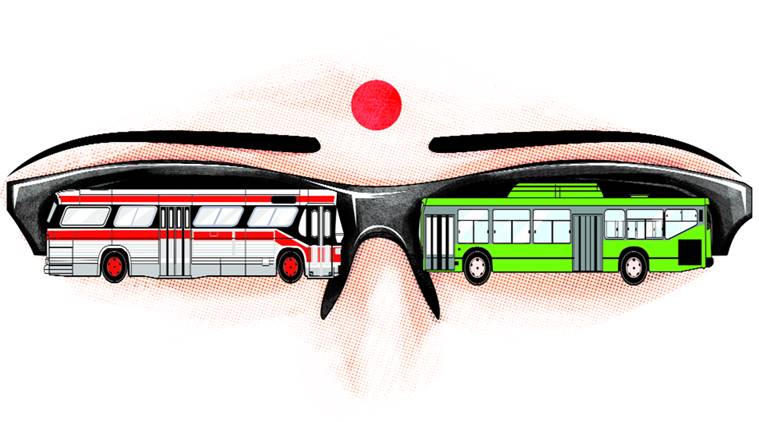
Inside the bus, secrets waited. (Illustration: Suvajit Dey)

Riding a bus had become foreign to me. As foreign as waking up to noiseless mornings that could put nights to shame with their stark absence of light. Since migrating to Canada seven years ago, I had let myself happily slide into the snug comfort of a personal car to get around.

One winter morning, that ceased to be the case.

In the middle of December 2017, I found myself waiting for a public bus on a steel-grey dawn with mountains of stiff white snow all around me. A change in the work life of my husband, with whom I used to share a car to get to the workplace, had just shaken up my daily commute. This meant a not-so-minor adjustment, coming as it did during the country’s unforgiving, bordering on dangerous, winter. The bus stop nearest to our house was a good 8-minute walk, not the best idea in a period visited by frequent and violent snow squalls. The next best alternative was to leave early in the morning, an hour and a half before my usual schedule, so that my husband could give me a lift to the bus stop — the first of the two I needed to wait at — before proceeding to his place of work in a different city.

Standing there in the pitch dark of a sunless morning, an arctic chill cutting through my skin like a hundred hypodermic needles, I wondered if I’d be able to bear the regimen for too long.

My interest in the ethics of public transit, especially as it related to reducing carbon footprint, wouldn’t merely be put to test but seriously challenged as I became a daily bus passenger amid temperatures plummeting to -20C and below. At each of the two bus stops, I would have to wait anywhere between two-nine minutes. Then, after a half-hour bus trip, I would have to walk for another six minutes to reach my office from the bus stop closest to it. Enough time for a skin-numbing life lesson on the power of a single minute.
The Insider’s View

Inside the bus, secrets waited. There was warmth and ease, and not only because of the controlled temperature settings. The first time the bus turned a right-hand corner instead of moving straight on the road that led to my workplace, I sighed in frustration. This easily meant a longer commute than I was used to. Within moments, we were deep inside the sprawling campus of a university. A new world — of gothic buildings nestled in woods, winding roads and sidewalks and a river bisecting the eastern part of the campus — kept extending before my eyes like a poetic dream. Even the heaps of snow that blanketed most of the landscape couldn’t mask the beauty and magnificence of it.

Over the course of the long winter I would look forward to this — the most twisted — part of my commute the most. Tall trees across the campus, rendered nameless by their wintry bareness, framed the building structures with their filigreed branches. Looking at them I forgot clock-controlled time. For an instant, I would imagine what the place would look like in spring or summer. Yet, I was in no hurry for that visual to manifest. What lay before me sufficed, spectacularly.

Immigrants are notorious creatures of existential comparison. Riding the public transit inevitably brought back for me memories of commuting to college in Delhi by DTC (Delhi Transport Corporation) buses, necessary yet dreaded. The three years of my undergraduate programme required me to board a crowded bus from Kalkaji to Netaji Nagar, always late and often tilted with the weight of the humans it carried. My experiences as a female passenger in those three years made me vow never to ride a DTC bus once I had a job. I kept this promise to myself. From day one of earning a salary, I switched to Delhi’s ubiquitous paid personal transport — the autorickshaw. This was and felt like, a luxury, considering my paltry income. It also increased my respect for my mother, who had to rely on DTC buses for the entirety of her working life, travelling from south Delhi to North Campus. In Delhi’s hyper materialist environment, anything that cost you more indicated your ascension on the status-symbol ladder. If you could afford an auto, you would never look back at a DTC bus again.

Two decades later, as I ride the public transit at the other end of the world, the democracy of the act intrigues me. Beyond the obvious inclusiveness of wheelchair and infant stroller access, the bus here is what the suit-and-tie executive rides alongside the homeless bum with his overflowing cart of broken belongings. Its egalitarianism has liberated me from any stigma I might have been carrying for the public bus in my subconscious.
A Public Inn

Some of the closest friendships my mother enjoyed were forged in the public bus. As an introvert, I listened with envy to her stories of the in-bus sisterhood of working women. They shared everything, from in-law problems to kids’ issues, health worries and edible treats. Not having inherited her propensity for bonding with strangers, I have found books to be my most trusted bus buddies. Reading a book inside a moving bus is exhilarating. From Delhi to eastern India to rural China, the geographies I have traversed through the pages of the books I read seemed to take on a more active, pulsating life with the bus’s jerks and swerves. As I read, the distractions around me — the university students’ banter, the bus driver’s announcements, the view outside the window — taught me how the world of a daily passenger is both solitary and communal. The silent alliances formed are no less real than verbal ones. There’s reassurance in the mere act of travelling together, even if you don’t exchange a single word.

The daily bus route to my office, curiously numbered 13, didn’t merely help me survive the Canadian winter on an unyielding snow belt; it took me to a spot — aesthetic and emotional — where I ended up writing a poem on this journey. As I would discover, the public bus has its own community of poets and artists. Poetry on Buses is an initiative that encourages daily commuters in King County in Washington, the US, to write poems on their experiences on the bus and other modes of public transit. Their poems are then displayed on the local transit systems. In 2016, the project invited poems on the theme, “Your Body is Water.” The obvious comparison between water and public transport reminded me of own poem in which I imagine the streets on which the bus runs as a meandering river. In London, Ontario, where I live, a woman artist drew a series of sketches depicting life in the bus. She went on to post her illustrations at bus shelters around the city as a gesture of her appreciation for this mode of transport and its role in engendering a spirit of community.

The public bus is no longer foreign to me. It’s a mobile inn where I rest and recharge myself before the world appropriates my limbs and spirit.

 

What Manto’s ‘Das Rupay’ Tells Us About Sexual Violence Against Girls Today

Originally published in The Wire.

“She was playing with little girls in the neighbourhood alley.”

This is how Saadat Hassan Manto opens his story Das Rupay (Ten Rupees). “She” is the story’s young protagonist, yet, as Manto implies by introducing her with the generic third-person pronoun instead of her name, she could be any girl. Nearly eight decades after he wrote that story, she – the fictitious Sarita – seems to be gathering a disconcertingly increasing number of real-life sisters in India. As one comes across news reports of little girls being sexually violated – each more harrowing than the other – across the country, Das Rupay serves as an unnerving reminder of everything that’s at stake for and taken away from a young girl when she is raped.

Image result for manto with daughter

Pushed into the flesh trade by her mother, 15-year-old Sarita is more a little girl than a teenager. Like most little girls, she’s free from worries. She enjoys, like I did in my teens, playing with girls a lot younger than her. And from the slivers of her personal life that have filtered through the horrific news surrounding an eight-year-old girl’s rape and murder in Kathua, we know she enjoyed playing with her horses. More recently, in the case of an 11-year-old girl who was raped by a dozen-and-half men over seven months in Chennai, her mother blithely assumed her daughter was playing with her friends when, in fact, she was being sexually abused.

Back in my teenage years, not all neighbours appreciated my propensity to play with girls younger than me. Some found such “childishness” annoying. As Tagore, too, illustrates in his short story, Samapti, this expectation for a girl to relinquish her girlhood no sooner than she hits puberty is anything but atypical in the Indian context.

In Das Rupay, Sarita’s playing in the nukkad irks her widowed mother for a different reason. Her daughter is an easy source of income and she hates to keep Kishori, the local pimp – and the fat-pocketed customers he brings  – waiting. As a cover for her complicity in trafficking her own child, the mother makes tall claims like, “I’m thinking of enrolling her to the municipality school that just opened,” which her neighbours know to be a sham. Sadly, for today’s flesh-and-bone Saritas, the school building isn’t always a safe place. School teachers, older students and even a principal in Patna can turn into sexual predators, as recent news reports suggest.

Read the rest in The Wire.

Map Making

The cubicle slumbers with a whirr of weekday monotony.
Defying screen slavedom, we three meet for lunch. She
from China, I from India and she from Canada. School
harks back to the lunch table as I cajole her to share
my chicken pot-pie. We discuss roots. “South-western China,”
she says, hastening to add the immigrant’s near excusatory,
“but education in Beijing and Shanghai.” She nods
when I speak of women and their place in Asia. My
“decent-enough-to-earn-me-a-writing-job-English”
surprises her. We branch out into languages thus.
Mandarin is hers. She makes sure her child mutters
it too, even though he claims to be a Canadian. I
talk about my mother tongue and how it created a new
country. Their eyes brighten, ears perk up. And she, the lanky,
blue-eyed one is taking a shot at Italian, her husband’s
root tongue. “Oh Italian!” our Asian friend squeals,
“Do they all carry guns there?”

And so we begin making
maps with fleeting-floating stock images, hackneyed
threads–losing sight and redeeming it with a native’s
estimation. I tell them about India, its many topographies–
“each state a country unto itself,” the need for
its women to develop lateral vision and thick
skins. What’s her origin, I ask the blue-eyed one.
“Danish-Swede hybrid,” she says lamenting the inhuming of
both languages beneath the inter-generational sedimentation
over the arctic snow.

We part with sweet somethings, convoluted
cartography and a promise to “do this again.”

Leading Ordinary Lives / Kunwar Narayan

Kunwar Narayan
(Translation mine)

I know
I can’t change the world,
Or win a fight against it.

It’s possible that I
Become a martyr fighting
And beyond that earn a martyr’s
Tomb or an artist’s fame…

But being a martyr
Is a different game altogether

There are people who despite
Leading entirely ordinary lives
Have been known to become
Martyrs, quietly.

मामूली ज़िन्दगी जीते हुए / कुंवर नारायण

जानता हूँ कि मैं
दुनिया को बदल नहीं सकता,
न लड़ कर
उससे जीत ही सकता हूँ

हाँ लड़ते-लड़ते शहीद हो सकता हूँ
और उससे आगे
एक शहीद का मकबरा
या एक अदाकार की तरह मशहूर…

लेकिन शहीद होना
एक बिलकुल फ़र्क तरह का मामला है

बिलकुल मामूली ज़िन्दगी जीते हुए भी
लोग चुपचाप शहीद होते देखे गए हैं

A People Ravaged: Peeling off the Many Layers of Partition Trauma

First published in The Wire

Literature, Gender, and the Trauma of Partition: The Paradox of Independence
Debali Mookerjea-Leonard
Routledge, Taylor & Francis Group, 2017

In writing my first novel, whose protagonist is a young refugee woman from East Pakistan, I employed the device of coincidence to achieve a happy ending. Doing so wasn’t a sudden rush on my part to end what had become a protracted writing project but a well thought-out conclusion. It was not to be. When they read it, two of my trusted beta readers quashed it summarily, citing it as lazy and escapist. Even though incredible incidents can happen in real life, one of them advised, in a work of fiction, coincidences are hard to pull off convincingly.

An incident Debali Mookerjea-Leonard mentions in the preface to Literature, Gender and the Trauma of Partition: The Paradox of Independence starkly bears out this paradox.

Shortly after the All India Muslim League’s call for Direct Action in Calcutta in 1946, the author’s grandfather was stranded in Howrah station as public transport had been suspended in the wake of the sectarian clashes. He eventually got a ride from a kind Muslim family who had a private car, but had to climb on the footboard as the vehicle was full. To ensure his safety, he was given a flag of the Muslim League and advised to shout “Pakistan Zindabad” when passing through Muslim neighbourhoods. He did, and reached his home safely.

The insanity that gripped the subcontinent a year later when India was partitioned has been arduously chronicled in historical archives. In the privileging of journalistic reportage and record-keeping, personal histories surrounding the traumatic event haven’t received much attention until recently. The initiatives of Urvashi Butalia, Ritu Menon, Kamla Bhasin, and Jashodhara Bagchi, among others come to mind.

Mookerjea-Leonard’s book is an important intervention in this regard, not only because of its meticulous research and compelling arguments but because it sits in that nebulous middle – a no man’s land if you will – of fact and fiction. The author examines with incisive rigour fictional works on Partition and juxtaposes them against factual information and recent recordings of oral histories. As someone not directly affected by the event, hers is a lens that is both objective and earnest.

The works discussed in Literature, Gender and the Trauma of Partition are mostly from Bengal, which the author calls the “neglected shelves” of Bengali literature, written by writers from both sides of the Radcliffe divide. As she mentions in the Preface, this book is her tribute to her city, Calcutta. It is also a conscious effort to shine a light on the sufferings of those at the eastern end of the divide, as the tragedy of Partition in Bengal has been either underrepresented or misrepresented when compared to Partition in Punjab. This could well be attributed to, as Mookerjea-Leonard is cognisant of, the predominant and recurrent theme ofdisplacement in the east as opposed to that of horrific violence in the west.

Read the rest in The Wire.

The Wolf’s Eyes are Red/Sarveshwar Dayal Saxena

(Translation: Bhaswati Ghosh)

The wolf’s eyes are bloodshot.
Glare at him
Until your eyes
Turn red, too.
What other choice do you have
When the wolf is in front of you?

भेड़िए की आंखें सुर्ख हैं / सर्वेश्वरदयाल सक्सेना

भेड़िए की आंखें सुर्ख हैं।
उसे तबतक घूरो
जब तक तुम्हारी आंखें
सुर्ख न हो जाएं।
और तुम कर भी क्या सकते हो
जब वह तुम्हारे सामने हो?

Deshgaan' – Janata Weekly

Sarveshwar Dayal Saxena (1927-1983)

LISTENING TO U. SRINIVAS

Mandolin’s secrets have no use for cover.
They burst open into splintered reveries
And flood your waking dreams.

Mandolin lures moody southern
Winds; blows them lustily in your
Courtyard. The breeze ruffles
Your hair, your sourness.

At temples, Mandolin gathers the
Holy fire of the morning sun to bathe
Your face.

When Mandolin plays, you turn
Into a snake and slither without a hiss
To a corner where the string
Charmer leads you.

Mandolin indoctrinates without
A mantra. Magicians rarely
Need one. You become a bird and
fly away with Mandolin.

More on U. Srinivas here.

U. Srinivas songs, U. Srinivas song MP3 download

Book Review: Love and the Turning Seasons – India’s Poetry of Spiritual & Erotic Longing

I recently had the opportunity tot read “Love and the Turning Seasons,” an exquisite collection of bhakti poetry in translation from Aleph. I wrote about it in Kitaab.

Love and the Turning Seasons

Title: Love and the Turning Seasons – India’s Poetry of Spiritual & Erotic Longing
Edited by Andrew Schelling
Publisher: Aleph
Pages: 294
Price: ₹399

I left shame behind,

took as an ornament
the mockery of local folk.
Unswerving, I lost my cleverness
in the bewilderment of ecstasy.

— Manikkavacakar (9thcentury), Tr. A.K. Ramanujan

In a lover’s enraptured world, love is the breeze that strips one, quite simply, of the garment of shame. In reading Love and the Turning Seasons, the newest offering from Aleph Classics, a series that aims to bring new translations of India’s literary heritage, the reader is swept in that denuding breeze. Edited by Andrew Schelling, the collection of poems bears the slightly beguiling subtitle, India’s Poetry of Spiritual & Erotic Longing. I say beguiling because it would seem like the poems could fall in either category – spiritual or erotic. In reality, as Manikkavacakar, the ninth-century Shiva devotee tells us, the line between the two states is as diaphanous as air itself. For, in the “bewilderment of ecstasy”, who is left to distinguish between the flesh and the spirit? This seamless merging of the body and the soul is at the heart of this anthology of bhakti poetry, translated by various poets and literary translators.

Love and the Turning Seasons alights upon the reader as a songbird to take her across time and space – from the sixth century (barring the Isa Upanishad) right up to the twentieth, on an anticlockwise path beginning in the south of India and ending in the east. Despite the multiplicity of expressions of the bhaktas or poet-minstrels, informed as they were by specific cultural and regional parlance, what unifies them is their rejection of societal norms in their unwavering quest for the divine. These were among the first true radicals in the Indian context, repudiating, with delightful contempt, tradition and convention. Gender-bending, caste-subverting, these individuals lived and (even) died on their own terms and sang of the divine with ariose abandonment. As Lal Ded, another Shiva devotee from Kashmir said,

Who instructed you, O Brahmin,
to cut this sheep’s throat—
to placate a lifeless stone?

— Lal Ded (early 1300s), Tr. Andrew Schelling


The Sanskrit word bhakti means devotion and has come to connote intense, even blind idolatry, and in these troublingly skewed times, bhakta (devotee) has become a bad word, an uncomplimentary term for blind followers of certain ideologies, political or otherwise. As the anthology affirms through its diverse voices, the bhakti poets were anything but blind in their devotion.

Read the rest in Kitaab.


Day’s End

The evening adjusts the hem
of her smooth rose wine
stole. You and I move
to the back porch. The sky
flushes to allure us with its
pink. But work and all that
went wrong with it take their
toll.

Bird wings hustle. Soon it will
be dark. We’ll pick up our
half-sipped glasses of
wine. When the day’s fatigue,
its taunts, its grime start
sinking us, the evening’s
blush will still leave its
mark.

The Crop by Sarveshwar Dayal Saxena

Translation: Bhaswati Ghosh

Even if I were to
hold the pen
like a plow,
a spade
or a trowel,
I wouldn’t be able to
harvest the crop.

I can only prepare the soil.
A few rare ones will sow the seeds of revolution
and nourish my toil,
carrying my journey forward.

Tomorrow, when I’m no longer there,
the crop will grow and flourish,
ripple in the breeze.
My spirit, a flush of golden sunshine
Will touch the feet
of those who planted the seeds
Those who harvest it will sow more seeds
I shall only sleep buried in the earth underneath.

Image result for crop

फसल / सर्वेश्वरदयाल सक्सेना

हल की तरह
कुदाल की तरह
या खुरपी की तरह
पकड़ भी लूँ कलम तो
फिर भी फसल काटने
मिलेगी नहीं हम को ।

हम तो ज़मीन ही तैयार कर पायेंगे
क्रांतिबीज बोने कुछ बिरले ही आयेंगे
हरा-भरा वही करेंगें मेरे श्रम को
सिलसिला मिलेगा आगे मेरे क्रम को ।

कल जो भी फसल उगेगी, लहलहाएगी
मेरे ना रहने पर भी
हवा से इठलाएगी
तब मेरी आत्मा सुनहरी धूप बन बरसेगी
जिन्होने बीज बोए थे
उन्हीं के चरण परसेगी
काटेंगे उसे जो फिर वो ही उसे बोएंगे
हम तो कहीं धरती के नीचे दबे सोयेंगे ।